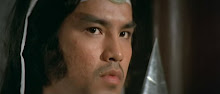
Ever seen the Shaw-Carlo Ponti co-production, THE STRANGER & THE GUNFIGHTER (1974)? How about the execrable THE FIGHTING FISTS OF SHANGHAI JOE (1974)? How about the obscurity that is KUNG FU BROTHERS IN THE WILD WEST (1973)? Well, get ready for a violent and bloody spaghetti western done Eastern style!
 THE FUGITIVE 1972
Lo Lieh (Siu Lao Fei Lung), Ku Feng (Ma Tien Piao), Li Ching (Ming Ming)
Directed by Tsang Tseng Chai

 Siu Lao Fei Lung(Lieh) and Ma Tien Piao (Feng) are bandits who ride from town to town holding up banks and killing anyone who tries to stop them using their superb and rapid fire shooting skills. When a holdup goes wrong, Siu sends Ma away with the cash and tells him that if he is caught to try and rescue him later. Siu is tortured, and as time passes, he realizes his sworn brother isn't coming to save him. Instead, Ma sets up a gang of thugs with himself as the leader to carry on with murdering and banditry. Sui manages to escape and heads for Ma's encampment for a settling of accounts.

 This film, obviously modeled after the Italian Spaghetti Westerns, is very exciting and bloody with enough wild gun battles for at least half a dozen Euro westerns. At nearly 77 minutes, the film chugs along at a brisk pace and the action seldom lets up. This becomes a slight problem as very few scenes are allowed to breathe; but then, action is the main attraction here.
 This being a lower tier Shaw movie, it's mostly style over substance, although there are a few polished scenes. There's lots of well done tracking shots and the first meeting of Siu and Ma after Siu breaks out of jail is nicely done utilizing the 'Man With A Harmonica' piece taken from the soundtrack of Leone's ONCE UPON A TIME IN THE WEST.

 The opening and finale are both memorable as well as Siu's jailbreak and also the scene where he is attacked by dozens of killers sent by Ma in Death Valley. There are some great locations that also ape the Italian western nicely. About the only thing I can say that's even remotely negative is that rarely does anyone ever run out of bullets. This is a constant complaint from critics in the Italian westerns but here it's way OOT. It's fine for me but someone who takes these things seriously may be put off by it.

 The action scenes are wildly outrageous which offers some exhilarating sequences which offer up the perfect extension of an actual kung fu fight. The way in which the gun battles are choreographed (mostly all multiple versus one or two opponents) are handled no differently had the performers been brandishing swords and spears or even fists and feet. The action sequences are breathtakingly exciting despite lacking any believability or logic.

 In addition to some nice cinematographic touches, there's a preponderance of zooms that populate the film. This adds to the frenetic pace of the film particularly when there's action onscreen; and that's quite often. Some may be put off by the one or two against a hundred scenario that dominates the numerous gun battles. This was a staple of the revered Chang Cheh. His films would feature a near invincible hero fighting against impossible odds in a scenario that would see the protagonist often killed in battle covered in blood and his guts spilling out. The same thing applies here only swords have been replaced with guns.
 There is also minimal use of kung fu on display. As already mentioned, the accent is on gunplay and even these scenes are laced with kung fu or 'gun fu' to be more precise. The sets as usual for Shaw Brothers movies are meticulous and quite amazing considering they produced anywhere from 40 to 50 movies a year(!) Even the lesser Shaw movies could be counted on to have some great sets if nothing else.

 Lo Lieh, as most always, is very good here showcasing a nice range of emotion in this role. The whole movie is surrounded by Lo's character. Nearly all the action scenes involve him alone against dozens of attackers. He is at first a criminal but has a change of heart later in the film. This being a Shaw Brothers movie, there is much tragedy on hand and Lo Lieh gets a lot of it leading up to the big battle at the end. Lo even gets his hands smashed (again) to keep him from handling a gun.
 A similar scene, but more violent, occurs in the first international kung fu hit KING BOXER (aka 5 FINGERS OF DEATH) from the same year. This being a Spaghetti Western done Shaw Brothers style, this sequence owes more to DJANGO (1966) I would say.
 The award winning actor Ku Feng again displays another great villain role. Feng, who also would play a hero from time to time made some memorable movies playing incredibly sadistic bad guys. Here, he's a treacherous scoundrel who on several occasions uses lies and trickery to get out of a jam against Siu.

 Sammo Hung even has a brief bit as a bandit that gets killed by Lo Lieh. He gets a couple of lines beforehand, though. It's quite interesting to see Hung in a Shaw movie considering his famous output for Golden Harvest. Dean Shek, whom had featured in a large amount of Shaw movies in supporting roles, went on to feature prominently in independently made martial arts films. He's one of the most recognizable character actors in martial arts cinema.

 Director Tsang Tseng Chai is one of the lesser known directors to emerge from the Shaw Brothers Studios, but he handles the action scenes very well even though the bulk of the film looks as if the cinematographer suffered from ADD. One minute you get a nice tracking shot, the next minute the camera lens is all over the place zooming in and out at a rapid pace. Tsang would also deliver some fine, yet over the top action with the violence filled, THE CASINO (1972). Tsang also handled directing chores on some 'unreleased to DVD' pictures such as REDBEARD (1971), THE GAMBLING SYNDICATE and QUEEN HUSTLER (both 1975).

 In keeping with the homage to Euro westerns, various musical cues are lifted from Italian oaters. Also, the actors are given stubble and have a very sweaty, unclean appearance to assimilate the style of the Spaghetti's. Definitely a step up from Chang Cheh's Martial "Spaghetti's" in terms of emulating the formula, Chang directed at least three films similar in style to spaghetti westerns--THE SAVAGE FIVE (1974), THE ANONYMOUS HEROES (1971) and THE INVINCIBLE FIST (1969) also starring Lo Lieh.
 All three are good films in their own right but THE FUGITIVE (1972) captures the flavor of the European sagebrush sagas perfectly. A thrilling, action packed and bloody film for fans of both cinematic styles.
This review is representative of the HK region 3 disc from IVL.
CULT FILM FAVES NOT ON DVD
This is a new section devoted to rare, obscure and 'as yet to be released on legitimate DVD' movies. Some films may have been released in some part of the world, or on some public domain label, or some may have simply never been released at all on the digital format. This section is designed to keep these films alive and to provide remembrance to those who may have seen them in some form or other, whether it be on the silver screen, video tape, or the small screen at home. THE BERMUDA DEPTHS 1978
Leigh McClosky (Magnus Dens), Connie Sellecca (Jennie Haniver), Carl Weathers (Eric), Burl Ives (Dr. Paulis), Julie Woodson (Doshan), Ruth Attaway (Delia)
Directed by Tom Kotani (Shusei Kotani)
"I met this girl on the beach...she was beautiful...absolutely beautiful...her name was Jennie Haniver."

 Magnus returns to his childhood home, a mansion on some craggy cliffs overlooking the sea, to learn the truth behind his fathers death. Meeting up with an old college friend, Eric, a marine biologist working with Dr. Paulis, Magnus joins the two in their search for gigantic creatures living miles below the oceans surface. Upon his return to Bermuda, Magnus sees a beautiful woman named Jennie Haniver who he discovers was his only friend when he was a little boy.

 The two played with a very large turtle whose egg had washed up on the beach. Jennie disappeared beneath the sea shortly thereafter. Now, with Magnus' return, the mysterious and beautiful woman reappears engaging in a strange romance with her childhood friend. Inexplicable events transpire revealing a hellish connection between the ocean dwelling female and a gigantic sea turtle hunted by the scientists in the enigmatic Bermuda Triangle.
 The second of a trilogy of films co-financed by Rankin/Bass and Tsuburaya Productions, the first was THE LAST DINOSAUR (1977) starring Richard Boone and the third was THE IVORY APE (1980) starring Jack Palance. This second film is the most fondly remembered of the three and possesses a sense of mystery and fantasy with merely a touch of superstitious horror trappings for good measure.

 It wasn't the first time Rankin/Bass had partnered with a Japanese company on a picture. Prior to this in 1967, they partnered with Toho Studios to produce KING KONG ESCAPES, a lively and enjoyable monster romp meant to tie in with the animated series produced in America by Arthur Rankin Jr. and Jules Bass. This new trilogy of films played theatrically overseas but went straight to television in the United States. Considering that STAR WARS (1977) had just reinvented the wheel in terms of special effects in movies, the more old fashioned and quaint style of fantasy filmmaking was quickly becoming extinct. With these lower budgeted efforts unable to compete with the state of the art offerings from the big studios, television was their safehaven, at least in America.

 The direction is good and is aided immeasurably by both a romantic and mystery enhanced soundtrack. This description also applies to the main theme, "Jennie", a ballad referencing the peculiar lady of the sea. Written by Jules Bass, the vocals are by Claude Charmichel. The musical score was created by Maury Laws, who made a career creating the music for the Rankin/Bass duo. The caliber of the cast adds a lot of added incentive to this picture, even more so than the previous movie in this trilogy, THE LAST DINOSAUR (1977). That film focused more on the monster elements of the script while THE BERMUDA DEPTHS (1978) focuses far more emphasis on the doomed romance angle and subtle fantasy than relying solely on the giant creature angle.
 A number of scenes stand out. Most of which all revolve around the strange relationship shared by both Magnus and Jennie. Director Kotani handles the entire movie masterfully, never quite letting the viewer know whether what they are seeing is "real", or a figment of the protagonists imagination. By the end, it's apparent that what you've seen is a fine film directed by a Japanese man hiding behind an American pseudonym.

 One of the most poignant scenes takes place during the last ten minutes. After the scientists have all been killed, Magnus is washed ashore unconscious. Jennie appears from the sea yet again. She leans down and kisses him. The look on her face tells everything. After all that has taken place, she can never be with him again. She returns to the sea, descending the waves never to see her love again. Magnus takes a boat leaving Bermuda and away from all the bad memories he has carried with him from childhood. As the boat exits the harbor, he takes the necklace Jennie had given to him and tosses it into the sea as the poetic ballad plays on the soundtrack.

 What's particularly fascinating about this relationship that can never be, are the parallels with vampirism. Similarly, one of the undead that has forsaken their soul for an eternal existence among the damned, can never walk among the living, nor love as a human again. Here, the character of Jennie Haniver is said to have given her soul to the Devil in exchange for immortality instead of perishing with other travelers aboard a doomed vessel during a massive storm at sea. It's stated by a strange woman named Delia that she sometimes appears as a small child, or as an attractive woman; and that her appearance heralds the death of those around her.
 Once Magnus realizes the involvement of the woman he's befriended and loved for years, he turns his back on his home and Jennie altogether stating to Doshan in a graveyard, "I never want to be near the sea again....ever." As he leaves, the camera pans over to a statue of a woman. Descending down to the base of the monument, the stone reads, 'Jennie Haniver, 1701-, Lost at Sea'. The image of the statue is the same as the masthead of the vessel that had carried Jennie across the sea centuries before.

 Leigh McClosky is a great choice for the role of the tortured and lonely young man struggling with the loss of his family as well as the enigma of the sea, the stunning Jennie Haniver whom he is in love with. McClosky found fame in many famous television programs throughout the 1980's. He also appeared in Dario Argento's INFERNO (1980), one of the Italian maestro's lesser efforts. McClosky also starred in the enjoyably raunchy sex comedy, HAMBURGER, THE MOTION PICTURE (1986).
 The alluring Connie Sellecca followed a similar career trajectory finding a great deal of work in television shows and movies made for the small screen including two cult pictures made for television, CAPTAIN AMERICA and CAPTAIN AMERICA 2 (both 1979) both of which starred Reb Brown in the lead as the popular comic book character.

 Carl Weathers was fresh off his famous role of Apollo Creed in ROCKY (1976) when he appeared in this US-Japan co-production. Prior to this, Weathers also did a lot of tv work, but mixed it up with a good number of movie roles, too. He had played bad guys in two blaxploitation pictures, BUCKTOWN and FRIDAY FOSTER (both 1975) in the beginning of his career. Weathers will forever be remembered for the memorable role of Rocky Balboa's nemesis and friend, in the ROCKY series (at least up to the fourth installment).
 Burl Ives will likely be best remembered for his many record albums as well as his voiceover work for the claymation favorite, RUDOLPH, THE RED NOSED REINDEER (1964). He was also a regular on tv commercials being a spokesperson for Luzianne Tea as anyone growing up in the late 70's early 80's will attest. Ives also co-starred in the previously banned Sam Fuller art picture, WHITE DOG (1982).

 THE BERMUDA DEPTHS (1978) is an accomplished fantasy love story with slight horror overtones that will appeal mostly to those who caught it on television during its original run. Curiosity seekers will no doubt find something of interest, but more hardened and less patient viewers may find this wonderful movie a bit slow going. This rare and obscure gem doesn't deserve to remain so, and hopefully one day, this intriguing and romantic fantasy picture will receive its long overdue legitimate DVD release.

 This review is representative of a fan made project meant to preserve the most complete version of THE BERMUDA DEPTHS yet available. Combining a number of different versions to create this 97 minute composite, this is the best way to see this virtually forgotten piece of genre filmmaking until a legitimate release is made available. To obtain a copy of this complete version, inquiries can be sent to this email address-- MazinZ@aol.com.
copyright 2013. All text is the property of coolasscinema.com and should not be reproduced in whole, or in part, without permission from the author. All images, unless otherwise noted, are the property of their respective copyright owners.