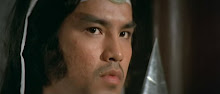
Chan (right) fights Hwang Jang Lee (left) in SNAKE IN THE EAGLE'S SHADOW (1978)
SHAW FISTS & INDEPENDENT KUNG FU KICKS CHAPTER 1
 Above--Hong Kong Movie News June 1978; Insert--B/W still from 14 AMAZONS (1972)
 After the release of SNAKE IN THE EAGLE'S SHADOW (discussed in part three), everybody was comedy kung fu fighting. Almost overnight, literally dozens of productions were hurriedly slapped together by fly-by-night companies and several upstart independents that managed to stay afloat amidst the grip of Shaw Brothers and their ferocious competitor, Golden Harvest. Many of these smaller films utilized themes and ideas pioneered by filmmakers at Shaw Brothers. Now, they were swamping the market with hundreds of similar movies with sometimes slight variances, or none at all. Before delving into that, let's go back a bit.
 Cheng Pei Pei (left) and Lo Lieh (right) in FLYING DAGGER (1969)
 There had been countless independent movies prior to '78 with tons of them proliferating from Taiwan. Many of Shaw's stars had jumped ship to these indy companies after growing disenchanted with the mogul's methods, many times to do with money. These indy offers gave the actors more flexibility, freedom and offered additional monies that attracted them unlike the system over at Shaw's. Apparently, actors there were paid a flat monthly fee (the equivalent of a few hundred dollars) and under a thousand per each picture they made. If actors wanted to freelance, permission must be granted and I would assume, if you were an actor who hadn't proven yourself at the box office, Shaw would refuse. This led to numerous law suits served when actors, tired of feeling subverted, left for greener pastures of one sort or the other. One such actor who exited the studio on not so good terms was Chang Yi.
 Chang Yi in A TASTE OF COLD STEEL (1970)
 Having been featured in numerous Shaw Brothers movies from the mid 60's into the early 1970's, he was often a co-star in numerous swordplay movies as well as a lead in such movies as the exceptional BELLS OF DEATH (1968) and the brutally violent A TASTE OF COLD STEEL (1970) among them. Other notable movies featuring Chang were BROTHERS FIVE (1970) and THE SECRET OF THE DIRK (1970). Chang Yi was also cast as the lead in CALL TO ARMS (1971), a film that began production in 1970, but was held up for over ten months after Chang abruptly left the picture and Shaw Brothers entirely. Chang Bin (Chang Pin) replaced Yi on the movie.
 Chang Yi in SECRET OF THE DIRK (1970)
 International Screen August 1971
Chang Yi then went on to Taiwan to feature in a co-production with Golden Harvest then titled THE DEADLY GOLDEN SWORD. It later became THE FAST SWORD (1971). Yi didn't stay with GH long and was also reunited with Shaw director, Hsu Cheng Hung, who left Shaw's around the same time. Chang Yi later found lots of work as a free agent appearing in a myriad of swordplay and fist and kick favorites throughout the 70's and into the 1980's.
 Cheng Pei Pei in COME DRINK WITH ME (1966)
 Battles with Shaw was a fairly common occurrence it seemed. Some didn't seem to mind it, but others longed for their independence. The famed director, King Hu was another director who had excelled at Shaw Brothers with movies such as SONS OF THE GOOD EARTH (1965) and COME DRINK WITH ME (1966). Problems on the latter film resulted in the venerable director having had enough, leaving the studio for Taiwan where, unfortunately, his career slowly disappeared into the clouds of the martial world. His indy film, A TOUCH OF ZEN (1971) received critical accolades and international acceptance, but failed in Hong Kong. Still, King Hu's reason for leaving the confines of the Shaw house was he wanted to do movies his way.
 Jimmy Wang Yu in THE ONE ARMED SWORDSMAN (1967)
 David Chiang in NEW ONE ARMED SWORDSMAN (1971)
Wuxia (Swordplay) movies were all the rage once Chang Cheh reinvigorated the genre with ONE ARMED SWORDSMAN in 1967. Movies featuring both male and female sword fighters were everywhere. With so many of them being shot, even the celebrated director gave up on them just two years after jump starting the trend. He would return to the Wuxia genre by the mid 1970's when they became popular once again after Chu Yuan morphed the style into something even more intriguing with a long series of 'Romantic Swordsman' movies based on the novels of Jin Yong and Gu Long.
 Above and below--INTIMATE CONFESSIONS OF A CHINESE COURTESAN (1972)

 Chu Yuan raised some eyebrows with the announcement he would be directing a swordplay production that featured lesbianism as a central plot device. The film was BODY & SWORD, a production that soon became the more salacious, but respectably titled INTIMATE CONFESSIONS OF A CHINESE COURTESAN (1972). Filled with violence, sex, gore and vengeance seeking females, Chu Yuan's movie was a hit in Hong Kong despite the taboo presentation of showcasing women in love with one another. It also is one of the classiest exploitation pictures of all time.
 Huang Chung Shun protects Shu Pei Pei in the Japanese styled THE MAGNIFICENT SWORDSMAN (1968)
Between the years of 1967 and 1973, the swordplay genre thrived and the Shaw Brothers had dozens of classy, if often derivative and convoluted pictures that showed off their level of production value unmatched by any other film company at that time. Ever the innovator, director Chang Cheh was going to further change Hong Kong cinema in another new and exciting way.
 David Chiang metes out some VENGEANCE! (1970)
While swordplay movies waged war at the box office, Chang Cheh helped introduce the basher style of kung fu movie with his film, VENGEANCE! shot in 1969 and released in 1970. While that film was very different from anything else seen at the time, Jimmy Wang Yu was busy creating his own signature basher movie entitled THE CHINESE BOXER (1970).
 Southern Screen September 1969
While Cheh's dark tale of revenge in the early Republic cleaned up with some notable awards, it was overpowered at the box office by Wang's brutal boxer movie. Called HAMMER OF GOD in America, it was the first martial arts film to showcase the arduous training that went into becoming a fighter without the use of swords and other cutlery. Lo Lieh was employed to play the Japanese villain. The movie was a hit and when Wang Yu jumped ship (refer to part 2), the legal entanglements created a lot of bad blood for everyone involved.
 ONE ARMED CHIVALRY FIGHTS AGAINST ONE ARMED CHIVALRY (1977)
 THE REBEL BOXER (1973)
 For every Shaw production with potential, Wang Yu fired back with a similar movie in an attempt to steal away some of their thunder. Wang Yu was a former swimming champion who became a rising star at Shaw Brothers. After leaving the company, he made a handful of movies in Taiwan with First Films and some in co-operation with Golden Harvest. Possessing an enormous cult following among kung fu fans, Wang Yu's approach to screen fighting is akin to a Japanese Karate style of wide swings and basic kicking maneuvers. His arrogant attitude seen onscreen mirrors his personality offscreen, too. Although seemingly having burned many bridges, he still made hundreds of movies of varying quality.
 THE ONE ARMED BOXER AGAINST THE FLYING GUILLOTINE (1976)
 The success of his career is accredited to his series of interconnected movies built around characters missing an appendage. The character was so popular around the world, he even did a co-production in Japan as part of the internationally acclaimed ZATOICHI series that starred Shintaro Katsu. That film was ZATOICHI MEETS THE ONE ARMED SWORDSMAN (1971). It was an attempt to instill new life into that series which also featured an entry entitled ZATOICHI MEETS YOJIMBO (1970). Although Shaw were successful in keeping Wang Yu from filming in Hong Kong till 1973, they were not able to keep him from shooting in Japan. This no doubt angered the Shaw's considering the amount of money they made off of Chang Cheh's initial crippled swordplay feature.
 THE BIG BOSS (1971)
 With THE CHINESE BOXER (1970) the number one hit of that year, that meant dozens more similar movies were coming and so it went for about five years when this more raw, basic, but brutal style was officially usurped by more intricate kung fu styles. Bruce Lee's THE BIG BOSS (1971) took the number one spot in 1971 followed by Chang Cheh's basher opus, DUEL OF FISTS, the first movie to showcase Thai kickboxing. Swordplay was still more prolific, though, as NEW ONE ARMED SWORDSMAN was at number three for the year followed by a preponderance of other Wuxia adventures.
 WAY OF THE DRAGON (1972); Insert--Bruce Lee visits the set of BLOOD BROTHERS (1973)
 Bruce Lee was the short lived king of fists at the Hong Kong box office. Having already broke into the American market with a popular, but brief stint on the GREEN HORNET TV show, Lee made appearances on various US television programs and became fast friends with a number of big American movie stars. Desiring to make movies in Hong Kong, Lee was a fan of the Shaw style of movie making and even did some promotional stills for his then purported endeavors with the company. Problems arose and Lee eventually went to Golden Harvest, whose studio head, Raymond Chow, was more than delighted to give Lee what he wanted as his studio was facing economic disaster.
 Wang Yu's BOXER FROM SHANTUNG clone, FURIOUS SLAUGHTER (1972)
 Shaw Movies like THE BOXER FROM SHANTUNG (1972) and its sequel, MAN OF IRON (1972) helped keep the fist and kick style of kung fu movie afloat as well as imitations such as FURIOUS SLAUGHTER (1972). The plot device of the evil Japanese fighter was employed to good effect in Wang Yu's CHINESE BOXER and it managed to seep its way into copycat movies like THE THUNDERBOLT FIST (1972) and the indy obscurity, DRAGONS NEVER DIE (1974).
 Lo Lieh is the KING BOXER (1972)
Shaw Brothers also released KING BOXER (1972), a film that is notable for starting the kung fu craze (refer to part 4) in America before Bruce Lee. While not a hit in Hong Kong, it nonetheless was a startlingly well made movie by notable Korean director, Cheng Chang Ho.
 Fu Sheng (left) and Chen Kuan Tai (right) are HEROES TWO (1973)
 1973's HEROES TWO showcased authentic Shaolin martial arts styles as did Chang Cheh's other Shaolin movies. This production (and the others that followed it) are the bridge between the basher style and the traditional kung fu style of action film that officially took hold between 1976 and 1978. By that time, the choreography became more streamlined, looking less realistic and more fanciful. Movements became smoother, faster and less abrasive and rough. Martial arts sequences also became more articulate in that there would be longer shots with many maneuvers before a cut in the camera. Then in 1978 the floodgates were broken down and a tidal wave of overly cheap and shoddy productions were mowing down the competition.
 GAME OF DEATH (1977)
Not only that, but Bruce Lee was dead and there was an amazing amount of pretenders (refer to part three) cropping up in an alarming number of movies that ranged from mediocre to absolutely awful. Not even the Shaw Brothers were immune from participating in this obvious attempt to cash in on one of the biggest Hong Kong stars of all time. Although ENTER THE DRAGON (1973) wasn't the monumental success hoped for in Hong Kong, that didn't stop money hungry producers from making money off of Bruce Lee's name.
 A laughable "composite" shot from GAME OF DEATH (1977). To cover another actors face into fooling the audience that it's Bruce Lee, a cardboard cut out of the actors face is superimposed onto the screen.
Even Golden Harvest, the company that managed to steal Bruce away from the Shaw's, showed a great degree of disrespect by making a mockery of GAME OF DEATH (1978) as well as producing a "sequel" entitled TOWER OF DEATH in 1981. Since his death, there have been countless conspiracy theories as to events leading up to, and including the mega stars demise.
 Jackie Chan (right) duels with Yen Shi Kwan (left) during the conclusion of THE FEARLESS HYENA (1979)
 While SNAKE IN THE EAGLE'S SHADOW is considered one of the greatest kung fu movies ever made, I find it a rudimentary production with nothing to recommend it but its fight scenes and a movie stealing performance by Hwang Jang Lee. Jacky Chan has never really interested me, although movies such as THE FEARLESS HYENA (1979) and THE YOUNG MASTER (1980) are quite good. I much prefer the more serious approach to the kung fu film, but I suppose after years of seeing so many movies like that, the public was hungry for something new and different. Ng See Yuen's poverty row production was just that becoming a top ten hit in 1978.
 Jackie Chan (left) encores with Hwang Jang Lee (right) in DRUNKEN MASTER (1978)
Chan's other star turn in DRUNKEN MASTER was even better and made more money. Not only was Chan a star, but he had two big hits in the same year and suddenly, Hong Kong was inundated with a slew of imitators. Shaw Brothers, the once mighty innovator, was now turning into an imitator of the successes around them.
TO BE CONTINUED...