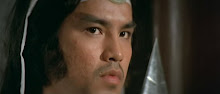
THE SPOOK WHO SAT BY THE DOOR 1973
Lawrence Cook (Dan Freeman), Janet League (Joy), Paula Kelly (Dahomey Queen), J.A. Preston (Dawson), Paul Butler (Do-Daddy Dean), Don Blakely (Stud Davis), David Lemieux (Pretty Willie), Joseph Mascolo (Sen. Hennington)
Directed by Ivan Dixon
***NOTE: This review is strictly my own opinion and observation. It is not intended to make a political statement, but comparisons are made to the increasingly heated political climate of the United States today.
"I want people to think...you don't act first and then think. You think first and then act. That's why we were given brains. That's why we don't act instinctively. When we do we're wrong. Which ever way they go, I want them to think about what I've had to say. I'm not tryin' to recruit anybody, I'm not tryin' to prophesize, I'm not tryin' to convince anybody...I want to shake up the man! I want people to look at that movie and go outa' there thinkin'..."--Sam Greenlee interview on DVD

The Short Version: This strikingly volatile protest movie written by Sam Greenlee from his own novel is an important, yet controversial indictment against oppression and discrimination. Arguably the single most significant African American production of the 1970's, it transcends what many would classify as "blaxploitation". This is not exploitation, but a serious look at racism and the need for people to be accepted and stand on their own two feet. What follows is a fictionalized, but still relevant and wrathful diatribe against white America of the day. Truly a brilliant piece of filmmaking.

 After being accused of racial insensitivity by a politician who is lagging in the polls, the CIA recruits a group of African Americans to be trained as agents. Dan Freeman is the only one who passes. Seeing the discrimination around him, Dan realizes nothing has changed and he is only there due to political reasons. Eventually leaving the CIA, Dan returns home to Chicago and secretly trains African Americans living in the inner city slums to be militant freedom fighters. The word spreads to cities across the nation resulting in violence between the militants, local police officials and the National Guard. Going to war against the establishment, Freeman's fight isn't so much about race, but about freedom.

 When I began getting into black action films back in the early 1990's, I often lumped them all into the blaxploitation genre. Since then, it seems even African American authors who have written about the genre, seemingly place any black oriented production into that category. Many consider it an offensive term and I can understand that when important films such as this are saddled with that label. That's why I created this separate category (see blaxploitation sidebar to the right) for what I consider movies about African Americans (or race relations) that aren't necessarily about action and violence, but have something serious to say regardless of how offensive, or controversial the subject matter. DETROIT 9000, MANDINGO and ACROSS 110TH STREET are some films that fit this criteria in my eyes. However, THE SPOOK WHO SAT BY THE DOOR (1973) staunchly represents this category above all others.

 Based on the novel by Sam Greenlee, this thought provoking, incendiary and highly controversial movie is one of the most important, if not THE most important race film of the 1970's. What makes Ivan Dixon's picture so engaging NOW is that this film resonates just as much today as it did back then. However, viewed today in light of the recent spate of politically charged racist remarks from the new Black Panthers and the seemingly disgruntled and damaging agenda of the current President, the ideals present in this movie are somewhat skewed and prophetic when viewed today. What's also noticeable is how little people have changed, both black and white in today's social climate.
 Student: Cool it. If you weren't so eager to please the white man and send the grading curve up there'd be three times as many of us here now. What kind of 'Tom' are you, anyway?
Dan Freeman: Same as you, I guess. Except I don't try to have it both ways.

At the time, this was a wake up call for acceptance and for those oppressed to stand up and take control of their lives. The film itself is an offensive, angry indoctrination on civil rights and the fight for acceptance and what author Greenlee states as self reliance. The interview with Greenlee is just as fascinating and attention getting as the film itself. An obviously learned, philosophical man, Greenlee takes no sides and tells things how it is. Regarding empowerment to African Americans, Greenlee says this among many other things in his interview...
"Now we're talkin' about integration, now it's diversity, and the latest thing is reparations...which aint nothin' but beggin' for crumbs from the white man's table. And we oughta' be about the business of buildin' our own tables and bakin' our own bread!"
This point is is in evidence during a conversation between Dan and Pretty Willie. The exchange is below...

Willie: Ya' know I can't figure you.
Dan: What's to figure?
Willie: I mean what are you in this for? You want power, you want revenge? What is it?
Dan: It's simple, Willy. I...just wanna be free. How 'bout you?
Willie: So do I. And I hate white folks.
Dan: Hate...white folks? This...is not about hate white folks! It's about lovin' freedom enough to die, or kill for it if necessary! Now you gonna need more than hate to sustain you when this thing begins. Now if you feel that way, you're no good to us...and you're no good to yourself! You ever kill a man, Willy?!
Willie: ...No.
Dan: I have! In Korea...and when you spill a man's guts in the gutter you see how fast hate disappears unless...you like killin' and I don't think you will. Now some of the Cobras will. Stud will.
Willie: Why Stud?
Dan: Because he's a killer. He doesn't know it yet...but he is.

 Greenlee's statement about "beggin' for crumbs", is used by Cook's character in the film when discussing things with the Cobras. Also of note, the fictionalized violent message in the film isn't the intention of the filmmakers, or Greenlee himself. It's all about self reliance and making one's own way. The violence of the film is a response to the oppression of the times. It's a release of the anger that surely was felt by African Americans of the time. Another way this picture is strangely prophetic are the parallels to the allegations that the Central Intelligence Agency had a hand in the training of Osama Bin Laden and the Mujahedeen, Afghan fighters engaging Soviet forces in Afghanistan in the late 1980's.
Just as Dan Freeman does for the Cobras and the other militants in THE SPOOK WHO SAT BY THE DOOR, Bin Laden allegedly took the training learned from the CIA and taught it to his own growing, private army (Al Qaeda) which would be instrumental in the 9/11 attacks on US soil.

 Although it's obvious the production had little money, what makes the guerrilla filmmaking of SPOOK work are its screenplay (by Greenlee, himself), the performance of Lawrence Cook as Dan Freeman and the pictures angry atmosphere which will no doubt hit home and be viscerally understood by those who lived through the Civil Rights Movement of the 1960's and into the 1970's. Special attention should be paid to the Civil Rights Act of 1964, the Voting Rights Act of 1965 and Dr. King's assassination and the Poor People's March of 1968. The latter march was a unification march for all races to perpetuate change in American society and our economy; something currently lacking in this current administration. Dr. King wished for peace and freedom for all men.
 THE SPOOK WHO SAT BY THE DOOR (1973) wants the same thing, but gets its pent up frustrations across as a wake up call for those to stop waiting for hand outs and start paving the way for a future of self sufficiency and dependence in one's own ability to obtain and succeed. Pulled from distribution by United Artists for fear of the violence the film may incur, the film has been restored and was re-released on DVD in a respectable special edition back in 2004. This film is a brilliant work that doesn't deserve to languish in obscurity, but should be seen by any serious film fan, or anyone with an interest in society in general.
This review is representative of the Obsidian Home Entertainment DVD