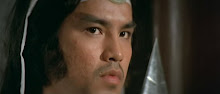
SAMURAI COMMANDO: MISSION 1549 aka SENGOKU JIEITAI 1549 (SENGOKU SELF DEFENSE FORCE 1549)
Yosuke Eguchi (Kashima Yosuke), Kyoka Suzuki (Kanzaki), Kazuki Kitamura (Shichibei), Takeshi Kaga (Tsuyoshi Matoba/Oda Nobunaga), Masato Ibu (Dohsan Saito), Haruka Ayase (Princess Nou), Akiyoshi Nakao (Tosuke), Katsuhisa Namase (Major Mori), Daisuke Shima (Mikuni), Koji Matoba (Yoda)
Directed by Masaaki Tezuka
The Short Version: This 2005 remake of the violent 1979 samurai/fantasy spectacular starring Sonny Chiba lacks the gruesome and gritty air of that film substituting grim theatrics with melodramatic bravado and heavier sci fi elements. It's mildly diverting, but not nearly as memorable as the original 139 minute original starring Sonny Chiba.
Note: This is a combination review and Remakes: Redux, Or Ridiculous entry comparing the two pictures. Click the highlighted title for the review of the original 1979 production: SENGOKU JIEITAI (1979).

 Major Mori of the Ground Self Defense Force and Lt. Kanzaki seek the aid of ex Lieutenant Kashima Yusuke, now running a restaurant, to lead a rescue team to be sent back in time to find Colonel Matoba, who disappeared two years earlier as part of 'Experimental Unit 3', a military unit testing a new magnetic shield. Matoba and his men were thrust back in time to the Feudal Era of japan when warlords battled for control of the country. Matoba has seriously altered history which has been causing an increasing number of deadly ripple effects in the present. He plans to create a new history for Japan by making the future extinct. Kashima and Mori are assigned to eliminate him and reverse the damage done and make it back to their own time within 68 hours before they, too, are trapped in the past.
 Kadokawa Productions celebrated its 60th anniversary with this remake of the Kadokawa Production from 1979. The man responsible for some of the most lively and action packed entries in the 'Millennium Series' of Godzilla pictures was given the task of remaking one of Sonny Chiba's most popular movies (although it was met with lots of fan indifference outside of Japan). Chiba, himself, cited it as one of his most enjoyable motion pictures he ever worked on. The original movie was also a huge success in its native Japan. The science fiction novel by Ryo Hanmura has proven popular with Japanese audiences as it also was the source of a mini series in 2003. Both the 1979 and '05 versions have similarities, but both are also very different from one another. When the '79 film was released in America (retitled G.I. SAMURAI), it was shorn of some 45 minutes of footage leaving nothing but the expansive battle sequences to marvel at.
Despite his propensity for directing entertaining examples of popcorn thrills, Tezuka pays a great deal of respect to the source material retaining much character interplay as opposed to lots of flashy effects work. Sadly, all this characterization falls flat amidst the more fantastical attributes of the plot. Save for one, or two actors, much of the cast fail to bring their characters to life. Considering this movie is brimming with jingoism (every character gets a grand speech, or send off before they expire), it all means little when the performers do little with what they're given.

Curiously, a US production from 1980 entitled THE FINAL COUNTDOWN (starring Kirk Douglas and Martin Sheen) shared a very similar plotline to the Japanese film from 1979. That film dealt with a crew on an aircraft carrier that are taken back to the days leading up to the attack on Pearl Harbor. They are placed in a position as to interfere with history or let it carry its course. The Japanese epic from the year prior featured the same arc--Sonny Chiba and his team were faced with altering Japan's history. Attempting to get back to their own time, the group was faced with the fact that it might not be possible to do so. The unit splits up into groups--one seeing the benefit of running wild in a violent era and the other trying to leave well enough alone not knowing the full consequences of their actions may drastically affect the future.
 TIME SLIP (1979)
 Eventually, Chiba and his now dwindled motley clutch of heroes decide it might be best to rule in the Feudal Era. He embraces his samurai spirit and although it isn't established, Chiba's character becomes Nobunaga Oda, the historical unifier of the Warring States of Japan's past. This same premise is also in evidence in the 2005 version, but with some major differences. Tezuka's movie retains the epic feel of the original, but adopts a more linear fantasy approach that allows for as much action and special effects as possible. Obviously, Tezuka had a bit more funds to play with, but the original is no pushover. The newer films science fiction angle introduces a number of implausible elements during the films 119 minute running time that keeps its scenario firmly entrenched within the realm of a manga. Oddly enough, the streamlined approach to the 86 minute international version of the Japanese 2005 film mirrors the gutted treatment Chiba's original was given for its US release; For some, less is indeed more (more on the 86 minute cut later).
 An example of just how outrageous Tezuka's movie becomes occurs when our "rescue team" are captured in an ambush by a group of samurai warriors. They are taken to a fortress surrounding a surreal, modernized castle with an oil refinery built next to it! Taken to the leader, Kashima and company discover that the man they were sent to bring back/kill has assumed the mantle of Nobunaga Oda after having killed him in a battle. Matoba/Oda plans to use a nuclear device(!) he has constructed to cause Mt. Fuji to erupt with even more devastating force. This change in Japan's past will kill 6 billion people in Japan's future for the greater good of Matoba's new, stronger Japan. This is the main crux of the plot in the new film. The original has a bit of this, but it's more of a side story wherein one of Iba's (Chiba) men, a bit on the demented side, takes it upon himself to zip around the coast pillaging and raping villagers with little regard as to the havoc being caused both in the past and the future.
 TIME SLIP/SENGOKU JIEITAI (1979)
 SENGOKU JIEITAI 1549 (2005)
 There are minor homages to Mitsumasa Saito's '79 adaptation such as a shock moment when the soldiers first realize they are not in friendly territory. It happens at the very beginning in the newer film and a little bit later in the original. One of the more noticeable changes are the action scenes. In the '79 film, the fights are incredibly raw, bloody and barbaric. There's a realism to them that is sorely lacking in the '05 film. There's nothing at all memorable about them. The action itself, such as the war scenes and explosions overshadow what little samurai action there is. Tezuka does manage some striking imagery such as the armor covered swordsmen brandishing machine guns, but the choreography in the scant few swordplay scenes makes one long for the JAC.
But even with all its stylish and extravagant special effects, nothing in SAMURAI COMMANDO comes close to the concluding 30 minute battle sequence in TIME SLIP. It's an amazingly violent piece of grandeur that is one of the most gripping battles I've seen in a movie like this. Mitsumasa Saito creates a staggering sense of hopelessness as Iba and his fleeting, ragtag band battle against thousands of samurai and ninja in a gruesome last stand. For the new film, the final battle isn't nearly as exciting, but it is filled with Hollywood level effects work and dozens of massive explosions which, in this day and age, is a logical trade off.

Tezuka's movie also plays things safe when compared with the original. In that film, the gore flowed freely, but here, there's only a few such scenes and at least one is a spray of CGI gore. The Chiba film also contains a fair bit of sex and nudity, but there's none of that in the '05 version. The newer film is much safer for general audiences than the much earlier production.

 The newer production also sports a wholly subtle soundtrack (compared with the export versions rousing orchestral score) while the original, like every other Japanese production of that time, contains a series of pop songs, power ballads and synth score. The score for the Chiba movie is quite strange, but I liked it, unlike seemingly everyone else. The score for Tezuka's movie mostly fails to set the tone for the adventure ahead, but the much shorter export version succeeds admirably in this department. While it's not a bad movie by any stretch, Masaaki Tezuka's tale of Samurai & Soldiers is a bit disappointing when compared with the original film starring Sonny Chiba.
Below are alterations between the two films as well as differences to the much shorter international version to Masaaki Tezuka's 2005 production...
1979: Chiba and company are transported back in time to Feudal Japan and attempt to find a way back home without altering Earth's future.
2005: Kashima and a large group of soldiers are transported back in time to stop a former military commander, also trapped in the past, from causing irreparable damage to Earth in the present day.
 1979 version
1979: Iba (Chiba) and his crew had far fewer pieces of military hardware and limited ammunition. They had one helicopter, one tank and a few transport vehicles. They shot to kill when in danger as they were initially unaware of the time period they found themselves in, but soon found that to survive in the brutal warring states, they had to kill to live.
 2005 version
2005: Mori and Kashima go back in time with an assortment of military vehicles and modern hardware including several tanks, a helicopter and a handful of personnel transports. Major Mori designs a special cellulose bullet that will not kill, but will also not leave any traces of their being in the past. Kashima is against this and asks why no live rounds. Mori stresses only in an emergency will they be allowed to use bullets for killing.
 1979 version
1979: Iba and his dwindling crew attempt to get back home, but when this proves difficult, to impossible, they decide to try and adapt to the ways of the Feudal Era. Becoming samurai in the process, Iba takes on the persona of what would ultimately become lord Nobunaga Oda.
 2005 version
2005: Kashima and his men are intentionally sent back in time to find his former commander, Colonel Matoba, who was thrust accidentally back to the Warring States Era and has been wrecking havoc that threatens the modern era of today. Once there, it is learned that Matoba has actually killed Nobunaga Oda and assumed his mantle.
 1979 version
1979: Iba becomes great friends with an ambitious samurai commander, Kagetora, and both intend to rule Japan's past together.
 2005 version
2005: Kashima becomes an uneasy ally with a samurai named Shichibei and both eventually take up arms side by side.
1979: While the film fluctuates between the past and present, the two eras are never shown to "co-exist" simultaneously; we only see the soldiers from modern times in the past. The scenes in the present day are brief and act as a parallel to the action occuring in the past, or to reflect on character exposition.
2005: Both modern and archaic eras collide in the new film; the past sees the future and vice versa. A lone samurai ends up in the modern age when Matoba and his men are thrust back in time. Shichibei first meets Kashima in the present day and both form an uneasy alliance till both eventually fight side by side in the past.
 1979 version
1979: Iba and his crew eventually run out of both ammo and time in Feudal Japan. Sinking their tank in the ocean, their helicopter destroyed and only a few men among them, the sheer numbers of samurai and their "primitive" weapons have taken their toll on the modern military might of Japan's modern Self Defense Force.
 2005 version
2005: Never at any time are the samurai's weapons a huge threat to the modern soldiers. The samurai themselves frequently take up arms with machine guns and high powered rifles. Colonel Matoba has also created a refinery to manufacture oil and the resources to make ammunition so there's never a threat of dwindling ammo or gas to run their helicopter.
1979: Iba's unit eventually splits into two groups. This second group is made up of soldiers who want to take advantage of the time period--rape, loot and kill wantonly without any consequence as per the lawlessness of the era. Iba and his group are not only at war with roving army of samurai, but with his own men.
2005: It's Kashima's group versus Matoba and his band of heavily armed samurai squadron. Matoba represents the awol soldier from the earlier film, but with a much bigger agenda than merely rampant robbing and killing.
 1979 version
1979: The modern soldiers are feared for their military weaponry, but are used by guileful aids to the Shogunate to further their positions. When they're no longer needed, and their ammunition depleted, the Shogunate calls for their deaths.
 2005 version
2005: Referred to as 'The Guides From Heaven', the modern militia are eventually revered for their superior weaponry and used for the advancement of the Japan of the Feudal Age, presenting a threat to the world of the future.
 1979 version; Isao Natsuyagi pictured firing the arrow
1979: The film had two nominations at the Japanese Academy Awards--Best Sound and Best Supporting Actor for Isao Natsuyagi in 1980.
 2005 version
2005: The film won Best Art Direction at the Asia-Pacific Film Festival in 2005.
86 minute International version of the 119 minute 2005 film:
Differences amount to around 34 minutes. Some scenes have been shuffled around including a scene between Kashima and Lt. Kanzaki which occurs earlier in the Japanese version. It's moved a few minutes ahead in the export print. A similar instance occurs during the finale. Shots of an approaching army are switched around in different places between the two cuts. At the end, a sequence with Shichibei, princess Nou and Tosuke is rearranged in the export cut.
There's a lot of flashback footage where Kashima remembers working under Colonel Matoba and his respect for the military commander. All of these are eliminated in the export version. A lengthy speech between the two prior to their duel at the end is also eliminated cutting straight to the fight.
Various scene extensions are removed such as several shots showing dead and rotted carcasses of samurai warriors. One trimmed scene shows the modern soldiers praying for their souls shortly after their arrival in the past.

Character interplay between several of the secondary characters is cut down extensively. Action scenes have also been trimmed slightly. The bulk of the truncated footage amounts to dialog exchanges that add more exposition. The scores are also vastly different between the Japanese cut and the international export version. The Japanese version features a somber and oddly less opulent soundtrack by a composer named 'Shezoo' while the export print features a loud and occasionally bombastic score credited to Mark Hannah. Incidentally, there's also a nice, melodic ballad that plays over the end credits in the Japanese version.

 As a stand alone feature, Masaaki Tezuka's SAMURAI COMMANDO (export title) is a bit of a disappointment when compared to the original. Japanese science fiction fans may enjoy it (watch for Kazuki Kitamura, the main villain from the awful GODZILLA FINAL WARS as Shichibei), but those expecting lots of violence ported over from the Chiba version from 1979 will likely be disgruntled to find a fairly safe adventure tale peppered with some damn fine effects work. Sadly, even with all the characterization, relatively none of the players are very compelling. Takeshi Kaga is a fun comic book villain as Oda and Masato Ibu (another FINAL WARS alum) is amusing as Dohsan Saito. Japanese science fiction completists should check this out, but others may find it mildly distracting, but will likely forget about the whole thing shortly after they've finished the film. As much as I enjoy the work of Masaaki Tezuka, this is another case of a remake failing to surpass, or even be as good as the film it takes its inspiration from.
This review is representative of both the 86 minute export version on R3 DVD through IVL from Hong Kong and the Japanese R2 DVD that runs 119 minutes. Oddly enough, the R3 DVD is also non-anamorphic.