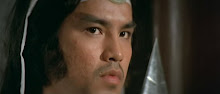
THE FLYING GUILLOTINE 1974
Chen Kuan Tai (Ma Teng), Ku Feng (Xin Kang), Frankie Wei Hung (Xu Shuang Kun), Liu Wu Chi (Ma Yu Ping), Chiang Yang (Emperor Yung Cheng), Wong Yu (Xie Tian Fu), Lin Wei Tu (Luo Peng), Ai Ti (Wan Zhu)
Directed by Ho Meng Hua
The Short Version: This Shaw Brothers classic about the creation and usage of a flying piece of killer cutlery is a favorite of 42nd street sleaze lovers. Aside from its exploitation elements, Ho Meng Hua's tale of righteousness, treachery and revenge is also one of his best directed movies and a shining, if gruesome example of Hong Kong cinema's golden age at its finest.

 In an effort to maintain control over the populace and eradicate those who oppose him, Emperor Yung Cheng orders the recruitment of a secret order of assassins proficient in the use of a new terrifying weapon that can take off a man's head at a hundred yards. The most bright member of the group, Ma Teng, discovers treachery and greed among their ranks and escapes the stronghold before he, too, is targeted for assassination. On the run, Ma attempts to start a new life, but the order of secret killers are close behind.
 Southern Screen July 1974
 Revered Shaw Brothers director, Ho Meng Hua, spent a year working on this production before it finally saw release in the early months of 1975. All his arduous work and that of scriptwriter, I Kuang and others paid off handsomely. By taking actual historical figures, a legendary death device and weaving them around well developed characters, Ho and company created one of the most endearingly brutal HK action dramas ever made. THE FLYING GUILLOTINE went on to be a huge success around the world as well as spawning numerous imitations. Considered an "exploitation kung fu classic" in America, the film brazenly eschews kung fu movie conventions in favor of a more story oriented production. There are a few fight scenes, but these are not the typical style of HK screen fighting of the time period. The casual staging of the scant few fights appears to be intentional to maintain focus on the weapon itself and subsequent dramatic elements.


 Director Ho is very successful in creating an atmosphere of dread brought out of the frightful nature of the flying guillotine--it can get you anywhere and nothing can stop it. Fiercely original, the weapon itself is an impressive design and thanks to the high skill level of the Shaw Brothers' props department, this imposing weapon looks like it could actually work. According to the director, the weapon did in fact exist. Apparently, something about the flying head snatcher must have been written about over the years--an Asian friend of mine said the weapon did in fact exist, but as Ho Meng Hua has pointed out, no one lived long enough to sketch what it looked like, nor have any drawings of the weapon been found. Until then, the flying guillotine will remain an enigma made larger than life by the imaginations of those interested in the subject.

 Imagination was definitely a driving force in the number of movies similar to FG that were ejected onto movie screens in the wake of Ho's successful action-horror-drama. One of the first and most well known is Jimmy Wang Yu's impoverished, but heavy on outrageousness, MASTER OF THE FLYING GUILLOTINE (1976); also known as THE ONE ARMED BOXER 2 and ONE ARMED BOXER VS. THE FLYING GUILLOTINE. Not to be outdone, the Shaw Brothers started work in February of 1976 on their own sequel, FLYING GUILLOTINE 2. The Shaw's even ripped themselves off that year with DRAGON MISSILE, a 'B' actioner that featured a different type of guillotine weapon and some interesting effects for its usage. Another independent entry was THE FATAL FLYING GUILLOTINES from 1977 and starred Carter Wong, Chen Sing and Meng Hoi.

 The Shaw's again showcased the flying noggin chopper during the first half of THE VENGEFUL BEAUTY (1978), one of their best 'B' action exploitation movies. The appearance of the weapon and the guillotine squad seems to take place during the same time frame of the original Shaw Brothers movie. Ho Meng Hua directs this tale of a vengeful and pregnant Chen Ping going after her husbands killers, a member of the Emperor's secret kill squad who was marked for death by his colleagues. A modified version of the weapon also appeared in Indonesian movies such as the wild and wacky Barry Prima mystical martial arts gore epic THE DEVIL'S SWORD in 1982.
 THE HEROIC TRIO (1993) also had a FG weapon, designed faithfully on the Shaw Brothers version and was thrown by Anthony Wong no less. Another modification of the classic death device cropped up in the gore drenched Japanese movie, THE MACHINE GIRL (2008). Some would also credit the weapon that Chiaki Kuriyama wields in KILL BILL (2003) as a variation on the famed piece of killer cutlery.
 Ku Feng (left) holds a decapitated head while Wei Hung (right) retrieves another; insert: one of the negatives of film restoration is that minor details become far more noticeable such as this manniquin head that is now visible through the mesh of the guillotine.
 Translated as 'The Blood Dripper', there's plenty of the red stuff on display and what is probably a world record of decapitations on screen. Some 25 victims lose their heads before the film ends. The flying frisbee of death also contains another method of dispatch--this steel helmet is aligned with saw blades. It's used to stab one poor soul in the face, and the guillotine ends up impaling one of the men who wields the weapon (future BASTARD SWORDSMAN Tsui Siu Keung, in fact) after it pulls a spear head from an ingenious device Ma creates to combat the guillotine (more on that later). While the picture is bloody, the film doesn't wallow in gory excess. The emphasis is on both the FG device and the characters, particularly Ma Teng; ably played by fan favorite, Chen Kuan Tai. Produced at the midpoint of Ho's career, it's the bridge between his earlier, classy productions and his later more exploitation driven works. It's the last truly great movie Ho Meng Hua directed. From here on out, his resume was dominated by far less serious and sundry offerings such as trash favorites BLACK MAGIC (1975), THE OILY MANIAC (1976), THE MIGHTY PEKING MAN (1977) and SHAOLIN HANDLOCK (1978).
 Chen Kuan Tai (left) and Run Run Shaw (right) leaving an awards ceremony
 Chen Kuan Tai does a great deal with his characterization of Ma Teng, a loyal follower to his country and Emperor who questions the motives of his superiors and even some of his compatriots when it becomes glaringly obvious that innocents are being slaughtered, and not rebels. The polar opposite to Chen's stoic turns as both Ma Yung Chen (THE BOXER FROM SHANTUNG) and Hung Hsi Kwan (HEROES TWO), Ma Teng is about as human a character as Chen has ever played. He displays fear, hesitates before killing those in pursuit of him and generally just wants to be left alone and forgotten about. Frankie Wei Hung delivers one of those slimy roles he was so good at essaying in his portrayal of the greedy and deceitful Xu Shuang Kun. Wei was never a huge star, but carved an indelible image in exploitation movies when a certain role was required in numerous Shaw sex and sadism movies.
 Frankie Wei Hung in the type of roles he was born to play
 Ku Feng smells a rat
 The celebrated and award winning actor, Ku Feng plays the ill fated creator of the flying guillotine, Xin Kang. A man unquestionably loyal to the Emperor, but not above suspicion. His part in this picture ends in an ironic bit of guilefulness on the part of one of the very men he trained. The scenes where he is engulfed in thought in designing the weapon and how it will work gives levity to the weapon once we see it. It isn't like he has an epiphany then in the next scene, the creation is revealed. The unveiling of the guillotine involves one of the most oft remembered shots from the film; some who have seen the film at some point in their life seem to always recall when the dog is decapitated in a gruesome display of the weapons capabilities. A real dog doesn't have his head severed, but the scene is still effective.
 Wong Yu (left); insert: Ai Ti in a state of undress
  Later to become a minor kung fu star in his own right is a young Wong Yu, who, in 1975 would star in Liu Chia Liang's directorial debut hit, THE SPIRITUAL BOXER. He has a minor supporting role in FG as a much too green member of the guillotine squad who finds he doesn't want to kill in the name of the Emperor and ultimately becomes a target, himself. Ai Ti, a major Shaw sex starlet during the 70s and early 80s also has a minor supporting role as one of the Emperor's concubines given to Wong Yu's character as a present.

 Ho Meng Hua's THE FLYING GUILLOTINE remains a classic in Hong Kong cinema and a favorite among fans. Part of its appeal lies in its non-conformance to genre conventions. It transcends the classical essence of the kung fu genre through its righteous and despicable characters without the use of fists and feet--the training and use of the lethal yo yo-like implement is a substitute for any number of animal styles that dominate the traditional kung fu flick. As with most movies where a counter style is learned to repel another, so another steel device is created to combat the dreaded guillotine. Ma Teng devises a steel umbrella, a rudimentary, but intimidating weapon in its own right. It works well for a brief time before it's surmised that only a flying guillotine can stop another flying guillotine. This occurs during the third act--the first being the build-up of the group and their motivations, the second act is the chase and pursuit of Ma and the third is Ma Teng, with no other option, finally fighting back against his former brothers.

 One of the most original films of its kind and one of the most accomplished, THE FLYING GUILLOTINE is a grand achievement of the director and one of the most well known productions that exploded from the famed Shaw Brothers studio in Hong Kong. It has had a lasting impression on numerous filmmakers, both in Asia and abroad and its influence is undeniable. Those expecting lots of action will instead find many heads being torn asunder amidst an oppressively grim atmosphere, but Ho's movie has much more going for it than that. Fans of Chen Kuan Tai will see the diversity of this actor in a role devoid of the near invincibility of his larger than life Chang Cheh portrayals. Hold onto your heads, THE FLYING GUILLOTINE is a highly recommended movie.
This review is representative of the IVL R3 DVD from Hong Kong (OOP).

THE BEST & SELECTED FAVORITES OF SEASON 2

 THE TWILIGHT ZONE kicked off its second season in much the same fashion as its inaugural debut of WHERE IS EVERYBODY?, an episode that, for the bulk of its 25 minute running time, revolved around a single character that found himself in a bizarre predicament that only got worse as the panic and paranoia increased. KING NINE WILL NOT RETURN was almost a remake of that season starter. Aside from the familiarity of the first show, second time is the charm for this series as there were a healthy amount of episodes that are considered some of the best of the entire TZ run.
 Above: THE MAN IN THE BOTTLE season 2; insert: DUST season 2
 Everything that made the first go round an incredibly entertaining, thought provoking venture, is found here as well. One thing becomes noticeably different--since the show was shot on 35mm film, CBS assumed that by shooting on video, the show would save a lot of money. What they didn't bank on was that much of the shows signature look, sound and feel was lost on the less vibrant videotape format. Thankfully, only six shows were recorded this way, but no doubt they could have been far more exceptional had they been shot on film. This especially applies to episode 17, 'Twenty Two'. This one has a FINAL DESTINATION vibe about it as a young woman keeps having nightmares of a strange woman beckoning her into room 22 which happens to be the morgue. At least one of these shot on video shows has survived the test of time as a true classic and some are considered true stinkers.
 A HUNDRED YARDS OVER THE RIM season 2
 Above: MR. DINGLE, THE STRONG season 2; insert: THE PRIME MOVER season 2
 An impressive stable of television and movie stars were peppered throughout this season, some of them being horror mainstays while others became popular faces that frequently entered THE TWILIGHT ZONE--Burgess Meredith, John Carradine, Art Carney (THE HONEYMOONERS), Donna Douglas (THE BEVERLY HILLBILLY'S), Agnes Morehead (BEWITCHED), Billy Mumy, William Shatner (STAR TREK), Dennis Weaver (GUNSMOKE), John Astin (THE ADDAMS FAMILY), Dick York (BEWITCHED), Buddy Ebsen (THE BEVERLY HILLBILLY'S) and Russell Johnson (GILLIGAN'S ISLAND) were some of the most recognizable faces this time out. The following is strictly my opinion of the best episodes of season two followed by a small list of additional, worthy shows.
 There's a centuries old saying that 'there's nothing to fear but fear itself'--fear of the dark, fear of the unknown, fear of ones self, the fear of the future and what it may bring. Some eat it like candy, others let it consume them till there's nothing left but an empty, miserable shell. For some, overcoming their fear is a rite of passage that leads to an epiphany of solace. For others, it's being dealt a bad hand in a poker game. It's the way the cookie crumbles in the Twilight Zone.
SEASON 2
Episode 41: THE HOWLING MAN

 Dazed, confused and lost in a raging storm, David Ellington is given shelter at an isolated hermitage, but is urged to leave as soon as possible. Over the course of the dark and stormy night, Ellington hears what sounds like the wailing of a man emanating from the halls of the hermitage. Told that no man is being held within the confines of the convent, Ellington later speaks with a captive who claims he has been imprisoned by the brothers of the order. Threatening to go to the police, brother Jerome tells Ellington he saw no man, but the devil himself. Simply one of the best, most eerie TZ episodes ever conceived. Surreal atmosphere aided by tilted camera angles and a story from Charles Beaumont that appears to have been inspiration to the 1978 movie, THE EVIL. An amazing morality tale that also has a heavy dose of horror and fantasy.
Episode 42: EYE OF THE BEHOLDER

 Janet Tyler, her entire head wrapped in bandages, anxiously awaits the results of her most recent operation to make her beautiful enabling her to fit in with society. Rod Serling wrote this series defining episode, ably directed by Douglas Heyes, who also helmed 'The Howling Man' and also 'The Invaders'--three top shows of the series. This incredibly simple premise contains enough surrealism, creepiness and social subtext in its 25 minutes to fill a full length feature. Masterfully photographed by George T. Clemens, the ZONE's most prolific DP, the viewer feels they are immersed in a world that is possibly not our own. Ironically enough, this episode resonates to an alarming degree in the era we live in right now.
Episode 43: NICK OF TIME

 Newlyweds, Don and Pat Carter stop off in the small Ohio town of Ridgeview for car repairs on their way to New York to start a new life together. Having lunch in a diner, they find their lives are put in turmoil when a napkin holder doubling as a devil bobble headed fortune teller feeds them their future for a penny per question. Captain Kirk's first of two TZ programs speaks volumes on how superstition can penetrate modern sensibilities relegating the most sophisticated minds to oldeworld thinking. Underneath that there's themes on attaining confidence in ones own abilities leading to a future made prosperous, or canceled based solely on decisions one makes for themselves and not some kooky looking fortune teller in an out of the way diner. A brilliant episode from Richard L. Bare ('To Serve Man').
Episode 47: NIGHT OF THE MEEK

 Henry Corwin, a down on his luck alcoholic who does seasonal work as a mall Santa loses his job on Christmas Eve for less than merry behavior. Stumbling down a lonely alley, Henry witnesses a can full of trash magically transformed into a bag of gifts. He proceeds to help out the less fortunate on Skid Row by passing out presents that seem to flow endlessly from the mystical bag. Once his job is complete, Henry is visited by an elf with a special proposition. One of two TZ Christmas episodes, this one has went on to be one of the most beloved of the series and one of the most exemplary scripts to deal with the Christmas holidays as well as one of Serling's finest half hours.
Episode 49: BACK THERE

 On April 14th, 1961, Pete Corrigan and a few of his social circle at the Potomac Club in D.C. discuss the probabilities of time travel and the altering of history. Upon leaving the club, Corrigan becomes disoriented and quickly discovers he is no longer in modern day Washington D.C., but has somehow been transported back to April 14th, 1865, the night of president Lincoln's assassination. Yet another brilliant Serling episode that has just the right amount of tension and eerie atmosphere accompanied by arguably the creepiest music ever composed by Jerry Goldsmith. A couple of nicely integrated twists round out this distinguished episode.
Episode 51: THE INVADERS

 An old woman discovers a UFO has landed in her attic and spends the remainder of the night in a death struggle against the alien invaders. Another incredibly simple premise that encompasses tight suspense, impeccable lighting effects, goosebump inducing music and absolutely no dialog. Yet another shock ending that comes up from behind knocking the viewer silly. The little "wind up" aliens in their metallic armor look just that, but are occasionally convincing and still contain an air of menace especially when armed with knives. The fact that these mini monsters are seldom seen save for the sound of their footsteps and the peculiar noises they make, the sense of fear, terror and tension is heightened. One of Richard Matheson's best for this series.
Episode 58: LONG DISTANCE CALL

 On his 5th birthday, the young Billy Bayles receives a toy telephone from his dying grandmother. After she has passed away, Billy's parents notice their son carrying on conversations on his toy phone. When asked who he's talking to, Billy says his grandmother. This was one of six TZ episodes shot on tape for purposes of saving a few thousand dollars, but at the expense of that signature look the show was "naked" without. Still, this particular show was arguably the best of the videotaped bunch. It's both touching and grim in its view of loss, moving on and parental values. It also gets a tad bit morbid when the child is seemingly beckoned to commit suicide so as to join the dead grandmother on the other side!
Episode 64: WILL THE REAL MARTIAN PLEASE STAND UP?

 A strange object is reported having crashed in a frozen lake. Two policemen discover tracks coming from the body of water and leading to an out of the way diner which is inundated with patrons; bus passengers stranded after a bridge is reported unsafe from the onslaught of snow. This is another Serling scripted show again dealing with alien visitors. This one is evenly balanced with suspense and modest laughs. The whole show takes place on a single set as the various multitude of characters attempt to pinpoint just who among them is not of this Earth. There's a nice, if morbid twist at the end.
Episode 65: THE OBSOLETE MAN

 Deemed obsolete by the government, Romney Wordsworth is on trial for being a librarian, promoting the reading of books. Condemned to death by this totalitarian regime, he's given his choice of liquidation which is to be televised on national TV for all to see. Burgess Meredith again showcases his skills in this frightening fantasy vision of a government with complete and total control over the populace. It's yet another episode that could possibly prove prophetic in light of the way the US government is attempting to gain more and more control over our lives. This episode, like 'Eye of the Beholder', is one of the most nightmarishly surreal experiences of the entire series.
Unlike season 1, the second go round ended strong, an aura that carried over into the third season and another healthy string of horror and science fiction heavy programs only slightly less cerebral than the two prior seasons.
Other episodes from season two worthy of note:
MR. DINGLE, THE STRONG
A PENNY FOR YOUR THOUGHTS
THE PRIME MOVER
A HUNDRED YARDS OVER THE RIM
THE RIP VAN WINKLE CAPER
 Your trip so far has been long and exhaustive. You're out of gas, tired and simply wish to rest for the night. You Stop Over In A Quiet Town, overwhelmed by an unnatural silence. The blackness engulfs you in a penetrating loneliness. Gasping for air you awaken in a brightness that burns your eyes and parches your throat. You are alone, but in the middle of a deserted highway...
copyright 2013. All text is the property of coolasscinema.com and should not be reproduced in whole, or in part, without permission from the author. All images, unless otherwise noted, are the property of their respective copyright owners.