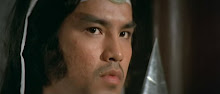
REVENGE OF THE CORPSE 1981 aka THE BLOODTHIRSTY DEAD aka FLYING CORPSE
Pai Piao (Sergeant Du Zhen Ren), Lo Lieh (Zeng Shang Yue), Ku Feng (Yang Hai Feng), Linda Chu Hsiang Yun (Sergeant Du's wife), Lee Kun (Mr. Han), Wu Yuan Chun (Zhao Ke), Chan Shen (Exorcist master), Yu Tsui Ling (Zhen Zhen), Yuen Wah (Shan Bing)
Directed by Sun Chung
The Short Version: Among his impressive resume, REVENGE OF THE CORPSE is one of the rarest movies of director Sun Chung; one of Hong Kong's most underrated talents. His first of two horror films, it was the most successful of his Shaw Brothers output. While Chung's notable artistic flourishes are on display, there's nothing HK horror-ghost fans haven't seen before, although there are some innovations for the time it was made. However, the final 20 minutes are a cornucopia of creativity and a stand-out amongst the familiar territory. The last showdown inside a paper amulet covered house between the vengeance seeking spirit against an Exorcist Master and his minions is a tense highlight.

Sergeant Du Zhen Ren is a highly respected official in West Town. He has a beautiful wife who is secretly having an affair with Zeng Shang Yue, a wealthy man in league with an underworld bandit gang that is being pursued by officer Du.
 Bribing the righteous Sergeant's colleagues, Zeng hatches a plot to frame officer Du for murdering a wealthy patriarch in the village and stealing their family heirloom. With several others in on the frame up, Sergeant Du is arrested and tortured while in jail.
Later released, his wife then poisons him. Just before he dies, he asks his sister to dress him in red shrouds before burying him. Not long after, three grave-robbers loot his grave unleashing Du's vengeful spirit in the process. He has returned from the dead to seek bloody retribution on all those connected with his unjust arrest and eventual murder.

Hong Kong has had its fair share of influential filmmakers that made a name for themselves outside of the once British colony, but there were many who did not shine internationally beyond cult fan devotion. Sun Chung was one such filmmaker. He was more "westernized" than most Hong Kong directors as well as being the first native Chinese on the island to use the Steadicam.

 For REVENGE OF THE CORPSE, Sun Chung throws his hat into the ghost-revenge genre, which has seen countless similar movies before and since. The director had explored virtually all genres, but this was his first attempt at doing a full-blown martial arts horror picture. His first Shaw Brothers movie, though, THE DEVIL'S MIRROR (1972), was a wild, blood-spattered Wuxia Fantasy with elements of horror in it. Unlike MIRROR, the director's signature stamps are all over this REVENGE; it's just there's nothing here you haven't seen before in the years since. Still, Sun Chung's attempt at this all too familiar territory is occasionally stylish and unquestionably intense in a few sequences; particularly during the films last half.
 Thankfully, the film eschews a last scene narration that treats the proceedings as some sort of morality fable. That sort of thing was "tacked on" to a handful of other HK horrors in what appears to be a half hearted effort at masking blatant exploitation as a message picture. Sun's movie is anything but exploitation. The glossy photographic touches enhance the production with the directors unique brand of editing, tracking shots and scene transitions that belie the typical HK showcase. It's obvious from Sun Chung's oeuvre he was aiming "outside the box"; there were always elements that made his movies post '77 feel non-Chinese at times.
 At face value, REVENGE OF THE CORPSE is strictly by the numbers horror told efficiently with director Sun's usual stylish flourishes; even adding some POV shots to his repertoire. When it was in production, it was ballyhooed for being an innovative example of martial arts horror. In its depiction of action choreography in 1981, making its protagonist a spirit that only kills the wicked, and the unusual special effects shots, it was certainly adding a fresh spin on the genre that was about to explode in a big way.
The script by the machine-like prolificity of I Kuang covers all the well worn bases. These include the bored, promiscuously cold-hearted wife; the corrupt lawmen and officials; the honorable downtrodden; and the righteous, doomed hero whose otherworldly vendetta is meted out over the course of the films 92 minutes. Basically, 'FLYING CORPSE' adds Chinese aesthetics to what the Japanese had been doing since at least the late 1950s with the revenge-from-beyond-the-grave classic YOTSUYA KAIDAN (1959) and its numerous imitations.

What is quite possibly the most interesting aspect of Shaw Brothers movies is in just how many of them seem to promote a left wing agenda possessing a dim view towards the upper class. What's strange about this is that the Shaw Brothers were extremely wealthy capitalists. Sir Run Run Shaw is even among the top richest men in the world. Still, there's little argument to be made that the Shaw's didn't help their communities from all the scholarships, schools, businesses and donations they made and built over the years via their movie town empire.
 I Kuang's script speaks on levels covered more in depth in countless other similar movies; such as themes related to authoritative corruption, which were the basis for the gloom and doom saturated excess of WHAT PRICE HONESTY (1980). In period films of the Shaw Studio, the law is almost always presented as greedy and duplicitous. You'll find at least one person of authority who has integrity, but they rarely make it to the final shot. These topics are covered in brisk fashion here as if to hurriedly set up the plot so as to get to the spook show as quickly as possible.

One such topic is a subplot concerning the unnamed gang Lo Lieh's character is tied to. This is never explored in any detail. He gives orders for the bandits to loot the surrounding towns since Sergeant Du is out of the way, yet outside of some of the bandits disguised as police officers, we never see them plundering, or making nuisances of themselves. We do hear about them and watch as they die at the hands of Sergeant Du's vengeance seeking ghost.
 Sammo Hung's SPOOKY ENCOUNTERS (1980) had recently finished its theatrical run by the time REVENGE OF THE CORPSE hit HK movie houses in April of 1981. CORPSE was in production the previous year alongside Chung's RENDEZVOUS WITH DEATH (1980). CORPSE even refurbishes some of the opulent sets built for that unique swordplay picture that, outside of lead Wong Yu and Chen Kuan Tai, starred much of CORPSEs cast such as Lo Lieh, award winning actor Ku Feng (who plays a corrupt policeman) and Chan Shen; the latter actor (see insert) will be recognizable to Anglo fans from the Shaw co-pro's THE LEGEND OF THE 7 GOLDEN VAMPIRES (1974) and CLEOPATRA JONES & THE CASINO OF GOLD (1975).
 Since comedy had been officially introduced in kung fu flicks in Jackie Chan's overrated nonsense, SNAKE IN THE EAGLE'S SHADOW (1978), it was only natural comedic conventions would be implemented into the horror genre. And so Sammo's SPOOKY ENCOUNTERS was born. Ignoring the lucrative benefits of instilling pratfall shenanigans into his movie, Sun's film remained (thankfully) straight up horror.
 Funny business still won out in the end, though. REVENGE OF THE CORPSE was Sun Chung's biggest 80s Shaw Brothers hit bringing in 2.9 million HK dollars. By comparison, Sammo Hung's comic horror opus amassed 5.6 million HK. It also bears mentioning that Sun Chung's other straight horror wuxia picture, the more well known and highly regarded HUMAN LANTERNS (1982) scrounged up 2.2 million HK dollars.
It's worth noting that horror mixed with comedy almost became a reality in the bizarrely titled Shaw production, THE SEX WOLF, which began shooting in 1975 under the direction of Kuei Chi Hung. The film was never finished, but found its way as the third story in Kuei's horror anthology, FEARFUL INTERLUDE (1975).
 ALIEN had greatly impressed Shaw (it was the premiere film at one of his then newly built movie theaters) and its advancement in horror movie conventions was possibly instrumental in the advances in Hong Kong special effects techniques for horror pictures; primitive though they were, effective nonetheless. While the fundamentals of HK horror like puking and spewing of bodily fluids are present, the effects artists add some ingredients to the mix. Nothing earth-shattering, but a slow progression for HK cinema in terms of keeping up with what other countries were doing at the time.
 The production gets a lot of mileage out of Sergeant Du's zombified spiritual entity. He's often seen as this flying zombie with a pulsating, vein-popping head! Kuei Chi Hung was doing similar things in his nauseating black magic movies like BEWITCHED (1981) and its sequel, THE BOXER'S OMEN (1983); both of those being several steps beyond Ho Meng Hua's silly, if occasionally gruesome and trendsetting BLACK MAGIC films of the previous decade.
The zombie version of Sergeant Du takes on two forms. The first is the above mentioned flying ghost with a bladder assisted appliance that makes his head expand. The second is the most imposing--a skeletal version that wears Du's police uniform. His first appearance is an affecting tracking shot of this skeletal avenger gliding slowly down a prison hallway while the convicts pray for forgiveness. It's also during this last twenty minutes that the film is at its most creative and impressive.

Shaw rival, Golden Harvest, released a movie with a similar looking creature in the semi-kung fu horror picture, THE PHANTOM KILLER. It was released the same month as REVENGE OF THE CORPSE in April of 1981. The skeletal visage was also modified for Sun Chung's gruesome horror follow up, the aforementioned HUMAN LANTERNS (1982).

Du's conspirators are killed off in elaborate fashion and the usual ghostly tropes are dragged out here--lots of smoke, floating furniture and bladed implements, bodily possession and a grand, tense finale. In it, the last two conspirators, Zheng Shang Yue and Du's wife, are holed up in a paper amulet adorned home guarded by an Exorcist Master (Chan Shen) and his monks.

 The few wirework sequences (shots of the zombiefied form of Du chasing his victims, or rising over trees) are quite well done considering it was still a couple years ahead before wirework in HK productions would reach a standard of excellence. If anything, Tang Chia was at the forefront of this movement with his two amazingly ornate Shaolin kung fu pictures, SHAOLIN PRINCE (1983) and SHAOLIN INTRUDERS (1983). Tang Chia also handled the relatively few fight scenes in this movie. Those, too, are of a high standard. Tang's friend and frequent co-choreographer Huang Pei Chi, has a role as one of Sergeant Du's assassins.

Sun Chung also makes potent usage of Brian May's score for MAD MAX (1979). Outside of a cue or two from ALIEN (1979), nearly the entire score is made up of May's excellent soundtrack. Ostensibly, the Shaw's were fond of this score as various cues from May's compositions crop up in numerous Shaw productions from around this time period at least to 1984.
 Pai Piao, who had re-joined Shaw Brothers a couple years earlier in 1979, was given 8 films--some of them were basically cameos, and others were lead roles. He had quickly become the John Morghen (a popular cult actor who had spectacularly disgusting demises in several popular Italian horror films) of HK cinema. He had a large wooden spike rammed up his rectum in Mou Tun Fei's A DEADLY SECRET (1980), was beaten, pissed on, and forced to eat insects in WHAT PRICE HONESTY (1980), and in this picture, he's mercilessly beaten and ultimately killed by his wife. He's not in the film past the 30 minute mark or so and it doesn't appear to be him under the monster make up, either.
During filming of Chung's movie, Pai was given the lead in Hua Shan's gory Wuxia-Horror flick, BLOODY PARROT (1981). He spoke highly of the production, particularly in that he was given so much to do.
 Kung Fu superstar Lo Lieh plays a master of a different sort in this film. He's playing yet another guileful bad guy as per his career trajectory at this time. His martial prowess is discussed, but never seen. However, his proficiency in bedroom gymnastics is reputedly unparalleled. While it's not expounded upon, he is essentially the leader of the underworld gang that has infiltrated West Town and bought off what passes for law and order there.
 Yang Hsiung, who came to some minor, if brief degree of prominence in Chang Cheh movies (mostly as a supporting villain), is relegated to a non-fighting role here playing Cui Da, one of three bungling graverobbers that let loose Sergeant Du's spirit. His participation is of no consequence, though. His first stand out role was as the near invincible Jiu Gao Feng in CRIPPLED AVENGERS (1978). He also did many non-Shaw movies, it's just unusual to see him in such a throwaway role as what he ends up with in REVENGE OF THE CORPSE.
Of no particular interest, but it struck me as peculiar; this print of REVENGE OF THE CORPSE has no English title below the Chinese title as was common practice at the time. It also bore this English credit in Shaw's promotional materials. The film began shooting under the title RETURN OF THE SWORDSMAN till it settled on the more familiar moniker it bears now.
 Exploring few new avenues, but comfortably traversing well traveled roads, Sun Chung's first horror film might not be entirely groundbreaking, but it approaches the material in a classy, innovative way. For those looking for it, there's martial arts present, but this is a horror film first, action movie second. The action itself is corralled at the beginning and the ending only. It's a shame this film remains unavailable legitimately on DVD anywhere in the world as of this writing. It deserves discovery just as the career of its director needs wider exposure.