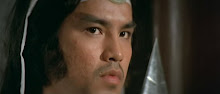
GONIN NO SHOKIN KASEGI 1969 aka BOUNTY HUNTER 2: THE FORT OF DEATH
Wakayama Tomisaburo (Shikoro Ichibei), Mayama Tomoko (Kagero), Oki Minoru (Mochizuki Yataro), Kitamura Eizo (Onizuka Hayato), Tokudaiji Shin (Bessho), Ibuki Goro (Otohei, ninja leader), Tsuchida Sanae (Miyuki), Ishiyama Ritsu (Shinpachi), Amatsu Bin (Jisaburo), Ushio Kenji (Asami Juzo), Arashi Kanjuro (Tazaemon), Nakatani Ichiro (Mondo), Koike Asao (Ozeki Sadonokami)
Directed by Kudo Eiichi
The Short Version: High octane sequel to the visually, and expositionally impressive SHOKIN KASEGI (1969) finds our bold samurai spy saving a fortified stronghold of farmers from a brutal government oppressor and his band of ninja assassins. It's a much bigger production this second go round in nearly every regard. The goriest, and most action packed of the trilogy, there's less emphasis on spy intrigue and more on slashing swords and blazing bullets in what is essentially THE SEVEN SAMURAI (1954) minus two.

 After a plan to force the farmers of Enoki Village to partake in the
rebuilding of Edo Castle crumbles, the government lays siege to the
peasant hamlet. Upon taking away their food, heavily taxing them, and murdering those who refuse to pay, the villagers lead an
uprising by building a fort around their homestead from which to defend themselves. Fearing
the government will eventually wipe them out, a young man seeks the help of the famous bounty hunter, Shikoro Ichibei and his small band of specialists.
After a plan to force the farmers of Enoki Village to partake in the
rebuilding of Edo Castle crumbles, the government lays siege to the
peasant hamlet. Upon taking away their food, heavily taxing them, and murdering those who refuse to pay, the villagers lead an
uprising by building a fort around their homestead from which to defend themselves. Fearing
the government will eventually wipe them out, a young man seeks the help of the famous bounty hunter, Shikoro Ichibei and his small band of specialists. 
 This superior sequel to the fitfully entertaining samurai-spy movie SHOKIN KASEGI (1969) starts off somewhere in the desert. Shikoro is transporting a criminal across the barren mountain regions. He's attacked by a group of enemies and quickly riddles their bodies with bullets rapidly fired from his pistol. So begins THE FORT OF DEATH, the grimy, if more ambitious entry in Wakayama's BOUNTY HUNTER trilogy. Think THE SEVEN SAMURAI (1954) without the extensive characterization, minus two title swordsmen, and more action and you have an idea as to what THE FORT OF DEATH is. In this second go-round, the Euroater flavor takes precedence from a visual standpoint. The music (by Tsushima Toshiaki) is more distinctly Japanese, and not quite as memorable as Yagi Masao's from the first movie, but the western feel is palpable in this films imagery.
 The Bondian trappings are almost non-existent with the scales tipped in the favor of sword and gun action, and lots of it. The use of a group of ninjas supplants the spy conventions that were so prevalent in the first feature. It's this section with the ninjas that provides THE FORT OF DEATH with its most viscerally exciting set piece. Otohei is the leader of this faction of Shinobi. He's a man of few words and is missing an eye. Sent in to steal away the Gatling gun Shiroko brought with him, they do get away with it, but Otohei and his men don't get far. Shiroko -- who is already having a bad night -- duels with the ninjas in his underwear! After dealing with an extremely horny woman, our half-naked hero is forced to fight a few unscrupulous ronin moments before ninjas attempt to kill him. It's a tense battle inside a bamboo grove that ends in gruesome fashion.
Ueno Ryuzo returns to contribute the fight choreography, although the sword battles are outnumbered by the guns this time. The large scale action is likewise very well executed. The fort is attacked multiple times, but the last fifteen minutes is a breathlessly intense segment that ends on a bitter note. Seeing Wakayama firing off a Gatling gun with a sword at the ready is surreal. He'd later repeat the gun and sword motif in his classic THE MUTE SAMURAI series from 1974.

 Wakayama Tomisaburo is even more charismatic this time out, although there's been some noticeable tampering done with his character. Takada Koji's screenplay (encoring from SHOKIN KASEGI, but taking sole credit) writes him as more emotional than before. He seems far more concerned about those around him than simply making money. He's not the only one, either. A few other actors in the picture wax patriotic at times. The movie is not a political one, but there's a slight subtext there regarding government oppression of a populace. Wakayama delivers a poignant speech during the closing moments about the uselessness of a governing body if its sole purpose is to march over the lives of those who keep them in power.
The actors penchant for comedy is in evidence here, but his brazenness that made certain situations humorous is exempt from this sequel. Instead, the humor is derived from an individual interacting with Shikoro, and his attempt to resolve the chaos before he's affected by it. The bulk of these moments revolve around the topic of sex, and Shikoro just doesn't have time for it in THE FORT OF DEATH.

 The women are just crazy about Shikoro in this series; and some of them are literally losing their mind to have sex with him. In fact, sex plays a big part in the societal makeup as depicted in this movie. In Shikoro's first scene he treats a man in his infirmary with gonorrhea who has waited an awfully long time to get treatment. This is an hilarious sequence, by the way. Moments later a woman comes in claiming to have an ailment, but Shikoro sees through her scheme of covert horniness. Later on at the fort, Shikoro is nearly raped by a woman with an unbridled libido. Towards the end, a woman who has lost her mind plays rough in an attempt to get the bounty hunter's clothes off! Oddly enough, Shikoro shows no interest in the flesh here unlike his libidinous aura of the first and third entries. His focus is on helping the Enoki villagers.
Shikoro's lover from the first movie returns, but the actress who played her the first time around, Yumiko Nogawa, does not. Playing Kagero in her place it's the exotic beauty of Mayama Tomoko. She played Akane, Shikoro's other lover in the previous movie.

 Speaking of sex and Kagero, there may have been something cut from the finished picture involving her. After a failed attempt to steal Shikoro's Gatling gun, his Iga ninja lover says to Shikoro he "shows more affection for the weapon". Doubtless there will be some who will read into this something that isn't there, but Kagero's frustration to get some attention may have been further explored in the movie prior to its release. There are production stills showing a half naked Kagero and shirtless Yotaro together like they'd just finished having sex (see insert). This lends a later scene a bit more gravitas. Towards the finale, Shikoro decides he will act as a decoy to lure away Mondo's men so that the village headman can escape to Edo for help. Yotaro speaks up and insists he go instead. It's as if he feels shame for moving in on his boss's woman. This is just speculation per the still photo and the absence of the scene in the film.
 Wakayama enjoys a respite of theater as he sings and dances for a quick wedding ceremony moments before the renegade official and his army attacks with his cannons. Early in his career, Wakayama was a kabuki performer, and you get to see some of that here. He also sings the opening theme, 'Song of the Bounty Hunter'. He would do this again singing the somber main theme for THE MUTE SAMURAI.
 Directed by the same man who helmed the original 13 ASSASSINS (1963), Kudo Eiichi shows a masterful touch in capturing a gloomy atmosphere. The darkly playful tone that balanced SHOKIN KASEGI is missing, save for the comical numbers mentioned above. The narrative itself, and ending is so dark, the comedic bits in GONIN NO SHOKIN KASEGI feel somewhat forced, but don't hinder the film so much as add a quirkiness to it that began at the start of the trilogy anyway. As downbeat as the movie is, it's not quite as bleak as the third and final film, SHOKIN KUBI: ISSHUN HACHI-NIN GIRI (1972).
 Aside from expert direction by Eiichi, Suzuki Jubei's cinematography gets additional mileage out of the expansive scope offered by Koji's script. From indoor settings to wide open spaces, Suzuki's camera captures the right mood. This is glaringly apparent during the opening moments with Shikoro in the desert windstorm backed by an almost red sky. Later shots are drenched in fog further enhancing the dank atmosphere Eiichi's movie wallows in.
Fans of Japanese exploitation will spot Makiguchi Yuji listed in the credits as the assistant director. He was an AD on a number of trashy movies in the 1970s and directed one of the most notorious, ghastly exploitation films ever made in the form of SHOGUN'S SADISM from 1976.

 With a multitude of characters, a large scale storyline, and a visually appealing landscape, GONIN NO SHOKIN KASEGI (1969) surpasses its predecessor in a number of ways. It lacks some things that made that first outing so special, but it also improves on some others. Fans of the star and his more well known international cult classics will find much to enjoy in this series, and this movie in particular.
You can buy this DVD and the box set HERE and HERE.