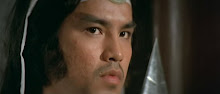
BUDDHA 1961 aka SHAKA
Raizo Ichikawa (Prince Kunara), Shintaro Katsu (Devadatta), Kojiro Hongo (Prince Siddhartha), Charito Solis (Yasodhara), Yamamoto Fujiko (Usha), Suratha (Higashino Eijiro), Elida (Isuzu Yamada), Katsuhiko Kobayashi (Ananda), Kano Junko (Matangi), Hiroshi Kawaguchi (Ajashartu)
Directed by Misumi Kenji
The Short Version: This ambitious, giant-sized historical epic from Daiei about the origins and teachings of Buddhism is the Nipponese answer to Anglo epics like THE TEN COMMANDMENTS (1956) and BEN-HUR (1959). Before encountering giant monsters, Kojiro Hongo sought enlightenment as BUDDHA. Pre-Zatoichi Shintaro Katsu gives able support as the duplicitous Devadatta -- warrior, rapist, and sorcerer. Fans of chambara megastar Raizo Ichikawa may be disappointed he's top-billed, but has a supporting role instead. Covering every nook, cranny, and crevice of morality, filial piety, scorn, lust, and greed, BUDDHA spreads his teachings over a dozen vignettes in its sprawling 155 minutes of opulence. It's all here -- treacherous women, ignoble men, sex, violence, love, hate, redemption and retribution in Misumi Kenji's grand adventure of morality and humanity.

 In India, 5th Century BC, a crown prince is born in the garden of Kativa Palace. Viewed as a good omen, the birth of the prince is prophesied to be the savior of the populace. Twenty years later, Prince Siddhartha wins the hand of Princess Yasodhara in a tournament of combat and archery. Living all that time within Kativa Palace, Siddhartha becomes increasingly disenchanted by the four tiered Caste system (Brahmin, soldier, citizen, slave), and the treatment of commoners left to die of starvation and untreated disease. The religious use of human sacrifice disturbs him so deeply, he decides to leave the palace, and his wife for six years to become a monk, seeking enlightenment under the Bodhi Tree before becoming Buddha, spreading his teachings to others. Meanwhile, Devadatta, the man he defeated for the beautiful Yasodhara, plots to take over the Kativa kingdom, and rule all of India.
Historical epics were a major source of box office revenue once upon a time. The United States and Europe (especially Italy) were professionals at producing them whether unilaterally or co-producing them together with the likes of SODOM AND GOMORRAH (1962) and CLEOPATRA (1963) being two of the resultant examples. In Italy, the early 1960s were the ripest for the Sword and Sandal genre with heavyweight titles such as two Steve Reeves spectacles THE TROJAN HORSE (1961), ROMULUS & REMUS (1961), and THE FURY OF ACHILLES (1962) flexing their budgetary and storytelling muscles.
 With big ticket super productions like THE TEN COMMANDMENTS (1956), BEN-HUR (1959), and SPARTACUS (1960) bringing in big numbers and big audiences, Japan's Daiei Studios mounted a massive 500-700 million yen (approximately $5-$7 million US dollars) Nipponese peplum production of their own; and one that contains all the elements required for the genre, but told with an Asian flavor. Planning for BUDDHA (1961) began in September of 1960, but the shooting
didn't start till April 8th of the following year. The finished product
was up on screens on November 1st, 1961. The massive production came in
as the tenth most profitable movie of that year. It was shown in American theaters in 1963 minus approximately 20 minutes of footage.
With big ticket super productions like THE TEN COMMANDMENTS (1956), BEN-HUR (1959), and SPARTACUS (1960) bringing in big numbers and big audiences, Japan's Daiei Studios mounted a massive 500-700 million yen (approximately $5-$7 million US dollars) Nipponese peplum production of their own; and one that contains all the elements required for the genre, but told with an Asian flavor. Planning for BUDDHA (1961) began in September of 1960, but the shooting
didn't start till April 8th of the following year. The finished product
was up on screens on November 1st, 1961. The massive production came in
as the tenth most profitable movie of that year. It was shown in American theaters in 1963 minus approximately 20 minutes of footage.
Endeavoring to compete on the world stage, Daiei president Nagata Masaichi's big budget epic was hyped as Japan's first 70mm production. With this being the first such presentation, there was no 70mm processing facility in Japan at that time, so the film was flown to a Technicolor lab in London. The superb Akira Ifukube soundtrack was mixed there, too. Sources have stated that this Super Technirama film was actually shot in 35mm, but printed onto 70mm film.

Renowned director Misumi Kenji was tasked with helming this 'Cast of Thousands' spiritual epic revolving around the life of Siddhartha and his Buddhist teachings. The film was reportedly controversial at the time for Yahiro Fuji's script taking liberties with historical details, and much of the scheduled location shoots in other countries being canceled as a result.

Renowned director Misumi Kenji was tasked with helming this 'Cast of Thousands' spiritual epic revolving around the life of Siddhartha and his Buddhist teachings. The film was reportedly controversial at the time for Yahiro Fuji's script taking liberties with historical details, and much of the scheduled location shoots in other countries being canceled as a result.
 Armed with an impressive talent slate both in front of, and behind the camera, BUDDHA (as it was called in the US) is an opulent, yet unusual entry in the annals of Japanese cinema. Mirroring biblical mythology, this tale is packed with drama, and even healthier dollops of tragedy, torture and death. Misumi's movies are often very melancholic, violent, with striking scenes of cruelty; and there's a lot of that here, too. However, he balances his tale of good vs. evil with equal doses of absolution and redemption. Furthermore, the brutality of BUDDHA is mostly off camera. There's a rape, mass groups of people burned alive, eyes burned out with hot pokers, baby killings, and slaves executed by being trampled by elephants for refusing to denounce their Buddhist faith.
Mirroring the Bible in its historical violence, and mythological metaphors for societal woes, Fuji Yahiro's script plays out like a series of vignettes wherein an individual, or diverse group of people are forced to confront their inner selves, their superficialities, or bring hidden desires to bear. They all eventually find their way to the Buddha, with the occasional interference of Devadatta -- the main villain of this piece, and the embodiment of evil.

 The section of the film regarding the caste system gives the script a chance to ponder not just social status on Earth, but in how much catastrophe and violence is construed as "the will of the gods". Prince Siddhartha, who is destined to die and rise as the Buddha, questions why he and his family must live so well while others on the outside suffer from starvation and disease. Upon visiting the surrounding villages, Siddhartha then questions why it's the will of the gods that these poor people must die in such horrible fashion. The answer is that for not worshiping them, nor giving significant offerings, the punishment is death. The same applies to the deplorable human sacrifices Siddhartha witnesses -- "Only great gifts bring blessings". He comes to the conclusion that, regardless of rich or poor, whether you pray to gods or not, everyone will grow old and die. Longing for everyone to experience true freedom, free of the constraints brought about by Earthly pleasures of the flesh and materialism, Siddhartha disavows this "shackled" existence, becomes a monk, and sets off on a spiritual journey, where he himself attains true enlightenment, and becomes a god.
 Fuji's script asks a multitude of questions about self-sacrifice, right and wrong, good and evil. The answer to virtually every calamity, act of attrition, and murder is love and forgiveness. Hate and revenge being a neverending cycle, a comparison can be made between religion and its potential for spurring hatred. Such is the case with the Buddhists who are captured by Devadatta, and forced to convert or die horribly. This mirrors the devout hatred towards Christians by Islamic extremists. For Buddhism, Devadatta seeks its destruction because it asks that man find peace within himself as opposed to worshiping, or fearing a god, or gods. In actuality, this is stripping man of his freedom. Devadatta really wants the populace to worship HIM, and obey his commands while keeping his brutalized flock enslaved and fearful of what disobedience might bring. Buddhism threatens this religious hierarchy by allowing an individual to be his own person. There are a great many interesting concepts explored here, and you don't have to be religious, agnostic, or atheist to enjoy this movie -- spirituality knows no denomination.
 This is partially a fantasy film too, so aside from its humanitarian mission, there's a lot of highly dramatic moments of biblical bravado -- such as when Siddhartha brings rain to a drought-ridden village, heals a wrongfully maimed man, and repels Devadatta's sorcery in the most subtle fashion involving a poor elderly woman and her oil-lit candle.

The art direction (Kisaku Ito) and photography (Hiroshi Imai and an uncredited Kazuo Miyagawa) are impeccable. The camera is frequently mobile; the tracking shots often drawing you into the scene. Virtually every frame is lit up with sumptuous sets and framing that captures the beauty of the natural locations and intricately dressed sound stage settings. Some of the sets reportedly cost in the millions (Yen) to build. The finale was shot on the grounds of Japan's Self-Defense Force, some 215,000 square feet of ground.

 Famed special effects artist, sculptor, modeler (and suit actor) Fuminori Ohashi modeled the various creatures (including three-headed demons, bird men, and killer midgets) that attempt to seduce and frighten Siddhartha while convalescing in a forest. The sexual quotient of this sequence is eyebrow raising for 1961. It's tastefully done, but unusual to see women in diaphanous gowns with a bare bottom, or breast exposed (but covered nipple, mind you). This exceptional sequence is BUDDHA at its most operatic. You feel like you're watching a stage play. The strains of Ifukube's cues in this scene have a theatricality about them that complement the bombast and romantic leanings of the rest of his score.
 The acting is top-notch, despite it being jarring having Japanese actors playing Indian people, but speaking Japanese. Kojiro Hongo is third-billed, but is the main character. Granted, as he gets closer to becoming the Buddha, the mysteriousness and mythical stature of his character is highlighted by his face being obscured, and only his voice heard. We do see him in long shots, in silhouette, or as a shadow. Just a few years later, Hongo graduated from high profile productions to chief monster actor for a few films in Daiei's Daikaiju Gamera movies in the mid 1960s. The first two were quality films, but the series got sillier, and the budgets got smaller.
 Raizo Ichikawa was a huge star at the time, and is top-billed here, although he doesn't show up till an hour in. With the dozen strands of overlapping character arcs, he's virtually a supporting player. His section of the movie is among the most dramatically grim. He starred in many great samurai pictures ranging from the SLEEPY EYES OF DEATH series to the SHINOBI NO MONO series. He died in July of 1969 from rectal cancer at only 37 years of age.
 Before wandering Japan as a wildly popular blind masseur, Shintaro Katsu turned man
against his brother, and brought misery to the world as the devilish
Devadatta. He's fantastic in this, and the previous year played the antithesis of his famous Zatoichi character in THE BLIND MENACE (1960). Katsu worked with Misumi on many occasions including THE GHOST CAT CURSED WALL (1958), THE TALE OF ZATOICHI (1962), and FIGHT, ZATOICHI, FIGHT (1964) to name a few.
Before wandering Japan as a wildly popular blind masseur, Shintaro Katsu turned man
against his brother, and brought misery to the world as the devilish
Devadatta. He's fantastic in this, and the previous year played the antithesis of his famous Zatoichi character in THE BLIND MENACE (1960). Katsu worked with Misumi on many occasions including THE GHOST CAT CURSED WALL (1958), THE TALE OF ZATOICHI (1962), and FIGHT, ZATOICHI, FIGHT (1964) to name a few.
Unfortunately, Daiei's gamble to produce Hollywood level pictures never paid off, at least not in the long run, as they would be traversing troubled financial waters from here on out, and be bankrupt ten years later in 1971. Hongo and Katsu worked together on another epic film, WHALE GOD the following year. Daiei would soon enter into the realm of SPX filmmaking and the Daikaiju genre that Toho had popularized with their Godzilla series and assorted other science fiction films. Daiei's GAMERA (1965) would prove an immense success with a string of seven movies over the next six years.

Daiei's president was apparently enamored with tales of Buddhist monks, stone idols, and the fantasy elements that went along with them. A few years earlier, his company had produced a similar epic starring some of the same cast members with NICHIREN AND THE GREAT MONGOL INVASION (1958). In 1966, in the midst of Daiei's financial woes, they lavished sizable budgets on three productions using the same idea with little variance -- mixing the samurai film with the popular Daikaiju genre to create DAIMAJIN.
World renowned filmmaker Misumi Kenji had been directing since 1954, and with a dozen or so films to his credit; one of which was YOTSUYA KAIDAN (1959). Misumi's version -- one of many cinematic interpretations -- was released two weeks shy of Nobuo Nakagawa's version from Shin Toho. It was also in B/W, and introduced some twists to the familiar tale of revenge from beyond the grave.

As for the prestigious BUDDHA, Misumi, along with his crew, put together quite an epic. With much of his filmography unavailable on these shores, it's difficult to gauge if Misumi helmed many more movies on this grand of a scale. After films like the two SATAN'S SWORD pictures starring Raizo, he quickly became a dependable helmer of chambara pictures; the most talked about of these outside of Japan being the gore-drenched six film LONE WOLF AND CUB series from the 1970s -- re-edited and unleashed most famously in America in 1980 as SHOGUN ASSASSIN. His last film before his death, aptly titled THE LAST SAMURAI (1974), was an epic in itself, if a less optimistic one.

If all you've ever known of Misumi's work are his samurai pictures, and are interested enough to branch out beyond that spectrum, BUDDHA (1961) is worth seeking out. An enlightening experience, there's still that Misumi touch of cruelty and somberness that got more extreme as the decade progressed, and into the next one. With so much going for it -- exemplar photography, set design, and a boisterous, saddening, romantic score by Akira Ifukube, Daiei's big adventure is as close to nirvana as you can get for vintage Japanese historical epics.
You can buy this English subtitled DVD HERE.