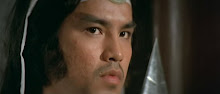
REVENGE OF THE NINJA 1983
Sho Kosugi (Cho Osaki), Arthur Roberts (Braden), Keith Vitali (Dave Hatcher), Ashley Ferrare (Cathy), Kane Kosugi (Kane Osaki), Virgil Frye (Lt. Dime), Mario Gallo (Caifano), Grace Oshita (Grandmother), Professor Toru Tanaka (Sumo servant)
Directed by Sam Firstenberg
The Short Version: The best US made movie about those black-clad stealth assassins is this lean, mean ninja machine starring Sho Kosugi. The plot is in the title, and the dialog is little more than a device to move from one fight to the next which is literally every few minutes. The action is often bloody, and always varied. A popular, profitable film in its day, REVENGE OF THE NINJA -- the second, and best of an unrelated ninja trilogy holds up extremely well as a macho martial arts classic.
After a decades long feud leaves his family murdered by ninja assassins, Cho Osaki, at the urging of an American friend, takes his son and mother to the United States to set up a doll gallery and start a new life. Unbeknownst to him, Cho's friend uses the gallery as a front for heroin shipments in association with a Yakuza syndicate from Japan, and a local mob cartel. Upon discovering this betrayal, Cho realizes no matter where he may go, there's no escaping his ninja past.
 Martial arts films were a dime a dozen back in the day. There were some good ones, and a whole lot of bad ones. This was especially true for ninja movies -- a style of martial arts actioner that has been predominantly poorly served on celluloid. Like Sonny Chiba before him, Sho Kosugi was integral in carving the ninja terminology into the American iconography in the 80s. For a good half dozen Nippon influenced actioners, Sho Kosugi enjoyed a brief tenure as an action star in Hollywood.
 Then newcomer, Polish born Sam Firstenberg was one of the reliable members of Cannon's stable when it came to making escapist action pictures. He helmed some of the company's best remembered pictures from their 80s heyday. REVENGE OF THE NINJA is one such movie. This high-octane, violent martial arts spectacle was one of Firstenberg's most successful movies, and likely the most successful of its star, Sho Kosugi. Aside from PRAY FOR DEATH (1986), this is possibly Sho's most fantastic showcase.
 Cannon's celluloid mishap ENTER THE NINJA (1981) formally introduced the world to Sho Kosugi, albeit as a villain. That pictures biggest claim to fame was being instrumental in stirring up ninja mania all around the world for a brief time, and was a decent enough success to gamble on a follow up feature. REVENGE isn't a direct sequel, but the second entry in an unrelated trilogy. In ENTER, Sho was the main fighting villain with a serious beef against an 'out of his element' Franco Nero pretending to be a warrior of the night (while wearing white ninja gear). Nero did a really lousy job of it, too. For REVENGE and NINJA III: THE DOMINATION (1984), Sho is the lead protagonist.
 REVENGE OF THE NINJA is easily the best of the American made Shinobi movies from the 1980s. Heavily laced with action, it unfolds like a video game. Every five minutes there's a fight sequence, and very few of the bad guys look alike. Many of them have their own unique look (an Indian, a guy dressed like a cowboy, etc). Furthermore, the picture faithfully follows the Hong Kong kung fu template wherein any and every setting means someone will be just around the corner ready to kick your ass.
 For instance, one scene has Cho and Dave (played by real martial artist Keith Vitali) seeking information about his missing son and vandalized doll gallery from a gang hanging out in a park. Just prior to this, Dave says, "There are some ex-cons I know who might have some information about your dolls." Just that sentence alone lets the viewer know the only info that will be passed around are digits of the fist and foot variety; and as expected, the gang, looking like the thug version of the Village People, show more interest in fighting. Nothing is learned to propel the story; the sequence is simply designed to showcase a fight, and virtually every other fight -- all elaborately, and brutally choreographed, mind you -- operates in the same fashion. Even when there's no actual fighting, something involving martial arts is onscreen.
 Aside from Sho Kosugi bearing the most intimidating visage this side of Sonny Chiba, Firstenberg's film contains one of the greatest movie chases of all time. What's special about this five minute chase is that the bad guys (again, another eclectic mix of characters) are in a van and Cho is on foot! He's leaping over walls, and on top of cars, and damned determined to get his dolls back. Cho catches up to them, and manages to spring onto the roof of the van. Accomplishing little from up there, Cho flips through the windshield where the battle continues. Eventually everybody spills out into the street till one bad guy remains and the chase is on again! At this point Cho is being dragged from the rear of the van, holding on for dear life to get those dolls back while the concrete acts as a sharpening stone against his legs. It's an incredible sequence, and if done today, it would have most likely been accentuated with computer technology.
The stunning final fight atop a skyscraper is the KING KONG of ninja battles. It took two weeks to shoot this elaborate duel. All that effort pays off as Sho and Braden battle it out all over the rooftops using every ninja trick in the book. The finale, as well as the entire movie, is spiced up with gory deaths and spraying blood that will recall imagery of Japan's LONE WOLF AND CUB (1972-1974) series, and the Shaw Brothers style of martial arts mayhem.
 The acting is about what you'd expect, but serviceable. Some of it's good, and some of it veers into atrocious territory. Sho Kosugi's intensity carries the entire movie, but those condemned to bad acting purgatory include Arthur Roberts (see insert) and Keith Vitali. Roberts utters all his lines in the same tone. He's not convincing at all as a ninja, and it was a good idea for the main villain to wear a silver demon mask so as to hide Eddie Tse -- who was actually wearing the suit. Vitali is a superb martial artist, but he's even more robotic than Roberts when he speaks his lines. Still, a couple more scenes with him fighting alongside Sho would have been welcome. He's better served as a nemesis of Jackie Chan in WHEELS ON MEALS (1984).

 Sho's more famous of his two sons, Kane Kosugi, is introduced in this movie. Shane is the child that takes a shuriken right to the brain at the beginning. Both boys featured together in some capacity in three other of their father's films -- 9 DEATHS OF THE NINJA (1985), PRAY FOR DEATH (1986), and BLACK EAGLE (1988). Kane got the most exposure, and is currently enjoying a career of his own today. Some of his resume includes MUSCLE HEAT (2002), GODZILLA: FINAL WARS (2004), DOA: DEAD OR ALIVE (2006), and NINJA: SHADOW OF A TEAR (2013).

 The attractive Ashley Ferrare replaced another actress virtually at the last minute. She was new to acting, and was quite beautiful with a very toned figure. Apparently some of her scenes (in addition to some scenes of violence)
were either cut, or reshot. The trailer features a few shots of scenes
not in the released version. Unfortunately, Ashley's career in show
business seems to have been a short one. Her only other credits were an
episode of THE MASTER (1984) and the Fred Olen Ray SciFi actioner,
CYCLONE (1987).
The attractive Ashley Ferrare replaced another actress virtually at the last minute. She was new to acting, and was quite beautiful with a very toned figure. Apparently some of her scenes (in addition to some scenes of violence)
were either cut, or reshot. The trailer features a few shots of scenes
not in the released version. Unfortunately, Ashley's career in show
business seems to have been a short one. Her only other credits were an
episode of THE MASTER (1984) and the Fred Olen Ray SciFi actioner,
CYCLONE (1987).
The actual box office numbers sourced for REVENGE OF THE NINJA vary between $10 million to a little over $13,000,000. Released in 432 theaters, then 504 by the time it finished its run, Kosugi's movie performed comparably, if not surpassing films starring bigger names like Chuck Norris and Charles Bronson. Their films released that year -- LONE WOLF MCQUADE and 10 TO MIDNIGHT -- were released in more theaters.
 With the success of Firstenberg's film, he was asked to do a sequel. NINJA III: THE DOMINATION followed in 1984. It was vastly different from the previous two pictures. 1985 brought one of the decades most popular action movies with Firstenberg's AMERICAN NINJA (1985). AVENGING FORCE (1986), a sort-of sequel to INVASION USA (1985) and AMERICAN NINJA 2: THE CONFRONTATION (1987) rounded out the directors theatrical action output. The 90s saw Firstenberg helm some films that were released straight to video such as AMERICAN SAMURAI (1992) -- a film that was heavily edited on tape, but was shown in all its gory glory on cable. CYBORG COP 1 and 2 from 1993 and 1994 respectively continued the directors penchant for action.
If you've never seen a Sho Kosugi movie, this is a great start. If you're already familiar with the man, a rewatch doesn't sound like such a bad idea, either. This second entry is such a tightly woven, gory action thrill ride, it's debatable what impact REVENGE would have had on the genre in America had it come first instead of the inferior ENTER. With a finely toned script from James R. Silke and a memorably catchy, stinging score from Rob Walsh, REVENGE OF THE NINJA (1983) is about as good of a Drive-in style martial arts actioner as you're going to get for one made in America.
This review is representative of the MGM DVD.
 THE DELTA FORCE 1986
Chuck Norris (Major Scott McCoy), Lee Marvin (Colonel Nick Alexander), Hanna Schygulla (Ingrid Harding), Martin Balsam (Benjamin Kaplan), Shelley Winters (Edie Kaplan), Robert Forster (Abdul Rafai), Susan Strasberg (Debra Levine), George Kennedy (Father O'Malley), Bo Svenson (Captain Campbell), Robert Vaughn (General Woodbridge), Steve James (Bobby), William Wallace (Pete Peterson), David Menachem (Mustafa), Avi Loziah (Jaffer Khalil), Uri Gavriel (Jamil)
Directed by Menahem Golan
The Short Version: In 1986 Silver Screens everywhere were projecting large quantities of manliness in this, one of the pinnacles of 80s masculine movies; a hellfire missile action hero sandwich from Cannon. Chuck Norris and Lee Marvin's names alone are worth the ticket price. Terrorists hijack a jetliner packed with enough well known actors to make Irwin Allen have a fit; and America's Delta Force is tasked with taking them out, and rescuing the hostages while one of the catchiest synth scores ever conceived blares in the background.
 Palestinian terrorists led by Abdul Rafai hijack a jetliner in Athens and threaten to kill everyone aboard should their demands not be met. The President sends in Delta Force to stop them and rescue the passengers. Unknown to them, the terrorists have moved the Israeli men aboard to a location in Beirut. Delta Force track them down and attempt to free the hostages before their execution.

 The Cannon Group's ratio of good to bad movies varied wildly during their bid for box office supremacy in the 1980s. THE DELTA FORCE is one of their best pictures from this period, and likely the best of Chuck Norris's tenure with the company. It was among the best casts ever assembled for a Cannon production, too; so many big names and recognizable character actors. Additionally, for a production with a basic action premise (based on real life events), it's surprisingly accomplished filmmaking from the co-head of Cannon, a company not often associated with quality motion pictures.

 A portion of THE DELTA FORCE is very similar to Irvin Kershner's Made For TV movie RAID ON ENTEBBE (1977) about the real life rescue of hostages held at Uganda's Entebbe Airport by Israeli commandos. There were two other movies -- Marvin Chomsky's Made For TV movie, VICTORY AT ENTEBBE (1976) that aired barely a month before the above mentioned Kershner film; and Menahem Golan's own OPERATION THUNDERBOLT (1977) based on the same daring rescue. This movie, though, feels like two films in one -- one half is a suspense thriller with a basis in fact, and the second half is a good ole fashioned action picture.
Originally Charles Bronson (already among Cannon's stable at this time) was tapped to co-star with Chuck Norris; but for whatever reason, Bronson never shared the screen with the American Karate king. Incidentally, Bronson starred in Irvin Kershner's film playing Brigadier General Dan Shomron. A shame audiences were denied this titanic team-up of two action cinema icons.
 Tough Guy paragon Lee Marvin, as tired as he looks, is up to the challenge as Bronson's replacement. This was the actors last motion picture, and he's a good pair for Norris. There's a running gag between the two of them -- McCoy (Norris) repeatedly tells Alexander (Marvin) to not wait for him; and he always ends up waiting for him. Marvin is the leader of Delta Force, an elite group of soldiers. You could say he's the covert teams patriarch. There's a familial bond between them all. This extends to the lesser members who get little more than a few lines of dialog.

 Lee Marvin was a former Marine, having served in WW2, and received a few awards for his service. His rugged looks was perfect for westerns and action films playing both the hero and the villain. Out of a career judiciously stacked with impressive titles, one of his best remembered is as Major Reisman in Robert Aldrich's classic war picture THE DIRTY DOZEN (1967). Even at age 63, and very sick, Marvin makes his last big screen role a memorable one. Prior to starring in the Cannon movie, Lee reprised his Major Reisman role for the Made For TV sequel, THE DIRTY DOZEN: NEXT MISSION (1985).
Going back to the films roots based on actual incidents, the plot of THE DELTA FORCE bears many similarities to the hijacking of TWA Flight 847 that occurred Friday, June 14th, 1985. It also briefly clones Operation Eagle Claw during the opening sequence depicting a failed rescue attempt. That disastrous operation took place on April 24th, 1980 in Tehran.
Menahem's movie is a fictitious piece using true events as its narrative structure; outside of those factors it's pure, unadulterated machismo. For approximately the first seventy minutes, the script (by Golan and James Bruner) wrangles a good deal of suspense that adds immeasurably to the action sequences that dominate the last 45-50 minutes.
 The sequence where the terrorists move all the Israelis to "first class", and then later, off the plane in Beirut, are two of the stronger moments before the action takes over. The various actors and actresses get the opportunity to (briefly) flex their muscle; such as Shelley Winters and tough guy in his own right, George "I'm Jewish like Jesus Christ!" Kennedy. As they're moved off the plane, the walk down the aisle seems to go on forever -- much like a condemned man going to his execution.
 After sporadic moments of heroism, close-calls, cliffhangers, and mishaps, the film switches gears, firing off volleys of testosterone once the rescue mission is finally enacted. At that point, THE DELTA FORCE ceases being a tense thriller and transforms into a highlight reel of machine gun fire, car stunts, and explosions. If you didn't get enough of Alan Silvestri's catchy main theme music before, prepare to have it burned into your memory banks once the action kicks into high gear.

 This was one of a few Cannon productions that critics seemed to like; yet at the time, and even today, there were some critics that claimed this film, like others of a similar ilk, depicts the Arab terrorists as savages. Seriously, there's no other way to describe such a group that lives to exterminate an entire race of people for their religious beliefs; not to mention favoring rather messy means of execution. I'd be curious to know what such critics thought about the Nazis; or even the Japanese military mindset during WW2 which facilitated an even more sadistic hatred towards the Chinese.

Furthermore, other critics labeled THE DELTA FORCE, and movies like it, as American propaganda. The first half is based -- rather closely -- on a factual expropriation. The latter half is an action movie that depicts its title commandos falling victim to bad intel, and an enemy that is consistently one step ahead of them till a little past the halfway mark. In real life, military operations fail and succeed -- just like they do in this movie. And that's all THE DELTA FORCE is... it's just a movie.

 While these militant killers are indeed the bad guys, the script doesn't draw them as purely evil. They prove their maleficent mettle with lines like, "Shut up, you American imperialist pig!", and "We kill everyone on this bloody plane!!!" Another bit that lets us know these guys aren't the most civilized of people is when a sympathetic German stewardess (based on the real life flight attendant Uli Derickson, of TWA Flight 847) refuses to name the Jewish passengers. She points to her German lineage, and won't be a part of a scenario that reeks of the Nazi Death Camps all over again. Mustafa, the excitable terrorist, naturally hates Israelis; and in response to Hitler's dead Jew tally of his Final Solution retorts, "Not enough, lady, not enooouugh!!!!"

Even so, there are a few moments where they show slivers of sympathy; like when Mustafa swaps out his angry, shaking, sweaty exterior for a warm and fuzzy one in the company of a little girl and again for a pregnant woman. Golan and Bruner's script cuts them just a wee bit of slack when they didn't have to. The real life terrorists of the factual event were far more brutal than their cinematic counterparts.

 Chuck Norris is his usual 'walk softly and carry a big kick' self. He gets a few more lines than he did playing the god-like Matt Hunter in the previous years INVASION USA (1985); one of Cannon's most violent movies. Chuck gets to smile a bit, too; expanding on his range of facial expressions when normally, his fists and feet do all the talking. In THE DELTA FORCE, Norris not only mows down terrorists again, but he also gets to do it on this nifty motorcycle armed with mounted machine guns, and front and rear rocket launchers. To top it off, he wipes the floor with Abdul's (Forster) ass in the finale with one of those classic Chuck fights where the bad guy is tossed around like a rag doll.

Robert Forster doesn't look like he's got any Arab in him, but he does a fantastic job playing one -- accent and all. Forster was an underrated actor that, while he appeared in dozens of movies, never got the credit he deserved; nor does he stand a chance against Norris's kicks and punches, but then who does? Forster ran into Chuck a couple more times on WALKER, TEXAS RANGER in the late 1990s.
THE DELTA FORCE (1986) made approximately $18 million in the USA when it was released theatrically in February of 1986. Later that year, Cannon released another Norris film, FIREWALKER (1986) pairing Norris with Louis Gossett, Jr. Currently, a European documentary titled CHUCK NORRIS VS. COMMUNISM is being produced regarding how Chuck Norris movies (among many others), along with a lone female voice dubber, aided in crumbling the Communistic wall surrounding Romanians during that time period.

 Quite possibly the best directed of Menahem Golan's US productions, THE DELTA FORCE (1986) is a true spectacle of American action movie manliness the likes of which you don't see anymore. The films Red, White and Blue stripes wave prominently during the climax -- the mission accomplished, and the rescued passengers all downing Budweiser while happily belting out a rendition of 'America the Beautiful'. Your enjoyment of TDF depends on how you feel about upbeat action movies; particularly those from the 1980s when pride in country was a common sentiment for many; and there's that main theme playing again....
This review is representative of the MGM Blu-ray.
copyright 2013. All text is the property of coolasscinema.com and should not be reproduced in whole, or in part, without permission from the author. All images, unless otherwise noted, are the property of their respective copyright owners.