"The ninja--his mind, his art, everything--is very pure; that is, unclouded by emotion. Certainly, some were seen as evil because they would accomplish their tasks no matter what--without any feeling. It was always emptiness, similar to the concept of zen." -- Sho Kosugi, Star Warriors, October, 1986.
The 1980s was the most boisterous, over the top period for action film Tough Guys. There had been numerous war hero types, vigilantes, and wise-cracking cowboy lawmen throughout the decade, but there hadn't been an Asian action star since Bruce Lee; at least not one with any staying power. However, one Asian actor managed to break into Hollywood in surprisingly fast fashion, and with little acting experience to his name. Even Bruce Lee took approximately seven years to hit it big in the United States (only to die shortly thereafter). Synonymous with the word 'ninja' in the 1980s, that man is martial arts superstar, Sho Kosugi.
COMING TO AMERICA
 Sho Kosugi started his martial arts training at the age of five. Coming from a poor family and calling himself a very weak child because of a hole in his lung, Sho's parents pushed him to take up Karate to strengthen his mind and body. Beginning with the Karate style Shindo Jinen Ryu, he then moved on to Ninjutsu at age seven under the private guidance of a neighbor Kosugi referred to only as Uncle Yamamoto. The aspiring martial artist amassed black belts in both Kendo and Judo, and accentuated his training regimen with Kobudo and Aikido. Naturally, the performing arts were on Sho's mind, having taken acting classes at a very young age; only to be kicked out for a lack of patience. Training in the fighting arts was the discipline that led the All Japan Karate Champion on his path to stardom in America.
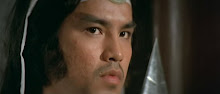
 After failing to get into a Japanese university, Sho fell into depression and attempted suicide. Pushed at a young age to attain martial enlightenment, Kosugi was now pushed by his sister to persevere at achieving his goals. In 1968 he would leave Tokyo for the USA. Calling Los Angeles his new home, Kosugi enrolled in college with the intention of obtaining a business degree. He later opened two Karate schools, accumulated some 663 trophies from tournament competitions, married, had two sons and a daughter, and found time for roles in a few Taiwan and Korean films; one of which was as a Japanese swordsman (see insert photo) who battles the hero in BRUCE LEE FIGHTS BACK FROM THE GRAVE (1976), aka STRANGER IN AMERICA.
ENTER THE NINJA
"Ninjitsu itself is a very secret process. There are no big fancy movements. They are very small and the art is viewed as espionage; you've got to kill your opponent no matter what. Just kill and complete the task, that's all that's important. Now ninjitsu is coming out with books, TV coverage, and everything. It used to be, however, that ninjitsu was low class and nobody wanted to know anything about it."--Sho Kosugi interview, Fighting Stars Magazine, October 1981.
 Those sneaky, invisible assassins of numerous Japanese samurai films had a spotty track record in American made action pictures prior to the 1980s. Cannon's mediocre, yet highly successful Philippine lensed ENTER THE NINJA (1981) formally introduced not only the mysterious style of ninjitsu, but Sho Kosugi to the masses. Karate champion Mike Stone had written a treatment for the film and taken it to the producers at Cannon Films. He would also come aboard as the main ninja. He didn't stay on long, nor did original director Emmett Alston. The footage shot was deemed disastrous, so Menahem Golan took over for Alston (who would later return to ruin a Sho Kosugi production), but Stone remained as choreographer and stunt coordinator. Sho Kosugi was among those chosen as fighting extras. Once Franco Nero was brought aboard to replace Mike Stone, Sho's initially small role grew into a much bigger one after producers liked what they'd seen of him; ultimately giving him the role of Hasegawa, Franco Nero's nemesis. Sho likewise did double duty playing some of the other ninjas in the film, and reportedly doubled for Franco Nero for some scenes.
"Only a ninja can stop a ninja!"
 With this films success around the world, Sho was tapped to headline the $90,000 gore spectacle, REVENGE OF THE NINJA (1983); the benchmark of ninja cinema in the USA, and a superior film to its predecessor in every way. It is particularly special in that this was the first movie to feature Kosugi as a leading man in an American production. This was a gamble on Cannon's part, having liked the actor enough to expand his role on ENTER, to now finance an entire picture built around him. Possibly if it had been another studio, Kosugi wouldn't have gotten a lead, and likely not so quickly. As much negativity that's directed at Cannon, Menahem, like Roger Corman, wasn't hesitant about taking chances on fresh faces. He gambled on Kosugi, and it paid off. Anticipation was high for ENTER, and the sequel, REVENGE, was planned right after, but didn't appear till 1983. As it was described in magazine articles in 1981, the original script was different. In it, Kosugi is a restaurant owner whose wife, father, and child are killed by ninjas hired by mobsters. He shows up to find his other son the sole survivor. The two set out to avenge their deaths. Some of this survived in the opening sequence of REVENGE, but the plot takes a different trajectory. Sho's popularity really exploded with this movie, and Sam Firstenberg garnered a healthy directorial career in action cinema for the next ten years.
NINJA III: THE DOMINATION (1984) didn't fare as well theatrically, but this story of ninja demonic possession remains a cult favorite. It has none of the splattery gore of the previous outing, but it does have a stunningly over the top opening sequence and a bizarre exorcism scene. Kosugi wasn't pleased with the picture, but he does look menacing wearing an eyepatch.
 With the rising (ninja) star on the horizon, Kosugi next got the role of Okasa on NBC's THE MASTER television series starring Lee Van Cleef and Timothy Van Patten. On this series, Sho was the antagonist who chased after John Peter McAllister, an aging WW2 vet turned ninja master who has left Japan for America in search of a daughter he didn't know he had. Feeling he has broken the code, Okasa makes it his mission to assassinate his former master. The series attracted an astonishing number of name stars, but remained in the shadows after a very brief run of 13 episodes. Kosugi not only choreographed the action, but doubled for Van Cleef by wearing a skullcap in those scenes. Having been dubbed in his previous movies, THE MASTER was the first time Sho's real voice was used. Remarkably, Sho's voice was similar to the one used for his Cannon films, the only difference being an obviously thicker accent. Finding working in television more difficult than making movies, Kosugi had little time to breathe while shooting cult favorite NINJA III: THE DOMINATION (1984) at the same time. THE MASTER series was shot in Los Angeles while the second NINJA sequel was being made in Arizona. According to Kosugi, he flew back and forth between states a total of 13 times.
1984 was truly the year of the ninja. Kosugi had about as many offers as he had weapons hidden in his ninja suit. Unfortunately, the one he signed on to star in immediately after the last episode of THE MASTER was the beginning of the end for the popular film star. A dispute over both the NINJA III script and his contract compelled
Kosugi to say 'sayonara' to Cannon and seek his fortune elsewhere.
 Till then, Sho was literally EVERYWHERE. He was on the cover of every martial arts magazine in the country--many of which were solely about the art of ninjutsu. Sho's likeness--particularly his famous leaping sidekick--was plastered all over any number of toys, comic books, video games, and anything else that could be marketed to the young boy demographic. Cannon Films even recycled the classic pose to market future productions even after the actor had already left the company. Sho even got his own ninja fan club.
 That same year in '84 Sho was back in the Philippines again, but this time shooting what is likely the worst movie of his career -- 9 DEATHS OF THE NINJA (1985). While a certain contingent of filmdom would say anyone working for Cannon was a misstep, Sho's decision to accept this offer from executive producer Robert Friedman and exploitation producer Ashok Amritraj was anything but progress. Whereas Emmett Alston wasn't allowed to wreck the already bad ENTER THE
NINJA, he did get his chance to thoroughly sabotage a Sho Kosugi movie
with this one. Originally titled AMERICAN NINJA (it was changed to avoid being confused with Cannon's film of the same name, but retained that title in foreign territories), 9 DEATHS could have been titled 9 WAYS TO KILL YOUR CAREER. Marketed as a ninja James Bond, Kosugi carried a variety of gadget-like weapons strapped to his person; and among his weapons of death was an attachment of.... lollipops?! Kosugi seemingly enjoyed working on the project (till he saw the finished product), even designing some of the weapons he uses. The result is anything but good.
That same year in '84 Sho was back in the Philippines again, but this time shooting what is likely the worst movie of his career -- 9 DEATHS OF THE NINJA (1985). While a certain contingent of filmdom would say anyone working for Cannon was a misstep, Sho's decision to accept this offer from executive producer Robert Friedman and exploitation producer Ashok Amritraj was anything but progress. Whereas Emmett Alston wasn't allowed to wreck the already bad ENTER THE
NINJA, he did get his chance to thoroughly sabotage a Sho Kosugi movie
with this one. Originally titled AMERICAN NINJA (it was changed to avoid being confused with Cannon's film of the same name, but retained that title in foreign territories), 9 DEATHS could have been titled 9 WAYS TO KILL YOUR CAREER. Marketed as a ninja James Bond, Kosugi carried a variety of gadget-like weapons strapped to his person; and among his weapons of death was an attachment of.... lollipops?! Kosugi seemingly enjoyed working on the project (till he saw the finished product), even designing some of the weapons he uses. The result is anything but good. Following this misfire that combined sloppily photographed Rambo theatrics with ninjas and rampaging midgets, Sho had another picture lined up to have been shot in Texas. Titled DARK WARRIOR, this futuristic actioner for producer Richard L. Albert (advertising agency president who worked with a lot of major and independent companies) was hyped as crossbreeding ninjutsu theatrics with Mad Max. Lance Kerwin was co-starring and Robert Clouse (ENTER THE DRAGON, FORCE: FIVE) was directing. Futuristic ninjas sound interesting, but it's probably for the best that this ambitious film never took shape. Sho's next motion picture did--a NY based thriller that was self-referential and arguably the most violent action movie he'd made up to that point, garnering an X rating in the process prompting some cuts.
"Stay away from the Saito family... they don't know anything about the Van Atta Necklace... if you don't, I promise you... you will pray for DEATH!"
 PRAY FOR DEATH (1986) was his first production for Trans World Entertainment, a then new video company started by Moshe Diamant and Eduard Sarlui that specialized in videocassette rentals and sales; and also, like other similar companies like Vestron Video, branched out into film production. PRAY FOR DEATH was the actors most highly publicized movie to date, garnering coverage in virtually every martial arts magazine from Black Belt, to Inside Kung Fu, to Ninja (which debuted in 1983), and others. Reportedly the first of Sho's catalog to be shown in Japan, it was basically a ninja version of DEATH WISH (1974) in which Sho, at the behest of his wife (Donna Kei Benz of THE CHALLENGE [1982]), moves his family to America only to immediately get into trouble with mobsters.
 PRAY FOR DEATH was successful, so a sequel was proposed (AKIRA: PRAY FOR DEATH 2), yet like DARK WARRIOR, this too never came to fruition. Still, ninja mania remained hot and Trans World took advantage of it.
"Hi, I am Sho Kosugi... welcome to The Ninja Theater!"
 Kung Fu Theater was a popular small screen attraction for fans desiring a HK kung fu fix; and with the booming videocassette industry an indomitable revenue stream, Trans World did their own version, crowning it 'Ninja Theater: Hosted By Sho Kosugi'. Over a dozen titles of Hong Kong and Taiwan made martial arts films were acquired ranging from SHAOLIN DRUNK FIGHTER (1983), WOLFEN NINJA (WOLF DEVIL WOMAN[1981]), VENUS THE NINJA (MATCHING ESCORT[1982]), PHOENIX THE NINJA (MIRACULOUS FLOWER[1984]), FISTS OF DRAGONS (1977), NINJA TERMINATOR (1985), YOUNG HERO (1980), NINJA CHAMPION (1986), and on and on. Ninja Theater not only had Sho hosting an intro before the movie, but he'd showcase a particular ninja weapon and demonstrate its use against a handful of attackers in shot-on-video segments. Going a step further with the 'horror host' tradition, this was a unique approach to the marketing of kung fu films on videotape.
Like Elvira at Thriller Video, Sybil Danning did a similar thing for USA Home Video's Adventure Video line; only she didn't partake in choreographed action, but did hosting duties at the beginning and also at the end of each picture where her bountiful assets were the major selling points.
TWILIGHT OF THE NINJA
 With the 80s past the halfway mark, Sho's star would begin to wind down to a degree. He was still a viable merchandising commodity, though. Honda used him to help sell their Honda Hurricane motorcycle in 1986; and USA Home Video and Trans World Entertainment released MASTER CLASS, a Sho and Kane Kosugi martial arts instructional video in April of '86. This 60 minute martial arts crash course did double duty as a promotional tool for PRAY FOR DEATH, which had opened in LA in February of that year. It was the last truly good movie he would headline. From here on out, his remaining filmography as a leading man would be very different in style from his previous works. Kosugi was also attached to a few productions that, like DARK WARRIOR, never got off the ground, or were altered in some way.
 RAGE OF HONOR (1987) was the man's next Trans World picture. Announced as WAY OF THE NINJA in 1985, the film was advertised as pairing Kosugi with Telly Savalas(!) and directed by Oscar winning makeup artist Robert Short. By the time it went into production late in '86, neither Short nor Savalas were attached. One of the actors least discussed works, it's an underrated little movie with a lot of over the top craziness and stunning location shooting to recommend it. It's the first movie where Kosugi uses guns in addition to his ninja arsenal; and an early example of a soon to be classic Action Hero staple--the slow-motion shot of the hero running away from a stream of explosions going off behind him.
Another unmade Sho flick was something called THE DEVIL'S ODDS: AMERICAN TRINITY. It would have paired Kosugi with Paul L. Smith in a Terence Hill-Bud Spencer style team-up with writer John Crowther listed as director. Taking the problems Smith had with Edward L. Montoro over the use of his name on CONVOY BUDDIES (1975/1978), it seems logical this one didn't get passed the planning stages; not to mention the poster art had the look and feel of repeating the NINE DEATHS fiasco.
 Sho's last lead of the decade came with the unremarkable BLACK EAGLE in 1988. From producer Sunil R. Shah (who produced Sho's Trans World actioners) and released on video through the then newly formed Imperial Entertainment, the best thing to be said about BLACK EAGLE is that it co-starred Jean Claude Van Damme as the main villain. It also offered a few fights between him and Kosugi in his last heroic, and first official non-ninja role in an American feature. A flood of no-budget ninja flicks (many of which were released by Imperial) contributed to the banishment of the cinematic ninja to video store shelves. Ninja was old hat and kickboxing had supplanted it as the "in thing"; ironically it was Jean Claude Van Damme who was responsible for this transition. Director Eric Karson (of THE OCTAGON) delivers a moderately entertaining, if mostly disappointing action-intrigue-spy picture, but a far cry from any of Sho's earlier and better works.
"You have to take advantage of something like this while you can. This may not last more than a couple more years. And I've made more money in the past year than in the ten years before!"--Sho Kosugi, The Best of Martial Arts Movies, January 1985.
 Sho had a very small role in Phillip Noyce's BLIND FURY (1989), a modern day, North American remake of ZATOICHI CHALLENGED (1967). Listed in the opening credits as 'Special Appearance By Sho Kosugi', the once stoic leading ninja was now playing a sword-slinging villain hired to combat Rutger Hauer's blind swordsman during the finale of that picture.
Prior to BLIND FURY, another Sho picture was announced titled SHOGUN MAYEDA (see insert). He was once more to be directed by Gordon Hessler. A few years went by and the film did get made as JOURNEY OF HONOR (1991); yet this period set US-UK-Japan co-pro went unreleased theatrically in America.
 In 1986, Sho was asked in an interview if he'd ever return to Japan. His response was that it was doubtful as he had so much opportunity in America. His intent was, by the close of the decade, to produce his own movies. Things didn't quite work out that way (he did co-produce JOURNEY INTO HONOR), and Sho did indeed return to Japan where he directed for the first time, opened up some Karate schools, and released a peculiar exercise video built around using nothing more than a towel. He returned to his ninja roots in 1998 by doing motion capture on the hit Playstation game TENCHU: STEALTH ASSASSINS. After a couple false starts with rejuvenating ninja mania in the mid to late 2000s, 80s ninja fans rejoiced in 2009 when Sho Kosugi landed a prominent role in NINJA ASSASSIN playing the lead heavy.
OTHER ASIAN STARS IN AMERICA
To further put Sho Kosugi's career into perspective, there have been other Asian actors that have come to America, but their road was a bit more difficult to travel.
 HK superstar Jackie Chan tried two different times to break into the American market--once in 1980 with the bland THE BIG BRAWL, and again in 1985 with the DIRTY HARRYish THE PROTECTOR. Neither film made a dent, nor made Chan a breakout star. The consensus was that if Chan had been allowed to do his own thing, he would have broken big. Kosugi was allowed to present the ninja to American audiences through Cannon, and he became a star right out of the gate; Chan had been a big star in Asia since 1978 and took nearly 20 years to find favor in the USA. To theorize, nobody else was doing ninja movies in America so it stood out. However, even when Chan did get his desired US intro in 1996, it couldn't have been a worse picture in RUMBLE IN THE BRONX (1995). With all the ballyhoo, it grossed over $32 million. One of his earlier movies (1992s POLICE STORY 3) and a newer one (1996s FIRST STRIKE) were released in edited form with new music and increasingly lesser box office.
 In the same year, Jet Li was introduced to American audiences with BLACK MASK (1996), another film tampered with by the releasing studio. With an even more tepid debut to Chan's (over $12 million), Li was then cast as the main villain in LETHAL WEAPON 4 (1998). With that films success, Li's acceptance was obvious since he went on to headline a few action films; unlike Chan who was cast in a string of buddy movies as opposed to solo ventures. Chan has been the more successful of the two, but it's interesting to compare Chan and Li's US debuts with that of Kosugi from the 1980s. A combination of right place, right time, and a company who (somewhat) understood the product. Additionally, the martial arts was huge at that time what with Bruce Lee, Shaw Brothers productions, and now Sho Kosugi bringing ninja to America.
 Not an Asian, but the son of the legendary Bruce Lee, Brandon Lee could have been the next big action star to fill the martial arts void left open by Kosugi. With his pedigree, he was well on his way to becoming one before an accident on the set of THE CROW (1994) ended his career and his life. He only starred in a few films and roles on television, but RAPID FIRE (1992) remains a curious window with which to see what he might of brought to the action-martial arts genre had he lived.
 In recent years, Thailand's major action star Tony Jaa has tried to break into the American market, and had a promising debut with the stunt-heavy ONG BAK (2003). Nonsensical scripts, troubled productions, and outright ridiculous movies have kept him from attaining mainstream recognition outside of the international spectrum; but that may change since Jaa, ten years after the stateside release of ONG BAK, has made his US debut in the ensemble actioner, FURIOUS 7 (2013).
THE RISING SUN SETS
 Throughout his career, Sho Kosugi always spread a positive message in martial arts, discipline, and even in child rearing. He was very family oriented, and founded SKI (Sho Kosugi Institute) in 1998. This was a similar venture to Sonny Chiba's JAC (Japan Action Club); the focus wasn't just on creating potential film stars, but instilling respect and discipline into young minds. Schools were opened in the United States, Nagoya and Toyko. His son Shane was the primary instructor at the Nagoya facility. The schools closed down in September of 2012, the reason given being due to a lack of available instructors. Sho Kosugi Productions, Inc. is still around, though; and so is its charismatic founder.
His star might not of shone as bright as Norris, Schwarzenegger, or Stallone, but Sho Kosugi did what hadn't been done since the early 70s. Whereas Bruce Lee was largely responsible for the longevity of the kung fu craze, Sho Kosugi was solely responsible for bringing ninja out of the shadows, and into the mainstream.