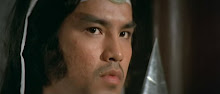
Hasegawa Kazuo (Tamiya Iemon), Nakata Yasuko (Oiwa), Kondo Mieko (Osode), Uraji Yoko, Takamatsu Hideo, Hayashi Naritoshi, Tsurumi Joji
Directed by Misumi Kenji
The Short Version: The same year that Nobuo Nakagawa helmed the most well known film version of Japan's famous ghost tale for Shin Toho, the revered Misumi (SHOGUN ASSASSIN) Kenji directed his own version for Daiei that debuted ahead of the competition. Romantic, tragic, and ultimately haunting in its imagery, Misumi's version is notable for its drastically different interpretation of the usually reprehensible Tamiya Iemon. It takes close to an hour for the horror to arrive, but till then, it's an operatic, twisting, character-driven storyline rife with lust, betrayals, and conspiracies culminating in the required revenge from beyond the grave.

 Tamiya Iemon makes a meager living as an umbrella maker with his devoted wife, Oiwa. Content with
his lot in life, Oiwa's uncle is dissatisfied the ronin shows no
interest in bettering himself. He pushes Iemon to seek a higher post to
live like a proper samurai and escape poverty. Iemon resists, stating
the government is corrupt, and to attain such a post one will have to
take bribes. Following the elder's advice, Iemon follows up on a lead with
the hopes of getting a job as a construction manager. He doesn't get
it, but on his way back home, he saves a young lady and her servant by
fending off some ruffians. The young lady, Oume, the daughter of the
businessman who declined his services, becomes smitten with Iemon and
desires to become his wife. Unknown to him, an elaborate
plan is hatched by various conspirators to get rid of his doting wife
and house servant Kohei. Once Oiwa is dead, her ghost returns to
avenge herself on those who plotted against her.
 Misumi Kenji remains well known internationally for SHOGUN ASSASSIN (1980), a re-edited version of two of Toho's brutal six film LONE WOLF AND CUB series from the early 1970s. Over the years some of his other films have gained a modicum of overseas recognition, but nothing to the level of the sanguinary spectacle offered in the mystical, over the top samurai series. Misumi directed the first in the ZATOICHI series and some of the best of the subsequent installments; the SLEEPY EYES OF DEATH series; and even big budget epics of fantasy with the likes of BUDDHA (1962) and RETURN OF DAIMAJIN (1966). Just before his death in 1975, he directed a suitable swan song in THE LAST SAMURAI (1974). Going back early in his career, Misumi counted Japan's most famous ghost story among his resume.
Yotsuya Kaidan was an extremely popular kabuki play written in 1825 by Tsuruya Nanboku IV. Brought to life on film and television over two dozen times, the various versions tinker with details of the original play. Nakagawa's adaptation is among the most faithful while Misumi's film is possibly the most radically altered of the bunch.

 Yahiro Fuji's screenplay eliminates certain character arcs written in the original play and substitutes with some others. Even more noticeable is the transformation of Iemon from a vile murderer into a sympathetic, even heroic character. His vision of the tale's central antagonist is a striking dichotomy to Iemon's depiction in Nobuo Nakagawa's picture from the same year. Nakagawa, Japan's preeminent master of Japanese horror, is the name that comes to mind when this popular ghost story is brought up, but Misumi's interpretation isn't without merits of its own. Since both films emerged the same year, a comparison of the two is too good to pass up.
 |
| Oume lets Iemon know she wishes to take him away from his wife. |
 As already stated, the handling of the Iemon character greatly deviates from the source. He remains a ronin in both films, but for Misumi's purposes, Iemon possesses a degree of integrity, and a lot of stubbornness. Unlike Nakagawa's film, Misumi's Iemon is already married to
Oiwa at the beginning. A great deal of time is spent on their relationship, building it till Hasegawa's Iemon is seduced by Oume, a wealthy businessman's daughter; even then there's reluctance on his part. In the other picture, Shigeru Amachi's Iemon is a sadistic murderer right from the start--falling in line with the character's depiction in the play.

The element of horror is the foundation of the source material. Its usage is like night and day between the two pictures. Misumi takes nearly an hour before delivering the famous sequence wherein Oiwa discovers she has been poisoned. In this reviewers opinion, this iconic sequence is handled better by Misumi Kenji. The remaining 20 minutes centers on the revenge. Without giving anything away, this too, plays out differently.
 Moreover, a handful of additional characters are added with their own sub-plots that intertwine with the main story. Far more convoluted than Nakagawa's picture, these extra characterizations are utilized to keep this version of Iemon a victim of circumstance considering he's both used and framed by those he thinks are his friends. The motivations of some in the original source are changed as well. Love, lust, retribution, and redemption are the focal points of Misumi's film.
Nakagawa, on the other hand, relies little on exposition, launching into the horror at the 40 minute mark. The main focus till then is in making Iemon as despicable as possible. The pacing is quicker in Nakagawa's movie, and suits his stark treatment of the material.

 The use of a comb is an important plot device that has different origins in both films, but has the same resonance during the crucial moment where Oiwa, whose face becomes deformed as a result of poisoning, desperately tries to make herself beautiful again, but only succeeds in exacerbating her predicament. Since Iemon isn't totally the human monster of the play, the comb is his gift to her in Misumi's film. In the Nakagawa version the comb has been handed down by her mother.
Whereas Nakagawa focuses on making the audience hate Amachi's Iemon, the themes of sex and success are given great emphasis in Misumi's film. These are immersive qualities that stand out from Nakagawa's movie, which has a smaller cast of characters, and nearly everyone is guilty of some crime.

 First, the success: Unlike the play, this Tamiya Iemon initially desires nothing--although the people around him do. He's perfectly fine making minimal wages and spending his free time fishing. The irony is that Iemon fears seeking a high-ranking post because of corruption; yet he, himself, is eventually corrupted--not by money, but by flesh. Oiwa, his wife, wishes he'd aspire for something else, but she, like him, is satisfied where she is--in this case, being the dutiful wife. Her sister, Osode, is the exact opposite, as is her fiance Yomoshichi. Both work hard so that they can have a comfortable future together. Yomoshichi works long hours in the hopes of owning his own shop. And Osode... well, that boils over into the sex....
 |
| Naosuke confesses his crime to Osode, the object of his obsession. |
 |
| Kohei (middle) is framed by two of Iemon's "friends". |
Additionally, the scores of the two films differ. Suzuki Seiichi's music for YOTSUYA KAIDEN is a rhythmic, lovelorn score that relies on melody in a way that Watanabe Michiaki's cues (in Nakagawa's TOKAIDO YOTSUYA KAIDEN) do not. Watanabe's traditional Japanese style is accentuated by sounds clearly meant to evoke unease and unsettle the viewer.

 Misumi's version haunted movie theaters on July 1st, 1959, while
Nakagawa's spooked screens two weeks later on the 14th. The latter is easily the more sadistic of the two, although
that's not to say Misumi doesn't manage some grim imagery of his own. By using horror to accentuate the dramatic aspects of the script, Misumi avoids basking in an overabundance of sadism. This might be an unattractive proposition to those expecting a more nihilistic approach from the man behind the goriest samurai saga of all time, but Misumi and his crew manage to make the few scenes of bloodletting have more impact with the reliance on plot.
 Considering the lasting impact of Nakagawa's vision of the classic ghost tale, Misumi Kenji's take on the material, in some ways, surpasses his colleague's abrasively horrific slant. Both films feature bloody violence, only Nakagawa set out to make a straight horror movie while Misumi settled for romanticized horror in the vein of Terence Fisher. Putting them side by side, it's understandable why Nakagawa's has stood the test of time while Misumi's picture remains in relative obscurity.
Director Misumi gets strong performances out of his cast, and, in lieu of the story's kabuki origins, his film resembles one with many interiors enhanced by some fabulous lighting effects. Nakagawa utilized fewer shots in the studio, taking advantage of some sprawling fields and waterfalls.

 Hasegawa Kazuo makes an unusual Iemon, bearing little of the amoral qualities of the character as originally written. His rendition isn't much of a bad guy other than an occasional disinterest, even coldness towards his wife. Once her face is disfigured, Iemon casts her aside in a fit of disgust. His biggest crime is losing interest in Oiwa over a free ride and a new bride. Hasegawa is brooding in the role, managing to build a lot of sympathy for the character even though he loses his way towards the end. This version of Iemon may not be evil, but he surrounds himself with evil individuals. One of Japan's most popular actors at that time, the material was unusual for him, and possibly tailored for his tastes.
 |
| Hasegawa and Isuzu Yamada-TSURUHACHI & TSURUJIRO (1938) |

Overshadowed by Nobuo Nakagawa's classic film, Misumi Kenji's picture is memorable in its own right, particularly for turning Iemon into a tragic hero. Horror fans may not find much to interest them here, but those with an appreciation for vintage Japanese horror and the famous kabuki play will.
You can buy an English subtitled version of this film HERE.