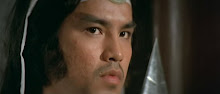
THE LADY VAMPIRE 1959 aka ONNA KYUKETSUKI
Shigeru Amachi (Nobutaka Takenaka), Keinosuke Wada (Oki Tamio), Junko Ikeuchi (Itsuko Matsumura), Yoko Mihara (Miwako Matsumura), Torahiko Nakamura (Shigekatsu Matsumura), Kyoko Yashiro (Tomoko), Hiroshi Sugi (Wada), Ayukawa Hiroshi (Tanigawa), Tsutomu Wakui (Dwarf), Satsuki Fuji (Old Witch Woman)
Directed by Nobuo Nakagawa
"The moon is rising. It joins my doom with that of Kisaragi Castle. How hateful is the moon, how unkind...."
"The moon is rising. It joins my doom with that of Kisaragi Castle. How hateful is the moon, how unkind...."
The Short Version: Based on Soto Tachibana's 1950 novel, Nakagawa's unique horror movie not only featured Japan's first Western-style bloodsucker, but goes out of its way to ignore western-style vampire lore. Shigeru Amachi is impeccably dressed and suitably worthy of the Dracula title, but this version of the classical vamp turns by the bright of the moon, casts reflections in mirrors, and uses golden crosses as a means of punishment for the enslaved women that betray him! The last twenty macabre minutes pits our young hero against the vampire in his underground Kisaragi castle of freaks complete with a dwarf, a bald henchman, and an old witch.


 On his way to his fiance Itsuko's birthday party, Tamio's taxi runs over a strange woman crossing the street. Upon inspection, the woman has suddenly disappeared. Shortly after Tamio arrives at the Matsumura household, it is discovered someone has entered a locked room upstairs that hasn't been occupied in years. Itsuko's father, Shigekatsu, finds a young woman in there; and to his shock, it's his wife, Miwako, who has been missing for twenty years and now looking the same as when she disappeared. The next day, Tamio and Itsuko go to an art exhibit and find a curious painting of a nude model who bears an amazing resemblance to her mother, Miwako. A few days later the painting is stolen and ends up shipped to Shigekatsu's home by an unknown sender. Miwako, having been in some sort of catatonic state, finally awakens and details her macabre ordeal. Revealing she was indeed the model for the art piece, Miwako fears that the undead man who painted her likeness is coming for her.
 A vastly underrated vampire movie from Japan's master of the macabre, Nobuo Nakagawa, his unusual addition to the undead canon is akin to Mexican vampire cinema in the way those films revised the lore. Aside from a few items of familiarity, and a lead blood-drinker who dresses like Lugosi with the mannerisms of Lee, the mythology is brazenly turned on its head. This vamp can walk around in daylight (while wearing sunglasses), casts a reflection in mirrors, and, while a vampire 24 hours a day, only turns into a fanged fiend when directly hit by moonlight. This immortal neck-biter also uses gold crosses to turn his rebellious female subjects into waxen statues so they can never leave him. The explanation for some of this arcane alterations are vague, but correlate to an information-heavy flashback-within-a-flashback discussed further down.
 Nakagawa's direction is meticulous; frequently bathing the screen in
shadow, capturing various architecture with tracking shots that
carefully creep in and out of the interiors while seizing the vast expanse of
the film's exteriors. At times bordering on avant garde, Nakagawa brings shades of oldeworld atmosphere to the modern day when he isn't dunking the film in a barrel of exploitation--primarily reserved for the outlandish final 20 minutes. A fascinating anomaly, THE LADY VAMPIRE is something of a bridge between the old-fashioned spookshow, THE GHOST OF KASANE SWAMP (1957) and the insane imagery of JIGOKU (1960). Shintoho would be absorbed into Toho in 1961, so it's possible the filmmakers wished to get a little crazy to entice ticket buyers. Having never read the novel, it's not currently feasible to do a comparison between the book and film.
Nakagawa's direction is meticulous; frequently bathing the screen in
shadow, capturing various architecture with tracking shots that
carefully creep in and out of the interiors while seizing the vast expanse of
the film's exteriors. At times bordering on avant garde, Nakagawa brings shades of oldeworld atmosphere to the modern day when he isn't dunking the film in a barrel of exploitation--primarily reserved for the outlandish final 20 minutes. A fascinating anomaly, THE LADY VAMPIRE is something of a bridge between the old-fashioned spookshow, THE GHOST OF KASANE SWAMP (1957) and the insane imagery of JIGOKU (1960). Shintoho would be absorbed into Toho in 1961, so it's possible the filmmakers wished to get a little crazy to entice ticket buyers. Having never read the novel, it's not currently feasible to do a comparison between the book and film. 
 If everything weren't already quirky enough what with the major adjustments made to traditional vampire iconography, the film's title is misleading. The 'Lady Vampire' of the title is most definitely drained of her plasma, but she never pursues fresh victims of her own. The people bitten by Shiro either die or become slaves to the master. A similar approach was taken in Hammer's Karnstein trilogy from the early 70s where some of the popular folklore was altered, but not to the drastic level of Nakagawa's eerie, kooky horror opus. Apparently, the original title was 'The Naked Lady Vampire'; a more exploitable moniker, but no less deceptive. The lady of the title refers to the character of Miwako (essayed by the lovely Yoko Mihara). The nakedness that was dropped from the title signifies the (partially) nude body of Miwako that is captured by the immortal Shiro on his unholy canvas.
This fairly complex backstory unveils itself as a flashback within a flashback, heading back to the Tokugawa Era, and, despite some stock footage, giving the low budget an epic feel. The centerpiece of undying love will be familiar to those of customary vampire cinema. Loved for centuries by the vampire, Miwako is the reincarnation of a 17th century princess, the daughter of Amakusa Shiro, a real figure of Japanese history. Adapted from Soto Tachibana's 1950 novel (the author would die in 1959, the year this film was made), the screenplay by Shin Nakazawa and Nakatsu Katsuyoshi ties the undead with historical accounts much in the way Vlad Tepes (Vlad, the Impaler) has been associated with count-less (pun intended) films for decades.
 Using the 17th century Shimabara Uprising as the springboard of the plot, the vampire
Shiro Sofue, as we're told, fought with the forces of the youthful leader of that
rebellion, the aforementioned Amakusa Shiro. Battling against the persecution of Japanese
Christians, Amakusa led nearly 40,000 rebels against the armies of the
Tokugawa Shogunate for a roughly four month period between December of
1637 and April of 1638 before finally being defeated. After the
rebellion was quelled, Amakusa was decapitated, and the government banned Christianity in Japan at that time.
Using the 17th century Shimabara Uprising as the springboard of the plot, the vampire
Shiro Sofue, as we're told, fought with the forces of the youthful leader of that
rebellion, the aforementioned Amakusa Shiro. Battling against the persecution of Japanese
Christians, Amakusa led nearly 40,000 rebels against the armies of the
Tokugawa Shogunate for a roughly four month period between December of
1637 and April of 1638 before finally being defeated. After the
rebellion was quelled, Amakusa was decapitated, and the government banned Christianity in Japan at that time. In conjunction with the film, Shiro, at the request of Princess Katsu, kills her as it becomes obvious Amakusa's forces are going to lose. Her death occurs during the rising of the moon, a full moon. Shiro, who manages to survive the ordeal (according to the story, only one man did survive Amakusa's final assault, and that man was said to be a traitor), drinks her blood, out of love, as he puts it, and become cursed as a vampire--to live forever and change into a monster when bathed in the bright light of the full moon.
 Naturally, the full moon turning a human being into a monster is generally associated with the lycanthropic school of folkloric legends. It's unusual to see it here, but within the context of the story, it fits just fine. Again, if you're familiar with Mexican horror pictures--particularly the vampire entries--there's plenty of mythology-tinkering going on there; so for there to be so many radical alterations in Nakagawa's movie, this approach is refreshingly unique. Also recognizable to werewolf lore, when Shiro changes, he struggles, and grasps his head in pain. The transformations of Larry Talbot
and other Wolfmen appear to be anything but pleasant.
Naturally, the full moon turning a human being into a monster is generally associated with the lycanthropic school of folkloric legends. It's unusual to see it here, but within the context of the story, it fits just fine. Again, if you're familiar with Mexican horror pictures--particularly the vampire entries--there's plenty of mythology-tinkering going on there; so for there to be so many radical alterations in Nakagawa's movie, this approach is refreshingly unique. Also recognizable to werewolf lore, when Shiro changes, he struggles, and grasps his head in pain. The transformations of Larry Talbot
and other Wolfmen appear to be anything but pleasant. 
 Shigeru Amachi strikes an imposing figure as Shiro Sofue; or, as his alias, Nobutaka Takenaka. Hammer's DRACULA (1958), or HORROR OF DRACULA in the US, had just come out the year before, and the actor channels Christopher Lee at times, but the B/W photography ensures the ghost of Lugosi lurks somewhere in the shadows of the cinematographer's palette. Whether intentional or not, Amachi brandishing a sword to battle the lead hero at the end recalls a similar duel of swords between vampire German Robles and hero Abel Salazar in the seminal Mexican horror classic, THE VAMPIRE (1957).
 Amachi was a fine actor with an intense face that served him well throughout his career. He worked with many of Japan's major directors in his heyday, as well as roles in popular film series' like Zatoichi, the Nemuri Kyoshiro (SLEEPY EYES OF DEATH) series and the crime films of the "Dog" series with Jiro Tamiya. Amachi founded his own production company in 1966, and co-produced with Spanish horror film icon Paul Naschy the film, THE BEAST AND THE MAGIC SWORD (1983). It would be one of his last theatrical features. Shigeru Amachi would die in early March of 1985 of a subarachnoid hemorrhage (bleeding inside the skull). He was 54 years old.
 Lastly, but certainly not least, there's the over the top last twenty minutes inside Shiro's lair, the ruins of Kisaragi Castle that are now underground! It's an extraordinary setting. Up to now the film has only dabbled in exploitational extravagance; near the end, it unleashes a whirlwind of wackiness where the world's of Yoshimi Hirano's photography and Haruyasu Kurosawa's art decor clash in a miasma of overwrought, exaggerated action. Nakagawa's curtain closer crams an old witch, Shiro's oafish, dwarf assistant (whom we see throughout), a bald strongman, an acid pit, and a sword-wielding vampire within a 20 minute time frame.
 Nakagawa's curious vampire movie (he made an earlier vamp-detective flick in 1956 entitled THE VAMPIRE MOTH) was the first of the Western-style variety to be seen in Japan. Some critics view it as a step backward for the director when compared with his more restrained efforts like GHOST OF KASANE SWAMP (1957) and the immortal classic, TOKAIDO YOTSUYA KAIDAN (1959); the latter title considered the definitive of its many incarnations. Others point out the lack of experimentation on the part of the
director. Personally, there's a great deal of experimentation in the
treatment of the material and the abundance of eccentricities found in
the script.
Nakagawa's curious vampire movie (he made an earlier vamp-detective flick in 1956 entitled THE VAMPIRE MOTH) was the first of the Western-style variety to be seen in Japan. Some critics view it as a step backward for the director when compared with his more restrained efforts like GHOST OF KASANE SWAMP (1957) and the immortal classic, TOKAIDO YOTSUYA KAIDAN (1959); the latter title considered the definitive of its many incarnations. Others point out the lack of experimentation on the part of the
director. Personally, there's a great deal of experimentation in the
treatment of the material and the abundance of eccentricities found in
the script. It would be over a decade before another attempt at an Anglo interpretation of the vampire would grace Japanese celluloid; those being a fascinating trilogy of Toho films often referred to as 'The Bloodthirsty Trilogy' comprising THE VAMPIRE DOLL (1970), LAKE OF DRACULA (1971) and EVIL OF DRACULA (1974).

 Based on its own merits, THE LADY VAMPIRE is bizarre enough for appreciation among the curio crowd looking for something on the fringes of insanity. Those expecting something more reserved will find it in intermittent doses, but might be put off by the outrageousness of some other elements. The low budget shows at times, but overall THE LADY VAMPIRE is worthy of reappraisal; and, depending on one's point of view, a fascinatingly bizarre success or failure on the resume of Japan's famous master of horror.