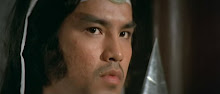
MESSAGE FROM SPACE 1978 aka UCHU KARA NO MESSEJI
Vic Morrow (General Garuda), Etsuko Shihomi (Princess Emerarida), Peggy Lee Brennan (Meia), Philip Casnoff (Aaron), Hiroyuki Sanada (Shiro), Narita Mikio (Rockseia the 12th), Makoto Sato (Urocco), Sonny Chiba (Prince Hans), Tetsuro Tanba (Ernest Noguchi)
Directed by Kinji Fukasaku

 The planet of Jillucia is attacked by the cruel Gavanian empire, a race of metal skinned aliens. To save their people and protect Princess Emerarida, King Kaiba unleashes eight holy Liabe seeds. These seeds are foretold to come into the possession of eight warriors of various backgrounds. With the Earth now threatened to be enslaved by the Gavanian Empire, the eight chosen fighters set out to free the universe from the onslaught of the Gavanas and their fleet of warships.

Kinji Fukasaku, a director of enormous respect and recognition both in Japan and internationally, has been responsible for some of the most violent and esteemed motion pictures ever. Whether it be his Yakuza films (BATTLE WITHOUT HONOR & HUMANITY), or his chambara dramas (THE YAGYU CLAN CONSPIRACY), or even his violent allegorical actioners like BATTLE ROYALE, Fukasaku was one of the best directors of Japanese cinema.

 When STAR WARS was unleashed to theaters in 1977, it totally transformed the way people perceive special effects and upped the ante on audience expectations as to what an action, or fantasy film should be. The success of Lucas's film was far reaching and not at all limited to America. There had been sci fi films before that featured similar elements, but nothing quite to the extent of STAR WARS. The award winning space opera was everywhere and people that didn't even enjoy sci fi were curious as to what all the fuss was about.

 Not long after its release, Toei Studios, one of the biggest in Japan, got in on the act in association with Kadokawa Publishing and Shogakukan Comics, two manga production companies. The result is a wholeheartedly goofy and grandly gaudy sci fi spectacular. Japanese studio giant, Toho, likewise produced their own STAR WARS clone. Their version was a shockingly tacky non epic called THE WAR IN SPACE (1977), an apparently rushed movie that was rushed out in December of that year in an effort to cash in on some of US pictures thunder. MESSAGE FROM SPACE is only slightly less tacky, but contains a ton of action and a lot of heart.

Hopelessly silly at times, this extravagant, colorful and ludicrous outer space fantasy is a curious entry among Fukasaku's resume. Compared with what he is normally associated with, MESSAGE FROM SPACE is something of a bastard child among his directorial credits.

 The guys check out each others space nuts
Regardless of its connections to the seminal STAR WARS, MESSAGE FROM SPACE (1978) is a futuristic variant of the famous Japanese literary classic, 'Nanso Satomi Hakkenden' about eight warriors destined to come together to restore a defamed family name and avenge its name. For this science fiction retelling, eight magic orbs (that resemble huge walnuts when they're not glowing) are thrust into space until they find their preordained owner. Those who are chosen, must free the enslaved Jillucia from the Gavana's who have also transformed the planet into their own spacecraft!

Throughout the films 105 minute running time, there's a mega ton of special effects sequences accentuated by a variety of spacecraft, laser gun battles and exaggerated costumes. Frequently lavish and cheap looking all at the same time, MESSAGE FROM SPACE was popular enough in Japan to garner a television series (called SWORDS OF THE SPACE ARK over here) shortly after is release. Fukasaku tried his hand at the story in a more traditional period setting with the grand scale fantasy adventure LEGEND OF THE EIGHT SAMURAI (1983), which was also quite popular and at the time, the biggest Japanese motion picture ever.

 Nobuo Yajima's effects work are a mixed bag. At times, they are actually kind of striking. The ships are nicely designed and creative if overly implausible in some cases. Taking a cue from the classic 1962 Toho sci fi sensation, GORATH (wherein Earth's scientists build enormous rockets in the arctic to move the planet out of its orbit to avoid being destroyed by the runaway star, Gorath), the Gavanas turn the planet Jillucia into a gigantic ship. The first time the Jillucians realize this is when their world begins to move as the planet cum battlestation heads towards the Earth.
 Rockseia (Narita Mikio; center) prepares to blow up the moon to show General Garuda (Vic Morrow; right) the Gavanians mean business
The ship and costumes for the Gavanas are also interesting designs. They take on a spider, or crab like appearance in both the alien fighter ships and also the suits the Gavanians wear. There's also an INFRAMAN meets FLASH GORDON (1980) vibe going on with all the vibrant colors with an added hint of Sid & Marty Kroft for good measure.

 Yajima was also responsible for effects work in the hugely popular cult Japanese television series' JOHNNY SOKKO & HIS FLYING ROBOT (1967) and SPECTREMAN (1971). He also had a hand in a fair number of Tokusatsu (live action superhero shows) programs. The effects seen in MESSAGE FROM SPACE have an anime quality about them such as the aforementioned planet-turned-battlestation, the giant flying ship that is built in the form of an oldeworld sailing vessel and the interconnecting spacecrafts.
 A STAR WARS moment if there ever was one!
 One other attribute of the production is the soundtrack. The score by Kentaro Morioka is suitably opulent and grandiose especially the main theme. It has that typical Japanese flavor just as Italian movie soundtracks are easily distinguished by their signature sound. Morioka's score is quite catchy at times and itself has an anime aroma about it. The only time the music is ever "playful" is during a chicken run sequence between Aaron, Shiro and a space cop.

Upon reading the synopsis one can draw the conclusion that this picture has some glaring similarities to STAR WARS. While that is true, it would appear that this film was somewhat influential on the remainder of Lucas's trilogy. The Disney movie, TREASURE PLANET (2002) also seems to have taken inspiration with the use of a flying space galleon. Some of the set design (such as the layout of the windows in the throne room) looks similar to those in THE EMPIRE STRIKES BACK (1980).

Also, the design of Shiro's ship looks a lot like the snow speeders seen during the Hoth sequence of EMPIRE. The battle fortress built into the planet is a riff off of the Death Star, but the central reactor beneath Jullucia (hidden within a series of tunnels) was also utilized for the Death Star seen in RETURN OF THE JEDI (1983). There may be nothing to some of these nuances, but it's interesting just the same.

 The cast is huge amassing quite a lot of big name Japanese stars as well as some recognizable American faces. Vic Morrow, who made an impression as a thug in THE BLACKBOARD JUNGLE (1955), had a long career as a screen heavy. Appearing in all manner of tv shows and movies, genre fans will know him from movies like DIRTY MARY, CRAZY LARRY (1974), THE BAD NEWS BEARS (1976), HUMANOIDS FROM THE DEEP (1980), THE LAST SHARK (1981), 1990: THE BRONX WARRIORS (1982) and TWILIGHT ZONE: THE MOVIE (1983), the film wherein he lost his life in a tragic helicopter accident. As General Garuda, he plays a character at a low ebb in life (probably true in real life for Morrow) pushed back into action to fight the Gavanas. He's given a robot sidekick by the name of Bebe 2. Morrow plays the role totally straight seldom smiling up until the end.

 Japanese superstar, Sonny Chiba is Prince Hans, heir to the Gavanas throne. It turns out that Rockseia killed his parents and took over the sovereignty. Of course, Hans is a good guy and must bring justice to his own people. Chiba is barely in the movie and doesn't appear till it's half over. Still, he gets in a lot of action during the explosive finale. He indulges in a sword fight with Rockseia in the ornately designed throne room. Chiba and Fukasaku were great friends and worked together on numerous occasions. At this point in his career, Chiba was fine with letting his students shine onscreen while he took a backseat to the proceedings.

 Hiroyuki Sanada has been an international heartthrob for several decades. Now at 50 years of age, Sanada has found a second surge in popularity after his role in THE TWILIGHT SAMURAI (2002) and his recent role on the hit series LOST (2010), Sanada shows no signs of slowing down. Originally one of Chiba's most promising acolytes, he is inarguably the most successful of the 'Streetfighter's' students from the Japan Action Club. Sanada was also a big name in Hong Kong where he made several movies as well. Some of his biggest roles and productions include SHOGUN'S NINJA (1980), SAMURAI REINCARNATION (1981), ROARING FIRE (1982) and the famous LEGEND OF THE EIGHT SAMURAI (1983).
 You could almost imagine Etsuko Shihomi stating Leia's line, "I thought I smelled your foul stench when I was brought on board." She traded in the Cinnabun's for a wreath, though.
 Etsuko Shihomi was Chiba's second most successful student starring in a string of solo efforts and supporting roles in addition to a singing career. She retired sometime in the mid 1980's. A stunningly beautiful woman, she had an imposing aura about her that shone through in her performances. She got her own quartet of SISTER STREETFIGHTER movies as well as another star turn in DRAGON PRINCESS (1976). Shihomi also featured prominently in Chiba's KAGE NO GUNDAN series as well as a nicely drawn role as a lonely, but deadly bounty killer in LEGEND OF THE EIGHT SAMURAI (1983).

 Narita Mikio is one of Japan's most prolific and reliable actors in Japanese cinema. He has an incredible affinity for portraying duplicitous characters and he puts it to good use in such films as FEMALE CONVICT SCORPION: BEAST STABLE (1972), HUNTER IN THE DARK (1979), NINJA WARS (1982) and as the Dark Shogun in the second series of the popular television program KAGE NO GUNDAN. Depending on the character, Mikio changes his oration as some points bearing an incredibly deep, imposing tone and at others with a high pitched cackling manner.
 Hideyo Amamoto (left), a male comedian, plays Rockseia's mother.
MESSAGE FROM SPACE (1978) is a very silly movie that is definitely cheesy in places and will likely appeal to small children and grown ups with a love for this type of fantasy film. It could probably fit quite cozily in the 'So Bad It's Painfully Funny' section of the site, but I don't have the heart to place it there.

It does have some good things about it, but does miss total shit status by a narrow margin. Perhaps Fukasaku intended this movie to be a fanciful child's fantasy; science fiction at its most goofy and playful. While it's definitely flawed, it's a nice little popcorn movie that no one in their right mind is going to take seriously. Japanese sci fi fans should have a field day and bad movie buffs may enjoy this big, overblown buffet.
This review is representative of the all region Eastern Star DVD. It contains both an English dub and a Japanese Stereo edition with English subtitles.