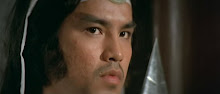
WHALE GOD 1962 aka 鯨神 (KUJIRA GAMI)
Katsu Shintaro (Kishu), Hongo Kojiro (Shaki), Fujimura Shiho (Ei), Enami Kyoko (Toyo), Fujiwara Reiko (Okoma), Takano Michiko (Yuki), Yosuke Takemura (Kasuke), Shimura Takashi (Village Elder)
Directed by Tanaka Tokuzo
The Short Version: Hongo Kojiro is Shaki, a young whaler hellbent on spearing a gigantic baleen that has wrecked havoc on his village for decades. Also vying for the pleasure of lancing the Kujira Gami (Whale God) is a brutish harpooner played by Katsu Shintaro. An early SPX drama from Daiei, Japan's answer to MOBY DICK (1956) is based on an award-winning novel from 1961 and features some extravagant special effects. Spirited performances, abundant testosterone, gallons of spurting whale blood and a doom-laden score by the one and only Ifukube Akira are among the highlights. Possibly a hard sell for strict monster movie lovers, fans of the actors and Japanese theatrics will either have a whale with this quasi-monster epic or go down with the ship.


 After decades of being terrorized by a gigantic whale, the elder of Wadaura, a coastal village in Kyushu, promises his daughter and all his land to the first man to slay the beast and bring him its snout tied to a rope. Losing his grandfather, his father and his brother Shatsu to the great Right Whale over the years, Shaki vows to kill it. Another whaler, a cruel drifter named Kishu, proclaims that he will be the one to bring down the devil whale. One bound by vengeance, the other by riches, the stage is set for a clash between both man and beast.
Daiei Studios had enjoyed international recognition in the 1950s with award-winning pictures such as Kurosawa's RASHOMON (1950), but it was the company's 1960s output that is easily their most popular. Wedged in between Art House films, tense samurai epics and entertaining monster movies are a few pictures that combined all three of those styles; WHALE GOD is one such production.

 Based on Uno Koichiro's novel from 1961, the inspiration is clearly Melville's 'Moby-Dick' novel from 1851; itself turned into a movie (for the third time) several years earlier in 1956. This Nipponese equivalent has shades of its source, but is distinctly Japanese in flavor. 'Kujira Gami' won the
46th Annual Akutagawa literary prize that same year in '61. Before you could
say "Call me Ishmael", Daiei secured film rights for a
reported one million yen. Unlike Melville, whose career sank after 'Moby-Dick', Koichiro became a popular and prolific author, finding fame as a mystery writer and,
to an even greater degree, for his erotic works--many of which were
made into movies by Nikkatsu Studios.
Based on Uno Koichiro's novel from 1961, the inspiration is clearly Melville's 'Moby-Dick' novel from 1851; itself turned into a movie (for the third time) several years earlier in 1956. This Nipponese equivalent has shades of its source, but is distinctly Japanese in flavor. 'Kujira Gami' won the
46th Annual Akutagawa literary prize that same year in '61. Before you could
say "Call me Ishmael", Daiei secured film rights for a
reported one million yen. Unlike Melville, whose career sank after 'Moby-Dick', Koichiro became a popular and prolific author, finding fame as a mystery writer and,
to an even greater degree, for his erotic works--many of which were
made into movies by Nikkatsu Studios.
 Shindo Kaneto's script adaptation of Koichiro's novel contains fleeting expressions of social class (Shaki's girlfriend born of a poor family; Toyo's enriched upbringing) and religion (the Christian iconography; the whale as a devil or supernatural entity) found in the Melville source, entrenching them within Japanese culture; such as when it revels in ancient village customs that occasionally clash with the encroaching modernism of the Meiji Era the story takes place in. The borderline insanity of Ahab is retained, if spread out among the villagers both frightened and hellbent on destroying the accursed whale. Still, the focal point is on the two male leads and the level of masculinity between them is as massive as the devil whale itself.
 The 1956 version of MOBY DICK had Gregory Peck and Richard Basehart. In the case of this movie, we have Hongo Kojiro and Katsu Shintaro. The script takes Captain Ahab and splits him between both these actors. To a lesser extent, Hongo is also the film's Ishmael. Whereas Melville's character was the lone survivor of the seafaring vessel the Pequod, the interpretation in Tokuzo's movie is the last surviving male member of his clan. His obsession with the sea beast mirrors that of Ahab's, but isn't limited to vengeance.
 Nearly half-crazed with revenge, Shaki's vendetta takes on a strange romanticism by the time he comes face to face with the mighty whale. This adoration reaches levels you'd likely never see anywhere else but in a Japanese drama. It's akin to the samurai spirit where this respect, this honor between combatants, supersedes any enmity. He's not even interested in obtaining the Elder's wealth nor his beautiful daughter Toyo; only the slaughter of the whale holds his attention. He already has a lover, Ei, a young lady from a poor family; lending the film some social relevance and soap opera-ish entanglements. Without giving things away, a detail from Melville's book involving Ishmael and a coffin has a decidedly Japanese twist placed on it during the spirituality-fused finale.
 Top billed Katsu Shintaro is Kishu, the other Ahab of this tale, and ostensibly the film's human antagonist. A socially inept drifter, his ogreish personality takes him further away from Melville's one-legged revenger in comparison to the torment of Hongo's character. Katsu plays Kishu as borderline evil, boasting of his abilities in between maiming some of the fishermen who challenge his dominance; even proclaiming himself to be a murderer at one point.
In arguably the most dramatic thread in the picture, Kishu rapes Ei, the girlfriend of Shaki. She never tells him this (till much later) and even upon going into labor he never questions who the father is. He takes the child as his own and after their marriage and the kids baptism, Shaki shows off the boy to Kishu, who seems noticeably uncomfortable--and with good reason. It's at this point in the movie that Katsu's character undergoes a change, ambiguous as it is.

 Both Shaki and Kishu are determined to be the first to deliver the fatal
blow to the title baleen whale. The former out of retribution for decades of familial loss; and the latter for the prizes that come with the kill. However, as despicable as Kishu is, the script, in a surprising twist, affords him some redemption born out of the scene described above.
Both Shaki and Kishu are determined to be the first to deliver the fatal
blow to the title baleen whale. The former out of retribution for decades of familial loss; and the latter for the prizes that come with the kill. However, as despicable as Kishu is, the script, in a surprising twist, affords him some redemption born out of the scene described above. In Melville's novel, Ahab's mania spells doom for both him and his crew; In WHALE GOD, this psychosis is shared by most everybody in the coastal village, but primary focus is given to Shaki while Ahab's fate is handed over to Kishu; yet his death comes not from self-indulgence but self-sacrifice. Despite his animalistic personality, Kishu is afforded the absolution denied Ahab.

 Hongo Kojiro had only a few films to his credit, including a star turn
in the previous years spectacular BUDDHA. That picture also featured
Katsu Shintaro in a less than noble role. Naturally, Japanese movie fans outside of Japan
know Hongo from his Gamera gigs and Katsu from over two dozen ZATOICHI
productions. Hongo suffices as the tormented and determined son, but Katsu makes the better impression here, at least in terms
of his range. He'd played a vile blind masseur in 1960s THE BLIND MENACE, and a duplicitous usurper in the aforementioned BUDDHA (1961).
His most famous role as a kindly blind masseur/yakuza in THE TALE OF ZATOICHI debuted in April of '62, three months prior to WHALE GOD's
theatrical premiere in July of that year.
Hongo Kojiro had only a few films to his credit, including a star turn
in the previous years spectacular BUDDHA. That picture also featured
Katsu Shintaro in a less than noble role. Naturally, Japanese movie fans outside of Japan
know Hongo from his Gamera gigs and Katsu from over two dozen ZATOICHI
productions. Hongo suffices as the tormented and determined son, but Katsu makes the better impression here, at least in terms
of his range. He'd played a vile blind masseur in 1960s THE BLIND MENACE, and a duplicitous usurper in the aforementioned BUDDHA (1961).
His most famous role as a kindly blind masseur/yakuza in THE TALE OF ZATOICHI debuted in April of '62, three months prior to WHALE GOD's
theatrical premiere in July of that year.
 The climactic man vs. whale is impressive and a testament to the special effects crew of Toru Matoba, Tsutomu Komatsubara, Hideyoshi Ono, and Takesaburo Watanabe. Painted backdrops, mattes, miniatures and animated seagulls heralding the arrival of the whale's seasonal tyranny enhance the drama. Daiei was still a few years away from making a huge splash in the arena of FX dominated cinema with GAMERA (1965), although the cloud of GODZILLA (1954) looms large over WHALE GOD and doesn't go unnoticed. One area that recalls Honda's iconic monster movie is in its music.
Ifukube Akira's incredible score reverberates the apocalyptic landscape from his work on the original GODZILLA (1954). His choice of music certainly makes the creature god-like; sort of a cross between the radioactive menace and the islander-worshiped Mothra. There's a beauty in Ifukube's sonic doom that evokes the death the protagonists desire to embrace. Ifukube would again compose a beautiful score for Tokuzo's similarly structured SPX horror drama, THE SNOW WOMAN in 1968.

 Setsuo Kobayashi gives director Tokuzo's movie a unique look with his stark B/W photography, creating a dank atmosphere nearly bereft of any sunlight that's especially beneficial during the whale sequences. Elsewhere, the nighttime scenes look coated in charcoal black, highlighting beads of sweat and water on the cast members. The massive amount of doom and gloom contrasts the sprawling sense of adventure of Huston's adaptation. Aside from what's discussed above, cultural differences account for the divide in tone, although both share their pseudo-monster movie trappings.
As for the 'Kujira Gami', an expensive life-size scale model was built by ape specialist, Ohashi Fuminori (HALF HUMAN [1955]). Much like the 90 footer built for John Huston's '56 version, the large model proved problematic for shooting in the water. Additionally, monster maker Ryosaku Takayama designed an 18ft miniature whale that the filmmakers got a lot of mileage out of.

The whale effects range in quality, but mostly they are comparable to Huston's epic interpretation; especially during the show-stopping finale, a violent symphony of man against mammal. It goes on a bit too long with Katsu, then Hongo, ferociously stabbing the whale's hide, covering themselves in geysers of blood; the unsettled waves wiping away the gore from their bare bodies as they're once more cloaked in crimson.
 The director and his crew made a strong dramatic feature although some of the editing is a bit wobbly. The passage of time is confusing what with the film's timeline jumping around on a few occasions. There's also an editing mistake during the finale. When Kishu goes after the whale first, there's a brief, misplaced shot of both him and Shaki atop the beast (represented by models of the actors; see insert). Incidentally, the trailer features shots that are absent in the movie of the two actors stabbing away at the monster whale together.
 WHALE GOD is one of Daiei's more peculiar productions. More of a drama than a monster movie, fans of that genre probably won't find much in terms of re-watch value here outside of curiosity for the title beast's presence. The Jidaigeki crowd, fans of the two main actors, and those wishing to see a Nippon spin on Melville's novel will benefit the most from this unusual movie. If you're only familiar with the director's samurai endeavors, you might be surprised at his versatility in the FX/Fantasy genre; of which WHALE GOD is considered one of his finest works.
This review is representative of the Kadokawa R2 DVD. Specs and Extras: Anamorphic 2.35:1; original trailer; photo gallery; commentary; no English options.