KILLER DARTS 1968
Chin Ping (Jin Yu Sien), Yueh Hua (Liu Yu Long), Fang Mian (Liu Wen Lung), Shen Yi (Lin Heung Kam), Peng Peng (Ah Fu), Chang Pei Shan (Hu Chi Feng), Ma Hong Sin (Chu Chao)
Directed by Ho Meng Hua
The Short Version: KILLER DARTS is one of Ho Meng Hua's lesser known films outside of Asia; a surprisingly dramatic, and character-varied swordplay-romantic-thriller. Occasionally bloody, it doesn't drench its cast in crimson as many others did at that time. Instead, screenwriter Du Yun Zhi (Tu Yun Chih) creates a wild world of swordsmen and swordswomen with unique abilities and a variety of projectile weapons including the "Soul-Chasing Darts" of the film's Chinese title. It's an engaging Swordplay feature with occasionally stunning photography and a healthy dose of tracking shots that pull the viewer into the scene. However, the complex plot woven around a typical revenge narrative is far too big for its 87 minute duration; and may not appeal to those seeking an emphasis on Chang Cheh-levels of violence.

 Swordsman Liu Wen Lung returns home to find his village being razed by bandit chief Chu Chao and his gang. Liu's wife is killed in the fray--leaving Liu to raise their son along with his faithful servant Ah Fu. Not long afterward, Liu's student, Hu Chi Feng, rapes and murders a young mother using his teachers secret dart weapon. Before dying, the woman tells her little daughter, Jin Yu Sien, that her killer used a lethal projectile and to find her murderer. Master Liu takes the girl and raises her as a foster child. Ten years later, love blooms between Liu's son and Jin but their vendettas take a fateful turn once the bandit chief Chu Chao returns to settle a score with Liu Wen Lung.
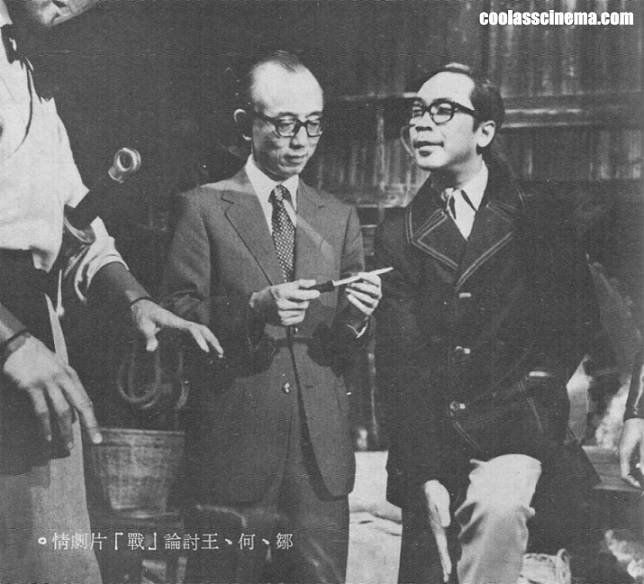
 Director Ho Meng Hua was riding high in 1968 with one accomplishment after the other. He'd received recognition for his imaginative and innovative quartet of JOURNEY TO THE WEST fantasy movies; following those with the surprising critical acclaim for his drama, SUSANNA (1967)--that film winning Best Picture among a reported total of 12 awards at the 14th Annual Asian Film Festival held in Japan in October of 1967. Chang Cheh's ONE-ARMED SWORDSMAN won high praise but it was Ho Meng Hua's shining moment.
  After the success of SUSANNA, director Ho then moved into doing Wuxia adventures. His swordplay pictures were different from Chang Cheh's in that they often dealt with familial tragedy or a clan dispute as opposed to the travails of devout swordsmen and blood brotherhood. Director Ho did nine swordplays between 1967-1971, one of them--THE GOLDEN LION--wasn't completed and released till 1975. If you're looking for something more violent and bloody, then Ho's AMBUSH (filming began in 1971 but it wasn't released till 1973) would be more in that vein.
 The year 1968 was a huge year for Swordplay pictures, and KILLER DARTS was Ho Meng Hua's next movie--followed by THE JADE RAKSHA and VENGEANCE IS A GOLDEN BLADE. Since ONE-ARMED SWORDSMAN grossed over HK$1.2 million (some Chinese sources list the gross at HK$1.5 million), the then new wave of sword-swinging heroes and heroines rejuvenated the genre style. The Shaw Brothers compensated by adding a Swordplay division to their Nanguo Experimental Theater Troupe; this was an actor training course that was greatly expanded upon when the Shaw's founded their Actor's Training Academy for Film and Television in 1971.
Filming on KILLER DARTS began in September of 1967. Ho's take on Wuxia would be very different from Chang Cheh, who had redefined the genre. To compare the styles with American filmmakers, you could say Ho was more John Ford than Chang's Sam Peckinpah.
 Screenwriter Du Yun Zhi fashions a typically complex story with diametrically opposing moods. You have a love triangle between Chin Ping, Yueh Hua and Shen Yi; and familial clashes between Chin Ping, her adoptive father played by Fang Mian and his treacherous pupil played by Chang Pei Shan (at left in insert)--one of the great villain character actors who also was Chen Kuan Tai's dubber during his first few years at the studio.
 Originally, Du's script went deeper into Chin Ping's loneliness--having her uncover her dead father's martial arts manual that detailed a devastating palm technique. This part of the script was either dropped or cut from the release version. What remains is Fang Mian discussing her Inner Strength training; and a scene where an angry Chin Ping knocks down a few trees with a single palm strike.
The action scenes aren't as varied as the weapons the myriad number of characters possess. The title projectile is more than just a weapon--it's an important plot point that is the main focus of the movie. It is certainly a "Soul-chasing Dart" as the film's Chinese title specifies. Once the skin is pierced by the weapon, your exit from Earth is only seconds away.

There are other dart-like weapons scattered about the script, including
one that is fired from a metallic appendage worn by the main villain
after his arm is cut off near the beginning. There are even mystical
powers where one character uses inner force to control objects in
mid-air.
Going back to the action, there's not a credited martial arts director. The reasoning is unknown; although one could surmise that since the Shaw's would produce a staggering 45 movies in 1968, there weren't enough action designers on the payroll to go around--leaving the work to the actors and background players.

The action design is largely standard but enhanced by periodic optical effects, wires, and in-camera trickery. One such scene is a wide-angle shot where Chin Ping practices with the title death darts using cups as targets.

 Actress Chin Ping was one of the biggest names in HK at that time. She would regularly switch between dramas and action pictures during her brief seven-year acting career. She'd just finished Lo Chen's drama THE RAINBOW (1968) when she began working on two swordplay pictures, THE BELLS OF DEATH for director Griffin Yueh Feng and KILLER DARTS--both films not only have two opposing atmospheres but Chin's roles are totally different between them. She's a meek and delicate young lady in the former and an emotionally-torn martial artist seeking revenge in the latter.
Miss Chin gets the chance to both act and do action here. It's a different sort of role than normally written for these movies. She's raised to avenge her family then deceived into believing her master is the killer she seeks. It's one of a few sword-opera styled twists in Ho Meng Hua's movie.
 To gauge her popularity, Chin Ping was voted the #2 most popular swordswoman in a newspaper contest in 1969. She would retire from the industry in December of that year to get married. Her last action picture was the top 10 hit THE TWELVE GOLD MEDALLIONS (1970). She was also working on Ho Meng Hua's THE BLACK ENFORCER in 1969. Due to her retirement, all her footage had to be re-shot with a new leading lady; that turned out to be newcomer, the gorgeous Wang Ping. Chin was also the co-star in Ho's 'The Golden Mace'--a movie that was never finished, but may have morphed into Ho's VENGEANCE IS A GOLDEN BLADE (1969); another swordplay featuring Chin and Yueh Hua again.
 Possibly due to her short run, Chin Ping seldom gets mentioned these days among fans but she was certainly an important actress in 1960s Hong Kong cinema. Sadly, she died from cancer on September 6th, 2017 at the age of 68.

 Yueh Hua is one of the genres finest actors; and a mainstay of the industry's Golden Age. Along with classmate Chin Ping, Yueh Hua was a graduate of the Nanguo Experimental Theater Troupe alongside Swordswoman Supreme Cheng Pei Pei. Arguably his most celebrated role was as the Drunken Knight in King Hu's COME DRINK WITH ME (1966). He'd actually been tapped to reprise the role in the second attempt at a loose sequel titled 'The Drinking Knight' under the direction of Pao Hsueh Li in 1971. The film was never completed.
 The character he plays in KILLER DARTS is the object of two women's affections; those being Chin Ping and Shen Yi. The latter lady was one of Shaw's sexy actresses--frequently playing concubines and other aggressive, or alluring personality types. The love triangle involving her, Yueh and Chin's characters isn't as interesting as the other angle dealing with Chin Ping's private vendetta, although both plots are woven together by the end.
 Miss Shen would request her release from her contract in 1970 presumably due to a long stretch where she wasn't working. She was said to have been a consummate actress who never complained and did everything asked of her. She ended her career in 1976 after two final appearances in back-to-back 'Women In Prison' pictures, GIRLS IN THE TIGER CAGE and REVENGE IN THE TIGER CAGE, both released to theaters simultaneously.
 The sword pictures made by director Ho are quite good and have long been overshadowed by his more globally well-known works THE FLYING GUILLOTINE (1975), BLACK MAGIC (1975), and THE MIGHTY PEKING MAN (1977). The first ten years of his career entails his best directing work. THE FLYING GUILLOTINE was his last truly great motion picture. The final five years of his career is dominated by exploitation movies and low-grade martial arts films. THE MIGHTY PEKING MAN is a unique title on his resume in that it was one of the most expensive Shaw Brothers productions, if not the most expensive. It's a great film, but mostly from an entertainment perspective.
  As for KILLER DARTS (the English title on the poster as 'KILLER DART' is in an unusually large font while the onscreen title adds an 's'), the film's script is quite good, but also the area where the movie falters to a degree. There's so many vendettas and dramatic arcs that the most important one isn't explored enough; that being where Chin Ping's character is deceived into believing the man that raised her is her mother's killer.
 Another area is Chu Chao's return, bringing a slew of cutthroats back with him. The menagerie of malcontents appear to be loosely based on characters from Shi Nai'an's famous novel, 'Outlaws of the Marsh'. Among them are actors Ku Feng, Dean Shek, Liu Kang, Han Ying Chieh and Wei Ping Ao. None of them figure heavily in the final fight at all; whether due to time or footage was edited out for pacing.
The film has so much going for it you may not even notice the minor shortcomings. One thing you will notice is how the colors pop off the screen in this blu-ray presentation, part of an 11-film set in Shout's Shaw Brothers Collection Volume 1. The picture quality is nothing short of amazing.

 The late filmmaker's earlier works like KILLER DARTS need more exposure and hopefully greater appreciation from martial arts film fans. They're surprisingly classy pictures next to what the director would be doing in the last half of the 1970s. If you enjoy 1940s swashbucklers with the likes of Errol Flynn, you'll possibly find enjoyment in these Chinese-language variants, but with more blood and melodrama.
This review is representative of the Shout! Factory blu-ray, part of their 11-film set, Shaw Brothers Collection Volume 1. Specs and extras: 1080p anamorphic widescreen 2.35:1; commentary with Eastern Kicks James Mudge; Celestial trailer; running time: 01:27:50.