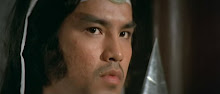
THE DRAGON MISSILE 1976
Lo Lieh (Si Ma Jun), Liu Yung (Er Long), Yen Nan Hsi (Tan Hsiao Li), Ku Feng (His Lordship), Terry Liu (Miss Sha), Chiang Yang (Chen), Fan Mei Sheng (Miu Fei)
Directed by Ho Meng Hua
The Short Version: Inferior and quickly made FLYING GUILLOTINE clone, Shaws own cash in made to compete with another similar movie made by Jimmy Wang Yu for First Films, an independent company. With zero plot, it's essentially a chase movie with bland fights and unlikable characters. The title weapon is the one saving grace as is the astounding Shaw sets, the best and biggest of which get showcased here.

 Si Ma Jun, master of the deadly dragon missile, is the trusted bodyguard to an oppressive and cruel lord. Falling ill due to a life threatening boil, Si Ma Jun is sent on a mission to recover the thousand year Longevity Rattan as it's the only medicine that can cure this rare, but deadly tumor. An old herbalist named Dr. Tan is the only person to possess it. The one drawback to this rare herb is that it cannot get wet lest its medicinal properties be nullified. One of the lords advisors says additional hands should be sent along to monitor the mission so a group of greedy fighters join Si Ma Jun. Through a series of double crosses and dead bodies, Si Ma Jun ends up a hunted man as he's pursued by the lords men as well as two warriors hellbent on revenge.
 HK Movie News February 1976
 There's virtually zero plot in this Shaw Wuxia quickie lazily directed by Ho Meng Hua. A rip off of Ho's own Shaw hit, THE FLYING GUILLOTINE (1974), he was likely pressured into this production when former Shaw star, Jimmy Wang Yu began work on his own FLYING GUILLOTINE clone, the poverty row MASTER OF THE FLYING GUILLOTINE (1976). Ever since he abandoned the Shaw ship in 1971 on the worst of terms, whenever his former employer had a big movie in preparation, Wang Yu was quick to whip up a clone of his own. At the time DRAGON MISSILE was being prepped in late 1975, Shaw's would soon be working on their own sequel to Ho's earlier guillotine picture starting at the first of the year in 1976.

 Already saddled with a full slate of movies he was working on, Ho Meng Hua managed to crank this one out within a few months followed by Shaws hasty release at the same time as Wang Yu's ridiculous, but popular guillotine clone, a sequel to his earlier THE ONE ARM BOXER (1971), itself his own 'slap in the face' to his former boss. Sadly, DRAGON MISSILE suffers terribly from what was undoubtedly a rushed schedule and also an apparent lack of interest from those involved. The Shaw production facility had certain films that took precedence over other, lesser quality pictures which were mainly designed to make a quick buck. DRAGON MISSILE is one of those quickies. Curiously, the film was heavily ballyhooed in Shaw's promotional magazines whereas their typical lower tiered movies seldom received as much space within the pages of Southern Screen and HK Movie News.

 Definitely a 'B' movie with 'A' movie production values, DRAGON MISSILE has very little plot whatsoever, borrowing heavily from Ho's earlier head slicing success. I Kuang's script is slapdash with the bare minimum of background regarding the flurry of characters on display. Ku Feng's despotic lord isn't even given a name, we learn next to nothing about Lo Lieh, or even the two characters played by Liu Yung and the bland beyond words, Nancy Yen. The latter two are the protagonists of this quickie and they get less screen time than the high number of cutthroats populating the cast. That Tang Chia and Yuen Chuen Yan were the choreographers, you'd expect at least the fights to be engaging, but these, too, are barely average. Tang Chia was a master at weapons fights, yet those seen here are below average with only the most basic punch, kick, block maneuvers. There's some interesting weapons seen here, but outside of the Dragon Missile itself, the choreography built around them is terribly static.

 The most interesting aspect of the script is that there is some attempt to make Si Ma Jun a pitiable character, despite him maliciously killing a few innocent civilians including a blind woman, the mother of his former martial arts brother. Fiercely loyal to his lord, when he finally returns an hour into the movie, he finds the rare herb he went through so much trouble to obtain has dissolved(!!!), the result of him having to swim to get away from his pursuers. Enraged, the tyrannical lord orders Si Ma Jun's death. Fighting his way out of the castle, the once trusted guard now must go on the run. The last twenty minutes is the same as the previous 60 only now Si Ma Jun has been stripped of his rank and now a fugitive. The final fight is over with fairly quickly (it's around 5 minutes long) and consists mainly of Si Ma slinging his bloodthirsty boomerangs at his dwindled posse of pursuers who utilize their ingenious idea with which to counter the Dragon Missiles. Once Lo Lieh's character is dead, he's barely hit the ground before 'The End' and 'Another Shaw Production' zooms into view.
 Southern Screen February, 1976; if you double click the photo, you can read the English text where you'll notice mention of certain exotic weapons to be used by characters played by Fan Mei Sheng and Chiang Yang, but these don't turn up in the film.

 Which brings us to the Dragon Missiles themselves. To see them, it would appear more time was spent creating them then actual production time. This pair of cruel cutlery is one of the most beautifully designed weapons of the Shaw Brothers impressive line of death devices. There's no hidden features, just what is essentially a razor sharp boomerang that literally destroys any object it comes into contact with. The effects are surprisingly good, too. These weapons and their usage are really the only reason to tune into this movie. Oddly enough, Ho Meng Hua was able to fill out his film with many of the Shaw Brothers most impressive sets, particularly most of the massive outdoor town and castle replicas.
 Hong Kong Movie News February 1976

 Tony Liu Yung, well known for his association with the late Bruce Lee, made his Shaw Brothers debut here in this gimmick movie misfire. A fine actor whose limited on screen martial arts skill was better suited in Wuxia type surroundings. He would quickly gain notice the same year of DRAGON MISSILE's release by his star turn in the popular EMPEROR CHIEN LUNG, a successful film that garnered several sequels. Liu Yung was acting in that production as well as Hua Shan's incredibly violent crime-martial arts gangster film, BROTHERHOOD in addition to his work on THE DRAGON MISSILE, all three in production at the same time. From here on out, Liu Yung became one of the most popular actors in Shaws stable of stars. Liu also fluctuated from playing both heroes and villains. Attached to various Shaw starlets throughout his acting tenure, Liu had some serious relationship issues over the course of his career.
 Nancy Yen, one of the least interesting female screen fighters in HK cinema, does little here to stand out aside from being one more character taking up screen time. It's unfair to pick on Yen Nan Hsi as there's really no script here that gives anyone anything to do aside from spout basic dialog then chase another character from one set to the other. In her defense, Nancy Yen did have a decade long stint in HK action movies from the early 70s to the early 80s. She did look good in her fight scenes in her films, she just lacked screen presence. Her Shaw career was short lived, ending after just a few films. After that, it was back to the indy scene till she retired in 1982. Some of her credits include MA SU CHEN (1972; aka REBEL BOXER), DEATH DUEL (1977), THE SEVEN GRANDMASTERS (1979) and MY BLADE, MY LIFE (1982).
 Southern Screen February 1976
 THE DRAGON MISSILE (1976) had several alternate translated titles during its filming including 'The Guillotine' and also its literal translation, 'Flying Dragon Cut'. Finally settling on the DM moniker, the picture came and went within a week barely breaching HK400,000 in April of 1976, losing out to the Wang Yu film, one of the few post Shaw hits he had. A weak link on Ho's resume, it's unlikely there was much interest in making a quality picture here as opposed to a fast bit of competition to counter what Wang Yu had been doing to the Shaws since the early part of the decade. Looking far more like a slightly more expensive indy martial arts movie, it was indicative of where Shaw Brothers was headed in the next few years when those cheap-jack kung fu movies became furiously popular at the HK box office, especially those whose plots contained far more comedy than serious heroics.

 Without doubt a lower tier Shaw Brothers exploitation actioner, completists will be the most interested parties here. It does have some stunning sets, an amazing weapon, some good effects and a bit of gore, which to some, will be enough. THE DRAGON MISSILE (1976) is pure martial arts exploitation that has some minor points of interest, but the film will never be mistaken for anything more than 'B' level entertainment. The more dedicated martial arts fans looking for lots of fights will find them, but will be disappointed by their rudimentary level of execution, especially for 1976. Trash fans with a casual interest in the genre may take to the picture as a mild diversion, but little else. For additional photos including this films original poster, click HERE.
This review is representative of the Hong Kong R3 IVL DVD (OOP)
 FLYING GUILLOTINE 2 1978
Ti Lung (Ma Teng), Shi Szu (Na Lan), Ku Feng (Emperor Yung Cheng), Wang Chung (Bai Tai Kuan), Lo Lieh (Bao Ying), Frankie Wei Hung (Gang Jing Fung), Fan Mei Sheng (Li Sing Nan), Shih Chung Tien (Jin Feng Chi), Liu Lu Hua (Jiang Cheung Fung), Nancy Yen (Tien Sin), Chen Szu Chia (Yu Lan), Cheng Kang Yeh, Ku Kuan Chung
Directed by Cheng Kang & Hua Shan
The Short Version: This official sequel was plagued with serious production problems from disappearing, or disgruntled cast members and a change in director. The ruptured shooting schedule is painfully noticeable in places, but there's some genuinely well done sequences here including the ferocious finale inside the Emperor's fortress. One of the most downbeat of Shaw pictures, those seeking the action lacking in the original will likely enjoy the bloody ride here.
 The last remnants of the Han Dynasty gather at Dan Hsia Mountain for a last stand against the tyranny of the cruel Emperor, Yung Cheng. Outlaw, Ma Teng, formerly one of the guillotine assassins, is sought by the heroes to join their cause. Among the fighters is Na Lan, the patriotic daughter of the Emperor's military secretary, Bao Lao. Swearing revenge for the death of her mother, Na Lan devises her own means of assassination to end Yung Cheng's despotic reign.

 This hyper kinetic and thoroughly delirious sequel to the Shaw Brothers' big hit, THE FLYING GUILLOTINE is the antithesis of the original. Where that picture was far more concerned with characterization and the terror wrought by the formidable head shaver, the sequel is far more concerned with heroic sword fights in a series of various assassination attempts and rescues. This Shaw production also differentiates itself from its predecessor by entrenching its framework within the Wuxia universe (swordplay films made popular again by Chu Yuan starting with KILLER CLANS in 1976); assorted weapons and slightly superhuman abilities abound. Good and bad guys alike leap through the air with the greatest of ease while sharp implements of varying shapes and sizes threaten to make shredded beef out of anyone caught in their path.
 Just as Ho Meng Hua's trendsetting horror-action-thriller took nearly a year to complete, this sequel was equally problematic, even more so. Beginning production in January of 1976 under the tentative title of 'The Improved Guillotine', the film ran into numerous production wrecking obstacles before the finished picture was unveiled to modest success in February of 1978.
 Production begins on FG 2. Note returning actors Chen Kuan Tai and Liu Wu Chi; Hong Kong Movie News February, 1976
 A spread of Liu Wu Chi, the actress that played Chen Kuan Tai's wife in the original FLYING GUILLOTINE. She mysteriously disappeared from the set of the second film and never returned to the HK film industry; Southern Screen May, 1975
 A couple months into the filming (Cheng Kang was also finishing up KING GAMBLER at the time also with Chen Kuan Tai, who was also working on Liu Chia Liang's EXECUTIONERS FROM SHAOLIN), problems began. Actress, Liu Wu Chi inexplicably disappeared. Rumors floated around that she had left for Taiwan, or Brazil and some claimed she was still in Hong Kong, but she never returned to the film industry. At Cheng Kang's request, Hsiao Yao (THE LAST TEMPEST), a discovery of famed erotic and historical film director, Li Han Hsiang, was hired to replace Liu Wu Chi. The delay reportedly cost the Shaw's HK200,000. But the problems were just beginning for this seemingly cursed production.
 Now same shot as above, but with Hsiao Yao playing the role of the wife; Southern Screen April, 1976
 In October of 1976, Chen Kuan Tai, one of the Shaw's biggest moneymakers, abruptly left the studio, breaking his contract citing monetary differences. Leaving for presumably greener pastures on the independent circuit (he finally made his directorial dreams come true during this time), the headstrong actor was plagued with financial and female problems in the near two year interim he was gone from the Hong Kong movie scene. So now, FLYING GUILLOTINE 2 was missing its main star. To add insult to injury, Hsiao Yao, who replaced originally cast Liu Wu Chi, followed in her footsteps leaving both the film, and the Asian film industry entirely. The Shaw's had abandoned numerous productions before, but they were determined to mine a sequel out of the hit original, even if the quagmire was far from solved.

 Now missing both its main star and actress, Ti Lung stepped into the shoes vacated by Chen Kuan Tai and sad eyed Chen Szu Chia (GHOST EYES) took over the role of Ma Teng's wife. But the storm wasn't over yet. With all the delays and change of cast (and no doubt a good deal of frustration), the meticulous Cheng Kang was unable to finish the picture, moving on to other projects. Hua Shan, a director with a propensity for gritty and violent crime thrillers and dark swordplay adventures, was brought on to finish the film and reshoot portions of it. All the footage with Chen Kuan Tai had to be discarded now and it's likely the script was altered as there were three writers here--I Kuang, initial director, Cheng Kang and Li Yung Chang (he also wrote and assisted direction on films for both of FG 2's directors).
 FG 2 poster: Southern Screen October, 1977

 Deciphering Cheng's footage from Hua's isn't too terribly difficult, but not necessarily easy, either. No doubt a lot of the scenes with Shi Szu and the heroes was Cheng's work. Those scenes possess a bit of the panache Cheng Kang was known for. The action scenes, though, have Hua Shan's stamp all over them what with the undercranked fights and quick cuts. Still, much of the chaotic editing appears to be the result of the numerous disruptions the film suffered during its two year gestation. Scenes occasionally begin and end hastily either being noticeably cut short, or appear to be chunks of a larger sequence. The film also has an episodic structure--a quarter of the film sets up the menagerie of characters and another is a series of assassination attempts and rescues.
 After that, the film turns into a slightly light-hearted (very moderate) "battle of the FG sexes" between Shi Szu with her all girl guillotine squad against Lo Lieh and Wei Hung. Even with all the discrepancies and flaws, FLYING GUILLOTINE 2 manages to be an energetically bloody good time.
 Behind the scenes of FLYING GUILLOTINE 2: Southern Screen May, 1976
 There are definitely some impressive moments here--the intro to the Han heroes, Shi Szu being forced to kill her father to prove her loyalty to the Emperor (possibly the best scene in the picture) and the gory finale inside Yung Cheng's fortress. With the multitude of characters (there's far too many), no one particularly stands out. Had Cheng Kang, a strong writer, himself, been able to finish the film uninterrupted, this no doubt would have been rectified. As it stands, you do get a certain punch to the gut when certain characters are gruesomely killed off. Sadly, the Ma Teng character, the major holdover from the original, gets nowhere near the screen time of the first movie. Ti Lung seems to be winging it here as if he's taking this part while on vacation, or something. He does fine with what little he's given, though, and gets into the spirit of things when brandishing the improved steel umbrella.

 The guillotine itself has been modified and the effects utilizing it are shown from a different perspective. Now, the killers carrying the cranium cleavers can twirl them over their heads like a lethal lasso. As opposed to the first picture, the creation of the weapon is accredited to a Tibetan lama named Kou Pin. Yong Cheng commissions him to create a new version of the guillotine to counter Ma's new and improved steel repellent. The improvement to the frisbee of death is pure comic book preposterousness. The guillotine also hides another secret which pops up at the end. This new addition prompts our heroes to steal the weapons blueprints so that Ma Teng can likewise upgrade his own weapon enhancing it with an added trick. One thing that can indisputably be said about Shaw Brothers action movies is that they came up with the most elaborately impressive caches of cutlery the film world has ever seen.
 Emperor Yung Cheng (Ku Feng--left) is shown the new and improved double guillotine, a weapon with an additional hidden feature.

 Award winning actor, Ku Feng returns from the first movie, but takes over for Chiang Yang as the evil, and real life Emperor Yung Cheng (or Yong Zheng). Described as evil under varying degrees from different interpretations, the Emperor's death (some sources state he was assassinated by a female avenger) has been a source of mystery as much as the legendary flying guillotine, itself. Ku Feng absorbs all the malice and black-hearted cruelty he could muster for his portrayal as the infamous historical figure. He suffers from a 'Nicholsonism' at one point, but manages to create one of the more sadistic enactments of an evil oppressor in a Chinese film. At the beginning, a naked woman is brought to his chamber and he promptly slashes her throat because she's a Han Chinese!
 Cheng Kang Yeh (right) aims for the Emperor, but the evil man evades death by using a concubine as a human shield
 Ku Feng also partakes in the action during the bloody end fight that takes up the last ten minutes. It's an exciting sequence as the few remaining heroes take on the Emperor, his guillotine goons and a cadre of spade wielding lama's. The sequence is nicely captured on film and integrated with good use of slow motion. Up to this point, the film has assaulted the viewer with a mixture of 'zoom in's' and 'zoom outs' and frequent use of tracking shots. Scenes are allowed to "breathe" only occasionally, no doubt a result of the aforementioned production problems.
 Akira Ifukube's music from the equally downbeat and somber MAJIN (1966) fits this film like a glove reiterating the 'doom & gloom' atmosphere. FLYING GUILLOTINE 2 is the BENEATH THE PLANET OF THE APES of Shaw Brothers movies. If you've seen that film, you know what I mean. The mood is thoroughly ruthless and extends to the final moments with Ifukube's music reinforcing the nihilism. Some may be taken with the fast paced aura of FG 2 as it would become 'de rigueur' by the mid 1980s through the mid 90s. Others may be intermittently confounded by its erratic nature. Nonetheless, like a sugary caramel filled quick fix, FLYING GUILLOTINE 2 satisfies.
This review is representative of the Hong Kong R3 IVL DVD (OOP)
copyright 2013. All text is the property of coolasscinema.com and should not be reproduced in whole, or in part, without permission from the author. All images, unless otherwise noted, are the property of their respective copyright owners.