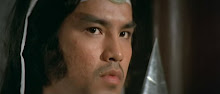
"We want to show our foreign fans that, although the Chinese people are small in stature, we are good fighters..."-- Liu Chia Liang in Southern Screen, July 1977 page 30.
 |
| Shooting the opening scene of 36TH CHAMBER OF SHAOLIN |
THE 36 CHAMBERS OF SHAOLIN (1978) was essentially Master Liu's version of Chang Cheh's SHAOLIN TEMPLE ([1976]; it even included a brief expansive shot from that film showing the inside of the temple set).
Easily one of the best movies of its kind to depict the actual training
of Chinese kung fu, Liu again manages to weave some genuine pathos for
his characters keeping them grounded in reality and overly sympathetic. This was in direct opposition to the adrenaline charged, testosterone fueled masculinity of Chang's pictures.
Liu's
magnum opus took 3 months to complete and employed upwards of 500
extras. All the hard work paid off handsomely, as the film was a huge
success. The directors devotion to Chinese martial arts is embedded in
virtually every frame. It's a brilliant movie from a brilliant director.
 Chang
Cheh's massive Shaolin spectacle was episodic in structure detailing an
array of characters and featuring many training sequences leading up to
a 30 minute battle at the end. When Liu Chia Liang made 36TH CHAMBER,
his film was equally sprawling, but put the central focus on a single
character -- the historical monk, San Te essayed to perfection by Gordon
Liu. He magnified the amount of kung fu training sequences going into
much greater detail than had been seen before. What was ingenious about
this was that through the meticulous, and varied training methods (detailing how the monks became martial arts masters)
San Te endures, the character is gradually built before our eyes. It's
one of the most fascinating character arcs ever seen in a martial arts
film. You're virtually watching a young boy grow up to be a man within a
two hour time span. It's easy to see why this film is so well regarded today.
 |
| Behind the scenes on 36TH CHAMBER OF SHAOLIN with Master Liu Chia Liang (middle) |
 |
| Master Liu cuts his adopted brothers hair for his iconic role. |
There
were many great kung fu movies, and many great directors of kung fu
movies. Liu Chia Liang was unique in that he was a martial artist making
them. He was always interested in delivering top kung fu pictures for
the domestic Asian markets. But now, he was recognized outside of Asian
territories. His enormous success and accolades seemed to imbue the
director with a desire to impress his foreign fans as well.
Unfortunately, this all seemed to change by 1980. Still, there was much
for the director to celebrate, and it was a great time to be Liu Chia
Liang and his adopted brother, Gordon Liu.
ALL IN THE FAMILY: JIMMY LIU CHIA YUNG (real name: Ho Chi-hung)
 |
| DRAGON'S CLAWS (1979) |
 |
| THE TIGRESS OF SHAOLIN (1979) |
The
youngest of the Liu/Lau family of fighters, Jimmy Liu is the nephew of
Liu Chia Liang. He had a good look about him, but he never hit it big in
movies. Some of the films he headlined were clones of whatever was popular
at the time, while others were barrel scrapers of the highest order.
His sole starring role for Shaw Brothers in the disastrous TIGRESS OF
SHAOLIN (1979) is a superb example of the latter. And who could forget
him being raped by a homosexual ghost in THE FEARLESS DUO (1978)? Even
Hwang Jang Lee couldn't save that one. He did co-star in the Lau Brothers production, CARRY ON WISEGUY (1980) aka WARRIOR FROM SHAOLIN. Two other pictures he starred in -- CRAZY COUPLE and DRAGON'S CLAWS (both 1979) were run of the mill, but worth watching. The latter film benefits from a lead villain performance by
Hwang Jang Lee. Jimmy Liu didn't confine his showbiz prowess solely in
front of the camera. He also operated in other duties behind it, as
well. Reportedly, he's still active today as a kung fu instructor.
 |
| L-R: Master Liu, David Chiang, Cecilia Wong; SHAOLIN MANTIS |
Sandwiched
between two of the directors greatest movies was possibly his oddest,
most divisive film for Shaw Brothers. While equally subversive (particularly in its treatment
of protagonist and antagonist) when compared to both his first movie, and HEROES OF THE EAST (which was also in production at the time),
SHAOLIN MANTIS (1978) was an unusual blend of Liu's typical
familial martial values mixed with a tragic plot line. The typical hero
role is made complicated for this film clouding discernment as to
whether he's actually a good guy or bad guy. The proposed hero is sent
by the tyrannical Qing emperor to uncover a powerful family of
government rebels. He manages to get close to the family to learn their
secret, even marrying the daughter in the process!
It
sets up a bewildering arc that confuses the audience on how they should
feel regarding the lead character. It's both a unique plot contrivance,
and also the films greatest detriment. Liberties are also taken in the creation of the Mantis style. It's simply a bizarre movie all around, but a rather daring experiment for the esteemed director.
 |
| Liu Chia Yung (left) fights David Chiang (right) during finale of SHAOLIN MANTIS |
Whatever ones opinion of SHAOLIN MANTIS, there's no denying that Master Liu made David Chiang (he's known as John Chiang nowadays) look the best he'd ever looked in a kung fu movie (he was also impressive in THE CHALLENGER [1979] and THE LOOT [1980]). Earlier in the decade, David was known as the 'Movie King'
at Shaw's for his popularity with fans and the number of box office
hits he was attached to. He was believable in swordplay films, but his
hand-to-hand failed to convince at times. Liu made him look good. Chiang
got a second wind at this point in his career, and headlined a slew of
kung fu movies in the late 1970s and into the early 1980s.
 |
| David Chiang (left) battles Gordon Liu (right) in SHAOLIN MANTIS |
Gordon
Liu has a guest star turn at the opening of SHAOLIN MANTIS playing a
bald shaolin monk ordered to fight Chiang's character in a duel.
Speaking
of Gordon Liu, his bald head became such an iconic image, that to see
him in a movie sporting a head full of hair seemed downright bizarre.
And seeing him with hair in his next movie is at first odd, but it's
such a great film, you soon separate the familiarity of San Te from
Gordon Liu.
 |
| Cast photo for Liu Chia Liang's production of HEROES OF THE EAST |
 |
| Gordon Liu and Yuka Mizuno promoting HEROES OF THE EAST |
Master
Liu continued his own brand of innovation with his next project, HEROES
OF THE EAST (1978). Working with the tentative title of 'The Heroic Chinese', Liu's next film was essentially the polar opposite of all the blood and viscera strewn 'Chinese vs. Japanese'
fist and kick flicks that dominated the early part of the 1970s. Liu's
film trades violence and generous splashes of red for a battle of the
sexes that leads to a serious misunderstanding between the two cultures.
What follows is a series of intricate duels wherein Gordon Liu takes on
a new Japanese villain each with their own varied style of martial art.
Peppered
with highlights, the Shaw's were apparently confident they had another
hit on their hands as HEROES OF THE EAST was heavily promoted in their
magazine publications. The Japanese heavy cast was ballyhooed to a great
degree, most especially the participation of Yasuaki Kurata and the
gorgeous model, Yuka Mizuno.
 |
| L-R: Gordon Liu, Yuka Mizuno, Liu Chia Liang |
In
the end, Liu had outdone himself yet again with this subversive take on
a familiar storyline packed with incredible, ingenious fighting
sequences. It's all the more amazing in that nobody dies. Chang Cheh,
and Shaw Brothers movies in general were renowned for their countless,
gory martial arts movies. Unlike most directors, Liu Chia Liang focused
more attention to family and tradition than to blood and guts.
From
here on out, Liu Chia Liang's movie career would be dominated by kung
fu pictures saturated with increasingly grating comedy shenanigans. The
films themselves were a delight in the intricacies of the fight
sequences, but often the heavy-handed humor made for a difficult viewing
experience at times. Save for one motion picture, all of Liu's Shaw
movies from this point on would contain a thick aura of comedy, or
operate as kid friendly entertainment.

This was readily apparent in Liu's next two movies -- DIRTY HO and MAD MONKEY KUNG FU (both 1979).
The humor is concentrated in the former -- born out of certain
characters parcel to some jarringly bizarre battles; but it points
towards the sort of extreme silliness Liu's movies were angling for in
subsequent pictures. The latter is non-stop action laced with near
constant goofiness.
 |
| Behind the scenes on DIRTY HO; Liu Chia Liang at right |
The
English title of DIRTY HO refers to the conman character played by Wong
Yu. The plot is somewhat complicated, if cynical in execution.
Essentially, it's the tale of the 11th Prince covertly mingling amongst
commoners while manipulating a petty thief to help eliminate a string of
assassins hired by 4th Prince, Frankie Wei Hung to keep him from
ascending the throne. The final scene, while humorous, is pessimistic as
the prince discards Ho after he's served his purpose; much like you
would a piece of garbage. The 11th Prince basically wants his cake and
eat it, too. Slaves aren't to question, but only do, and that's how
Gordon Liu's character shows himself to be come the finale.
DIRTY HO features some of the directors most creative choreography; most particularly in the 'congenial duels'
found throughout -- a number of fights take place while hidden under
the guise of a friendly conversation. For example, everyone else is
oblivious to the fact that two men are trying to kill each other while
sharing their love for art!

Both
here and in MAD MONKEY KUNG FU, Master Liu devises creative fighting
sequences that are enhanced by the artfully designed Shaw sets. MAD
MONKEY KUNG FU is a particularly irritating movie, but the fights save
it, and that's really all it has going for it. Liu Chia Liang not only
directed and designed the plethora of action, but he took the lead role,
as well. Master Liu often took small roles in his films, but this was
the first time he'd taken the lead. His student, Hsiao Hou, co-stars (see above photo),
but he fails to be a memorable presence despite being an incredible
acrobat and kung fu performer. The film is very popular among fans, and
it probably has the most action of all the films on the directors
resume.
DISCIPLES OF THE MASTER: HUI YING HUNG
 |
| Hui Ying Hung both castrates and guts Wang Lung Wei in 8 DIAGRAM POLE FIGHTER |
 |
| L-R: Hui, Chiang Sheng, Sun Chien; INVINCIBLE SHAOLIN |
Reportedly
spotted by a Shaw talent scout, Kara Hui Ying Hung was a nightclub
dancer before Chang Cheh put her in a few of his movies including THE
BRAVE ARCHER (1977) and INVINCIBLE SHAOLIN (1978). She signed with the
company in February of 1975. Other early roles include an assaulted teen
in Kuei Chi-Hung's nasty CRIMINALS 5: TEENAGERS NIGHTMARE (1977) and
came to a tragic end in Wang Feng's obscure THE LAST JUDGMENT (1979).
Having learned martial arts from her sisters prior to appearing in
movies, she didn't get a chance to do much in the way of fighting till
her co-starring role in the awful THE TIGRESS OF SHAOLIN (1979). From
1981 onward, she got many fighting roles, most famously in the works of
Liu Chia Liang. She won a Best Actress award for her role in MY YOUNG
AUNTIE (1981) aka THE ELDER. She was also alleged to have been
romantically involved with Liu. Her brother was the late Austin Wai Tin Chi. Kara has had one of the longest careers of any HK movie actress, and still appears in motion pictures today.
 In
1979, Lo Lieh was given an opportunity to fulfill his dream of
directing a film solely of his own. That particular movie was CLAN OF
THE WHITE LOTUS (1980). Operating as something of a sequel/remake of Liu
Chia Liang's EXECUTIONERS FROM SHAOLIN (1977), the revered Master Liu
helped out his friend by choreographing all the marvelous fight scenes.
Lo Lieh even played the White Lotus of the title -- the superior
colleague of the now dead White Brow Priest, Pai Mei. The team-up of Lo and Liu (see insert photo) was a much ballyhooed event at the time.
 Sometime around the completion of MAD MONKEY KUNG FU (1979), Liu's temperament changed. Despite his wealth (he had an affinity for fancy cars) and popularity, Master Liu became disenchanted with the company. As relayed to Chang Cheh by Sir Run Run Shaw himself, Liu was not "someone for long-term partnerships."
His sense of pride and
ego seemingly got the best of him at times. His relationship had soured
with Chang Cheh in 1975, and a few years later, the same had happened
between him and the Shaw's. Whereas at one time he seemed eager for international appeal,
he had now changed that sentiment, too. Still, he remained constant in
always displaying traditional Chinese martial arts onscreen with
superlative choreography.
 Liu
left the company briefly to work with his brother on a few independent
films under the Lau Brothers Film Company banner. Liu didn't direct any
of these, only designed the action sequences. Reportedly, Liu was an
avid gambler on horse races, but luck wasn't on his side when it came to making independent movies.
He eventually returned to Shaw's, and to familiar territory, with RETURN TO THE 36TH CHAMBER and MY YOUNG AUNTIE. The Shaw's, obviously excited about the potential of Liu's 36TH CHAMBER sequel, entered the picture at Cannes; but Liu was reportedly not interested in this sort of exposure. It's worth noting that Liu Chia Liang took a huge gamble with RETURN by having Gordon Liu play an entirely different character the second go round.
MY
YOUNG AUNTIE (1981) is arguably the more interesting of the two; mostly
in the way the director bridges the generation gap while presenting
Western influence on Eastern culture. Some fans dislike Fu Sheng for his
impish antics, but Liu Chia Liang lets his disciple Hsiao Hou run wild
seemingly every time. He's a marvel to watch onscreen, but too often he appears to suffer from ADD.
 |
| Liu Chia Liang battles Korean, Kwan Young Moon (right) in MY YOUNG AUNTIE |
 |
| Director Liu instructs Mai Te Lo in MY YOUNG AUNTIE |
Both films are incredibly silly, and despite being suitable for the entire family (nobody dies in these two, either), the oppressive, forced humor may be too much for some viewers to take.
Overly exaggerated comedy was a staple of Liu's movies beginning in
1980. Even predominantly serious films like LEGENDARY WEAPONS OF CHINA
(1982) wasn't immune to irksome humor (not to mention some scenes being backed by annoyingly shrill music). However, the fight sequences remained incredible, and both those pictures (RETURN and AUNTIE)
benefited from supporting villain roles from Chuan Yung-wen aka Kwan
Young Moon; a Korean Taekwondo expert familiar to kung fu movie fans.
 |
| Director Liu on set of MARTIAL CLUB |
The silliness continued with 'The Gyms'; or MARTIAL CLUB as it was known upon its theatrical release in 1981. This was Master Liu's favorite of his films (previously it was HEROES OF THE EAST),
and considering his upbringing and early career pre-Shaw's, it's not
hard to understand why. MARTIAL CLUB contains some of the directors best
work, and it's obvious the subject of a young Wong Fei-hung amidst
rival gyms was close to the directors heart. Master Liu tinkered with
cinematic tropes once more -- this time in having perennial villain,
Wang Lung Wei play a good guy! The film is one of the best kung fu films ever made, and while the comedy is prolific, it's not nearly as abrasive as it is in some of the directors other productions. Strangely enough, it was titled INSTRUCTORS OF DEATH on these shores despite nobody dying in the movie.
 |
| Liu Chia Liang and his brother Liu Chia Yung (right) |
It
was around this time that the troubled actor, Alexander Fu Sheng would
star alongside his brother, Chang Chan Peng, in Liu Chia Yung's
hilarious THE TREASURE HUNTERS (1981). He would also become a pupil of
Liu Chia Liang, and star in a few of his movies. This meant there were
more overwrought comedy scenarios coming, but also some true kung fu
classics. An example of the latter began shooting in May of 1981 as 'The Heroic Family'.
With virtually zero humor, it was to be the directors most serious,
gloomy work yet; and ultimately proved so in more ways than one.
FINAL INSTALLMENT TO BE CONTINUED IN PART 3
 "I want to put the sense of movement of kung fu into my films, and I always use real kung fu. Kung fu is the driving force in all my films." -- A Tribute to Action Choreographers, Liu Chia Liang interview, pp61
There have been many great directors of Hong Kong kung fu movies over the years. Arguably, no other martial artist (or martial arts director)
has been as dedicated to personifying the Chinese arts for Asian movie
lovers than Liu Chia Liang; or in Cantonese as he's predominantly referred to today, Lau Kar Leung.
 Regrettably, the
champion purveyor of kung fu cinema passed away Tuesday, June 25th, 2013 after an
approximately two decade long battle with cancer. Diagnosed with Lymphoma in 1994, his health declined further in 2005 when he got pneumonia
while working in cold temperatures on Tsui Hark's SEVEN SWORDS (2005). It was his last motion picture. His families from his first and second marriages were by his bedside when he passed on at 10:17am Tuesday morning. He was 76 years old.
Living
and breathing Chinese kung fu his entire life, Master Liu came from a
family of martial artists with a lineage that stretched back to the great Wong Fei-hung. The young Liu's father, Liu Chan (Lau Cham), was a
student of the famous Lam Sai-wing (himself the subject of a well known Sammo Hung movie). Lam (or Butcher Wing) was a student of Wong
Fei-hung (one of China's most revered national heroes, and the subject
of numerous kung fu films).
 Beginning
his training at an early age (sources state between 7 and 9 years old),
the Hung Fist passed down from Fei-hung to master Lam to Liu Chan was in turn passed on to his son, the young (soon
to be) master Liu -- a fourth generation disciple of Fei-hung. Adversity and determination paid off, and by the time
he was 14, the young master was already coaching others. He got his
break in the movie industry in the 1950s at age 17 (some sources say 18) appearing in a number of
productions as an extra or stuntman; many of which were early films
about Wong Fei-hung starring the venerable Kwan Tak Hing.
According to Master Liu, in
the early days of the Wong Fei-hung movies, these types of stagey kung fu pictures were financed by kung fu schools; and, unlike later, it wasn't uncommon for HK films to be shot with sync sound. Action choreography
was very different from where it would be in the late 1960s and beyond, but
master Liu was one of the chief proponents in its evolution.
 |
| Liu Chia Liang (at left), David Chiang (middle), Liu Chia Yung (right) |
It
wasn't till Chang Cheh recruited Liu (along with Tang Chia [Tong Kai in
Cantonese]) that his star really began to emerge. It wouldn't blossom
till 1975, but starting in the mid 1960s, Liu was under the banner of what was then the
biggest, most high profile film studio in Asia; not to mention being
one of the largest film studios in the world -- the Shaw Brothers studio.
Tasked
with executing action sequences for Chang Cheh's varied, and
exceedingly ambitious production slate, Liu Chia Liang and Tang Chia
(whose differing styles complemented one another) were as important of a
choreographing team as David Chiang and Ti Lung were as an acting duo.
It was quite an indomitable force to be reckoned with -- Liu and Tang
creating the fights, Chiang and Lung acting them out, and Chang Cheh
directing them.
 |
| Liu Chia Liang (standing) on ANGRY GUEST (1972) set |
|
Beginning in 1973, Liu went with Chang
Cheh to Taiwan to shoot a series of pictures for Shaw Brothers. The Hong
Kong based company had a lot of capital there that by law, couldn't be
extradited out of the country. After Cheh set up Chang's Film Company,
Liu's expertise in Hung Fist would be put to use in creating realistic
fighting sequences that hadn't been seen before. A few years earlier,
bare-fisted battles blazed across the screen in THE CHINESE BOXER
(1970), and in countless similar films afterward. These maneuvers were more
Karate-like and lacked grace, despite looking sufficiently brutal
onscreen. Liu made kung fu more fluid and realistic in showcasing the
actual style itself.
For the next few years, Chang Cheh did a successful
string of films that highlighted Hung Gar and its Shaolin origins. The
choreography of Liu Chia Liang was a key element in the success of these
pictures. However, towards the end of the decade, Master Liu, on his own, would apply emphasis on the martial arts itself, with less emphasis on the violence.
ALL IN THE FAMILY: LIU CHIA YUNG

 Master
Liu's brother, Liu Chia Yung (Lau Kar Wing in Cantonese), operated in much the same capacity that
his older brother did. He appeared in, choreographed, and directed almost as many movies as his more famous brother. The younger Liu brother did work more on the independent circuit, though. They even had a production company (Lau Brothers Film Company) independent of Shaw's where they made a few pictures like FISTS AND GUTS (1979) and CARRY ON WISEGUY (1980) to name two. Onscreen at Shaw's the two brothers
fought each other in CHALLENGE OF THE MASTERS (1976) and most famously
in Liu's much celebrated LEGENDARY WEAPONS OF CHINA (1982). Both
brothers had very different personalities. The older Liu was
aggressively passionate about his work with an ego to match. The younger sibling seemed to be far more laid back and seemingly less interested in
being in the limelight. Both men made enormous contributions to Hong Kong cinema.
 |
| Liu Chia Liang (middle) with Chang Cheh (right) |
Creative differences between
Chang and Liu emerged during the shooting of MARCO POLO (1975) in
Taiwan. Finally tiring of blood and guts theatrics, Liu wanted to make
his own movies. There could be only one king on the
mountain. Liu wanted to do things his way, and while under the aegis of Chang Cheh, that wasn't happening. Both men were similar in some
ways, and different in others. The hand of Chang Cheh is
noticeable throughout Liu's career, although the devout master of
Chinese kung fu placed his own stamp on his pictures. Furthermore, a
rift arose between the two (apparently spurred on by Liu, himself) and a reconciliation wasn't forthcoming till the late 1980s.
 |
| Master Liu & Chen Kuan Tai (left) on SPIRITUAL BOXER set |
Now
back in Hong Kong, and given the greenlight by Mona Fong, Liu was set
to direct his first motion picture. Beginning production under the title
of 'Skillful Fighter', the film was a light comedy effort (the first kung fu comedy) that
poked fun of superstitious Chinese beliefs and folklore surrounding the
Boxers -- fighters who could allegedly summon powerful gods to protect them from
bodily harm and death. Starring a virtual unknown in Wong Yu (Huang Yu), famous actors Ti Lung and Chen Kuan Tai appeared as guest stars during the beginning to add some additional star power. Taking only about a month to complete, the
experimental film was a success for the first action choreographer ever
given the directorial reigns. It also ensured more movies would be coming from Master
Liu.
THE SPIRITUAL BOXER (1975) was modestly similar to a
super production Chang Cheh was working on at that time entitled THE
BOXER REBELLION (1975; released in early 1976). The latter was a controversial 137 minute epic (drastically cut for its theatrical run and the title changed)
surrounding the historical event itself; while the former merely used
the Boxers and their spirit possession trickery as a comedic plot device. Liu would again
mine similar territory in 1982s LEGENDARY WEAPONS OF CHINA.
 |
| Master Liu and his disciple, Wong Yu (right) |
An unrelated sequel to this movie, THE SPIRITUAL BOXER 2, was released
in 1979. Compared to the first, it wasn't as successful in what amounted
to a poor kung fu-quasi horror comedy. It was possibly deemed a good gamble after
the first film proved lucrative upon its re-release that year. Wong Yu
returned in a different role, and the picture dealt with China's 'Corpse
Herders' -- technically, funeral arrangers who used black magic to transport corpses back to their family villages. The comedy is mostly weak, and the action doesn't show up
till late in the film. It would be the first misstep of Liu's career.
But after 1978, Master Liu couldn't go much higher having reached his
pinnacle that year.
ALL IN THE FAMILY 2: GORDON LIU

 The most famous Liu brother wasn't even of blood relation. Gordon Liu Chia Hui (Lau Kar Fai in Cantonese), the godson of Liu's mother, was first introduced in Chang Cheh's exemplar SHAOLIN MARTIAL ARTS
(1974). He had a fairly sizable supporting role as an ill-fated Eagle
Claw student. He also played one of the main Mongol villains in MARCO
POLO (1975), and had much smaller parts in Cheh's FIVE SHAOLIN MASTERS
(1974), THE BOXER REBELLION (1975), and SEVEN MAN ARMY (1976). He was eventually sent back to
Hong Kong so that he could take part in his adopted brothers movies. He
co-starred with Chen Kuan Tai in CHALLENGE OF THE MASTERS (1976), and
took guest star turns in both EXECUTIONERS FROM SHAOLIN (1977) and
SHAOLIN MANTIS (1978). His career skyrocketed in 1978 upon the release
of THE 36TH CHAMBER OF SHAOLIN, one of the most famous, and enduring
kung fu movies of all time. Most fans refer to him as 'the Master Killer';
so named for that films English translated theatrical release title.
Gordon Liu also made being bald fashionable for kung fu fans all around
the world.
 |
| Director Liu (middle at right of camera); Gordon Liu (at right) |
Liu's next few films were Shaolin affairs. It was his own 'Shaolin Cycle'
of pictures akin to those that Chang Cheh shot while in Taiwan. The
first of these had only a tenuous connection to that fabled temple. It
was also Liu's first of two cinematic depictions of Wong Fei-hung for Shaw Brothers.
Vastly different from Chang Cheh's style of heroism, Liu's second go as
director opted for a moralistic approach. It's arguably the perfect
martial arts film to watch for those who have no interest in the genre;
or for those with an interest in studying the arts itself. There's much drama and
humility found here, and Gordon Liu features in one of his best acting
roles in the lead as a very young version of Wong Fei-hung.
As
diverse as Liu's first two movies were, the influence of Chang Cheh was
in evidence. Chang began using the names of his protagonists as the
films Chinese titles starting with HEROES TWO (FANG SHIH YU AND HUNG HSI KUAN [1973]), and Liu Chia Liang
follows suit with the Chinese title of CHALLENGE OF THE MASTERS, which translates to LU AH TSAI AND WONG FEI HUNG.
 |
| Lo Lieh as Pai Mei -- one of a few white-haired villain roles he portrayed. |
His
second Shaolin effort -- EXECUTIONERS FROM SHAOLIN -- was a more straight ahead kung fu film; and feels
like a direct sequel to Chang Cheh's sprawling 120 minute epic, SHAOLIN
TEMPLE (1976). It begins at virtually the same moment that Chang's film
ends with the burning of Shaolin and the small band of warriors that
managed to escape.
 |
| Master Liu (right) gives Pai Mei (Lo Lieh at left) instructions |
Liu began work on 'Two Generations of Masters'
after wrapping THE SPIRITUAL BOXER (1975). Not long after, the familiar
moniker of EXECUTIONERS FROM SHAOLIN (1977) was attached. The opening
ambush is of special note for its ferocity -- an area of action Liu
rarely ventured. From there, the film slips into more comfortable
expository surroundings. Just as Cheh had introduced Priest White Brows,
Pai Mei in SHAOLIN AVENGERS (1976), Master Liu made him the central
antagonist of his movie. The director found three times was definitely
the charm at the box office. Not only was it a great success, but it
reinvigorated Lo Lieh's career, and spawned a slew of white-haired
villain movies.
 |
| Chen Kuan Tai |
Luck was on Liu's side in other ways, too. In October of 1976, Chen Kuan Tai (who plays Shaolin hero Hung Hsi Kwan in the film)
abruptly left the Shaw studio disrupting other pictures the actor was
working on at the time. Chen's departure didn't affect the completion of
EXECUTIONERS at all. Overall, this movie encapsulated Liu's strict
adherence to tradition and the importance of family. Aside from its weak
ending, it's a signature film in the directors oeuvre.

Liu
Chia Liang was riding high at this point. He had three box office hits
under his belt, and his work ethic, passion, and production slate showed
no signs of stagnation, nor slowing down. His next picture would
resonate beyond Hong Kong's borders becoming a huge hit all around the
world. It became the directors signature motion picture, and propelled
Gordon Liu into superstardom.
TO BE CONTINUED IN PART 2
copyright 2013. All text is the property of coolasscinema.com and should not be reproduced in whole, or in part, without permission from the author. All images, unless otherwise noted, are the property of their respective copyright owners.


 Chang
Cheh's massive Shaolin spectacle was episodic in structure detailing an
array of characters and featuring many training sequences leading up to
a 30 minute battle at the end. When Liu Chia Liang made 36TH CHAMBER,
his film was equally sprawling, but put the central focus on a single
character -- the historical monk, San Te essayed to perfection by Gordon
Liu. He magnified the amount of kung fu training sequences going into
much greater detail than had been seen before. What was ingenious about
this was that through the meticulous, and varied training methods (detailing how the monks became martial arts masters)
San Te endures, the character is gradually built before our eyes. It's
one of the most fascinating character arcs ever seen in a martial arts
film. You're virtually watching a young boy grow up to be a man within a
two hour time span. It's easy to see why this film is so well regarded today.


 In
1979, Lo Lieh was given an opportunity to fulfill his dream of
directing a film solely of his own. That particular movie was CLAN OF
THE WHITE LOTUS (1980). Operating as something of a sequel/remake of Liu
Chia Liang's EXECUTIONERS FROM SHAOLIN (1977), the revered Master Liu
helped out his friend by choreographing all the marvelous fight scenes.
Lo Lieh even played the White Lotus of the title -- the superior
colleague of the now dead White Brow Priest, Pai Mei. The team-up of Lo and Liu (see insert photo) was a much ballyhooed event at the time.
 Sometime around the completion of MAD MONKEY KUNG FU (1979), Liu's temperament changed. Despite his wealth (he had an affinity for fancy cars) and popularity, Master Liu became disenchanted with the company. As relayed to Chang Cheh by Sir Run Run Shaw himself, Liu was not "someone for long-term partnerships."
 Liu
left the company briefly to work with his brother on a few independent
films under the Lau Brothers Film Company banner. Liu didn't direct any
of these, only designed the action sequences. Reportedly, Liu was an
avid gambler on horse races, but luck wasn't on his side when it came to making independent movies.