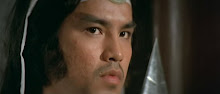
THE BOXER FROM SHANTUNG 1972 aka KILLER FROM SHANTUNG
Chen Kuan Tai (Ma Yung Chen), David Chiang (Tan Si), Cheng Kang Yeh (Hsiao Chang), Ching Li (Chin Lin Chi), Ku Feng (Chang Fa), Tin Ching (Li Cai chun), Mario Milano (Russian wrestler), Yuan Man Chi (prostitute)
Directed by Chang Cheh and Pao Hsueh Li
The Short Version: Chang Cheh's gangster epic became one of the biggest hits of his career, and made its star famous in rapid succession. Chen Kuan Tai is stoic as the country bumpkin who goes to Shanghai to seek his fortune, and climb the ladder of success on his own terms. He finds it's not only lonely at the top, but rather violent when the literal backstabbing begins and that famous Shaw shade of red is splashed from one end of the set to the other. An entire sub-genre of similar movies followed in BOXER's blood-drenched wake. A true classic of Hong Kong action cinema.

 Ma Yung Chen comes to the bustling city of Shanghai with his childhood friend. Encountering trouble soon after, Ma's superb kung fu abilities attracts the attention of local boss Tan Si, a gangster of the honorable sort. The two become quick friends, and Tan offers to help Ma; but he refuses any hand-outs, preferring to make it, or break it on his own. Soon, Ma's name spreads around Shanghai, attracting the attention of the dreaded Four Champions, a bloodthirsty, hatchet wielding mob syndicate run by Boss Yang. After a serious of encounters, Ma proves too much of a match for the rulers of the city, so a plan is hatched to eliminate both Tan and Ma Yung Chen permanently.
 1972 was a spectacular year for Shaw Brothers. Some of their biggest hits debuted that year; and it was a year that presented many of their most polished, high profile productions; THE BOXER FROM SHANTUNG was among them. It was one of director Chang's biggest hits of his prolific career, and a subject he would revisit a few other times in one form or another.
Unusual for its time, this films primary focus is on building character while placing kung fu fighting secondary to the plot. For a two hour movie, there's enough action to satisfy genre fans, it's just that these sequences are born out of the situation as opposed to filling a 'beat'em up' quota. THE BOXER FROM SHANTUNG isn't your average Fist & Kick flick.
1972 was a spectacular year for Shaw Brothers. Some of their biggest hits debuted that year; and it was a year that presented many of their most polished, high profile productions; THE BOXER FROM SHANTUNG was among them. It was one of director Chang's biggest hits of his prolific career, and a subject he would revisit a few other times in one form or another.
Unusual for its time, this films primary focus is on building character while placing kung fu fighting secondary to the plot. For a two hour movie, there's enough action to satisfy genre fans, it's just that these sequences are born out of the situation as opposed to filling a 'beat'em up' quota. THE BOXER FROM SHANTUNG isn't your average Fist & Kick flick.

 When Ma arrives in Shanghai, he immediately strikes up a friendship with local "good" gangster, Tan Si (played by David Chiang). Tan is rich and Ma is poor; so Tan makes him an offer to fight for a dollar coin, and tries to convince the noble peasant to relieve him of a fancy pocket watch if he can. Ma desires both items (money and what it can buy), but chooses to earn it, refusing any handouts. Shortly after this chance meeting, Ma runs afoul of Boss Yang and the Four Champions, the other gang in town; and a ruthless bunch who kill with hatchets and knives. Both gangs vie for supremacy in Shanghai in their respective casinos and drug deals. Ma quickly proves to be a formidable foe for Boss Yang -- outright declining to cozy up with him and his men.

Ma Yung Chen's eventual rise isn't the typical scenario of money and power ruining a good-natured soul. He may be a gangster, but he steadfastly refuses to allow his men to push the poor for protection money, and likewise shows no interest in acquiring revenue by taking over any of Tan Si's territory. The Chun Fu Lane territory lies right between Tan's and Yang's properties, so Ma sets his sights on claiming it for his own. It's here where the turning point occurs -- Ma Yung Chen has gotten to the top, but it's a long, deadly way down to the bottom.
 The friendship between Ma and Tan isn't elaborated on a great deal, but it's palpable in the handful of scenes the two men share together. From the dialog spoken, it's apparent there's a great deal of respect between them. Both are like real brothers -- both are from Shantung, and both have similar personalities. They share something else in common, but if you haven't seen the movie, I'll leave that to the viewer to discover.
There's a stronger bond depicted between Ma and his martial artless friend, Hsiao Chang. He is extremely loyal, and like a little brother. Hsiao idolizes Ma, and even at the end when Ma decides to go meet with Boss Yang alone, Hsiao wants to remain by his side as his coachman. Ma sends him away to start a new life away from the criminal underbelly that has gripped Shanghai.
The friendship between Ma and Tan isn't elaborated on a great deal, but it's palpable in the handful of scenes the two men share together. From the dialog spoken, it's apparent there's a great deal of respect between them. Both are like real brothers -- both are from Shantung, and both have similar personalities. They share something else in common, but if you haven't seen the movie, I'll leave that to the viewer to discover.
There's a stronger bond depicted between Ma and his martial artless friend, Hsiao Chang. He is extremely loyal, and like a little brother. Hsiao idolizes Ma, and even at the end when Ma decides to go meet with Boss Yang alone, Hsiao wants to remain by his side as his coachman. Ma sends him away to start a new life away from the criminal underbelly that has gripped Shanghai.
 The symbolism in Chang Cheh's script (co-written with noted, and prolific writer I Kuang) is laid on as thick as the gushing blood. The director displays a preoccupation with staircases, and equating them with success; or even a downfall. This happens on a few occasions such as when Ma is poor and gets to room in an upstairs loft, and again in a whorehouse seen taking three women up to a room for a tryst! At the end during the violent free-for-all, Ma finds it difficult to get to his target at the top of the stairs, so he brings the top down to his level.

 In addition to the violence and subtext, there's a pseudo romantic sub-plot involving famous actress Ching Li, but it's elaborated on about as much as the friendship between Ma and Tan. Again, it's the visuals that get the point across. Ma spies Chin (Ching Li) in a teahouse one afternoon. The two become momentarily transfixed on one another, but don't share a conversation between them. She's a low-income songstress, and Ma is still at the bottom of the totem pole. Once he gets some name value, the two meet again in the same place, but now her facial expression has changed to one of sadness in light of how Ma has changed, at least in her eyes. The striking part of this is that Ma's personality remains the same despite his chosen profession.
 Later in the film, it becomes obvious a drunken Ma Yung Chen definitely has Miss Chin on the brain. He's in a brothel with his pals, all of whom are surrounded by girls. Chin Lin Chi's name is brought up and when he looks over at the pretty face of Yuan Man Chi (co-star in Chang's SHAOLIN MARTIAL ARTS), he sees Chin in front of him. Unfortunately, the two never get close, which only adds to the depressing tone of the movie. Inside, Ma probably knows that, because of his current standing, he feels he doesn't deserve a woman like her; and like the typical Chang Cheh hero, he's too proud to let on, even though others around Ma can see it.
Both Chen and Ching Li reunited in the sequel where they did the deed they never got around to in this one. Ching would play Chen's adulterous wife in Chang Cheh's classic BLOOD BROTHERS (1973).
Later in the film, it becomes obvious a drunken Ma Yung Chen definitely has Miss Chin on the brain. He's in a brothel with his pals, all of whom are surrounded by girls. Chin Lin Chi's name is brought up and when he looks over at the pretty face of Yuan Man Chi (co-star in Chang's SHAOLIN MARTIAL ARTS), he sees Chin in front of him. Unfortunately, the two never get close, which only adds to the depressing tone of the movie. Inside, Ma probably knows that, because of his current standing, he feels he doesn't deserve a woman like her; and like the typical Chang Cheh hero, he's too proud to let on, even though others around Ma can see it.
Both Chen and Ching Li reunited in the sequel where they did the deed they never got around to in this one. Ching would play Chen's adulterous wife in Chang Cheh's classic BLOOD BROTHERS (1973).
 The fight scenes are fairly standard of the time period, yet the action turns up to 11 during the finale. The last 15 minutes is a no holds barred blood-fest. BOXER is a signature film in defining the directors style -- an honorable, yet stubborn man willing to walk into the fire knowing he'll get burned. Fire spreads, and a great many others get burned, and scorched spectacularly, mind you. If you're familiar with the directors work, you will have some idea as to how this movie will end. With four choreographers (Liu Chia Liang, Tang Chia, Liu Chia Yung, Chen Chung), they deliver a dazzling denouement of blood, sweat, and fists.
Chang's archetypal good gangster surfaced in the previous years THE DUEL (1971), starring David Chiang and Ti Lung. The former is a guest star here, likely to lend support considering Chen Kuan Tai was an unknown commodity at that time.
A 1969 Singapore martial arts champion, Chen can be spotted as one of the thugs that comes to a bad end in Cheh's award winning classic VENGEANCE! from 1970. He signed on to appear in Chang's WATER MARGIN films, but is sidelined in the first one; left mainly in the background. THE BOXER FROM SHANTUNG (1972) is his introduction to the world as a lead actor, and his charisma leaps and kicks off the screen.
 THE BOXER FROM SHANTUNG (1972) was highly influential, resulting in a healthy dose of clones and quasi-remakes throughout the decade; some of which would star Chen Kuan Tai, or directed by disciples of the venerable Chang Cheh. Like THE CHINESE BOXER (1970) starting a long running string of Chinese vs. Japanese motifs, popularized further with the advent of Bruce Lee, Chen's portrayal of Ma Yung Chen (sometimes listed as Ma Yung Cheng, or Ma Yong Zhen) beget dozens of shanghai gangster movies. These included Jimmy Wang Yu's rip-off FURIOUS SLAUGHTER (1972), HERO FROM SHANGHAI (1977), and BIG BOSS OF SHANGHAI (1979); the latter two starred Chen Kuan Tai in the title roles.

The Shaw's were enjoying big box office with their movies in the early 70s, and BOXER was yet another, netting over 2 million in Hong Kong alone. A sequel was assured, debuting in Chinese theaters later the same year. Titled MAN OF IRON (1972), it was a cooperative effort between Chang and his acolyte, DP Pao Hsueh Li, who'd also collaborated with the director on the first movie. In his memoirs, Chang credits Pao as the chief executive of MAN OF IRON; despite it looking and feeling more like a Chang Cheh movie than Pao's own later solo efforts.

 This was such a popular movie, director Chang revisited this 'rags to riches' storyline on two more occasions with DISCIPLES OF SHAOLIN (1975) and THE CHINATOWN KID (1977); both films starred Alexander Fu Sheng, and both pictures used items symbolic of wealth and success at the center of their narratives. For BOXER, it was a cigarette holder (and fleetingly, a gold pocket watch); in DISCIPLES, it's the pocket watch our young boxer desires. The romantic sub-plot gets a lot more mileage in this one; for CHINATOWN KID, it was a modern day digital watch that Fu Sheng was attracted to.

Years later, the enduring popularity of BOXER didn't go unnoticed. In 1996, the Shaw's resurfaced with a remake entitled HERO starring Takeshi Kaneshiro in the Ma Yung Chen role. Yuen Biao was Tan Si, and Yuen Tak was memorable as the deadly main villain. The film performed poorly, but the story of Ma was remade once more in 2013 as ONCE UPON A TIME IN SHANGHAI (2014). There were TV shows based on this story, too.
 Deserving of its accolades, THE BOXER FROM SHANTUNG (1972) is a highlight of Chang Cheh's career that nearly reached 100 motion pictures. The fighting sequences are dated now, but still impressive; especially during the bravura conclusion. It's not only an influential, important piece of HK cinema, but both John Woo and Godfrey Ho were assistant directors on the picture. The style of the former is evident in Chang Cheh's techniques. If you've not seen a movie by the Godfather of Hong Kong Action cinema, Chang Cheh, this is a good place to start.
This review is representative of the IVL R3 DVD.
 LOS CAMPEONES JUSTICIEROS 1970 (THE CHAMPIONS OF JUSTICE)
Blue Demon (himself), Mil Mascaras (himself), El Medico Asesino (The Killer Doctor/himself), Alejandro Cruz (The Black Shadow), Tinieblas (Darkness/himself), La Sombra Vengadora (The Avenging Shadow/himself), David Silva (Dr. Zarkoff/Black Hand), Elsa Cardenas (Elsa)
Directed by Federico Curiel
The Short Version: Before THE AVENGERS movie, there was THE CHAMPIONS OF JUSTICE. Five of Mexico's biggest wrestling stars engage a mad scientist and his superhuman, machine gun totin' midget militia in a neverending string of action set pieces. Just like the action, the jazzy soundtrack seldom slows down. Beautiful girls, some explosions, and slicker production values than usual enhance this lively, absolutely bonkers, low budget Bondian piece of Lucha madness.

 Dr. Marius Zarkoff, alias Black Hand, seeks revenge against The Champions of Justice for putting him in prison five years earlier. The Champions are a five man team of wrestlers that fight evil when they're not battling opponents in the ring. To see his vendetta through, Black Hand creates an army of superhuman midgets he uses to kidnap the Goddaughters of the Champions -- all of whom are beauty contest participants -- in addition to setting a variety of traps for our heroes. Zarkoff eventually captures one of the Justice members and takes control of his mind. The rest of the Champions battle their way to Zarkoff's hideout for a final showdown.
 Prolific Mexican director Curiel is often reliable in delivering shoestring entertainment that satisfies its core audience; other times, not so much. Thankfully, this is among the man's best efforts. LOS CAMPEONES JUSTICIEROS is also one of the best of the Lucha canon, and appears to have been granted something resembling a budget. Make no mistake, it's still an impoverished affair, but rarely has mediocrity been this ingeniously rewarding.
The action sequences are (moderately) varied as opposed to having the heroes and villains slug it out in the same locales over and over again; cars and boats are blown up, which is unusual for this sort of thing. The heroes drive motorcycles, as well as their own signature vehicles that only adds to spice up their personalities. If nothing else, this Mexican 'Justice League' is ambitious well beyond its means.
Prolific Mexican director Curiel is often reliable in delivering shoestring entertainment that satisfies its core audience; other times, not so much. Thankfully, this is among the man's best efforts. LOS CAMPEONES JUSTICIEROS is also one of the best of the Lucha canon, and appears to have been granted something resembling a budget. Make no mistake, it's still an impoverished affair, but rarely has mediocrity been this ingeniously rewarding.
The action sequences are (moderately) varied as opposed to having the heroes and villains slug it out in the same locales over and over again; cars and boats are blown up, which is unusual for this sort of thing. The heroes drive motorcycles, as well as their own signature vehicles that only adds to spice up their personalities. If nothing else, this Mexican 'Justice League' is ambitious well beyond its means.
 For this genre, wrestling is an integral factor to the success of these pictures. There's often at least two, but for this first entry in the trilogy, there's only one wrestling match, and that's at the very beginning. Oftentimes these matches have no impact on the plot, but sometimes are integrated into the storyline. The one that opens LOS CAMPEONES JUSTICIEROS seems like it's the former, but turns out to be the latter when one of Black Hand's peewee perpetrators attempts to assassinate three of our heroes with a machine gun!
 Blue Demon (real name Alejandro Munoz Moreno) was a hugely popular Lucha star; not worshiped to the level of the one and only Santo, but his popularity was on par with that of El Enmascarado De Plata; as was a long standing rivalry between the two that began with the unmasking of Blue's then partner, Black Shadow in 1952. Making his first wrestling appearance in 1948 in Laredo, Texas, Moreno made his way back to Mexico where he adopted the famous Blue Demon persona. On September 25th, 1953, Blue defeated El Santo, and his career skyrocketed from there. In 1964, Blue began a film career that spanned 25 films (a little under half of the number Santo starred in); 27 if you count his first two minor roles. Blue retired from the spotlight in 1989. He died from a heart attack on December 16th, 2000 while coming home from a gym. He was 78 years old.
 Mil Mascaras (real name Aaron Rodriguez) is among the biggest, most popular Mexican wrestlers in history. His legendary status is due in no small part to his crossing borders around the world cementing his name in the United States and Japan to name two. Debuting in 1964 as Ricardo Duran, he was spotted by Valente Perez, a magazine owner who was looking for a man to fill the mask of a new Lucha character. On July 16th, 1965, Ricardo Duran had officially become Mil Mascaras, or Thousand Masks. Mil was voted Most Popular Wrestler in American wrestling publications in the 1970s. In 1966, he began a film career that prospered till 1977 with 14 movies. Between 1980 and 2010, Mil starred in 5 more pictures, and counting. Clarifying in a 1977 interview, Mil has stated he will unmask upon his retirement. At 74 years old, Thousand Masks is still wrestling today.
 At 6'3", Tinieblas (Darkness) earned his subtitle, El Gigante. He debuted in the ring shortly after he made his big-screen debut in this film. Despite his imposing size and bodybuilder status, Darkness never got a film series of his own, but did co-star with virtually all the big names within a ten year span. His last two pictures were with Lucha cinema king, El Santo. Like the Saintly one, Darkness was popular enough to garner his own comic book series that outlasted his film career. Under his real name, Manuel Leal, the giant played Satan in the classic smash THE MUMMIES OF GUANAJUATO (1970). His nicknames were El Gigante Sabio (The Wise Giant) and Captain Adventure. Like many Luchas, his son carries on the Darkness tradition. Tinieblas, Sr. retired from the ring May 21st, 2011 at 72 years of age.
 El Medico Asesino of CHAMPIONS was not the same as the original Killer Doctor (Dr. Wagner, real name Manuel Gonzalez Rivera), who was the star of 1952 movie THE MAN IN THE SILVER MASK; a role turned down by Santo (and one he accepted in 1958 leading to a famous series of 52 films). Gran Markus, the Killer Doctor (real name Juan Chavarria Galicia) began his professional wrestling career in 1963 as Doctor Markus, and teamed with the original Medico Asesino some time later. Like Mil Mascaras, Gran Markus wrestled in America; particularly in the once thriving Texas organization, World Class Championship Wrestling teaming with Gino Hernandez. His film career began in 1969 where he was a stuntman in SANTO & BLUE DEMON VS. THE MONSTERS (1970). His onscreen debut as The Killer Doctor started with CHAMPIONS in 1970. died at 64 on November 15th, 2007 from diabetes.
 Alejandro Cruz Ortiz began wrestling at 19, but didn't go under the mask as The Black Shadow (above at left) till 1947. At that time, Black Shadow teamed with Blue Demon, begetting an intense rivalry with Santo; this culminated in a 70 minute match wherein Black Shadow lost both the match, and his mask. He was famous for his versatility, and fathering some of the sports most famous tropes like high-flying maneuvers. Despite losing his mask, Ortiz's career never slowed down. He supplemented his wrestling career with one on the Silver Screen appearing in numerous Santo films as a wrestler. He wore his mask in CHAMPIONS, and even played Blue Demon's doppelganger in SANTO & BLUE DEMON VS. THE MONSTERS (1970). Ortiz passed away March 8th, 2007 from pneumonia at 82 years of age.
 The Avenging Shadow (also listed as the Shadow Avenger) is a movie character created by producer Luis Manrique, and played by Fernando Oses in four movies all from 1954, and directed by Rafael Baledon. The character appeared again in at least two films in the 1960s. LOS CAMPEONES JUSTICIEROS was the last onscreen appearance of The Shadow Avenger. Oses was a well-rounded talent, not only as a wrestler and an actor, but also as a prolific writer, producer and director. Onscreen he mostly played bit parts as wrestlers, or henchmen of the bad guys; and on some occasions, the main antagonist like the vampire BARON BRAKOLA (1965). Oses had a rugged look about him, and his matches with El Santo were some of the best, often most brutal matches seen in Lucha cinema. The Man of a Thousand Talents, Fernando Oses, died May 2nd, 1999.
Another popular wrestler Rayo de Jalisco (Lightning from Jalisco) wore an almost identical outfit for his in-ring persona, and took the place of the Avenging Shadow in the two sequels, VUELVEN LOS CAMPEONES JUSTICIEROS and EL TRIUNFO LOS CAMPEONES JUSTICIEROS.
 Black Hand (not to be confused with the wrestler of the same name) is your typical mad scientist that crops up in these movies, virtually interchangeable from the last. Where Zarkoff differs is in his small army of midgets (redundant, ain't it?). These are no ordinary half-pints, mind you. They dress all in red, wear capes, and have an 'M' emblazoned on their chest. These lethal little people have been scientifically enhanced with the strength of ten hombres. Your jaw will hit the floor when you see agitated midgets beating the hell out of Blue Demon, Mil and the rest. There's also some spectacular dummy moments where the heroes show off their midget tossing skills.
 Much like the Italian sword and sandal movies during their declining years, midgets were a popular plot device in Mexican genre pictures. It made sense considering midget wrestling matches were always crowd pleasing attractions around the world in the sport of professional wrestling. It gets hysterical watching the wrestlers having to bend down in some way so the hyperactive halflings can Karate chop them. The little guys get to strut their stuff a lot in this one.

 Much of the fun factor of CHAMPIONS OF JUSTICE is due to some glaringly ridiculous, brain-dead moments; some of these include The Killer Doctor and Tinieblas on a boat wired to explode. For some unexplained reason, they never notice the explosives in plain sight just to the right of them. Apparently watching the bikini clad Elsa Cardenas on water skis was too much of a distraction. Another perplexing scene has our maniacal Lilliputians shooting ray guns that emit flame, but instead of setting the target on fire, it freezes them instead.
 Federico Curiel has been so prolific in Mexican cinema, his name bears mentioning twice. The man's hand guided numerous Mexican genre pictures from the Nostradamus vampire quartet, and several Lucha films of varying entertainment value; one of which was the biggest Lucha hit of them all, the aforementioned THE MUMMIES OF GUANAJUATO (1970). He helmed the first sequel to CHAMPIONS OF JUSTICE, VUELVEN LOS CAMPEONES JUSTICIEROS (1972) while Rafael Lanuza took the reigns of the third, and final entry, EL TRIUNFO DE LOS CAMPEONES JUSTICIEROS (1974).
Fans of masked wrestler pictures will get more than their money's worth from this one. The box office smash from 1970, THE MUMMIES OF GUANAJUATO gave you three Luchas, this one gives you five in a typically nutty adventure packed with mad scientists, midgets, and mucho acciones.
This review is representative of the Brentwood/BCI DVD.
copyright 2013. All text is the property of coolasscinema.com and should not be reproduced in whole, or in part, without permission from the author. All images, unless otherwise noted, are the property of their respective copyright owners.