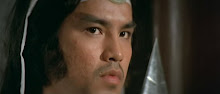
THE BRAIN STEALERS 1968
Lily Ho (Li Hsiao Lan), Peter Chen Ho (Chia Wen), Ku Wen Chung (Li Jung Hua), Chin Feng (Li Yuan Ming), Lin Chi Yung (Chi Hsia), Betty Ting Pei (Ding Die), Dr. Zero (Wu Ma), King Pai Chien (Lo Tian), Ho Pin (Chiu Tien Wei)
Directed by Inoue Umetsugu
The Short Version: Highly ambitious, if convoluted and kooky Bond-styled Sci-Spy thriller keeps it together for the most part, but loses its mind during the chaotic finale in the villains lair. Lily Ho, sporting a feminine version of Jack Lord's FIVE-O hairstyle and a constantly revolving fashion array may give some viewers a headache due to her judo-chopping character losing a bit of her edge as the film progresses. Despite a thick air of intrigue and red herrings, the brain teasers are occasionally interrupted with various gadgets, deadly traps, and a scarred, one-eyed, cackling super-villain. In the end, the only crime committed by THE BRAIN STEALERS is in being an intermittently brainless, yet consistently fun ninety-seven minutes.

 Having already kidnapped a number of the world's greatest minds, the uni-ocular and diabolical Dr. Zero sets his sight on Li Jung Hua, a leading Hong Kong scientist who has created a growth serum with the potential to increase plant life and food supply for the entire planet. Dr. Zero plans to use it to create a race of giants with which to conquer the world. Li's Judo-chopping daughter and a womanizing, ex-Interpol agent are recruited to stop him.
 The Shaw's had been on the James Bond bandwagon for a couple of years with films bearing such titles as ANGEL WITH THE IRON FIST (1966), POISON ROSE (1966), KISS AND KILL (1967), SUMMONS TO DEATH (1967), and ASIA-POL (1967) to name a handful of them. Considering how prolific Asian film production companies were, the number of James Bond inspired actioners were little more than a novelty; a fashionable film style that was dried up by 1970. With its short-lived popularity between 1966-1968, director Inoue did two of them -- the spy spoof OPERATION LIPSTICK (1967) and the brain-swapper being reviewed.
 Umetsugu wrote the screenplay, and it's chock full of genre tropes; some of which have that patented, over-the-top Shaw Brothers style about them. Inoue's professionalism is evident right off the bat, segueing into wilder territory upon introducing the principle bad guy. From there Umetsugu settles into a more serious position piling one red herring on top of the other. But once the film returns to Japan, that refreshing loopiness of the opening 15 minutes returns, and stays for the remainder. However, the finale has problems of its own....
 During the climax, Inoue gives his movie a brain aneurism with radical script revisions implemented to seemingly throw off audience affiliation with Peter Chen Ho's mushy status from his prior pictures. This big surprise comes off rushed, messily inserted, and makes very little sense in light of previous scenes; not only wrecking havoc with the narrative, but an underdeveloped sub-plot that no one remembers is re-introduced. Hong Kong movies often had many an implausible twist in their tails, but the one put into play here stretches suspension of disbelief to its limit. It's especially detrimental to THE BRAIN STEALERS since it's been such a fun ride up till the end. The film isn't ruined because of it, but it loses a lot of momentum over such sloppiness.
 For Shaw Brothers fans, THE BRAIN STEALERS does a fine job of holding viewer attention with its colorful set design and intrigue. The villains stronghold embedded inside a mountain isn't new, but it's nicely designed, and comes with the requisite traps and bizarre architecture. Gadgetry on display includes the main set piece -- a brain transport contraption of Dr. Zero's design. It operates much like the Disintegrator-Integrator of THE FLY (1958) and the transporter on STAR TREK. For the purposes of Zero's machine, your gray matter is transferred and swapped out with another host. Elsewhere our pulchritudinous Judo expert is armed with a perfume bottle that has two functions -- spraying a mist that renders enemies unconscious, and also a handy flamethrower! In addition, there's the standard communication devices hidden inside pens and cufflinks. An intimidating SciFi gun is seen, but never named. Its
actual function isn't specified, but it appears to disrupt the inner
organs of those shot with it.
For Shaw Brothers fans, THE BRAIN STEALERS does a fine job of holding viewer attention with its colorful set design and intrigue. The villains stronghold embedded inside a mountain isn't new, but it's nicely designed, and comes with the requisite traps and bizarre architecture. Gadgetry on display includes the main set piece -- a brain transport contraption of Dr. Zero's design. It operates much like the Disintegrator-Integrator of THE FLY (1958) and the transporter on STAR TREK. For the purposes of Zero's machine, your gray matter is transferred and swapped out with another host. Elsewhere our pulchritudinous Judo expert is armed with a perfume bottle that has two functions -- spraying a mist that renders enemies unconscious, and also a handy flamethrower! In addition, there's the standard communication devices hidden inside pens and cufflinks. An intimidating SciFi gun is seen, but never named. Its
actual function isn't specified, but it appears to disrupt the inner
organs of those shot with it. The original ending of the film had Lily rushing in to save the day armed with one of these ray guns, but in the release version, lovely Lily never even picks one up. Speaking of comely, Lily Ho's beauty is weapon enough. She has that sexy innocence with which to carry the picture.

 Li Hsiao Lan, as played by Lily Ho and her distracting hairstyle is a cross between her classy lady portrayals and the action heroines she occasionally essayed. At the very beginning, we see her practicing Judo. A few minutes later, she's unexpectedly tested by her employers into taking on a whole room full of attackers. Over the course of the movie, her aggressive nature gradually slips away teetering dangerously close to scared damsel mode; not that there's anything wrong with that, but the film vacillates between these two personalities -- one minute Li is capable of defending herself against multiple opponents, and a short time later, she is intimidated by a single adversary. In a bit of a cheesecake moment, Lily gets to fight in a nightgown; yet she never comes off quite as fierce as she does in the beginning.
 Lin Chi Yung is the James Bond identifier in the picture (he's referred to as 009 at one point), and for his amorous spy character to be integral to the plot, he has to muscle in on some of Lily's action. Both she and Lin have chemistry onscreen; and both share some mild romantic scenes together. Lin rescues her during one sequence wherein a snake charmer has loosed a cobra in her room! Another highlight is the battle atop Tokyo Tower. Finely realized via Shaw's indoor set that comes complete with an imperiled Lily Ho and two dummy deaths.
 The Bondian allusions are very much in evidence -- the way the film begins in setting up its story; the offbeat villains and assassins; the inclusion of dancers covered in body paint from head to toe; and the final scene recalls the closing shot from any entry in the Bond catalog of an impending sexual dalliance between Bond and his paramour. In this instance, the roles are reversed since Lily Ho is the main attraction. Unlike 007, she didn't make a return engagement.
 Japanese director Umetsugu cast his favorite actress Lily Ho in a
starring role for the fourth time up to that point; the fifth if you
count her guest star turn in HONG KONG RHAPSODY (1968). The fourth film
starring Ho, THE MILLIONAIRE CHASE (1969), had begun shooting a month
before THE BRAIN STEALERS in February, but was released after it. THE
BRAIN STEALERS has much the same cast as THE MILLIONAIRE CHASE, and both
films exteriors were done in Taiwan, Thailand, and Japan.
Japanese director Umetsugu cast his favorite actress Lily Ho in a
starring role for the fourth time up to that point; the fifth if you
count her guest star turn in HONG KONG RHAPSODY (1968). The fourth film
starring Ho, THE MILLIONAIRE CHASE (1969), had begun shooting a month
before THE BRAIN STEALERS in February, but was released after it. THE
BRAIN STEALERS has much the same cast as THE MILLIONAIRE CHASE, and both
films exteriors were done in Taiwan, Thailand, and Japan. 
Lily Ho was a Shaw starlet for almost a decade before calling it quits in 1974. Officially signing with the company in 1965, she appeared in many of the studios big drama and musical hits. This being Shaw Brothers, it wasn't long before Lily was tasked with action-thrillers, and then onto swordplay pictures. Her striking looks were an asset, and stood out from the rest of her colleagues.

 Dramas, comedies, and musicals were Peter Chen Ho's specialties. An actor of repute (accentuated by a high profile marriage to Betty Loh Ti), his role in THE BRAIN STEALERS was a change of pace for him. He tampered with his image even more in 1969s DEAR MURDERER. Unfortunately, the life of Chen wasn't the usual smiles and laughter of his movies. He and wife, the famous actress Betty Loh Ti, divorced in '68, followed by her apparent suicide in December of that year (although some sources claim it was accidental). Just as unfortunate, Chen Ho would die in 1970 at just 40 years of age. The star couple did appear onscreen together in such movies as THE DANCING MILLIONAIRESS (1964) and SONS OF THE GOOD EARTH (1965).
 Controversial actress, Betty Ting Pei (the lover of Bruce Lee, and the last person to see him alive) had signed with Shaw's in 1967. She'd previously been an actress for Central Motion Picture Corporation under the name of Tang Mei-li. Her role in THE BRAIN STEALERS is a minor one, playing the emotionally defiant underling whose disobedience proves expensive. Her demise is one of the best scenes in the picture.
A note about this restoration versus the stretched and cropped bootleg tape: Celestial's penchant for frame cuts to eliminate all signs of print damage has caused THE BRAIN STEALERS to lose approximately 7 minutes of its running time. There are no sequences removed, just frames averaging a minute per every 15 minutes of running time. These amount to closeups, a couple seconds of characters entering/exiting rooms, etc.

In the Asian spy canon, Umetsugu's second and last such film is among the most entertaining of the lot; even with its fractured finale and fickle onscreen temperament of its lead. If you're a fan of Bond imitations al dente, the Hong Kong style will likely be of interest to you for their outlandishness alone. Occasionally, and unfortunately taxing on the ol' bean, THE BRAIN STEALERS' inventive plot fails to realize its full potential, relegating it to pure popcorn entertainment value as opposed to any sort of brain food.
You can buy this movie HERE.