CHARLEY-ONE-EYE 1973
Richard Roundtree (The Black Man), Roy Thinnes (The Indian), Nigel Davenport (The Bounty Hunter), Aldo Sambrell (Mexican driver), Officer's wife (Jill Pearson), Mexican Youth (Luis Aller), Mexican Leader (Rafael Albaicin)
Directed by Don Chaffey
The Short Version: One of the weirdest westerns ever made is this Grand Guignol Brit filth western starring an amazingly unhinged, ill-mannered Richard Roundtree hot off his heroic triple threat as John SHAFT (1971) and its two subsequent sequels. Beginning with a dog fight and ending with chickens being blasted into chicken nuggets, CHARLEY-ONE-EYE (the name of The Indian's one-eyed fowl friend) is a tale of the talky west; where distrust, hate and revenge rule; where crippled outcasts and deviants of the barren desert wasteland are misshapen, hostile, and uncivilized. Drenched in surrealism with an almost arthouse sensibility, Chaffey's downer western is about the complicated bonding between an uncouth deserter/murderer and a club-footed Indian and their encounters with a bounty hunter and angry Mexicans. British financed and shot in Spain, it feels like experimental filmmaking coming from the director of kid-friendly flicks like JASON AND THE ARGONAUTS (1963), ONE MILLION YEARS B.C. (1966), PETE'S DRAGON (1977) and C.H.O.M.P.S. (1979).
 In 1866, Ben, a black Army soldier wanted for murdering a white officer after being caught in bed with his wife escapes into the Mexican desert and crosses paths with a crippled, half-breed Indian. Essentially taking the Indian captive, Ben berates and abuses the red man, forcing him to cook and cater to his every need. After an endless assault of verbal and mental abuse, the two outcasts learn to like each other. Eventually taking sanctuary in an abandoned church, they proceed to start new lives and raise chickens in seclusion. Danger manages to find them when a bounty hunter tracking Ben shows up and the two men incur the wrath of vengeful Mexican villagers.
  CHARLEY-ONE-EYE is one of the damned weirdest westerns you're ever likely to see. An obscure entry in the filth style of oater that rode into movie theaters back in the 1970s, the atmosphere is so realistically grimy (aided immeasurably by the near-constant sound of buzzing flies), you can almost smell the aroma of body odor emanating off the screen. The virtually non-existent plot paints everybody as ugly, cruel, or crippled. At the center of it all is a celluloid treatise on the nature of man; in this case harmony vs. hatred--more the latter than the former. There are no heroes. Only villains... and, in the case of one major character, the slow transformation from pacifism to aggression.
 What's curious about CHARLEY-ONE-EYE is in the casting of Richard Roundtree as Ben (or, as the end credits list him, The Black Man), a character who wouldn't win any awards for social graces. It's a startling performance and Roundtree is superb, even if he's about as genial as a desert rattlesnake. Roundtree was trying to escape the shadow of SHAFT (1971),
afraid of being pigeonholed in the same type of role over and over again. There was supposed
to have been some four more adventures of the screens first black private eye, but
Roundtree wanted to change his career path and pursue greener pastures. Unfortunately, some of
those pastures produced little crop. CHARLEY-ONE-EYE was one such
production.
What's curious about CHARLEY-ONE-EYE is in the casting of Richard Roundtree as Ben (or, as the end credits list him, The Black Man), a character who wouldn't win any awards for social graces. It's a startling performance and Roundtree is superb, even if he's about as genial as a desert rattlesnake. Roundtree was trying to escape the shadow of SHAFT (1971),
afraid of being pigeonholed in the same type of role over and over again. There was supposed
to have been some four more adventures of the screens first black private eye, but
Roundtree wanted to change his career path and pursue greener pastures. Unfortunately, some of
those pastures produced little crop. CHARLEY-ONE-EYE was one such
production.
 One of the first motion pictures of British TV producer David Frost's Paradine Productions (distributed in America by Paramount), filming began in Almeria, Spain on May 27th, 1972. Following Italy's lead in presenting the grittiness of the genre, the Italians had already switched to doing western comedies by this time. Don Chaffey's curio transcends them all, foregoing action and comedy, turning into something akin to Jodorowsky's EL TOPO (1970) with various symbolism and religious iconography. For example, one important sequence late in the picture occurs inside a church. The two friends make bets on their marksmanship using an effigy of Jesus Christ as their target. It comes back to haunt one of them at the end via symbolic use of the cross. Italy had its own existential style to their westerns so CHARLEY-ONE-EYE shares kinship with that breed.
 Standing out like a sore thumb on the resume of Don Chaffey, seeing a dark parable on the despondence of man from the guy who gave you lively, upbeat fare like JASON AND THE ARGONAUTS (1963) and Raquel Welch among the dinosaurs in ONE MILLION YEARS B.C. (1966) is an eye-opening experience. Known primarily for fantasy and kids movies, Chaffey seems an odd choice for the material; he nonetheless turns in surprisingly provocative results in comparison to other directors working with similar subject matter. Chaffey's last theatrical work was the AIP kiddie favorite, C.H.O.M.P.S. (1979). From there his career was dominated by numerous television programs.
 In keeping with CHARLEY's doom-laden quirkiness, Keith Leonard's script doesn't even give its characters names--although Roundtree states early on his name is Ben. The credits refer to each character as simply, 'The Black Man', 'The Indian', or 'The Bounty Hunter'. If the movie weren't already strange enough, the film's title is the name of The Indian's pet chicken. Thick with dour characterization, your tolerance for dialog will come into play as to whether you're able to endure CHARLEY-ONE-EYE or not. It's not a shoot'em up in the traditional sense, but an allegory that at times is difficult to discern.
 Going back to the characters, Roundtree's Ben is the polar opposite of John Shaft. A thoroughly unlikable and ignominious man; there's nothing noble about him at all. The first time we see him he steals a dead, partially eaten animal away from two starving dogs fighting over it. How he got there is revealed shortly thereafter in a flashback. Ben is caught in bed with the wife of his commanding officer. Naturally things don't end well and the walls get a new coat of red before he makes his escape into the desert. When Ben runs into The Indian, he basically takes him captive and treats him like a slave--sarcastically referring to him as 'Geronimo' or 'Sitting Bull' when he isn't calling him 'boy' and other forms of mental torture. The Indian gets a bit of payback, though, when Ben sprains his ankle during his mock-fest and can't walk on his own.
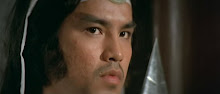
 "I never seen... crippled nigger before...", says The Indian just before cackling madly. After another series of stereotype jousting and further emotional battles, the two men formulate a bizarre friendship that eventually molds itself into something resembling trust between them. Roy Thinnes is a showstopper as The Indian with a bad leg. Virtually unrecognizable, his makeup is extraordinary, giving him an unkempt look to his face and hands. It's in stark contrast to his inner self. It would appear The Indian, a half-breed, has been an outcast for a lengthy period of time. He can't make a bow and arrow and probably never even knew his name. His non-exposure to humankind has served his passive nature well, though. Unfortunately, by the end of the movie he angrily accepts his heritage and joins the rest of the world in its obsession with violence.
 I've no idea what Keith Leonard had in mind when writing the script, nor why the film is named after a disfigured chicken. Having no friends in the world, The Indian, who also has a disfigurement, is immediately taken with the bird upon discovering it on the wagon of an old farmer they find dead on the trail. Things begin to look up for this eccentric trio till a bounty hunter tracking Ben finds them. Nigel Davenport instills the proper amount of villainy that manages to create some sympathy for Roundtree's unsympathetic character. The film becomes even darker with back-to-back moments of shock value; especially in the last moments with Thinnes' Indian ultimately embracing the low ebb of the human race.
  Prejudice is the only shared equality found in CHARLEY-ONE-EYE. Everybody hates everybody. Ben, as he puts it, doesn't understand honkies; he hates them, bragging about being "paid to kill white folks" in the Army ("I'd of done it for nothin'!"); Thinnes' wandering pariah just wants to be left alone but eventually learns what hatred is; Nigel Davenport's gruff bounty killer has an obvious disdain for blacks judging by his colorful verbiage; fiercely tribal, the Mexicans will rob you and kill you, plain and simple.
Italian western fans will spot perennial bad guy Aldo Sambrell (at left in above insert) in a small role as a Mexican who tries to rob both Ben and his lame-legged pal.
 With lots of closeups and few wide shots, the colors are drab as seen through the lenses of Kenneth Talbot's camera. The impenetrably burnt, dried out palette suits the claustrophobic tone of the movie so perfectly you can almost feel the heat and cracked earth crumbling beneath the actors' feet.
The music of John Cameron (PSYCHOMANIA [1973]) is as idiosyncratic as anything else in the picture. It's nothing particularly memorable, nor should you expect anything familiar to traditional westerns of US or Italian pedigrees.
CHARLEY-ONE-EYE was released to DVD in the UK in a fullscreen presentation in 2012. The running times vary (the DVD lists 84 minutes while other sources show 96 minutes) but this satellite airing runs 1:47:01. The film has yet to surface in America on any format.
 Oppressively negative from beginning to end, Chaffey's bizarre stab at the genre is in a class by itself. Aside from Thinnes' peculiar, effective portrayal, it is Richard
Roundtree who shines through Chaffey's cinematic cesspool. If you're a fan, you'll either be shocked by his performance or
impressed by his versatility. Likely prone to divisive opinions as much today as it was back then, CHARLEY-ONE-EYE (1973) probably won't find much of an audience today, either. Akin to its main characters, the film is an outcast among other defeatist westerns of the era; strangely, that is one of its strengths, too.
Oppressively negative from beginning to end, Chaffey's bizarre stab at the genre is in a class by itself. Aside from Thinnes' peculiar, effective portrayal, it is Richard
Roundtree who shines through Chaffey's cinematic cesspool. If you're a fan, you'll either be shocked by his performance or
impressed by his versatility. Likely prone to divisive opinions as much today as it was back then, CHARLEY-ONE-EYE (1973) probably won't find much of an audience today, either. Akin to its main characters, the film is an outcast among other defeatist westerns of the era; strangely, that is one of its strengths, too.