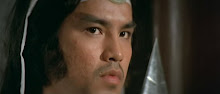
SILENT NIGHT DEADLY NIGHT PART 2 1987
Eric Freeman (Ricky Caldwell), James Newman (Dr. Henry Bloom), Elizabeth Kaitan (Jennifer), Jean Miller (Mother Superior)
Directed by Lee Harry
"It was him! Jolly St. Nick... with a knife in his hand!"
The Short Version: To say SILENT NIGHT, DEADLY 2 is only half as good as the first movie would be a somewhat accurate assertion. Approximately 30 minutes is made up of footage from the original leaving you with an hour's worth of an all-new film. Schlocky in places, it's undeniably well made in others with very tight editing, crisp cinematography, and a few splattery effects. Scorned for years, SILENT NIGHT 2 is louder than the first time
around; this is mainly due to lead star Eric Freeman turning it up to 11 with his volcanic
performance that epically erupts in the last 20 minutes. Years later we've learned the filmmakers were in on the joke and you should be, too.
 Doctor Bloom is assigned to get inside the head of mentally unstable Ricky Caldwell, a hulking killer locked up inside a sanitarium for various crimes. Beginning with his childhood and on through adulthood, the more questions Bloom asks, the more information he learns... and wishes he hadn't. Determined to decipher the method to Caldwell's madness, Bloom is told by the short-fused psychopath he's the 13th shrink to be in his presence. Bloom states 13 is his lucky number... but his luck has run out. Caldwell breaks free and goes on a rampage, leaving a trail of bodies in his wake while seeking to avenge the death of his late, equally homicidal brother on the Mother Superior who ran the orphanage from his childhood.
 Doctor Bloom is assigned to get inside the head of mentally unstable Ricky Caldwell, a hulking killer locked up inside a sanitarium for various crimes. Beginning with his childhood and on through adulthood, the more questions Bloom asks, the more information he learns... and wishes he hadn't. Determined to decipher the method to Caldwell's madness, Bloom is told by the short-fused psychopath he's the 13th shrink to be in his presence. Bloom states 13 is his lucky number... but his luck has run out. Caldwell breaks free and goes on a rampage, leaving a trail of bodies in his wake while seeking to avenge the death of his late, equally homicidal brother on the Mother Superior who ran the orphanage from his childhood.
  There were several horror sequels in 1987 including higher profile titles like CREEPSHOW 2 and EVIL DEAD 2. One that flew under the radar was SILENT NIGHT, DEADLY NIGHT PART 2. Aside from a minor mention in Fangoria of its impending release and a letter from an angry theater patron (see further down), there was virtually nothing written anywhere about the killer Santa reprise. It's surprising that a sequel was even banked on considering the trouble the original SILENT NIGHT, DEADLY NIGHT (1984) brought down on itself. Aside from one major strike against it (detailed below), SNDN2 is highly entertaining and surprisingly well made considering the circumstances surrounding its making.
Unanimously despised after its summer theatrical release in 1987, and its wider exposure on home video, it has since gained a cult following. Some find it the perfect antidote to the sadistic extremes of the original while others view it as unwatchable tripe. There's the camp that prefers the first movie and then there's the camp that feels the sequel is the best of the series. What has been learned in the ensuing years sheds new light on the sequel--allowing for a more fair analysis and viewing experience.


 Doubtless the film's biggest detriment is its usage of stock footage. This is not the fault of the filmmakers but the financiers who, shockingly, wanted to re-release Charles E. Sellier, Jr's film in a re-edited format and package it as a sequel. When you think about it, this really wasn't too different than the numerous film producers and distributors of the 70s and early 80s that re-packaged movies under different titles and often saddled the pictures with vastly dissimilar advertising campaigns. The outrage over the stock footage is minuscule compared to what might of happened had the sequel been released as a re-cut version of part one. Thankfully, director Lee Harry was able to convince the moneymen to pony up some additional funds for new footage while satisfying the distributors who simply wanted to take the lazy, deceptive route with their acquisition.
  In total, the amount of recycled footage comes to
a little over 28 minutes. Part 2 is 88 minutes, so you get an hour's
worth of new movie; including a handful of new shots replicating the re-used scenes from Part 1 (like a sex scene and a shot of Ricky as a little boy). Back then, there was a critical freakout over the inclusion of this footage to pad out the running time. Reviews always mis-stated some 40 minutes or more was scenes from Sellier's movie. Sadly, few outside of the filmmakers knew the reasons why. All these years later SNDN2 is far better than its reputation suggests.
In total, the amount of recycled footage comes to
a little over 28 minutes. Part 2 is 88 minutes, so you get an hour's
worth of new movie; including a handful of new shots replicating the re-used scenes from Part 1 (like a sex scene and a shot of Ricky as a little boy). Back then, there was a critical freakout over the inclusion of this footage to pad out the running time. Reviews always mis-stated some 40 minutes or more was scenes from Sellier's movie. Sadly, few outside of the filmmakers knew the reasons why. All these years later SNDN2 is far better than its reputation suggests.
 The film's editing is exemplar, and easily one of its best attributes. The editing of the old footage integrated into the new film is likewise well handled; tightened up with the "dead ends" removed. Some were bugged that the gore from the original was considerably lessened, but that was more to do with the MPAA; who were clamping down on violence in movies at that time, and especially in non-major studio pictures. The new portions have some very good gore effects such as a battery charger death, the popular umbrella death, and a good severed head gag.
In Sellier's original version, the pacing suited the footage since it not only fits that film's tone but it belongs there. In what seems like a move to keep the audience's attention, a lot of the re-used footage has Ricky's narration over it; granted, a lot of it doesn't... since it would be impossible for him to know those details (as well as to have seen them).

 Perhaps had this sequel emerged on the heels of the original, it wouldn't have seemed so scandalous to horror fans. Since Charles E. Sellier, Jr's movie was pulled just two weeks into its run over its controversial subject matter, not many people saw it.... but a great many people wanted to; the controversy surrounding it guaranteed a level of public interest. Further, there was a window of a year and a half between SNDN's theatrical and home video release. The first film hit videocassette in 1986 and was a hot rental. By the time the sequel surfaced in 1987, everybody had already seen the first movie; so naturally, they felt cheated.
 |
| Reader letter from Fangoria #66, August 1987 (address removed) |
This wasn't the first time a sequel had a higher than usual quotient of scenes taken from a previous movie. Uli Lommel's BOOGEYMAN 2 from 1983 went much farther than Lee Harry did. The tone of both pictures is similar (Lommel's movie is kind of autobiographical) yet it's the Santa sequel that stands out.
When I first saw it in 1988 I was grossly disappointed. The recycled SNDN1 inserts quickly bored me; and when the actual movie began, it was hokey, seemingly vying for a slot in the annals of Worst Movies Ever Made. Over the years the picture grew on me and I began to appreciate it for both its schlocky and technical qualities. Having learned about the film's production and paying a bit more attention to it, there is certainly some good things living among the silliness.
 If there's any question the filmmakers were going for something with a lighter taste as opposed to the hard liquor of PART 1 need only look at the scene in the movie theater. In it, Ricky and Jennifer end up watching, of all things,
SILENT NIGHT, DEADLY NIGHT (1984). It's one of the funniest in-jokes to be found in any horror flick, good or bad. Taking the jokiness even further, the
narration of the trailer we hear unfolding offscreen sounds like one of your finer
Samuel L. Bronkowitz productions featured in THE KENTUCKY FRIED MOVIE
(1977).... "CHAOS! The motion picture you've been waiting for! More
action! More violence! More death and destruction than any film ever
seen before! CHAOS!"
If there's any question the filmmakers were going for something with a lighter taste as opposed to the hard liquor of PART 1 need only look at the scene in the movie theater. In it, Ricky and Jennifer end up watching, of all things,
SILENT NIGHT, DEADLY NIGHT (1984). It's one of the funniest in-jokes to be found in any horror flick, good or bad. Taking the jokiness even further, the
narration of the trailer we hear unfolding offscreen sounds like one of your finer
Samuel L. Bronkowitz productions featured in THE KENTUCKY FRIED MOVIE
(1977).... "CHAOS! The motion picture you've been waiting for! More
action! More violence! More death and destruction than any film ever
seen before! CHAOS!" This sequence is made even more funny with the ubiquitous annoying-movie-theater-guy played by Eric Freeman's friend, Randy Post. Seated next to our spikey-haired noisemaker is director Lee Harry. Clearly Lee Harry has a knack for comedy; traits that are heavily evident in his recent short film of darkly comical genius, THE WHISTLER (2015). It's a shame Lee didn't direct more than a few features; or that he and his crew couldn't have returned to direct the full-length third film, SNDN3: YOU BETTER WATCH OUT. That picture desperately needed a shot of adrenaline and a return of PART 2's lead star....
 Above all else, what has kept the film alive--good or ill--has been the lead performance by Eric Freeman. Manic, at times subtle, but almost always over the top; the utterance of the words "naughty" and "punish" ensures violence is coming. The near-constant grimacing and camera mugging reminded me of Sonny Chiba in one of his skull-cracker movies. And yet that is the key to the film's longevity. Aside from Eric's frequent "Hulk Smash" mode, there's an occasional nuance in his performance that belies the exaggeration everyone is fond of.
  There's a moment during the celebrated 'rampage' sequence; it's the moment the cop (Kenneth McCabe, affectionately referred to as Barney Fife) tries to arrest him. Ricky, having just murdered his girlfriend, turns slowly with this calculating, maybe even tired look on his face. This tiredness is more or less confirmed when he tries to kill himself after embarking on a brief suburban shooting gallery. Relaying this to Dr. Bloom, Ricky, in a mocking tone, laments that his suicide was halted.
It's also worth noting that Ricky has, like his brother before him, taken on the attributes of the Mother Superior; twisting them into a murderous form of disciplinary action. Where it was beaten into his brother, Ricky's madness is fueled by revenge. It's not hard to miss what with all the overt goofiness every few minutes. This scripting addition is found in the original, but taken to more cartoonish extremes in Part 2.

 One of Ricky's character traits is that the color red sets him off; similar to Terence Hill in SUPER FUZZ (1980). The difference is that, unlike Terence Hill, he doesn't lose any super powers, he just loses his mind. The script gets a lot of mileage out of this device--a little red here, a little red there... When he dons the Santa suit during the last ten minutes, it sends him into overdrive and justifies the extreme go-for-broke style Eric Freeman indulges in during the 'settling of accounts' with the Mother Superior character from the first movie (now played by Jean Miller).
  This finale is superior (pun intended) to the one that closes the original. Ricky arrives at her home, his axe substituting for a door knock. Another of the film's sight gags/moments of irony is that her house number is none other than 666! It's a satisfying final confrontation that was denied the original. Granted, Sellier's movie had some power to its ending, but it needed a bit more of a punch. Ricky "dies" in the same way, but more spectacularly, and with more rambunctious musical accompaniment.
Freeman utters some very silly lines with the conviction of a bull in a china shop; one such line being the phrase "Garbage Day!" It became a meme known far and wide from fans and even those who've no idea what SNDN2 is. There's a number of other humorous lines but that's the one that stuck.
Sadly, SNDN2 didn't lead to a longer genre career for Eric Freeman. Aside from other parts in television and movies like David DeCoteau's MURDER WEAPON (1989), it remains his sole lead role.

Far from receiving a welcome reception back when it first came out, SNDN2 has since garnered a cult following that continues to find increasing levels of appreciation. Adored by many as bad cinema made good, there's no denying some genuinely well made, memorable moments spread throughout the film's 60 minutes of original material. A good score, funny moments, memorable gore, and a boisterous lead performance.... there's nothing SILENT on this NIGHT.