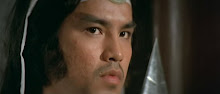
MANIAC COP 1988
Tom Atkins (Frank McCrae), Bruce Campbell (Jack Forrest), Laurene Landon (Theresa Mallory), Robert Z'dar (Matt Cordell), Richard Roundtree (Commissioner Pike), William Smith (Captain Ripley)
Directed by William Lustig
The Short Version: Wickedly well written pseudo slasher-action horror picture from the director of the slimy MANIAC from 1980. There's far too many characters, but Lustig and writer-fellow filmmaker, Larry Cohen devise a fast and furious indie horror mini epic about a killer cop who may, or may not be back from the grave in his pursuit for revenge.

Innocent citizens begin turning up dead after dark, the victims of an unknown, but psychotic police officer. Not long after, officer Jack Forrest is arrested as the prime suspect with all evidence pointing to him as the killer. Detective Frank McCrae discovers the real murderer is Matt Cordell, a former wild, but celebrated policeman. Framed by crooked politicians and placed in prison with a number of the criminals he put away, Cordell was murdered while incarcerated, or was he?

 This late 80s stunt horror flick flirts with slasher movie conventions and mixes them with lots of shootings, car crashes and a slight giallo-ish 'whodunit?' vibe that dominates the first half. Lustig creates an intriguing upper tier 'B' picture aided and abetted by a smart and witty script by Larry Cohen (who also produced), the director of such movies as BLACK CAESAR (1972) and IT'S ALIVE (1974). Cohen's script is overcrowded with characters like your typical big city prison, but just enough time is spent with most of the principals to get a modicum of exposition. A beautiful reporter hired by McCrae is introduced early on, but seemingly dropped immediately after. The Japanese version contains a crooked mayor character that is only mentioned in the US version. James Glickenhaus, the director of one of the most fondly remembered Vietnam-vigilante movies, THE EXTERMINATOR (1980), acts as Executive Producer for the show.

 The cast itself is an exploitation fans dream what with the participation of Richard Roundtree (SHAFT), William Smith (THE LOSERS), Laurene Landon (HUNDRA) and of course, Tom Atkins (THE FOG) and Bruce Campbell (THE EVIL DEAD). Atkins is listed as the main star, but he's not really the main character. Campbell and Landon are, but they don't even appear till nearly 30 minutes into the movie. It's an ingenious plot device that's been used at least as far back as Hitchcock's PSYCHO (1960). As detective McCrae, Atkins is the kind of character actor that brings something special to his roles that hasn't gone unnoticed, garnering him quite the fan following. Campbell speaks for himself, but Laurene Landon is yet another cult actress whose participation is most welcome. Both Smith and Roundtree aren't in the film as much as one would like, but their presence is indeed appreciated and their exit from the film is a bit of a surprise.

 Robert Z'Dar had been in movies and TV before, but came into his own with his intimidating role as Matt Cordell. Personally, his character works better when he's seen from a distance, or silhouette and when you don't see his face in close up. The exaggerated facial expressions at the end are a bit silly, but otherwise, Z'Dar's silent killer echoes what Kane Hodder brought to the table for his genre defining turn as Jason Voorhees. Z'Dar would be even more impressive in the even more exciting sequel, MANIAC COP 2 (1990). Z'Dar also donned the uniform for the least interesting entry, the troubled MANIAC COP 3: BADGE OF SILENCE (1993). If any fine can be written out for MANIAC COP, it's that it's never known if Cordell is alive, or back from the grave. This portion of the script is muddled, but by the second movie, this query is rendered obsolete as it's pretty clear he is definitely a zombie in the TERMINATOR mold.
 William Lustig has had a fairly average, uneventful, filmmaking career as most of his movies are derivative of other, more widely known features. Still, he's been very successful at it. Save for MANIAC (1980), none of his movies have really made a major impact outside of cult appeal. His RELENTLESS (1989) is probably his most well known work to mainstream audiences, a film that garnered at least three sequels. Still, Lustig shows undeniable skill in presenting New York City as a frightening, violent place to live in most of his pictures; something Larry Cohen was equally adept at. Their partnership here is a stroke of low budget genius. Lustig is also gifted at putting numerous stars and fan fave personalities in big, or memorable roles long before Tarantino made it fashionable. Lustig later found his niche when he created the amazing Blue Underground Entertainment DVD label, a source to re-release films he has a passion for that hadn't been seen in decades as well as a means to introduce said films to an all new audience.

 MANIAC COP (1988) works very well even if it is occasionally on the silly side and wears its 80s vibe like a badge of honor. Larry Cohen has fashioned a fine script that belies the potentiality for cheap horror thrills and the stunts and action raise the production above typical terror fare. There's relatively little gore, which may put off those expecting a FRIDAY THE 13TH styled flick. Lustig's movie, an independent feature, was viable enough to inspire an uninspired rip off that debuted on tape as PSYCHO COP in 1989. This crime on video committed another criminal act by getting a sequel, the even more inferior PSYCHO COP 2 in 1993. Lustig's 'sort of' companion pic to his sleaze-tastic MANIAC (1980) still holds up shockingly well on its minimalist budget and is easily one of the best horror hybrids of the 1980s.
This review is representative of the Synapse DVD.