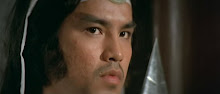
KARATE WARRIORS 1976 aka KOZURE SATSUJIN KEN (KILLING FIST WITH CHILD)
Sonny Chiba (Chieko), Isao Natsuyagi (Mizuki), Yayoi Watanabe (Genko), Hideo Murota (Nisha), Eiji Go (Iga), Tatsuo Umemiya (gangster), Akiko Koyama (Yumi), Ben Amatsu
Directed by Kazuhiko Yamaguchi
The Short Version: Yamaguchi, the director responsible for Sonny Chiba's classic OYAMA trilogy returns to guide the icon in this interesting modernist Chambara/western bereft of the wild absurdities that often dominate Chiba's movies. An aura of colorful comic shenanigans enters the picture towards the end, but predominantly its a heart-felt affair in a re-telling of YOJIMBO (1961) complete with a clashing of the past and present, a search for millions in stashed heroin, sex, gory action and a pitiable, pushed around little boy who only wants a family. One of Chiba's best films that successfully melds poignancy and pathos with sex and violence.

 Chieko, a drifter and lone fist for hire, finds work between two sibling gangs warring for territorial superiority in addition to seeking the whereabouts of millions in heroin hidden away in a secret location. Formerly one gang, the group split after their honorable leader, Kenzo died and his savage successor, Koreko--who hid the high dollar heroin--was imprisoned for murder shortly after taking over. Chieko heats up the blood battle between the two brothers while a devious mobster whore works them all for her own gains. Meanwhile, a silent samurai with son, clinging to his country's old ways, works for one of the cartel, yet retains the fortitude of Bushido. Amidst the violent clashes to find the concealed drugs, the little boy is caught in the middle and made both a pawn and a target of the vicious gangsters.

 One of Sonny Chiba's best movies is this variant on his popular Takuma Tsurugi STREETFIGHTER character that also acts as a remake of Kurosawa's YOJIMBO (1961) and a dose of the LONE WOLF series for good measure. Chiba plays a 'Lone Wolf' of sorts a veritable mercenary for hire; a somewhat underhanded individual, but one with an emotional side especially towards children. It's a complex character and one that was a lot different from the brutal comic book caricatures of many of Chiba's other movies. KARATE WARRIORS, like Chiba's earlier THE BODYGUARD (1973), is a fascinating movie, only not for reasons of exploitation cinema history as that picture was. KARATE WARRIORS derives its immersive qualities from how it subverts, or expands on themes, characters and ideas from prior Japanese productions.

 Chieko is similar to the iconic actors portrayal of Takuma Tsurugi in that he is mainly out for himself personifying the dividing line between a hero and a villain. Aside from that, both are vastly different. Chieko even makes the statement, "I don't fight dirty", while the mantra, "If you've gotta fight, fight dirty!" was used to promote the savage fury of Tsurugi. It's also a popular notion that Sonny Chiba was technically lacking in grace in his onscreen martial arts fighting movements in comparison to other silver screen fighters. Again, THE STREETFIGHTER is the template by which everything Chiba has done is essentially judged. The man was certainly graceful in his films, but Tsurugi was not supposed to be the Karate version of Gene Kelly or Fred Astaire. He was supposed to be rough and straightforwardly brutal. The character of Chieko in KARATE WARRIORS is frequently graceful pulling off moves that look far more attractive than those delivered by the lumbering, if entirely precise Tsurugi the caveman.

 The YOJIMBO connection is a lone stranger who ends up in the middle of a gang war between two brothers. Chieko feigns seeking work between the two ultimately creating more violence in the process all the while scheming with his own ulterior motives. Meanwhile, a mysterious and predominantly silent samurai named Mizuki works for one of the factions while his sad son tags along. This is where the Itto Ogami accent is inserted from Toho's hugely popular LONE WOLF & CUB series but it, too, is presented with some additional twists. So many of Chiba's movies feature children in some sort of subplot even though the violence level and sexual situations are at odds with the familial nature of the child interactions. For this film, the plotline with the little boy is integral to the success of the picture and by the end, the sorrow entrenched plight of the child will temper even the most hardened soul.

 The two characters of Chieko and Mizuki offer a strikingly alluring dichotomy between the past and the present. Mizuki wanders the streets decked out in traditional samurai garb. Although his enactment of Bushido is a bit skewed, he still fights honorably with his sword. On the opposite end of the spectrum, Chieko is a fighter who is skilled in the sword, but prefers his fists and feet. A few times during the film, Chieko is seen delivering a sword strike followed by an offensive maneuver with his body such as a kick or a punch. It's this marriage of the past and present that enables Chieko to have the upper hand against the samurai upon their fated duelling date. Both respect each other highly, but both have their own agendas that will bring them to eventual battle.

 Isao Natsuyagi had been in movies since the original 13 ASSASSINS from 1963. He made his mark in two B/W Chambara pictures from Hideo Gosha, SAMURAI WOLF 1 and 2 from 1965 and 1966. He, like Chiba, has a great deal of onscreen charisma. This magnetism served Natsuyagi extremely well in his other movies especially in a grand showing from the ambitious box office success that was the peculiar TIME SLIP from 1979 also starring Sonny Chiba. For his role as the quiet samurai of this modern day Karate film, Natsuyagi is more methodical and barely showing any emotion in his face. He's not the least bit brazen as some of his other roles engender. His duel with Chiba in a cemetery is a high point and choreographed in traditional Chambara style only the Japan of the 1970s sits in for the period Japanese settings of the Feudal Era.

 The marriage of period samurai tales and modern Yakuza action is displayed in other ways throughout the movie, too. Some of the dusty, desolate and windswept locations and even Iga's sleazy night club where Chieko first meets them has amenities that recall the saloons of the old west such as the same type of swinging door. The one thing lacking, though, is a sheriff. In fact, the police element is predominantly absent here. It's the one major flaw that keeps the film firmly planted in comic book territory. You could make the argument that the cops are paid off, but we never see this. The strength of the dramatic portions of the picture are palpable enough to supersede the minor shortcomings.

 Not only is there the blood feud between two brothers, but there's also a minor subplot of clashing lifestyles between two sisters, Yumi and Genko. Yumi is a nurse struggling to make a living while her sister is a prostitute who jumps ship from one boat to the other depending on how sturdy the hull is. Flip flopping between gangsters (and Chieko, too) she's used and abused all the while hiding her own agenda. She's the more interesting of the two in that we learn she has used her body to help get her sister on her feet and pay her way through school. This is just one of several cogs in this scripted wheel that paints a different picture of what is perceived as lower level society.

 The other subplot, and the one that gets the most mileage, concerns Nanu, the little boy. His father, Mizuki seems to have no time for him from being busy as a sword for hire with Nishi's gang. Nanu's numerous scenes with Chieko quickly takes on a father-son relationship. Chieko helps the boy learn fishing, protects him and consoles him after witnessing the child being tormented by other school kids. Later in the film, Nanu is put in harms way and is injured. Chieko gives his blood for a transfusion to save the childs life. Afterward, this is the first time Mizuki steps in as a father figure to his unanimously unloved son. He tells Nanu what Chieko had done and that he should "never forget his generosity" and also speaks what we the audience already know--that the two will eventually have to fight each other.

 And when the two warriors do finally meet at sixty minutes into the movie, you'd think this was supposed to be the big finish. Debts are paid and services rendered, but it's a false finish! Koreko and some of his men bust out of prison and seek to take back their syndicate. It's here that the movie is at its most manga with this colorfully decorated group of villains that would fit right in among the post apocalyptic wasteland. The remaining thirty minutes is more or less KARATE WARRIORS-CHAPTER 2 with the main plot now resolved, a new one takes its place and soon Chieko's true inner humanity takes hold.
 With Chieko now in possession of the coveted heroin stash, Koreko's men are sent after him. While aboard a train enroute to find Nanu's mother, Chieko befriends a prisoner, handcuffed to a detective. The chained man, in a moment of bravery, saves Nanu from being thrown from the train. It's yet another instance where the script champions criminals, or those of a less than respectable nature showing us they're not necessarily as bad as we may think they are. It would seem the goal Tatsuhiko Kamoi's script is to show us that not every crook is what they seem; that even the most ignominious soul retains the capacity for love and compassion. This fascinating viewpoint collides with the wholesome novelty of the family unit.

 Upon meeting Mizuki's ex wife who is now remarried and has a new son, Chieko explains the situation. Amazingly, she rejects her first born citing, "I only know my boy here. I can't accept that other one now!" We never learn exactly why Mizuki and his wife split apart whether due to infidelity or due to him becoming embroiled in underworld activities. The sadness of the whole thing is that Nanu was led to believe that his mother had been dead all that time and now that he's been brought to her, she doesn't want him. Her disownership seems involuntary, but it's a powerful scene upon putting everything in perspective. This child had essentially no father to bring him up, no friends and was regularly tormented by his classmates as well as being nearly killed by gangsters and assassins. Throughout all this, the kid was tossed around like a rag doll to evade death and now upon finding his mother whom he thought had died, she wishes to have absolutely nothing to do with him. Thankfully, both Nanu and Chieko gain some much deserved redemption by the final scene.

 While the camerawork isn't as chaotic as it is in other Yamaguchi movies, the use of slow motion and experimentation with various speeds enhance the already superlative and creatively choreographed fight sequences. The use of this intriguing editing technique would crop up in many more Sonny Chiba movies and others featuring members of his JAC organization. The score isn't as memorable as some other Chiba pictures, but there's a couple funkadelic cues that occasionally pull us out of the seriousness of the film and hands us a bucket of butter soaked popcorn to savor during the moments of escapist entertainment. KARATE WARRIORS has that and more. If you're new to the man called Sonny Chiba, THE STREETFIGHTER (1974) is the most popular place to start, but this complex Karate & the Kid picture is an accomplished alternative.
This review is representative of the BCI double feature DVD paired with DRAGON PRINCESS
 SOUL OF CHIBA 1977 GEKISATSU! JARO KEN (VIOLENT DEATH! WAY OF THE EVIL FIST) aka SOUL OF BRUCE LEE
Sonny Chiba (The Man With No Name), Yasuyoshi Shikamura (Someone/Sam Wan?), Tadashi Yamashita (Sho Kam), That Uncredited Guy (Tai Kam), Etsuko Shihomi (Lee Fa), Bolo Yueng (Ni Pol), Liu Ya Ying (That Diamond lovin' Lady), Fang Yuan (Jen Sheng Kam)
Directed by Yukio Noda (a Chan Tung Man is given sole directorial credit here)
"I cooked supper! It's a lovely dish...it's a grilled parrot!"
The Short Version: You'd probably never expect to hear Abbott & Costello and Sonny Chiba in the same sentence, but this movie is a grab bag of snickers derived from what could be described as some long lost routine for the "Who's On First?" comedy duo. Chiba plays a drug addicted kung fu man on a mission to find "Someone", the murderer of his master. Bronson Lee, himself is an undercover cop who features in the films other plotline. Overall it's an absolute bonkers movie that features Chiba doing an Electric Jig in spandex and a fishnet top and bottom, battling spiritual boxers possessed by monkey's and battling the most grossly underfunded drug cartel lorded over by a balding Thai guy who loves to laugh...a lot. If you ever wanted to see Chiba do a HK style kung fu'er, this is it, unfortunately.
 A kung fu student wanders Thailand in search of his master's killer who was murdered by one of his pupils. The determined and now drug addicted warrior aligns himself with an undercover narcotics agent (how's that for irony!) to uncover the truth behind the kung fu instructors death which has ties to a Thai drug cartel.

 More welcome, if blatant bootleggery from the folks at Rarescope and BCI comes this fruit loop miasma of martial malcontentment allegedly produced by both Sonny Chiba and Tadashi Yamashita. If the thought of a Japanese-Hong Kong co-production set in Thailand wasn't insane enough, we get a VHS print with Italian credits and a German onscreen title. The Japanese version on the DVD, while subtitled, is missing the damn Japanese credits! Instead we get the ENGLISH CREDITS and ENGLISH DIALOG inserted into the movie! This is truly an international production, in every way. SOUL OF BRUCE LEE, or whatever the hell you want to call it, is quite simply the single most playfully demented Sonny Chiba movie ever made and that's saying something considering his name and the word crazy often share a symbiotic relationship.
 If only the Cobra Kai had seen this movie, THE KARATE KID (1984) might have had a different ending.
 The plot is typical student avenges the death of his master spiel, only this time, there's a major sting at the end that both makes absolutely no sense and flies in the face of about a couple thousand other kung fu flicks that had erupted before and since. The morality and irony of the final scenes are about the only truly capital moments in this hopelessly below average fist and kick fest. The finish also manages to seriously cripple the mood by showing Chiba having suddenly sprouted a mustache in a matter of seconds before his face returns to a clean, smooth surface again. While the credits are little help, it's safe to assume there was no continuity person on the set.

 Now THIS is how you take over a drug syndicate--with ease. The Corleone's and Tony Montana's of the world could learn a lot from this guy.
 In between the Chiba storyline, there's this other plot about an undercover cop working for a sleazy drug trafficker who laughs more than the average Asian villain in these movies. An aspiring villain-to-be named Tai Kam arrives post credits and in a matter of seconds, takes over the "organ-eye-zation". It's never made clear if Tai Kam is a real bad guy or not, but we do learn he's Sho Kam's (Yamashita) missing brother. He's not in the movie long enough to care aside from wondering why in the hell he's there in the first place. Making both the Chiba and Yamashita characters long lost brothers makes more sense than introducing someone (no, not THAT Someone, but someone else) then discarding them some fifteen minutes later. But then nothing makes sense in this movie. The script has far too many characters with far too many backstory's for the filmmakers to juggle between kung fu fights. Amidst all the insanity, there's actually some good things in the script which would have made a better mini series than movie.
WORDS OF WISDOM FROM THE SOUL OF CHIBA
 Master Jen Kam: "When a man concentrates his life force, his body becomes a machine of incredible power!"
Sonny Chiba: "But how do I become like that?"
Master Kam: "By thinking of nothing. Because nothing will become of nothing!"

 Sonny Chiba may have smoked the dope as an undercover cop in YAKUZA DEKA (1970), but here, he's addicted to some sort of "secret potion" he takes when he gets the shakes. You could also say that everyone involved in this movie was smoking something during the shoot. Outside of the kinetic and brutal fight sequences, it's apparent the crew was clueless as to how to tell this story. It's not surprising considering Yukio Noda is often tagged with directing this mess even though the only director credited is a Chan Tung Man. Incidentally, Noda and Chiba teamed up again the same year to produce the more focused GOLGO 13: KOWLOON ASSIGNMENT. Going back to Chiba's onscreen drug problem, it's not revealed what the drug is he's addicted to, just only that the undisclosed years of tracking his master's murderer has turned him into a drug addict who does his health no favors by hooking himself up to a machine that sends high voltage through his body. Adding to the chaos of the production, Chiba's character isn't even given a name.
 I wonder if MACGYVER ever thought of this?

 Speaking of names, the dubbed version is a wealth of comedy in that it features a running gag that inadvertently emulates the famous Abbott & Costello "Who's On First?" routine. Former Shaw Brothers bit player and choreographer, Yasuyoshi Shikamura--aside from being one of the least imposing lead villains in martial arts cinema--plays this guy named Someone.--Of course he does, who is he? Someone. I know that, but who does he play? He plays Someone. Sonny Chiba is looking for him. Looking for who? He's looking for Someone. I know that, but who is the guy he's looking for? That guy, Someone.--This leads to a number of hilarious lines of dialog such as when Chiba asks his dying master who stabbed him and his teacher says, "...It was...someone..." Some of the other great lines are listed below...
Chiba: "Do any of you know this man? His name is Someone."
Chiba: "Someone! I'm gonna kill you!"
Chiba: "I can't win! I'm never gonna beat Someone!"
Chiba: "Tell me quickly! Where is Someone?!"
I suppose it's possible the guy's name could be "Sam Wan", but the dubbing sounds like "Someone".--Who does it sound like? Someone, the guy in the movie. You don't know his name? Yeah, someone. So you don't know his name? Yeah, someone. Who?!?!? Someone, the guy in the movie.--See where this is going? Even funnier, on the Japanese track everybody says it like, "Samu-one". Whatever the case, I thank the scriptwriter (if they even had one) for concocting such a kooky name for Sonny Chiba's nemesis.
 For all the female Asian action fans out there, if you were ever curious about Chiba's stash...
 But seriously, this is one of Chiba's least impressive performances despite the unusual character traits and the impressive fight sequences. If not for the frequent action, this movie would have little outside of the hilarious dubbing to make it mildly watchable. The term 'Chopsocky' offends me especially when it's applied to good martial arts films. But there's a clutch of films that personify that terminology and this is one of them. Reportedly Sonny Chiba and Bruce Lee had been in discussion to do a film together earlier in the decade, but the 'Little Dragons' death in 1973 ended that dream project. Whether that proposed project would have looked anything like this is debatable, yet a modicum of the spirit of Lee hovers over this movie especially when Chiba is seen training with a Shock Therapy device while wearing his fishnet top from THE EXECUTIONER (1974) and spandex shorts, his buttocks covered by a pair of fishnet breeches of all things.
 "There's no more time for talk. Let's just say I don't want you to die. I fear for you...I'm worried about you..."--Tadashi Yamashita reveals some man-love in SOUL OF CHIBA.

 Tadashi Yamashita (SHINOBI, SWORD OF HEAVEN, BRONSON LEE CHAMPION, AMERICAN NINJA) embarrasses himself when he's not kicking ass onscreen. Thankfully, he does a lot more of the latter than the former. If nothing else, it's refreshing to see two iconic martial arts stars sharing the screen together as well as being protagonists. It allows them both ample opportunities to show off their skills in a string of kung fu/karate fights--the one area where the film never missteps. Yamashita had his own KARATE trilogy the first of which was released in the US in an edited form under the wonderfully titled BRONSON LEE, CHAMPION (1974) directed by none other than that Nipponese madcap Yukio Noda. Yamashita is still one of the most highly respected martial artists on the planet owning dojo's all over the world as well as being President of both a Karate and Kobudo Association in Japan and America.
 Bolo's character had his tongue cut out, but miraculously it's grown back
 Bolo left his 'No Look' style back in Hong Kong and unlike his hometown movies, he gets a nicely vicious fight sequence here.

 Etsuko "Sue" Shihomi is as fiesty and beautiful as ever in a role that's all in a flashback where she plays a Thai girl that nurses Chiba back to health after he's quickly trounced by Someone.--Who is it that beats up Chiba? The guy in the movie. Yeah, who is it, what's his name? Someone, the main villain. Well who does Chiba play? I don't know, he plays somebody.--Shihomi's moves in her couple of moments to shine (sparring with Chiba in one and battling the Thai version of the Village People in the other) are as impressive as the main stars. It's a shame she doesn't get a better fight with the scrawny lead villain whose name shall go unmentioned from here on out.
 The Thailand locales are attractive and add some production value to this wacky movie and one or two stunt shots are impressive including one where a guy leaps from one hotel level to the next. Laughing Drug Ring Guy's gang is the most impoverished bunch this side of The Orphans, the lower level street gang seen in the uber classic THE WARRIORS (1979). For a drug syndicate, the mob that attacks our heroes at the end seem financially burdened as only about three guys have a gun, a few more carry a knife or sword while the bulk of the jeans and T shirt bunch get nothing.


 The music (whomever the composer happened to be) is really good even though outside of some whistling, the same theme is heard over and over. The main theme heard during the beginning when Chiba embarks on his quest drinking and drugging his way across Thailand captures a mood that the rest of the movie fails to capitalize on. Japanese action movies can generally always be counted on to create some great cues with their unmistakable marriage of a horn section with an Ella Dell'Orso imitator. While I would surely label this as the worst Sonny Chiba movie ever (even though the man still has a slew of work that remains unreleased on DVD), it's not without some (de)merits as utterly ridiculous and unintentionally goofy as they may be. The entertainment world can only be a better place with more Chiba in the marketplace.
This review is representative of the Rarescope/BCI DVD
copyright 2013. All text is the property of coolasscinema.com and should not be reproduced in whole, or in part, without permission from the author. All images, unless otherwise noted, are the property of their respective copyright owners.