TRENDS, TURMOIL & SHAKE-UP AT SHAW
While the spy themed movies ran their course rather quickly, adventure movies and suspense thrillers molded in the likeness of Hitchcock took their place. Some of these movies did borrow elements from the more fancifully outlandish Bond styled actioners. Unfortunately, a fair number of these peculiar pictures are still unavailable and it's up in the air as to if some of them even still exist (however, a handful of the titles shown here are housed within the Celestial ZiiEagle Movie Box). The year 1969 was both a busy and tumultuous time for the Shaw Brothers studio. The House That Shaw Built was growing at a rapid rate and the production slate was likewise increasing reaching an unprecedented 40 to 50 films made in a single year as the 1970s began.

Ling Yun and Yu Hui are menaced by the bad guys in the suspense action thriller HELLGATE (1970)
It wasn't all roses, though, as the studio would lose some of their biggest talent both in front of, and behind the camera over the next several years. Some of these disgruntled employees would take a temporary leave (Li Han Hsiang, Joseph Kuo) and others would never return (Wang Yu, Chang Yi, Jenny Hu). Shaw would also lose one of his chief executives in Raymond Chow who would make his exit in 1970 and start his own production company, Golden Harvest that same year. These were major, almost crippling set backs, yet the studio continued to sign talent that showed lots of promise, or had proven their mettle elsewhere before finding a home at the then largest privately owned film studio in the world. Prior to the dawn of the new decade, the Shaw's were still the best ticket in town and continued their monopoly on the industry with the biggest stable of stars and best filmmakers throughout Asia.

With the homegrown Bond craze having died down in Hong Kong, a number of movies were also in production that were derivative of the bygone days of the classic cliffhangers and adventure programmers such as SWEET IS REVENGE from 1967. In it, Yueh Hua plays "The Masked Bandit", a Robin Hood styled superhero that raids the riches of a local military commander who's keeping the surrounding villagers in squalor. Yueh Hua would play essentially the same role in Chu Yuan's THE LIZARD in 1972.
THIEVES, WIVES, MURDERERS & THEIR LOVERS

Even more intriguing were the productions that were reminiscent of the works of Alfred Hitchcock such as his TO CATCH A THIEF (1955), NORTH BY NORTHWEST (1959) and TORN CURTAIN (1966) being some examples. Considering how much the Shaw Brothers admired and modeled their films on old Hollywood pictures, a batch of movies patterned after the 'Master of the MacGuffin' was a no-brainer. Shaw Brothers had done these types of films before, but the year of '69 was full of them.

Check out Wang Hsieh playing a leading man and clean shaven!
One of the earliest was POISON ROSE in 1966. In it, Julie Yeh Feng is the title villainess, the head of a narcotics smuggling ring. The police are unable to catch her, but knowing her lustful craving for men, a good looking detective goes undercover to capture her. The plot device of having a female as the lead villain would also crop up in several of the Chinese spy movies including the upcoming ANGEL WITH THE IRON FISTS (1967). This film would also have a curious choice for the lead protagonist considering this actor was more commonly seen in martial arts pictures as a slimy bad guy.

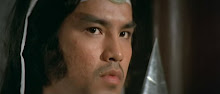
Wang sports a Zatoichi type sword in this photo
Wang Hsieh (or Wang Hsia) is an actor many kung fu and wuxia fans will recognize from numerous swordplay and kung fu movies. Wang was most often cast as the antagonist in the bulk of his films, but early in his career he fleetingly was promoted as a leading man before his penchant for villainy took over. Yet another Taiwanese discovery, Wang also took leading, or supporting roles in several of Shaw's spy and suspense thrillers.

These included one of his very first leads in the aforementioned POISON ROSE (1966) and subsequent roles in films such as the Chinese western DOWNHILL THEY RIDE (1966), the semi-spy thriller THE BLACK FALCON (1967) and the murder yarns DEAR MURDERER (1969) and RAW PASSIONS (1969). DEAR MURDERER was one of Wang's rare turns as a good guy. In it, he plays a detective attempting to bring the character played by comedy actor, Peter Chen Ho to justice after he's murdered his pregnant girlfriend in order to marry another woman belonging to a wealthy family. Wang Hsieh also starred in at least two Korean co-productions such as NAKED LOVE (1970) and THE BANDITS (1971).

The latter title was an action adventure tale while the former was a modern day gangster thriller about two professional killers--one played by Wang Hsieh and the other by Korean leading man, Shen Yung-chun--who are involved in smuggling diamonds from Hong Kong to Korea. Shaw actress, Fang Ying is the young woman who comes between them. The plot would be refurbished numerous times over and from here on out, Wang Hsieh would rarely be seen onscreen without his beard and goatee, a look that enhanced his villain roles. NAKED LOVE was also one of the very last roles of Fang Ying, who also starred in pictures like the action thriller ASIA-POL (1967), the lively serial fashioned GUN BROTHERS (1968) and the seedy DIARY OF A LADY KILLER (1969).

DIARY OF A LADY KILLER is another nicely mounted Chinese production enhanced by the guidance of a Japanese filmmaker. Set in both Hong Kong and Japan, it's about a man named Zhou who suffers from a sex addiction. Since his fiance doesn't believe in bonding before marriage, Zhou embarks on a string of sexcapades with a variety of beautiful women then writing about his dalliances in his diary; hence the title. When his betrothed decides to look in on him, she discovers what he's been up to. Meanwhile, the bodies of his conquests begin piling up. The films title is a bit deceptive, yet it does have a double meaning. The opening credits promise an artistically erotic experience, yet the film isn't quite as exploitative as it could be. It nonetheless is a nifty little diversion from the Shaw norm.

Shirley Huang photo promoting DIARY OF A LADY KILLER
DIARY is a unique production for a variety of reasons. There's a literal parade of stunning Shaw beauties on display here including Fang Ying, Shirley Huang (see photo above), Fanny Fan (who has a nude shower scene with Chin Han), Tina Ti Na and Margaret Tu Chuan. You'll even spy Sir Run Run Shaw's mistress, Mona Fong singing in a nightclub! It was one of the last non action roles for Chin Han before he would appear predominantly in swordplay and fist and kick flicks. It was also the last HK production for Japanese director Koh Nakahira who shot four films for Shaw Studio. On a sour note, it was also the last film for the seriously troubled award winning actress Margaret Tu Chuan who, along with her female lover, committed suicide by overdosing on sleeping pills a few months after this movie hit theaters in November of 1969.

Promotional spread for the modestly dark humored musical GUESS WHO KILLED MY TWELVE LOVERS?
While Chin Han played a possible psycho in LADY KILLER, he also played a victim of sorts in the failed murder mystery comedy, GUESS WHO KILLED MY TWELVE LOVERS? (1969). This pedestrian, mostly awful comedy-musical about a mysterious woman who has allegedly killed a dozen men and may make Chin Han number 13 was the last Shaw picture for mega starlet Jenny Hu. She plays herself here and while it isn't a complete failure, the only other point of interest would be to see Dean Shek pretending to play guitar. Jenny quit Shaw's in April of 1970 and after taking a six month break, returned to the screen in the independent suspense thriller, SECRET OF MY MILLIONAIRE SISTER (1971). TWELVE LOVERS director Wu Chia Hsiang was better off leaving this sort of material for the far more adept Inoue Umetsugu.

Proficient in shooting both musicals and action pictures, the versatile Umetsugu tried his hand at a murder mystery with haunted house overtones with 1969s superior THE 5 BILLION DOLLAR LEGACY. It was the only such film he did at Shaw Brothers, which is a shame as it's an engaging picture with some stunning photography, gorgeous Japanese locations and a bit of gratuitous nudity thrown into the mix. The convoluted plot concerns three young girls who receive letters stating their father has left them a vast inheritance, but they must come to Japan to get it. Murder, intrigue, "ghosts" and numerous instances of subterfuge ensue. Kuei Chi Hung was an assistant director on this production and some of his later works have moments that are reminiscent of this picture.

The photo at bottom features the director and his cast discussing the movie
One of the most ambitious and high profile of these murder mysteries premiered towards the end of 1969. It starred one of Shaw's brightest talents as well as one of their biggest box office draws. It was also heavily ballyhooed for the Shaw Studio acquisition of a big name talent previously known to appear exclusively in extreme left wing film circles.

Top: Kao Yuen and Ivy Ling Po; Bottom right: Wang Hsieh and Meng Li in bed together
Kao Yuen, a former communist, was already a well known actor having been in films for 14 years prior to joining Shaw Brothers. Upon signing with Hong Kong's then reigning film production company, Kao was teamed up with mega starlet Ivy Ling Po in the thriller RAW PASSIONS (1969). The film is about a seductive dancer who has a second job blackmailing her admirers. These include Mr. Lin (Kao Yuen), who happens to be married. When the belly dancer (played by Meng Li) attempts to extort a large sum of money from Lin, she's mysteriously murdered, but which one of her "victims" is responsible?

This was the first film for the award winning Ivy after a year long hiatus that resulted from a disagreement with the Shaw Brothers. This was also her first starring role in a thriller. She was known primarily for Huang Mei operas and dramatic features such as THE LOVE ETERNE in which she played the male lead. As mentioned in part one, it wasn't uncommon for women to portray male roles in Chinese cinema till this preference was altered towards the end of the 1960s. Ling Po was one of Asian cinemas biggest, best loved and most spectacular screen performers with a list of amazing titles on her impressive resume.

Ivy did eventually leave Shaw's for the more free climate of the independent circuit with her actor husband, and former Shaw leading man Chin Han. It should be noted that Ivy was once engaged to star Paul Chang Chung, the star of the Bondian adventures THE GOLDEN BUDDHA (1966) and OPERATION LIPSTICK (1967) (among others). Incidentally, all three were under contract at Shaw's at the time. Making headlines at the time, Ivy abruptly broke off her engagement with Paul and quickly married Chin. Fans will recall him as the eldest brother in Chang Cheh's classic THE HEROIC ONES (1970) as well as the star of THE CHAMPION OF CHAMPIONS (1971) and Chu Yuan's sought after THE KILLER also from 1971.

Kao Yuen upon his arrival at the Shaw Brothers Studio
Meanwhile, Ivy's co-star, Kao Yuen, dabbled for a time in swordplay films (like Lo Wei's BROTHERS FIVE and THE GOLDEN SWORD) before he, too, left Shaw's for Taiwan in 1971. There, he would be reunited with RAW PASSIONS director, the renowned Lo Chen for his first independent swordplay feature, THE CRAZY KILLER (1971).

Promotional spread for A CAUSE TO KILL (1970)
While shooting RAW PASSIONS, Ivy was also working on another murder thriller entitled A CAUSE TO KILL (1970). She shared the screen with another big ticket actress, the lovely Chiao Chiao. The plot concerns a love triangle between a wealthy businessman (played by SUSANNA's Kwan Shan), his gold-digging wife (Ivy Ling Po) and his mistress played by Chiao. When the well-to-do entrepreneur is framed for murder, his mistress attempts to prove his innocence while the scheming wife plans to make sure nothing stands between her and her husbands millions.

Chiao Chiao became a starlet almost by accident. She wasn't picked out of a group of hopefuls from Shaw's training academy, she was offered a contract after coming to HK to be with her then husband, Shaw contract player Huang Chung Shun. Her strong role as the wife of the ONE ARMED SWORDSMAN (1967) kept her popular among the wuxia crowd and even led to a few lead fighting female roles like THE BLACK BUTTERFLY (1968) and the ghoulishly titled HEADS FOR SALE (1970). You can see her alongside Ling Yun in the highly enjoyable GUN BROTHERS (1968) and the missing in action DARK RENDEZVOUS (1969).

Ling Yun in GUN BROTHERS (1968)
Ling Yun was a major star at Shaw Brothers and he was popular with audiences for a good many years. He did relatively few of these types of pictures, but he had a striking face that served him well. He got his start in numerous hit dramas before segueing into action movies and swordplay pictures. One of his best films is the aforementioned GUN BROTHERS co-directed by Wu Chia Hsiang and Cheng Kang.

Angela Yu Chien and Ling Yun about to be in a compromising situation in DARK RENDEZVOUS (1969)
Coming off as a throwback to the old 30s and 40s American serial programmers, the plot dealt with the tried and true formula of oppressed Chinese in the grip of Japanese warlords. The film, while very entertaining, fails to maintain the momentum of its rousing opening sequence. Ling Yun plays a dual role with one of them being a sort of Chinese Zorro/Robin Hood. Shaw's were particularly fond of this type of character as they would revisit it often, but alter the script to suit different time periods such as those seen in director Wu's SWEET IS REVENGE (1967) and Chu Yuan's THE LIZARD (1972).

Ling Yun has worked with many of the HK film industry's biggest and hottest female actresses. His heartthrob status was only reinforced when sharing the screen with the likes of Jenny Hu, Lily Ho, Angela Yu Chien and Tina Chin Fei to name but a few. He would have made a great James Bond. He came pretty close to that type of character with the unreleased to DVD obscurity HELLGATE from 1970.
ONE OF OUR MOVIES IS MISSING

Ling Yun is menaced by the villainous Betty Ting Pei in HELLGATE
HELLGATE (1970) is yet another rare and seemingly exciting detective suspense thriller and another Shaw title unfortunately unaccounted for on DVD or any viewing format. Directed by Mu Shih-chieh (real name Murayama Mitsuo), this film stars dramatic leading actor Ling Yun as a news reporter who stumbles upon an injured man who hands him a brief case. Requesting he deliver the contents to his daughter, it's discovered the dying man is a scientist who has created a formula for a new type of rocket fuel. Hidden inside a pen, a criminal organization led by sex siren Betty Ting Pei is also after this formula.

This lady wrestling sequence was being pushed as a highlight of HELLGATE, an action picture packed with talented names and potential stars.
In what would seem to be the filmmakers attempt at adding an air of almost carnival level of wackiness, this thriller also features a sequence of lady wrestling for additional entertainment value. This was apparently one of the first, if not the first time this sort of sporting event was presented onscreen in a HK production. The adorable Shen Yi, singing sensation, Agnes Chen's equally talented sister Irene Chen I-ling and musclebound Kao Ming also feature in this rare movie from the director of 1969s equally elusive DARK RENDEZVOUS (also starring Ling Yun) and A CAUSE TO KILL (1970).

Shen Yi was one of the 'Delectable Dozen' chosen from Shaw's Southern Drama Group in 1965 along with others like Jenny Hu and Tina Chin Fei. Shen first showed her stunning looks onscreen in PRINCESS IRON FAN (1966), the first sequel to THE MONKEY GOES WEST (1965). She also played the main villain in ANGEL STRIKES AGAIN (1968) and got to play one of the lead swordswomen in SWORDSWOMEN THREE (1970). That film saw her, Essie Lin Chia and Pan Yin Tze take on Lo Lieh in an average, but bloody swordplay adventure. She also featured in HELLGATE (1970) with Ling Yun and would also exit the Shaw studio that same year.
THE WORLD ACCORDING TO BETTY TING PEI

As so many of Shaw's gorgeous ladies were steadily vacating the studio, they were replacing them just as fast. One of these new actresses would become one of Hong Kong's most infamous women in the film industry. Formerly a star at Central Motion Picture Corporation under the name of Tang Mei-li, Betty Ting Pei joined Shaw Brothers in 1968. An accomplished go-go dancer, she put her moves to good use in a string of popular Inoue Umetsugu pictures such as THE SINGING ESCORT, THE MILLIONAIRE CHASE (both 1969) and Umetsugu's last Shaw film, THE YELLOW MUFFLER (1972). Her sex appeal soon extended to action pictures and erotic thrillers.

This two page spread shows the original director of STRANGER IN HONG KONG, Lin Fang-kang shooting scenes at an airport.
STRANGER IN HONG KONG (1972) began production in mid 1971 and was one of the studios most highly touted action thrillers at the time. It was the first Shaw film from Italian trained filmmaker, Lin Fang-kang. Apparently dissatisfied with his progress, the Shaw's dismissed Lin from the picture and replaced him with Kuei Chi Hung who was also busy shooting THE GOURD FAIRY (1972). While it remains unseen (unless you have the ZiiEagle box) and among the many titles not announced for a DVD release, the plot revolves around a man named Chang Shan who arrives in HK with his family only to be told that someone wants him dead. Not long after, a mysterious woman named Li Na (played by Betty Ting Pei sporting long hair) enters his life and soon, Chang's own life as well as that of his wife and child are in grave danger.

Ting Pei's exotic looks served her well in roles such as this. Her biggest claim to fame is being Bruce Lee's lover and being the last woman to see him alive. Lee was found dead in her apartment on July 20th, 1973. In 1975, Ting Pei responded to the massive controversy that surrounded her by both starring in and producing the exploitation level "true account" that was BRUCE LEE & I (1976). Danny Lee played Bruce (in what amounted to a secondary role) while Ting Pei took center stage in her bid to tell her side of the torrid true tale. With her film career and life mostly in shambles after this, she eventually retired from the movie world in the mid 1980s.
FIVE DEADLY WOMEN

Two page spread promoting the making of the prison action drama LONG ROAD TO FREEDOM (1970).
Inoue Umetsugu directed relatively few action films and his last of the genre was a 'Girls On A Mission' movie entitled LONG ROAD TO FREEDOM (1970). It started production with the much more colorful working title of FIVE PRETTY GANGSTERS ON THE LOOSE. Five female convicts escape prison and later enlist the aid of a policeman played by Chin Han to help clear their names as well as eradicate their enemies that put them there. This is yet another movie that was denied a DVD release and isn't included among the few dozen "lost" titles accounted for on Celestial's ZiiEagle box.

Pai Lu, where are you?
Umetsugu's unjustly obscure and unavailable movie is likely the first such instance of a film about a group of women fighters each possessing different backgrounds and specialties. The Five Deadly Women in the movie are Essie Lin Chia, Shirley Huang, Meng Chia, Ting Feng and Pai Lu (pictured above). Pai Lu is of particular interest. This luscious siren signed with Shaw Brothers in 1969 at 20 years of age. Her first film was HELLGATE (1970) starring Ling Yun, Ting Pei and a gaggle of other stars (why isn't THAT film on DVD?). Pai told reporters at the time that she had no problems going fully nude. With statements like that, it's astonishing she didn't become the 70s first 'Queen of Exploitation', a title proudly worn by Chen Ping and then briefly by Jenny Liang. Possibly realizing the film world had little prospects for her, Pai Lu seemed to disappear from the industry in 1972 after just six known films.

As the 60s came to an end, so did the look and feel of that decades movies. The 70s would bring with it a new breed of gritty thriller that would more often than not be taken from true accounts of various murders and kidnappings. Kung Fu movies would become vastly popular and the martial arts would also permeate dramatic features that had a little more to offer than lots of fighting sequences. But as the 70s wore on, modern day action and crime productions got increasingly more brutal and sadistically violent giving birth to a few incredibly talented directors with a dark and grim view of society around them.
CONTINUED IN PART 3...