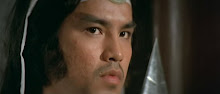
PROFILE IN ANGER 1984
Leung Kar Yan (Leung Ting Yu/Chun Yu), Chan Wai Man (assassin #1), Philip Ko (assassin #2), Chang Yi (Wai Kit), Damian Lau (Wong Kin Hang), Patricia Ha (Heidi Lam Sau Ling)
Directed by Leung Kar Yan (Liang Chia Jen)
The Short Version: Fan favorite, Leung Kar Yan gets down and dirty with this thoroughly ridiculous, hugely enjoyable and brutally violent piece of Hong Kong trash about a former race car driver turned architect who gets mixed up in a friends vendetta. Outrageous is an understatement in the face of cackling assassins, mohawked, futuristic gangs, gratuitous car crashes, bars with built in ramps for motorcyclists, even more gratuitous violence, a damn fine Euro Prog Rock-Metal score, and a plot that makes less and less sense as this films modest 83 comes to a close. This type of insanity and outright cinematic chaos could only come from the wacky world of Hong Kong cinema.

 Leung Ting Yu, an architect, former race car driver, and avid sports enthusiast, picks up his childhood friend, Wong Kin Hang at the airport. Thinking he is in town on a visit, Wong's purpose is a bit more personal. He plans to kill a jewelry tycoon named Wai Kit who had killed his father and taken his wealth and properties back in South Africa. Failing to do the job, Wong is tortured and reveals to Wai that he has documented evidence of his crimes that's in safe keeping. Not long after, Wai learns of Wong's friend, Leung. Assuming he is a knowing accomplice, Wai sends assassins after Leung and his fiance.
Leung is about to be attacked by the KISS Army.
 Prior to re-joining Shaw Brothers, Leung Kar Yan (Liang Chia Jen) helmed his first directorial effort for Shaw's biggest competitor, Golden Harvest. Not only did Leung direct, but he also co-choreographed the action (with former Shaw action designer Shikamura Ito), took the lead role and also wrote the screenplay. He apparently took on far more responsibility than he could handle what with the script maintaining cohesiveness for the first half of the film then quickly dovetailing into kitchen sink territory immediately thereafter. It starts off as a typical revenge story resembling those in the DEATH WISH mold (Leung is even an architect, much like Bronson's Paul Kersey character), but soon deteriorates into the most enjoyably nonsensical mess indigenous to HK cinema; the likes of which can either be the bane, or the blessing to Asian action movie fans.

 What we have here is a less sadistic, but no less chaotic version of Shaw's monumentally troubled PURSUIT OF A KILLER (1985), a film that went through two directors and lost numerous chunks of footage over the course of the four years it took to complete. The two films are similar in that they have flip-flopping hairstyles and start off on course before taking a wrong turn and ending up in bizarro-ville. But while the Dr. Frankenstein patchwork that is PURSUIT OF A KILLER has an indelibly seething mean-spiritedness about it, PROFILE IN ANGER is a roller coaster by comparison; a roller coaster that flies off the tracks killing everyone aboard, but a roller coaster just the same. Leung's movie balances its brutality with hyper under cranked car chases, saloons with conveniently placed ramps inside of them, abandoned cars just sitting in the middle of suspiciously empty streets, brick walls out in the middle of nowhere, post apocalyptic gangs and two supporting villains who aren't given names, but get far more screen time than the main antagonist does.

 Phillip Ko obviously has no compunction about nudity and he seemingly has a clause in his contracts stating that he must bed down at least one of the non essential female cast members whether it makes sense in the film or not. If a gratuitous sex scene for a character who isn't even given a name isn't enough, halfway through the movie, we see that Ko's character is actually bald and bears massive burn scars over a quarter of his body! No explanation is given for this, we are forced to accept it. Possibly this is due to injuries sustained from his phantasma-gory-ical light show battle with puke eating wizards from THE BOXER'S OMEN (1983).
 Also, his character has suddenly transformed from a machete wielding bodyguard to a sniveling, cackling, insane madman. Both Leung and Ko's characters reach an incredible level of ludicrousness during the mud and blood soaked salvage yard battle near the finale. While whacking the hell out of each other with impossibly heavy truck parts swung with the most herculean of ease, Ko's TERMINATOR like assassin disappears briefly only to emerge moments later stripped down to his underwear with steam coming off of him!
A really scary moment at the 79 minute mark during the final minutes of PROFILE IN ANGER.
During this "backyard battle", it's clearly evident Leung was performing some rather dangerous stunt work. It's possible he could have suffered some head trauma which might explain why his movie loses its mind at around the 40 minute mark. Speaking of stunt work, during the twisted metal finale, a potentially fatal bit of business has a large steel prong affixed to a dump truck piercing the back of a speeding car where it appears to possibly cleave the head of the stunt driver! It's difficult to tell as the camera cuts away too fast, but it's a harrowing bit of footage nonetheless.

 Chan Wai Man (Chen Hui Min to you Mando followers), whom you may remember as the screens ultimate ninja bad ass in Chang Cheh's flashy, gory spectacular, FIVE ELEMENT NINJAS (1982), steals the film as another nameless assassin (we can refer to him as assassin #1, although the DVD box refers to him as killer Mau) who gets a few of the films best scenes when he isn't torturing people, smacking kids around, or running over pregnant women.
 One of them is a suspensefully shot sequence during a thunderstorm wherein Chan's character pursues Leung's bride-to-be throughout their home with the intent of killing her. Some other great Chan moments are a brutal battle with Leung (Chan holds Leung at gunpoint all the while beating the crap out of him) that leads into a rambunctious car chase. This scene also showcases another moment of Leung Kar Yan performing a dangerous stunt, this time jumping off of a balcony with no mat to brace his fall. He lands on his feet and takes off running, having evaded a severe sprain or even a broken foot, ankle, or leg.

 The level of outright bat-shittery reaches an apex when Leung finds himself on a set that looks almost identical to the one lorded over by Gene Simmons' hermaphrodite villain from the MAD MAXian-James Bondian silliness of NEVER TOO YOUNG TO DIE (1987). Housed within are a gang of post apocalyptic punks that look to have stepped out of any number of early 80s heavy metal music videos. Leung proceeds to battle what appears to be the gang leader. Why is this scene even taking place? What the hell does it have to do with the movie? Why does the film look like it's suddenly transformed into one of those ROAD WARRIOR clones? Are they going to fight over the last can of gas or water?
 Apparently, this mohawked character is 'Buffalo', a man whose name we hear earlier in the movie when a gang of motorbike ridin' cretins enter a saloon from the SECOND FLOOR. This isn't just any saloon, either. This establishment has its own ramp as if folks on motorbikes frequently ride in and trash the place on a regular basis. Either way, it gives the stunt guys something to do and a chance to break a lot of glass and balsa wood furniture.
Does Chang Yi look suspiciously like Sir Run Run Shaw, or what?!
 Chang Yi, the bad guy from such oldschool kung fu favorites such as EAGLE'S CLAW ([1976]also with Leung Kar Yan and Ko Fei) and THE VILLAIN (1980), not to mention a handful of earlier Shaw Brothers swordplay classics like THE BELLS OF DEATH (1968) and THE SECRET OF THE DIRK (1970) is the main villain here. But you wouldn't know that from his terribly limited screen time, particularly during the second half of the movie. His death warrant against the uninvolved Leung after his friend, Wong foolishly implicates him sets the action in motion. However, he disappears for most of the movie and doesn't reappear till the last couple minutes when Leung shows up suddenly sporting a much thicker, hastily thrown together beard! How ironic in that Leung was famous for his facial hair including his famous beard which gave birth to his UK fan handle, 'Beardy'.
 After the salvage yard skirmish and the car chase mash up, some viewers might find the last moments abrupt. Considering the array of nuttiness preceding the ending, you half expect a few dozen suit and tie wearing minions brandishing machetes to come out of the woodwork to protect the big boss, but that doesn't happen. What we do get is a patently pissed off Leung Kar Yan brandishing both a shotgun, the aforementioned fake ass facial hair, and that ever so charismatic look of 'Im'a fuck you up' he wore so well in movies like SHAOLIN MARTIAL ARTS (1974), THUNDERING MANTIS (1980), SECRET SERVICE OF THE IMPERIAL COURT (1984) and HONG KONG GODFATHER (1985).

 If bad movies with an over abundance of verve grab your attention, than prepare for sensory overload. For all its ineptitude, PROFILE IN ANGER seems to take forever to reach the last few seconds of its short 83 minutes, but it never seems to drag, at least not for very long. It's also worth mentioning the Euro style prog rock-metal soundtrack, which adds to the outlandish nature of Leung's debut directorial effort. This shoestring production, as impoverished and intellectually barren as it might be, is miles away more entertaining than the similarly retarded big budget HK-US co-pro mega bomb from 1982, MEGAFORCE. Golden Harvest could stink it up as good as the next studio and rarely does cinematic shit smell as sweet as polished turds like PROFILE IN ANGER (1984).
This review is representative of the Fortune Star/Joy Sales DVD
 THE DEVILS 1971
Oliver Reed (Priest Urbain Grandier), Vanessa Redgrave (Mother Superior, sister Jeanne), Graham Armitage (Louie the XIII), Christopher Logue (Cardinal Richelieu), Dudley Sutton (Baron de Laubardemont), Gemma Jones (Madeline de Brou), Michael Gothard (Father Barre), Georgina Hale (Phillipe)
Directed by Ken Russell
"I pray that I may assist you in the birth of a new France where church and state...are one."
The Short Version: Controversial filmmaker, Ken Russell, amassed critical hellfire and brimstone with this incendiary, yet true account of a 17th century historical case of alleged satanic possession. Incredibly offensive, THE DEVILS is a film of vast social, political and religious importance. Oliver Reed acts his heart out as the doomed martyr, Father Grandier, a surprisingly liberal man of faith who finds himself at the center of political corruption, religious defamation and object of revenge from a scorned, sexually frustrated and misshapen mother superior. A visual feast from start to finish, some will be in awe and others will be stunned by the shocking imagery. While it's not for everybody, THE DEVILS is an important cinematic document, a testament of a fiercely creative decade for a film that could not be made today. Considering the treatment it still receives from the very studio that financed it (Warner Brothers), the underlying political and social subtext resonates strongly even today in our current hysteria fueled and violent society.
***WARNING! This review contains nudity and images of a sensitive nature***

 In plague-ridden 17th century France, Urbain Grandier, a philandering priest, lords over Loudun, a self contained provincial town within the kingdom of Louie the XIII. The king, aided and abetted by the guileful cardinal Richelieu, wishes to ensnare Loudun to gain total control over the surrounding lands. While the city enjoys its independence, decadence is alive and well within the barred monastic walls of the Ursuline convent. The blasphemy within Loudun reaches its apex when the misshapen Mother Superior, sister Jeanne, learns that Grandier, whom she secretly and sexually covets, has privately married Madeline de Brou, one of the convents nuns. Sister Jeanne then conspires with the Cardinal and Baron Laubardemont to accuse Grandier of his alleged satanic association that has resulted in the purported possession of the convents followers. A mass exorcism erupts in a farcical explosion of sexual depravity ensuring the baron and the vengeful, hunchbacked mother superior successfully discredit Grandier implicating him as the devil's disciple.
"Your humiliation is nothing! If god wants you to suffer...than you...should want to suffer...and accept that suffering gladly!"

 Ken Russell's controversial classic has remained largely unseen since its original release some 40 years ago acquiring a far reaching vilification that few films have ever attained. One similar example of a film that shook the foundation of its studio and the patrons and critics who saw it is Tod Browning's FREAKS (1932). However, Russell's picture didn't just strike a nerve with its financial backers, critics and audiences, it summarily raped them into oblivion with one scene of sexual madness after another in its depiction of a depraved, morally corrupt society. It's made all the more incendiary in that it's based on documented accounts that took place in the historical Loudun in 17th century France.

 Truth can sometimes be more outrageous than fiction and Russell's most notorious film redefines the word with its unabashed scenes of human cruelty, psycho-sexuality and outright bizarre behavior. Some viewers may find it hard to believe that such events and actions could have taken place as it's understandably difficult to fathom that we as human beings in a civilized society can behave as savages. A similar controversy befell Ralph Nelson's SOLDIER BLUE (1970), which featured an incredibly sadistic finale wherein a US cavalry unit mercilessly tortured and slaughtered innocent Native American men, women and children. Even today, despite the unbelievable brutality being documented, it's hard to swallow that man could act out in such a manner. Such deplorable travesties occurred again in WW2 with the Nazis and Japan's genocidal missions to exterminate the Jews and the Chinese respectively. Even in our modern climate, we as a civilized people "co-mingle" in an uncharacteristically animalistic fashion. Unfortunately, little has changed over the last several hundred years.
"Now there's a man well worth goin' to hell for, eh?!"

 For the time period in which THE DEVILS takes place, religion is something to be revered, feared and twisted and maimed for political purposes, often with diabolically tragic results. Russell's movie operates on multiple levels- as an historical work, a political statement and also as a powerful diatribe about religion (including catholicism versus protestants) and the ways in which it was/is used to control and or manipulate the lives of those with faith, whether strong willed, or weak-minded. The centerpiece of all this is Urbain Grandier played to perfection by Oliver Reed in an exemplar performance wherein he explores every emotion imaginable before making the audience wince during the disturbingly heartrending finale. If you're a fan of Oliver Reed, this is easily among his best work, if not the best, surrounded by the most sumptuous scenery with which to chew magnanimously.

 Reed as Grandier is viewed as something of a saint, but also a sinner, freely cavorting with several women while being uncharacteristically lusted after by seemingly every female within Loudun's walls. One devout, sex hungry admirer of Grandier is the hunchbacked, and quite mad sister Jeanne, the mother superior of the Ursuline nuns. So potent is sister Jeanne's attraction to the priest, she fantasizes about him as Christ. Removing himself from the cross he has been crucified upon, bloody lashes and all, she begins to lovingly lick and kiss his wounds prior to making love to him. Her desire for this man, whose affection has been given to numerous others, consumes her, pushing her to the brink of madness; the outer reaches of which have already seen her frequent visitation in her self-vilification of her own physical abnormality. Of course, the mother superior's sins do not go unpunished as she indulges in self-flagellation for her penance.
"These raving women are possessed of devils, I take it?"

 What with this borderline sociopathic nun obsessing dangerously about an already sexually active man of the cloth, a dandy-ish dictator (who enjoys dressing protestants up as black birds and gunning them down as they run across his yard) collaborating with a calculating cardinal to overtake Grandier's self-governing township, the stage is set for tragedy of monumentally manic proportions. It's during the latter part of the film where much of the controversial material is present. A kinkily insane witch hunter is summoned to exorcise the possessed nuns utilizing methods of torture including forced enemas culminating in a spectacularly over the top orgy that has the libidinous ladies literally swinging from the ceiling. While one is seen feverishly stroking overly large candles, the wax oozing down the "shaft", a group of naked nuns take down a statue of Christ and sexually desecrate it; the latter act having never been included in any print of the film.

Not in the film, snippets of the 'rape of Christ' appear in the HELL ON EARTH documentary.
 Warner Brothers, the studio that financed the film, has objected to the reinstatement of the sequence into the picture even to this day. The controversial sequence did find its way into a documentary on THE DEVILS that aired on British television in 2002, but has since been returned to the vaults. The documentary is part of this BFI 2 disc DVD, but the 'Rape of Christ' sequence is only seen in snippets. Interviews with catholic clergymen do not see the scene as blasphemy, but apparently the studio feels otherwise. Actually, Russell's film is most assuredly not for everybody and doubtless a good many religious followers will be wholeheartedly offended by what is showcased throughout the 107 minutes of the film in what amounts to the most complete official version to be released thus far.
Not in the film, a portion of this scene is present in the HELL ON EARTH documentary.
Phallic symbolism are among the offensive delights found within THE DEVILS, such as a brainwashed nun furiously stroking a large candle, or another masturbating with a burned leg bone. Sadly, the latter example is one of the scenes unaccounted for on this glorious DVD presentation due yet again to the nervousness of Warner Brothers. It's a scene during the finale wherein Redgrave's sex crazed character diddles herself with a charred bone of Grandier. Kissing the bulbous end of the shaft simulating testicles, she then inserts the broken and burned piece of penile pleasure into her vaginal regions finally enjoying Grandier's "love" in the way she never could when he was alive. A portion of this sequence is present in the Hell On Earth documentary on disc 2.
"These priests are depraved! It is they who are guilty of sacrilege...she has been deliberately provoked by the priests...they have desecrated god's house with this blasphemous spectacle!"

 Aside from its numerous scenes of religious corruption and appalling sexual proclivities, THE DEVILS contains a social subtext that is relevant today reminding us all that civilization never seems to learn its own history lessons regardless of how many times they are repeated, nor how much violence and decadence that is born from man's ignorance. Michael Gothard (horror fans may remember him from SCREAM & SCREAM AGAIN [1969]) is incredible as the theatrically bonkers charlatan priest, Father Barre. Much like the sham Snake Oil Salesmen throughout history leading up to the Faux Faith Healers of the 80s who used their "craft" to steal away the life savings from the gullible while leading secret lives of debauchery, Barre uses his gift of gab in the most deranged fashion to profane religious iconography. There's even a scene where the transvestite king Louie, disguised as a Duke, visits the Ursuline convent and craftily exposes Barre for the counterfeit clergyman he really is. It's too late, though, as the brainwashing is complete and Barre's "technique" proves to be a grievous success.
"...and with the security of our independence gone, our freedoms would go, too!"

 The political ramifications seen here mirror much of the current turbulent situation in America right now and act as a view into a possible future should certain socialist agendas prevail. The loss of Loudun's freedom and independence, the subjugation and indoctrination of the Ursuline nuns and the silencing and wrongful accusation of Loudun's leader and signifying voice perverted by an oppressive dictatorship reflects the current state of affairs in the United States. It's intriguing to watch this true account brought to bear through the eyes of Ken Russell under the realization that little, if anything has changed in terms of how power is exuded, usurped, or taken away through deceptively evil means. THE DEVILS are not demonic spirits possessing the flesh of innocent souls. THE DEVILS are man and the evil that resides within us all.
 I would be remiss if I didn't mention the magnificent set design by Derek Jarman, stunning in its construction. Bearing an almost futuristic look, the monolithic, ceramic styled buildings are incredibly impressive and rival any such design as you'd find in the most current production, no doubt "built" inside a computer of all things.
 While I am unfamiliar with the bulk of Russell's resume (his LAIR OF THE WHITE WORM finds him revisiting similarly offensive religious imagery), THE DEVILS (1971) is simply a brilliant film not just of the 1970s, but of all time. It's proof yet again of this bygone, turbulent decade excreting a savage creativity and controversial ferocity that, in the case of this production from director Ken Russell, has stood the test of time; slowly amassing a level of respectability that eluded it upon its initial release.
This review is representative of the BFI R2 DVD 2 disc set.
copyright 2013. All text is the property of coolasscinema.com and should not be reproduced in whole, or in part, without permission from the author. All images, unless otherwise noted, are the property of their respective copyright owners.


 Leung Ting Yu, an architect, former race car driver, and avid sports enthusiast, picks up his childhood friend, Wong Kin Hang at the airport. Thinking he is in town on a visit, Wong's purpose is a bit more personal. He plans to kill a jewelry tycoon named Wai Kit who had killed his father and taken his wealth and properties back in South Africa. Failing to do the job, Wong is tortured and reveals to Wai that he has documented evidence of his crimes that's in safe keeping. Not long after, Wai learns of Wong's friend, Leung. Assuming he is a knowing accomplice, Wai sends assassins after Leung and his fiance.
 Prior to re-joining Shaw Brothers, Leung Kar Yan (Liang Chia Jen) helmed his first directorial effort for Shaw's biggest competitor, Golden Harvest. Not only did Leung direct, but he also co-choreographed the action (with former Shaw action designer Shikamura Ito), took the lead role and also wrote the screenplay. He apparently took on far more responsibility than he could handle what with the script maintaining cohesiveness for the first half of the film then quickly dovetailing into kitchen sink territory immediately thereafter. It starts off as a typical revenge story resembling those in the DEATH WISH mold (Leung is even an architect, much like Bronson's Paul Kersey character), but soon deteriorates into the most enjoyably nonsensical mess indigenous to HK cinema; the likes of which can either be the bane, or the blessing to Asian action movie fans.
 What we have here is a less sadistic, but no less chaotic version of Shaw's monumentally troubled PURSUIT OF A KILLER (1985), a film that went through two directors and lost numerous chunks of footage over the course of the four years it took to complete. The two films are similar in that they have flip-flopping hairstyles and start off on course before taking a wrong turn and ending up in bizarro-ville. But while the Dr. Frankenstein patchwork that is PURSUIT OF A KILLER has an indelibly seething mean-spiritedness about it, PROFILE IN ANGER is a roller coaster by comparison; a roller coaster that flies off the tracks killing everyone aboard, but a roller coaster just the same. Leung's movie balances its brutality with hyper under cranked car chases, saloons with conveniently placed ramps inside of them, abandoned cars just sitting in the middle of suspiciously empty streets, brick walls out in the middle of nowhere, post apocalyptic gangs and two supporting villains who aren't given names, but get far more screen time than the main antagonist does.
 Phillip Ko obviously has no compunction about nudity and he seemingly has a clause in his contracts stating that he must bed down at least one of the non essential female cast members whether it makes sense in the film or not. If a gratuitous sex scene for a character who isn't even given a name isn't enough, halfway through the movie, we see that Ko's character is actually bald and bears massive burn scars over a quarter of his body! No explanation is given for this, we are forced to accept it. Possibly this is due to injuries sustained from his phantasma-gory-ical light show battle with puke eating wizards from THE BOXER'S OMEN (1983).


 Chan Wai Man (Chen Hui Min to you Mando followers), whom you may remember as the screens ultimate ninja bad ass in Chang Cheh's flashy, gory spectacular, FIVE ELEMENT NINJAS (1982), steals the film as another nameless assassin (we can refer to him as assassin #1, although the DVD box refers to him as killer Mau) who gets a few of the films best scenes when he isn't torturing people, smacking kids around, or running over pregnant women.

 The level of outright bat-shittery reaches an apex when Leung finds himself on a set that looks almost identical to the one lorded over by Gene Simmons' hermaphrodite villain from the MAD MAXian-James Bondian silliness of NEVER TOO YOUNG TO DIE (1987). Housed within are a gang of post apocalyptic punks that look to have stepped out of any number of early 80s heavy metal music videos. Leung proceeds to battle what appears to be the gang leader. Why is this scene even taking place? What the hell does it have to do with the movie? Why does the film look like it's suddenly transformed into one of those ROAD WARRIOR clones? Are they going to fight over the last can of gas or water?

 Chang Yi, the bad guy from such oldschool kung fu favorites such as EAGLE'S CLAW ([1976]also with Leung Kar Yan and Ko Fei) and THE VILLAIN (1980), not to mention a handful of earlier Shaw Brothers swordplay classics like THE BELLS OF DEATH (1968) and THE SECRET OF THE DIRK (1970) is the main villain here. But you wouldn't know that from his terribly limited screen time, particularly during the second half of the movie. His death warrant against the uninvolved Leung after his friend, Wong foolishly implicates him sets the action in motion. However, he disappears for most of the movie and doesn't reappear till the last couple minutes when Leung shows up suddenly sporting a much thicker, hastily thrown together beard! How ironic in that Leung was famous for his facial hair including his famous beard which gave birth to his UK fan handle, 'Beardy'.

 If bad movies with an over abundance of verve grab your attention, than prepare for sensory overload. For all its ineptitude, PROFILE IN ANGER seems to take forever to reach the last few seconds of its short 83 minutes, but it never seems to drag, at least not for very long. It's also worth mentioning the Euro style prog rock-metal soundtrack, which adds to the outlandish nature of Leung's debut directorial effort. This shoestring production, as impoverished and intellectually barren as it might be, is miles away more entertaining than the similarly retarded big budget HK-US co-pro mega bomb from 1982, MEGAFORCE. Golden Harvest could stink it up as good as the next studio and rarely does cinematic shit smell as sweet as polished turds like PROFILE IN ANGER (1984).