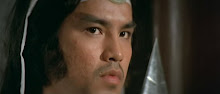
THE LAST SAMURAI 1974 aka OKAMI YO RAKUJITSU O KIRE (THE FIVE WOLVES)
Takahashi Hideki (Sugi Toranosuke), Ogata Ken (Nakamura Hanjiro/Kirino Toshiaki), Taichi Kiwako (Ohide/Hoshuni), Matsuzaka Keiko (Reiko), Kando Masaomi (Iba Hachiro), Saiko Teruhiko (Okita Soji), Tamura Takahiro (Ikemoto Mohei), Tatsumi Ryutaro (Saigo Takamuri), Honami Chikako (Tsuya), Ryunosuke Minegishi (Aizawa Denshichiro)
Directed by: Misumi Kenji
The Short Version: The last production helmed by Kenji SHOGUN ASSASSIN Misumi is quite possibly the man's best work. It's easily the best film of his now legitimately available body of work on North American shores. This exemplary historical account is a sweeping, if somber depiction of the samurai warriors last days before Japan became more westernized upon entering the modern age. Highly dramatic, it contains a generous amount of action scenes that are made all the more exciting from the engaging performances and the melancholic romanticism of Akira Ifukube's brilliant score. Long dormant as an obscure footnote in Jidaigeki cinema, this licensed DVD will hopefully open up a new audience to those who only know the man by his work as the director of the LONE WOLF & CUB series.
 Returning home after an eight year absence, Sugi Toranosuke discovers his father has passed away. A sickly boy growing up, Sugi had attempted suicide upon overhearing he was not likely to live past 20; and, because of his sickness, was to be disinherited from the family estate. Rescued from drowning and raised by Ikemoto Mohei, a Shogunate spy, Sugi is taught the ways of the Samurai; later becoming a skilled ronin.
 Anxious to put his years of sword training to good use, Sugi is eventually tasked with escorting a Shogunate agent named Reiko to Kyoto. After an attack on the road, they're separated. While searching for her, Sugi meets with his master Ikemoto again. His teacher orders him to return to Edo and start a new life in order to avoid the impending violence of the Satsuma and Choshu rebellions that threaten to topple the declining Tokugawa Shogunate.

 While pondering his decision, Sugi meets up with three swordsmen of different schools and backgrounds. One of the men, Iba Hachiro, is Sugi's good friend from Edo. Ignoring Ikemoto's request, Sugi decides to stay in Kyoto and instead of joining his friends in battle, Sugi marries Reiko, but the rampant violence won't allow them peace for long.
Through all the political turmoil, Sugi's friends end up in rival clans and ultimately fight against each other. After years of struggle and senseless loss of life, the Shogunate is no more. The Meiji Period takes hold leading to industrialization and westernized advances that signal the end for the Age of the Samurai. Sugi must now contemplate putting away his sword for good and embracing the impending modernity taking hold in Japan.

 Having been the guiding force behind many of the best, and best remembered examples of Chambara cinema, it's naturally fitting that master filmmaker Kenji Misumi would close his directorial career on a film entitled THE LAST SAMURAI (not to be confused with either the 1990 or 2003 films of the same name); especially one as sprawling as this one. Misumi's dramatically gloomy style is clearly in evidence here, aided and abetted by the majestically melancholic cues of Akira Ifukube. The John Williams of Japan, Ifukube's oppressively bleak chords have worked magic for many entries in the immensely popular GODZILLA series, the Kaiju-Chambara crossover series of DAIMAJIN and numerous samurai sagas including a number of the ZATOICHI movies.
 A monumentally epic production in every sense of the word, the 'GONE WITH THE WIND' of Jidaigeki (based upon a serialized novel entitled 'That Man' by Ikenami Shotaro) covers so much ground and explores a wealth of diverse characters, the near 3 hour running time is just barely able to contain it all. Broken up into two chapters--"The Passionate Storm" and "The Surging Waves", the proceedings unravel much like a gritty mini-series.
 With so much drama involved, a movie entitled THE LAST SAMURAI wouldn't be complete without sword duels. Misumi's movie has an abundance of them (choreographed by Adachi Reichiro) throughout in addition to several large scale battle sequences which shows Japan engaging in increasingly Anglo enhanced styles of warfare.
With Misumi's name attached, some might go into this one expecting violence on the level of the LONE WOLF & CUB series. While there is definitely a lot of violence here, outside of one sequence towards the end (that features an incredible instance of brutality that recalls the end of every episode of VOLTRON), the savagery is never of the comic level of blood-spraying from that iconic samurai series.

 Misumi has worked with a great many titans of the genre including such luminaries as Tomisaburo Wakayama (the LONE WOLF series), his brother Shintaro Katsu (the wildly popular ZATOICHI series) and Raizo Ichikawa (the SLEEPY EYES OF DEATH series) among others.
For this film, it's Hideki Takahashi and Ken Ogata. Both men deliver exemplary performances especially the former. His character of Sugi stubbornly follows his sword master much like a doting child would loyally tag alongside their father. Sugi looks to Ikemoto as his father, and much more in fact. Just as he refuses to abandon his master, he likewise refuses to obey him in his wish that Sugi return home and settle down; as opposed to becoming embroiled in samurai bloodshed during Japan's political and societal transition.
Sugi manages to avoid the battlefield, but does draw his sword occasionally. The difference is that it's of a personal level, not one of pride or country. During the finale, Sugi explains this to his longtime friend, Hanjiro when destiny ironically brings them together one last time.
 Those mostly familiar with the directors ZATOICHI entries, his LONE WOLF & CUB films, or the abridged, 'Greatest Gore Hits' of SHOGUN ASSASSIN for that matter, will be in for a surprise here. It's as if Misumi knew his time was coming (the man died in September of 1975) and concentrated all his passions and effort into one last production.
 Granted, this isn't a film for the rabid kung fu crowd, or for those seeking spurting blood and anti-heroic swordsmen. This is a serious historical account of one of Japan's most oft filmed time periods encapsulated within a near three hour time frame. At least know going in that this is one of those movies where you are going to absorb a lot of information and things you will miss, you will pick up in a second or third viewing.
 The DVD supplements go a long way in putting the era and the time period the film is set in into perspective. The notes are simplified and to the point, and not confusing at all. They're really quite helpful in enhancing the experience of watching an epic unfold before your eyes.
A rare and obscure picture known mostly through devoted fan circles, Misumi's THE LAST SAMURAI was an ending in a few ways. It was his last movie and heralded the finality of the jidaigeki as fewer and fewer of them were coming out and even less possessed the magic of those of the earlier decades. Impeccably directed and acted, Misumi's last may quite possibly be his best.
You can purchase this DVD at amazon HERE and at Far East Flix HERE.
This review is representative of the Neptune Media DVD.
 EXECUTION SQUAD 1972 aka LA POLIZIA RINGRAZIA (FROM THE POLICE WITH THANKS)
Enrico Maria Salerno (Commissioner Bertone), Mario Adorf (District Attorney Ricciuti), Mariangela Melato (Sandra), Franco Fabrizi (Bettarini), Cyril Cusack (Stolfi), Laura Belli (Anna Maria Sprovieri), Jurgen Drews (Michele Settecamini), Piero Tiberi (Mario Stateletti), Luciano Bonanni (Raf Valenti)
Directed by Stefano Vanzina
The Short Version: One of the Eurocrime genres best and most influenial films has yet to gain its overdue respect in America, but its influence is evident most noticeably in Eastwood's MAGNUM FORCE from 1973. Vanzina's picture is far more political and a far better film in its exploration of a violence laden Italian society and the lengths some go to "clean up the city". Salerno is spectacular here and Adorf is suitably subdued as the meddling and liberal assistant DA. Stelvio Cipriani's score is magnificently melancholic and, along with the film, one of the best the genre has to offer. Highly recommended.

 Commissioner Bertone is a by the book cop dealing with rampant crime in a city over-run by violence and senseless brutality. Strapped by a liberal justice system, many crimes go unpunished with the criminals ending up back on the streets to kill again. However, the bodies of some of the released criminals turn up dead. Bertone soon discovers that a secret organization of vigilantes is working the night shift cleaning the streets of the scum the police can't keep behind bars. A young criminal--on the run after a bungled robbery costs the lives of two innocents and another after a failed arrest--is the syndicates next victim. Bertone tries to bring the kid to justice under the law, but the mysterious squad of executioners are closing in.

 Considered the launching point for the Eurocrime genre in the 1970s, the genre had many crime pictures before it, but EXECUTION SQUAD was a big success inspiring a number of like-minded movies with increasing levels of violence and often with political messages at their core. Considering the wave of political violence that erupted in Italy during the late 60s, this all too real violence would soon erupt on European cinema screens. Often referred to as rip-offs of American action pictures, these were, predominantly, nothing of the sort.
While some of these movies were close approximations of such movies as Coppola's THE GODFATHER (1971), EXECUTION SQUAD was cloned in Eastwood's MAGNUM FORCE (1973), a film with a very similar plot, if less political than its Italian antecedent. Eastwood was no stranger to Italian movies, of course, having gotten his start in Sergio Leone westerns. He also copied a mediocre Euro western (DJANGO, THE BASTARD) for his own version of that tale as HIGH PLAINS DRIFTER (1973).
 Anyway, Vanzina's movie (the director is often listed, or referred to simply as Steno) works from a wonderful script (of which he shares a story and screenplay credit) that tackles a ton of hot topic subjects in a relatively brief 100 minutes. Leading the pack of choice performances are Enrico Maria Salerno as Bertone. The man is on fire here. His frustration with the media and liberal authority figures who exacerbate the problem flow from his facial features like beads of sweat. Salerno rarely, if ever smiles in this movie. He perfectly conveys similar emotional outbursts that were taken to over the top levels by the likes of genre favorite Maurizio Merli.

 Merli shot to stardom just a few years later after the success of Enzo G. Castellari's influential HIGH CRIME (1973) starring Franco Nero essaying real life policeman, Luigi Calabresi. There's a hint of Calabresi in Salerno's Bertone, but the excessive force attributed to the real life tough cop (who was assassinated in May of 1972) is mentioned only in passing in relation to Salerno's character; which may only have been media fiction to levy a fake image of the character to the public. Throughout this movie, Bertone is seen doing his job by the book, which, judging by Salerno's nuances, he doesn't always want to do things according to the law, but a sense of duty compels him to stay in line.
 This strikes an interesting dichotomy with the "street cleaning squad" which is, as we later learn, made up of former police officers jettisoned from the police force for excessive brutality. The notion of a late night vigilante unit eliminating criminals that authorities are powerless to keep behind bars is a favorable one for a terrorized public wishing for justice. But there seems to be a darker, more sinister mission underneath the surface where this surprisingly high society syndicate is concerned.
 This secret, fascistic execution squad does indeed eliminate society's undesirables, but they don't stop there. Not only extremist criminals, but others such as prostitutes and homosexuals are targets as well. In the eyes of this well funded group, the variance of the victims is symbolic as explained by Stolfi in the film. Prostitutes are viewed as lowering the morale of what should be a clean city, while homosexuals are viewed as the corruption of the youth. The anarchists, or youth extremists are seen as a danger to authority with their propensity for unnecessary violence and destruction of property.
 With Italy's abolition of the death penalty and the liberal judicial system strangling the authorities ability to successfully convict the criminal element, a purge is deemed necessary by this murderous Third Party. There's also a hint that a number of Bertone's subordinates are interested in subverting their services to these Fascistic avenging angels. In addition, there's a bit of grim irony in some of the murder sequences. They're often committed near, or around areas where signs displaying the phrase, "ROMA E' ANCHE TUA AIUTACI A TENERLA PULITA" (WITH YOUR HELP, WE CAN KEEP ROME CLEAN) adorn walls, or sides of buildings.
 The theme of a hidden societal exter-mination squad was a popular one and was also the centerpiece of a number of other Italian crime pictures. The aforementioned actor, Maurizio Merli, made his big entrance in the genre with the starring role in Marino Girolami's VIOLENT ROME (1975). This was one of the Calabresi styled 'Violent Cop' films that was popularized throughout the decade by this actor. Nero started this style, but Merli made it fashionable. In this film, Richard Conte is the brains behind the secret society of 'street sweepers'.
 Umberto Lenzi did a version utilizing this concept in his equally interesting MANHUNT IN THE CITY (1975) starring Henry Silva. The Brute Corps of this film aren't as integral to the narrative as they are in EXECUTION SQUAD, but these hooded hitmen provide a crutch with which to aid in Silva's eventual turn from a fragile family man into his own private vigilante.
 This archetype was also expanded further in such films as COLT .38 SPECIAL SQUAD (1976) and STUNT SQUAD (1977), both pictures starring Marcel Bozzuffi, an actor who also participated in THE FRENCH CONNECTION (1971).
William Lustig also paid tribute to the Italian crime genre in his VIGILANTE (1982), a film that featured a similar styled group of scum squashers led by Fred Williamson. However, these men weren't interested in toppling a city's social and economic system to turn it into a dictatorship; it was merely presented as violent vindication for innocent lives lost because of legal loopholes and technicalities.
 Also in the cast of EXECUTION SQUAD is Mario Adorf. He plays Ricciuti, the Assistant District Attorney, and the character who constantly has a watchful eye on Bertone to make sure he doesn't break the law. Adorf is arguably more associated with rabid, brutish characters such as those he essayed in films such as FOR A ROOF, A SKY FULL OF STARS (1967), THE SPECIALIST (1969), MILAN CALIBER 9 and MANHUNT (both 1972). Here, he rarely raises his voice and is constantly at odds with Bertone. Ricciuti is possibly the one voice in the crowd keeping him morally centered even if Ricciuti's tactics ultimately compound the situation.
 Fans of 1980s FLASH GORDON will recognize the lovely Mariangela Melato as a kindly reporter, Bertone's love interest in the film. She acts as the media's moral center and seems more interested in facts than sensationalism.
The score by Stelvio Cipriani is one of the best damn scores the genre ever produced. It's grim, downbeat and highly hummable and you'll likely have it in your head for a day or two after you've seen the movie. It's wonderfully melancholic, almost militaristic at times, but always Italian in flavor. A dynamite score and one of the genres most memorable.

 Virtually unknown in the west, EXECUTION SQUAD was a big success and has found acclaim pretty much everywhere but in America where it was marketed by the Fanfare Corporation, an indy company that handled exploitation movies, as little more than a standard cop thriller. Stefano Vanzina's movie deserves a much wider audience; and considering its central plot device was the blueprint not just for the Italian variants, but for an entry in the DIRTY HARRY series, you'd think it would have garnered a lot more attention and respectability in North America by now. With expert direction, performances, and a shocker conclusion, this vastly important entry in the violent world of the Italian crime genre is at the top of the list and one of the best examples of this underrated form of cinema.
*US poster image: movie poster shop*
This review is representative of the Al!ve 2 disc R2 DVD from Germany.
copyright 2013. All text is the property of coolasscinema.com and should not be reproduced in whole, or in part, without permission from the author. All images, unless otherwise noted, are the property of their respective copyright owners.


 Returning home after an eight year absence, Sugi Toranosuke discovers his father has passed away. A sickly boy growing up, Sugi had attempted suicide upon overhearing he was not likely to live past 20; and, because of his sickness, was to be disinherited from the family estate. Rescued from drowning and raised by Ikemoto Mohei, a Shogunate spy, Sugi is taught the ways of the Samurai; later becoming a skilled ronin.
 While pondering his decision, Sugi meets up with three swordsmen of different schools and backgrounds. One of the men, Iba Hachiro, is Sugi's good friend from Edo. Ignoring Ikemoto's request, Sugi decides to stay in Kyoto and instead of joining his friends in battle, Sugi marries Reiko, but the rampant violence won't allow them peace for long.
 With so much drama involved, a movie entitled THE LAST SAMURAI wouldn't be complete without sword duels. Misumi's movie has an abundance of them (choreographed by Adachi Reichiro) throughout in addition to several large scale battle sequences which shows Japan engaging in increasingly Anglo enhanced styles of warfare.
 Misumi has worked with a great many titans of the genre including such luminaries as Tomisaburo Wakayama (the LONE WOLF series), his brother Shintaro Katsu (the wildly popular ZATOICHI series) and Raizo Ichikawa (the SLEEPY EYES OF DEATH series) among others.