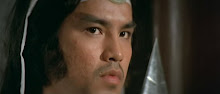
SANTO CONTRA EL REY DEL CRIMEN 1962 (SANTO VS. THE KING OF CRIME)
Santo (as himself), Fernando Casanova (Fernando Lavalle), Ana Bertha Lepe (Virginia), Beto el Boticario (Conrado Gonzalez), Guillermo A. Bianchi (Don Cosme), Rafael Munoz Aldrete (assistant to Don Cosme), Augusto Benedico (Matias), Francisco Curiel (young Roberto de la Llata), Rene Cardona (de la Llata, Sr.)
Directed by Federico Curiel
The Short Version: After battling zombies, Santo tackles more down-to-earth opponents in the rotund gangster Don Cosme and his gambling syndicate. In between wrestling bouts more heated than normally seen, the busy Santo finds time to play a bit of Jai Alai to trap Cosme and his men. The real fascination with this early entry in the long running Santo series is that the Silver Masked One is given an origin, and a Batman styled persona replete with a big mansion, a caretaker, and a secret lab completing his superhero ensemble. A monsterless movie, KING OF CRIME is kinda talky, but kinda fun. Recommended for serious Santo fans.

 Standing up to bullies to protect a little girl and her puppy, the young Beto de la Llata's valiance makes his father proud. This prompts the patriarch to reveal to his young son that his former identity was that of Santo, a protector of the people from the forces of evil that has been a family tradition for decades. Entrusting his son to one day don the silver mask, upon winning Mexico's coveted wrestling championship belt, Roberto unsheathes his father's silver mask, ready to battle criminality. His first task is to bring a ruthless gangster syndicate to justice.
This Santo adventure is the first of a crime caper trilogy filmed in between SANTO VS. THE ZOMBIES (1962) and the cult favorite SANTO VS. THE VAMPIRE WOMEN (1962) from Federico Curiel and the Peliculas Rodriguez production company in 1961. The other two films being SANTO EN EL HOTEL DE LA MUERTA (SANTO IN THE HOTEL OF DEATH) and SANTO CONTRA EL CEREBRO DIABOLICO (SANTO VS. THE DIABOLICAL BRAIN). All three starred Fernando Casanova, Ana Bertha Lepe, and Beto el Boticario as Santo's detective colleagues.
 Curiel, no stranger to Santo cinema and Mexi-horror in general, wrote the script, and keeps things moving for the most part. The film falters here and there, and the editing could definitely use some tightening up, but the air of a superhero movie is palpable throughout. This is most indicative in that Santo is given an origin story (his first movie, SANTO CONTRA CEREBRO DEL MAL, didn't give him one); we're even given a glimpse of his face, so to speak. A similar stunt is pulled in the Santo film EL HACHA DIABOLICA (1965). What's interesting about this origin is that, unlike other movies, Santo is the alter ego of wrestler, Roberto de la Llata; his "mysterious disappearance" prompting the emergence of the Saintly One, leaving his life as his former self behind.
 Famous director of trashy, yet highly entertaining movies, Rene Cardona plays the father of the young man who would be Santo -- in fact, the father WAS Santo, but debilitating health led to his hanging up the mask. His son takes up the mantle of savior of the people to battle evil wherever it may reside. The evil in this case is the title King of Crime. And this Mexican kingpin is a portly, multi-lingual fellow who runs a gambling racket fixing sporting events in both wrestling and Jai Alai (a sport akin to Handball, or Tennis) from half a dozen phones on his desk.

 Speaking of which, there's quite a bit of sporting event footage in this one. Most Santo movies contain at least two wrestling matches (some have none at all), and this one has two, plus a few segments of the main characters attending Jai Alai events. Santo even participates in a game; or more precisely, a player of a much smaller build wearing his mask. These scenes are integral to the story, mind you; and while they may feel like there only purpose is to pad out the running time, these scenes are interesting to see how this sport is played.
 The attempt at building an arc around the two detectives and the feisty female reporter is a nice touch, and rare for these films. Some of it is unnecessary and out of place (where is the editor?), but it does aid in accentuating Santo's scenes when he shows up out of nowhere to save our intrepid trio of investigators.
Enrico Cabiati's jazzy score is atypical of these movies, although some Santo films have genuinely attractive soundtracks; mostly for the entries with fantastical elements, which doesn't apply here.
The most popular Santo movies are the ones where he battles mad scientists and monsters, and while there's none of that here, some minor SciSpy concepts shine through. The new Saint is shown his fathers secret laboratory where he once conducted his research and tracking of the bad guys. There's all sorts of devices about the room (which was so secretive, Roberto, for his entire life, was unaware even existed) including his father's invention, the X-Alpha, a wristwatch that acts as a communications device.
 There isn't wall to wall action like in some Santo flicks, but what's here is well choreographed, and unusually brutal. The two wrestling matches in particular are fast-paced and more creative than most. Santo and Fernando Oses give it all they've got in an exciting display of rapid fire maneuvers that escalates into an all-out war in the ring. Even the ref gets clobbered. Apparently there's no disqualifications in Mexico. It gets so intense, blood is even drawn. Both men look like they're really wailing on each other, too. The second, and shorter, but no less vicious match sees Santo take on Max Stromberg (Eduardo Bonada). This one culminates with an attempt on Santo's life by an assassin with a sniper rifle hidden inside a guitar case.

 Among the batch of crooks, watch for midget actor Rafael Munoz Aldrete as Cosme's hunchbacked
assistant. He appeared in similar capacity in the bonkers Santo-Blue
action-monster mash SANTO AND BLUE DEMON VS. THE MONSTERS (1970); and he
played the Stinky Skunk in the infamous RED RIDING HOOD trilogy
released here dubbed from K. Gordon Murray. After a long career in
cinema, Rafael died on January 2nd, 2002 after suffering a heart attack.
He was 72.
Among the batch of crooks, watch for midget actor Rafael Munoz Aldrete as Cosme's hunchbacked
assistant. He appeared in similar capacity in the bonkers Santo-Blue
action-monster mash SANTO AND BLUE DEMON VS. THE MONSTERS (1970); and he
played the Stinky Skunk in the infamous RED RIDING HOOD trilogy
released here dubbed from K. Gordon Murray. After a long career in
cinema, Rafael died on January 2nd, 2002 after suffering a heart attack.
He was 72.
SANTO VS. THE KING OF CRIME never attempts to take itself too seriously, and this is clearly in evidence during the climax when the ineffectualness of the bumbling crime king and his cohorts reaches its zenith. It's a satisfying finale with some touches of humor, and all the Jai Alai scenes justify themselves.
Compared with other Santo actioners without monsters, KING OF CRIME is one of the best of that lot. Some interested parties might be put off by the absence of any fantastic elements, so be mindful of that if you're a fan. It sometimes feels like it's schilling for the sport of Jai Alai, but the wrestling bouts, brawls, and moderate exposition, not to mention the bonus of an origin for our hero, add up to an entertaining entry in this series of Mexico's most famous luchador.
This review is representative of the RTC-Cinematographica Rodriguez DVD. There are English subtitles.
 DR. NO 1962
Sean Connery (James Bond), Ursula Andress (Honey Ryder), Joseph Wiseman (Dr. Julius No), Jack Lord (Felix Leiter), John Kitzmiller (Quarrel), Anthony Dawson (Professor Dent), Eunice Gayson (Sylvia Trench), Bernard Lee (M), Lois Maxwell (Miss Moneypenny), Zena Marshall (Miss Taro)
Directed by Terence Young
"It's a Smith & Wesson... and you've had your six." -- James Bond administering last rites to an unlucky assassin.
The Short Version: DR. NO kicks off the lucrative James Bond franchise in low-key fashion with this modest spy thriller that, with its assassins, killer spiders, "fire-spitting metal dragon", and cyanide laced cigarettes, hints at all the garishly colorful villains and outrageous elements the series would soon become known for. The memorable world dominating villain of the title is only seen in the last reel, but a slew of succeeding madmen follow closely in No's megalomaniacal footsteps. A huge box office success, audiences were shaken, but not sufficiently stirred till spy spectacle GOLDFINGER rolled out. Just say YES to DR. NO, and The Man With the Midas Touch, James Bond.

British secret service agent James Bond is assigned to investigate the murder of a colleague and the clues lead to an island stronghold lorded over by the half-Chinese madman, Dr. Julian No. Upon getting close to his quarry, Bond is captured and taken to the lair of the mysterious Dr. No. Over dinner, the good doctor informs Bond his intention to avenge himself on the East and West by first wrecking havoc with the space program at Cape Canaveral with his atomic beam weapon before utilizing his harnessed nuclear power to rule the world.
 His name is Bond... James Bond, and this, his first spy mission, is a modest affair from director Terence Young and producers Harry Saltzman and Albert R. Broccoli. Easily one of the most influential movies of all time, DR. NO started a spy craze that lasted for several years on both the big and small screens. Everybody from Italy to Hong Kong were assigning spies to their own brand of secret agent adventures. For a 1 million budgeted picture, the scope and production values look great. Ted Moore's photography and the elaborate sets for No's villainous lair allow the film to appear much bigger than it really is. With its massive, and ensuing popularity, the Bonds, their budgets, and everything about them, would get bigger.
With this expanse, the signature staples of the James Bond film series that began here would likewise become more wild, outrageous, and sexier with each sequel; the following film, FROM RUSSIA WITH LOVE (1963), established additional Bond conventions that laid the blueprint by which the remaining entries would follow.
One of these establishing Bond elements are those memorable opening credits sequences that either precede the start of the film, or appear after an action scene; which eventually became a series mainstay. Maurice Binders design with animation by Trevor Bond influenced many a Bond rip-off; and particularly countless Italian westerns.
Of course the music by Monty Norman is among the top most recognizable cues in motion picture history. That famous Bond theme is played frequently throughout DR. NO (1962).
 One of my favorite series concepts is the cordial, albeit deadly rapport James Bond shares with the villains. Both are very much aware who the other is, and what they're up to; not to mention both surely wish the other dead. It's a game of cat and mouse between the dapper protagonist and arrogant antagonist. Even during the "settling of accounts" sequence wherein the well-mannered villain reveals his diabolical plan to his self-assured nemesis -- usually over a meal and witty banter -- the bad guy still can't bring himself to simply shoot Bond, preferring to make him suffer some horrible fate instead; but not before showing his gracious nature. Despite this, there's a mutual respect found between the two enemies and their 2 hour chess game that concludes in a life-ending checkmate.
 When viewed next to other Bond movies, DR. NO is quaint in comparison. It's a fairly simplistic story with no gadgets, fancy cars, or imposing, comic book styled henchmen (unless you count the three assassins, the 'Three Blind Mice'). Dr. No, the half-Chinese, half-German mad scientist is the sort of world dominating villain that the series became famous for, you don't see him till the last 20 minutes. If only he had a goatee he could easily pass for Fu Manchu. Now there's a pairing -- Ian Fleming's famous spy meets Sax Rohmer's criminal sadist! No does have metal hands that can crush objects with ease, however. It's during this last reel that the audience gets a taste of where the series is headed in the ensuing years.
The action sequences are all small-scale (brutal fisticuffs and a couple car chases), but these are exciting none the less. DR. NO focuses more on the mystery and intrigue; which works very well within the bounds of the budget. The film itself is more about building the Bond character -- displaying him as a suave, charismatic, sometimes cold-blooded man who gets the job done without the benefit of quasi-SciFi accouterments of later pictures.

 While he's not quite on the level of the vengeance seeking operative
Bond became in LICENCE TO KILL (1989), he's neither the comical,
one-liner spouting womanizer of the 70s and early 80s; but somewhere in between. The scene where
Bond outsmarts, and executes hitman Professor Dent shows a merciless side to the
secret agent, if necessarily so. His witty response prior to forever silencing Dent isn't the sort of one-liner you'd hear throughout the Roger Moore years; although he does spout off a Mooreism when he sends the 'Three Blind Mice' to an early grave. His swift sentencing of Dent is darkly humorous, if callous in Connery's intonement.
While he's not quite on the level of the vengeance seeking operative
Bond became in LICENCE TO KILL (1989), he's neither the comical,
one-liner spouting womanizer of the 70s and early 80s; but somewhere in between. The scene where
Bond outsmarts, and executes hitman Professor Dent shows a merciless side to the
secret agent, if necessarily so. His witty response prior to forever silencing Dent isn't the sort of one-liner you'd hear throughout the Roger Moore years; although he does spout off a Mooreism when he sends the 'Three Blind Mice' to an early grave. His swift sentencing of Dent is darkly humorous, if callous in Connery's intonement.
As Bond, Connery is effortless in the role, with nearly every move he makes the personification of perfection. Like Sherlock Holmes, he has a confidence about him wherein he's frequently one step ahead of those who want him dead; and a roguish charm in the way Bond beds down women he clearly knows are his enemies. From here, James Bond would morph into a secret agent of a comic book stature, possessing an uncanny ability to stay alive -- surviving scenarios that defy logic.
His affinity for women is glaringly apparent, but this too would be exaggerated in later pictures where Bond becomes a veritable Don Juan with every woman he comes into contact with; and occasionally these women want him not just in bed, but dead, too.
SPECTRE (SPecial Executive for Counter-intelligence, Terrorism, Revenge and Extortion), the insidious worldwide terrorist organization makes their debut here. The global terror group encores in FROM RUSSIA WITH LOVE (1963), returns
for the fourth film THUNDERBALL (1965), and again attempts to rule the
world in YOU ONLY LIVE TWICE (1967), ON HER MAJESTY'S SECRET SERVICE
(1969), and DIAMONDS ARE FOREVER (1971). The non-Eon Production (the company that produced all the Bond movies) NEVER SAY NEVER AGAIN (1983) brought back SPECTRE one last time.

 In these appearances, the face of SPECTRE is represented famously by that of Ernst Stavlo Blofeld. Anthony Dawson (Professor Dent in DR. NO) plays a faceless Blofeld in FROM RUSSIA WITH LOVE (1963) and THUNDERBALL (1965); Donald Pleasence in YOU ONLY LIVE TWICE (1967); Telly Savalas in ON HER MAJESTY'S SECRET SERVICE (1969); Charles Gray in DIAMONDS ARE FOREVER (1971); John Hollis, like the second and third films with Dawson as the bald, white cat stroking character, never shows his face as Blofeld (unnamed and uncredited for legal reasons) during the opening sequence in FOR YOUR EYES ONLY (1981); and Max Von Sydow in the unofficial Bond adventure NEVER SAY NEVER AGAIN (1983).
Other performers that make DR. NO work very well are Jack Lord as Felix Leiter and Ursula Andress as Honey Ryder. Lord of course, went on to enormous fame as McGarrett on the original HAWAII FIVE-O; a series that ran from 1968-1980. Prior to that, his monetary demands caused him to lose out on portraying Leiter in subsequent roles, and also the Captain seat on the Enterprise before William Shatner was awarded with it. It's likely for the best, as both FIVE-O and STAR TREK became iconic because of the actors that played them; and it's difficult to imagine anybody else playing McGarrett and Kirk respectively.
Andress's career skyrocketed because of her Bond affiliations with roles in virtually every genre style of varying taste and quality. Her emergence from the ocean in DR. NO has been homaged by Halle Berry in DIE ANOTHER DAY (2002), and repeated in other films outside the Bond spectrum. She was the benchmark for later Bond women, and especially those that survive the end credit crawl.
 There's little else to say about DR. NO aside from praising every aspect of the production. It's a bit silly in places (the section with the metal dragon is hard to swallow that a big tank with a mounted flamethrower would be mistaken for a real dragon), dated in some others, but it still holds up incredibly well, if being a bit on the talky side. Connery's debonaire, if deadly portrayal keeps things interesting, although some less patient viewers might find their mind wandering from time to time. Still, it's essential viewing for fans, and those even remotely curious about Bond's big screen beginnings.
This review is representative of the MGM DVD.
copyright 2013. All text is the property of coolasscinema.com and should not be reproduced in whole, or in part, without permission from the author. All images, unless otherwise noted, are the property of their respective copyright owners.