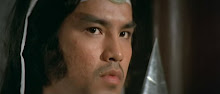
LOS CAMPEONES JUSTICIEROS 1970 (THE CHAMPIONS OF JUSTICE)
Blue Demon (himself), Mil Mascaras (himself), El Medico Asesino (The Killer Doctor/himself), Alejandro Cruz (The Black Shadow), Tinieblas (Darkness/himself), La Sombra Vengadora (The Avenging Shadow/himself), David Silva (Dr. Zarkoff/Black Hand), Elsa Cardenas (Elsa)
Directed by Federico Curiel
The Short Version: Before THE AVENGERS movie, there was THE CHAMPIONS OF JUSTICE. Five of Mexico's biggest wrestling stars engage a mad scientist and his superhuman, machine gun totin' midget militia in a neverending string of action set pieces. Just like the action, the jazzy soundtrack seldom slows down. Beautiful girls, some explosions, and slicker production values than usual enhance this lively, absolutely bonkers, low budget Bondian piece of Lucha madness.

 Dr. Marius Zarkoff, alias Black Hand, seeks revenge against The Champions of Justice for putting him in prison five years earlier. The Champions are a five man team of wrestlers that fight evil when they're not battling opponents in the ring. To see his vendetta through, Black Hand creates an army of superhuman midgets he uses to kidnap the Goddaughters of the Champions -- all of whom are beauty contest participants -- in addition to setting a variety of traps for our heroes. Zarkoff eventually captures one of the Justice members and takes control of his mind. The rest of the Champions battle their way to Zarkoff's hideout for a final showdown.

 Prolific Mexican director Curiel is often reliable in delivering shoestring entertainment that satisfies its core audience; other times, not so much. Thankfully, this is among the man's best efforts. LOS CAMPEONES JUSTICIEROS is also one of the best of the Lucha canon, and appears to have been granted something resembling a budget. Make no mistake, it's still an impoverished affair, but rarely has mediocrity been this ingeniously rewarding.

The action sequences are (moderately) varied as opposed to having the heroes and villains slug it out in the same locales over and over again; cars and boats are blown up, which is unusual for this sort of thing. The heroes drive motorcycles, as well as their own signature vehicles that only adds to spice up their personalities. If nothing else, this Mexican 'Justice League' is ambitious well beyond its means.

 For this genre, wrestling is an integral factor to the success of these pictures. There's often at least two, but for this first entry in the trilogy, there's only one wrestling match, and that's at the very beginning. Oftentimes these matches have no impact on the plot, but sometimes are integrated into the storyline. The one that opens LOS CAMPEONES JUSTICIEROS seems like it's the former, but turns out to be the latter when one of Black Hand's peewee perpetrators attempts to assassinate three of our heroes with a machine gun!

 Blue Demon (real name Alejandro Munoz Moreno) was a hugely popular Lucha star; not worshiped to the level of the one and only Santo, but his popularity was on par with that of El Enmascarado De Plata; as was a long standing rivalry between the two that began with the unmasking of Blue's then partner, Black Shadow in 1952. Making his first wrestling appearance in 1948 in Laredo, Texas, Moreno made his way back to Mexico where he adopted the famous Blue Demon persona. On September 25th, 1953, Blue defeated El Santo, and his career skyrocketed from there. In 1964, Blue began a film career that spanned 25 films (a little under half of the number Santo starred in); 27 if you count his first two minor roles. Blue retired from the spotlight in 1989. He died from a heart attack on December 16th, 2000 while coming home from a gym. He was 78 years old.

 Mil Mascaras (real name Aaron Rodriguez) is among the biggest, most popular Mexican wrestlers in history. His legendary status is due in no small part to his crossing borders around the world cementing his name in the United States and Japan to name two. Debuting in 1964 as Ricardo Duran, he was spotted by Valente Perez, a magazine owner who was looking for a man to fill the mask of a new Lucha character. On July 16th, 1965, Ricardo Duran had officially become Mil Mascaras, or Thousand Masks. Mil was voted Most Popular Wrestler in American wrestling publications in the 1970s. In 1966, he began a film career that prospered till 1977 with 14 movies. Between 1980 and 2010, Mil starred in 5 more pictures, and counting. Clarifying in a 1977 interview, Mil has stated he will unmask upon his retirement. At 74 years old, Thousand Masks is still wrestling today.

 At 6'3", Tinieblas (Darkness) earned his subtitle, El Gigante. He debuted in the ring shortly after he made his big-screen debut in this film. Despite his imposing size and bodybuilder status, Darkness never got a film series of his own, but did co-star with virtually all the big names within a ten year span. His last two pictures were with Lucha cinema king, El Santo. Like the Saintly one, Darkness was popular enough to garner his own comic book series that outlasted his film career. Under his real name, Manuel Leal, the giant played Satan in the classic smash THE MUMMIES OF GUANAJUATO (1970). His nicknames were El Gigante Sabio (The Wise Giant) and Captain Adventure. Like many Luchas, his son carries on the Darkness tradition. Tinieblas, Sr. retired from the ring May 21st, 2011 at 72 years of age.

 El Medico Asesino of CHAMPIONS was not the same as the original Killer Doctor (Dr. Wagner, real name Manuel Gonzalez Rivera), who was the star of 1952 movie THE MAN IN THE SILVER MASK; a role turned down by Santo (and one he accepted in 1958 leading to a famous series of 52 films). Gran Markus, the Killer Doctor (real name Juan Chavarria Galicia) began his professional wrestling career in 1963 as Doctor Markus, and teamed with the original Medico Asesino some time later. Like Mil Mascaras, Gran Markus wrestled in America; particularly in the once thriving Texas organization, World Class Championship Wrestling teaming with Gino Hernandez. His film career began in 1969 where he was a stuntman in SANTO & BLUE DEMON VS. THE MONSTERS (1970). His onscreen debut as The Killer Doctor started with CHAMPIONS in 1970. died at 64 on November 15th, 2007 from diabetes.

 Alejandro Cruz Ortiz began wrestling at 19, but didn't go under the mask as The Black Shadow (above at left) till 1947. At that time, Black Shadow teamed with Blue Demon, begetting an intense rivalry with Santo; this culminated in a 70 minute match wherein Black Shadow lost both the match, and his mask. He was famous for his versatility, and fathering some of the sports most famous tropes like high-flying maneuvers. Despite losing his mask, Ortiz's career never slowed down. He supplemented his wrestling career with one on the Silver Screen appearing in numerous Santo films as a wrestler. He wore his mask in CHAMPIONS, and even played Blue Demon's doppelganger in SANTO & BLUE DEMON VS. THE MONSTERS (1970). Ortiz passed away March 8th, 2007 from pneumonia at 82 years of age.

 The Avenging Shadow (also listed as the Shadow Avenger) is a movie character created by producer Luis Manrique, and played by Fernando Oses in four movies all from 1954, and directed by Rafael Baledon. The character appeared again in at least two films in the 1960s. LOS CAMPEONES JUSTICIEROS was the last onscreen appearance of The Shadow Avenger. Oses was a well-rounded talent, not only as a wrestler and an actor, but also as a prolific writer, producer and director. Onscreen he mostly played bit parts as wrestlers, or henchmen of the bad guys; and on some occasions, the main antagonist like the vampire BARON BRAKOLA (1965). Oses had a rugged look about him, and his matches with El Santo were some of the best, often most brutal matches seen in Lucha cinema. The Man of a Thousand Talents, Fernando Oses, died May 2nd, 1999.
Another popular wrestler Rayo de Jalisco (Lightning from Jalisco) wore an almost identical outfit for his in-ring persona, and took the place of the Avenging Shadow in the two sequels, VUELVEN LOS CAMPEONES JUSTICIEROS and EL TRIUNFO LOS CAMPEONES JUSTICIEROS.

 Black Hand (not to be confused with the wrestler of the same name) is your typical mad scientist that crops up in these movies, virtually interchangeable from the last. Where Zarkoff differs is in his small army of midgets (redundant, ain't it?). These are no ordinary half-pints, mind you. They dress all in red, wear capes, and have an 'M' emblazoned on their chest. These lethal little people have been scientifically enhanced with the strength of ten hombres. Your jaw will hit the floor when you see agitated midgets beating the hell out of Blue Demon, Mil and the rest. There's also some spectacular dummy moments where the heroes show off their midget tossing skills.

 Much like the Italian sword and sandal movies during their declining years, midgets were a popular plot device in Mexican genre pictures. It made sense considering midget wrestling matches were always crowd pleasing attractions around the world in the sport of professional wrestling. It gets hysterical watching the wrestlers having to bend down in some way so the hyperactive halflings can Karate chop them. The little guys get to strut their stuff a lot in this one.

 Much of the fun factor of CHAMPIONS OF JUSTICE is due to some glaringly ridiculous, brain-dead moments; some of these include The Killer Doctor and Tinieblas on a boat wired to explode. For some unexplained reason, they never notice the explosives in plain sight just to the right of them. Apparently watching the bikini clad Elsa Cardenas on water skis was too much of a distraction. Another perplexing scene has our maniacal Lilliputians shooting ray guns that emit flame, but instead of setting the target on fire, it freezes them instead.

 Federico Curiel has been so prolific in Mexican cinema, his name bears mentioning twice. The man's hand guided numerous Mexican genre pictures from the Nostradamus vampire quartet, and several Lucha films of varying entertainment value; one of which was the biggest Lucha hit of them all, the aforementioned THE MUMMIES OF GUANAJUATO (1970). He helmed the first sequel to CHAMPIONS OF JUSTICE, VUELVEN LOS CAMPEONES JUSTICIEROS (1972) while Rafael Lanuza took the reigns of the third, and final entry, EL TRIUNFO DE LOS CAMPEONES JUSTICIEROS (1974).

Fans of masked wrestler pictures will get more than their money's worth from this one. The box office smash from 1970, THE MUMMIES OF GUANAJUATO gave you three Luchas, this one gives you five in a typically nutty adventure packed with mad scientists, midgets, and mucho acciones.
This review is representative of the Brentwood/BCI DVD.