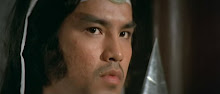
THE KILLING MACHINE 1975 aka SHORINJI KEMPO
Sonny Chiba (Doshin So), Makoto Sato (Otaki Kentaro), Yutaka Nakajima (Kiku Sakamoto), Makoto Naoya (Hiroshi Tomoda), Etsuko Shihomi (Miho), Kyoichi Sato (Kaga), Tetsuro Tamba (Police Chief Nobuyuki), Rikiya Yasuoka (Takehara), Kinji Takinami (Akamatsu)
Directed by Norifumi Suzuki
The Short Version: Bone-breaker extraordinaire Sonny Chiba returns to the screen essaying the real life martial artist, Doshin So, the founder of Shorinji Kempo. There's elements of Master So in this film, but sensationalism dominates; especially in the last 40 minutes. Suzuki tries to take things seriously most of the time, but the urge for breaking arms, geysers of blood, and scissoring off a rapists penis for a hungry dog is just too much to resist. Arguably one of the Bad Man From Japan's bests movies, it sits stoically alongside other brute-tastic, body mangling movies like THE STREET FIGHTER (1974) and THE EXECUTIONER (1974).

 After Japan surrenders in 1945, Doshin So, an undercover agent behind enemy lines in China, goes back home to Osaka. Upon arriving there, he rescues a young lady sold into prostitution by a Yakuza gang, and takes in a band of orphaned children. Running into trouble with some American GI's, Master So cripples two of the MP's and is arrested. The Japanese chief of police is sympathetic to the martial arts master, and allows him to leave quietly. Leaving for Shikoku, Doshin So sets up a martial arts school, and soon runs into the same Yakuza mobsters from Osaka. Along with corrupt lawmen, the mob begin taking lands for their own use, and So's school is highly prized by them. A violent war between Doshin and his students versus the gangsters litters the landscape with blood and broken bones.
 So far the only movie based -- as loose as it is -- on the life of Nakano Michiomi, later to be known as Doshin So (or Kaiso, 'the founder'), the man who brought Shaolin martial arts to Japan. Filmed in cooperation with Japan's Shorinji Kempo Federation, Isao Matsumoto's script inserts small chunks of the real Master So's experiences, using these bits and pieces to build the action portions of the story around them. These autobiographical moments are gotten out of the way rather quickly so as to make room for three sub-plots that are all connected to Chiba's character. Throughout the picture, Doshin So acts as a problem solving Karate savant; a martial arts Moses, if you will. These three arcs are modestly peppered with violent interactions with the villains who will feature heavily in the last half of the picture when the exploitation portions of the film set in.

 Taking place during a three year period in Master So's life (1945-1948), the film begins at the end of WW2, and So's job as a military intelligence agent is done after Japan's surrender. Returning to his homeland, he sees a devastated, demoralized Japan. He then makes it his mission to aid in rebuilding Japan by rebuilding the crushed spirits of its citizens. He founds Shorinji Kempo in 1947; and that's the extent of the historical connections. There's also a brief flashback to So's childhood when he visits his mother's grave. As for accounts on the real man himself....

 According to sources, Michiomi enlisted in the military at 17, and eventually found himself
stationed in Manchuria as a secret agent. It was also during this time
he became heavily influenced by Chinese martial arts, particularly the
kung fu styles of Shaolin. Taught an array of locks, grappling, and
throwing techniques (which makes up a lot of the martial arts seen in
the film), Michiomi learned faster than the average student. His master,
Wen Tai Zhong made him his successor, granting Michiomi the title of
Grandmaster; and changing his name to Doshin So (Religious Servant of
the Way). He returned to Japan and began his efforts of reinvigorating the Japanese by reaching out to, and eventually training the youth of the day.

 One of the most fascinating aspects of Doshin So the man was his abandoning of ideological, religious, and political polarities in favor of individual qualities of a person; pushing his students to do their best, and find the confidence within themselves to re-establish their sense of purpose and self-worth; this, too, is touched on in the movie on a handful of occasions; particularly when he is forced to get physical with the now one-armed Tomoda (one of the three dramatic arcs presented in the film). Drunk and wishing to die, Master So throws him out into the rain and begins wailing on him, tossing him around like a rag doll to try and anger Tomoda to the point he'll realize he can't let his crippling injury allow him to give up.
Racism is an issue that's espoused upon; it's not a subject the script dwells on, but it makes its presence known a few times. There's disdain from the Japanese towards the Americans, and an even more palpable sense of prejudice from the Japanese towards the Korean population residing there. This discrimination is the catalyst for two of the three expositional branches Suzuki's movie uses to tell its story.
For example, Otaki Kentaro (frequent Chiba co-star, Makoto Sato) returns home from the way only to find his wife has remarried, and to a Korean. Thinking he was killed in battle, he's stunned at his wife's admission; and upon discovering she has a son now, he's even more devastated. Things get no better when Otaki learns the son is actually his. Instead of breaking up this new family, Otaki decides to go his separate way. He contemplates suicide till his friend Doshin convinces him otherwise.
 Known for his sleazy pinky violence movies, and artistically unsavory films along the lines of SCHOOL OF THE HOLY BEAST (1974), Norifumi Suzuki mixes Karate action with heavy doses of drama in SHORINJI KEMPO. It's an unusual pairing that periodically mimics the outrageous antics seen in Shigehiro Ozawa's THE STREET FIGHTER (1974) the year prior. However, Suzuki's film enters Ozawa's nihilistic arena in a big way after the 50 minute mark -- highlighted by one sequence in which Master So punishes a Yakuza for raping a young girl. He pulls out a pair of scissors and severs the man's penis! Tossing the sausage to the ground, the meat attracts the attention of a dog who then makes a meal out of the malcontent's member.
 The Doshin So of Suzuki's film, and of Chiba's portrayal likewise mirrors THE STREET FIGHTER's Tokuma Tsurugi's penchant for bone breaking. Director Suzuki tries to one-up his colleague by having Chiba bend, twist, and contort his victims limbs till they no longer resemble functioning appendages. In addition to all the crushed bones and fractured ribs, there's a gory dismemberment with a LONE WOLF level of arterial spray.

 The real Doshin So worked with lead star Sonny Chiba in preparation for shooting this picture. The martial arts may be there, but the movie was the opposite of So's teachings. A disclaimer at the beginning somewhat confirms this; but then an ending title card tries to justify all the onscreen brutality with a Blaise Pascal quote, "Justice without force is powerless; force without justice is violence". The quote is applicable to this movie, only it's fickle about being a serious story, and one riddled with violence and Karate fights. The films American release as THE KILLING MACHINE only pushed the movie further away from the philosophical underpinnings of Shorinji Kempo, and reinforced the action and brutality quotient stamped into the film like a hellfire missile of Chiba combos.

 Regarding the violence, much of it is foisted upon Sonny Chiba and those close to him in this, one of his best movies. Playing a man prone to passivity, the Cheebster keeps that patently mean visage in check, evoking just enough intense vexation to know that he's bringing the pain, and someone else will be feeling it. He actually gets to emote a bit, and expand on his range as an actor for this sort of picture. Chiba would star in a similar movie released in August of that year, KARATE BULL FIGHTER; a film based on the life of his martial arts teacher, Masutatsu Oyama. It was the first of a trilogy. Coming on the heels of his iconic THE STREET FIGHTER (1974) and the similar THE EXECUTIONER (1974), SHORINJI KEMPO was released in February of 1975. It was one of nine(!) movies the actor appeared in that year.
This was Suzuki's first outing with the martial arts superstar. Six years later, he'd be working with JAC again with the wild SHOGUN'S NINJA (1980), the modern day bizarro martial arts actioner ROARING FIRE (1981), and KAGEMARU, THE NINJA (1983), a live-action adaptation of the anime IGANO KAGEMARU.
 Composer Shunsuke Kikuchi's riffs have that standard Chiba sound to them like many of the actors other Karate pictures around this time. Kikuchi composed some of those too, like KARATE BULL FIGHTER (1975). There's nothing remarkable about the SHORINJI KEMPO score, but the cues suffice in their usage. One of the best pieces is the wa-wa guitar heard in the finale. Kikuchi was incredibly prolific -- to a degree that might make Morricone blush. Just some of the man's genre works include the music and theme song for many of the KAMEN RIDER series', IRON KING, and the MESSAGE FROM SPACE television series; his movie work includes GOKE, BODY SNATCHER FROM HELL (1968), the last four Showa Gamera films from GUIRON onward, and the SISTER STREET FIGHTER (1974) film series.

 SHORINJI KEMPO is sometimes lost in the shuffle, or on down the list when Chiba's available filmography is discussed; this is unfortunate as it's one of the man's bests pictures. It features some of Chiba's best martial arts sequences displaying a level of control that was vastly different from his more famous roles as the STREET FIGHTER Tokuma Tsurugi and Koga of the two EXECUTIONER movies. It's another martial arts film, but the character Chiba plays is multi-layered; something he hadn't played yet in these pictures up to this point. While many would immediately recommend THE STREET FIGHTER, this pseudo-biographical actioner is an engaging introduction to The Killing Machine, Sonny Chiba.
This review is representative of the BCI/Ronin Blu-ray.
 CONAN THE DESTROYER 1984
Arnold Schwarzenegger (Conan), Grace Jones (Zula), Wilt Chamberlain (Bombaata), Mako (Akiro), Tracey Walter (Malak), Sarah Douglas (Queen Taramis), Olivia D'Abo (Princess Jehnna), Pat Roach (Thoth-Amon/Monster), Jeff Corey (Grand Vizier), Sven-Ole Thorsen (Togra), Ferdinand Mayne (Keeper of the Horn)
Directed by Richard Fleischer
The Short Version: The bloodthirsty barbarian, having quenched his taste for revenge, is tempered for this lighter, funnier, but still gritty sequel that shares a lot more in common with the mediocre 2011 remake than the 1982 original. Conan might be billed as a Destroyer, but he's got jokes in this formula adventure that's a whole lot of fun if you can separate it from the blood and guts, fantasy fury of the first film. At times feeling less like a sequel, and more like one of those CONAN rip-offs, but with a much bigger budget, it's one of the finest pieces of 'B' movie escapism despite causing many a troubled brow for the devotees of Robert E. Howard. It is I, the Chronicler, who will tell you of the good and bad of this tale of high adventure.

 Conan is tasked with escorting a virgin princess to procure a magical crystal that will unlock a sacred horn hidden away in a mountain crypt. If successful, Conan is promised by the bewitching ruler, Queen Taramis to return the dead Valeria to him, and a kingdom of his own to rule. Leading a band of thieves, warriors, and the powerful Captain of the Guard in Shadizar, the journey leads them across distant lands and into dangerous encounters with magic and monsters.
 It's not the popular opinion, but CONAN THE DESTROYER (1984) is just as good a movie as CONAN THE BARBARIAN (1982), but for very different reasons. An enormously entertaining 'B' picture, Fleischer's film is the barbaric equivalent of the Saturday matinee features of old. Recycling old cliffhanger templates that were popularized for the modern age with RAIDERS OF THE LOST ARK (1981), CTD is a near perfect example of the formula adventure. The original intent was to create something with broader appeal; something that was the polar opposite of John Milius's classic manly movie milestone; and in that, they succeeded well beyond expectations.

 There's the musclebound, valorous hero (a more Herculean Schwarzenegger); his trusted sidekick (comedy relief, Malak); a wizard (Mako as additional comedy relief); a fierce warrior woman (Grace Jones, who got too carried away in her fight scenes); an insidious, deceptive villain (Sarah Douglas, who else?), and the requisite quest; in this case, a multi-faceted one. Conan must find one item that will unlock another. These are all ingredients integral to the Sword and Sorcery genre. Without these things you've got the cinematic equivalent of something smelly stuck to the bottom of your shoe like THE INVINCIBLE BARBARIAN (1982); or hilarious, unbelievably retarded celluloid mistakes like ATOR, THE BLADE MASTER (1984).

There had been over a dozen similar films made prior to CONAN THE DESTROYER going into production. It's budget (estimated at $18 million dollars) would probably cover the cost of most of them; and with a sizable sum of money behind it, there's an air of sloppiness about CONAN 2 you'd expect to see in a motion picture made with a fraction of the cost.
 In the first movie, there's a couple shots where blood bags are noticeable, but in the sequel, things are a little more glaring. On a few occasions you can see the swords bend during fights; Toth-Amon, upon transforming into a mottle-faced monster, isn't able to close his mouth. It just hangs open; the nose moves, though. At the end of the movie, Dagoth turns into a slimy, amphibious looking monstrosity that, in certain shots, looks like a rush job; and in some instances, the thick padding is obvious. Perhaps Grace Jones was originally part of the fight, and Rambaldi didn't want the suit performer getting hurt underneath all that rubber?

Regarding Carlo Rambaldi's Dagoth creation (Andre the Giant was inside of it), he could do fabulous work (like E.T.), but some of his creations might of looked good on paper, but didn't translate so well upon their construction. That useless giant King Kong robot from the '76 remake for instance. Dagoth is another. It looks menacing enough in a few shots, but when you get a longer look at it, the beast looks like Swamp Thing's cousin's sister's brother... twice removed.
For those who voiced their disdain for Milius reworking Howard's creation, the vilification from hardcore REH fans came in great numbers for the sequel. Conan the Family Friendly Barbarian is only a Destroyer when he has to be. The rest of the time, he's a laid back, more mature savage; prone to smiling spells, and cracking jokes -- such as when he shows Jehnna a sword is preferable to a wooden spear -- "if you're going to learn how to fight, then learn with a real weapon... not with a toothpick!"

 There's a good deal of humor throughout; much of it coming from Conan's sidekick, Malak, the butt of barbarian jokes. There's a funny bit when he references his cousin's sister's brother finding a way out of the wicked city of Shadizar. Later in the film, Conan is doing his Hercules impression by bending some bars that Malak claims his cousin's sister's brother forgot to mention. As Conan nearly gives himself a hernia solving this particular riddle of steel, Akiro and Malak argue behind him whether it was his cousin's sister's brother, or his sister's brother's cousin. For the record, Malak did indeed say it was his cousin's sister's brother.
Paramount of this nuanced savage, and unusual for Iron Age denizens of the male persuasion, he shows no interest in ravaging the shapely form of Olivia D'Abo (who was only 14 at the time), despite her advances. Yes, our little princess was an aspiring Lolita of the Hyborian Age. Conan still mourns for Valeria, and in this movie, even prehistoric sword-slingers have a soft side.
 One a side note relating to the Jehnna character, earlier in the movie, the evil Queen Taramis instructs Bombaata to ensure Jehnna's virginity returns to Shadizar intact. Yes, the 7'1" Wilt Chamberlain, the man who claimed to have bedded down 20,000 females, is in charge of making sure a young woman's maidenhood remain untouched. That's comparable to having a deceased relatives burial handled by a funeral home run by Ed Gein.
 Additionally, there were some that took issue with the campfire sequence showing a drunk Cimmerian; apparently some had forgotten Conan enjoyed his alcohol in the first movie, too; and as gruesome as Milius's movie could be, it wasn't without its own streak of funny business; only here, the comedy is about as subtle as the violence was in Milius's movie. The main difference being that while CONAN THE BARBARIAN was high adventure, CONAN THE DESTROYER was high camp. It's understandable why the hardcore REH set would be disgruntled. The
first movie mixes and matches details from various Howard sources while
the sequel is an even more loose adaptation. Thoth-Amon for instance, is
a central villain in the mythology; but here, he's seen as just another
wizard.
When I saw CONAN THE DESTROYER in the theater, everyone had a
great time with it, and laughed at all the jokes and seemed to really
enjoy it. And I think that's all the filmmakers were going for. My grandmother dropped me off and the choice was either STAR TREK 3, THE MUPPETS TAKE MANHATTAN, or CONAN THE DESTROYER. I made the right choice that day.
Arnold dropped 30 pounds for the first movie, but put 10 back on for the sequel. In this second round, Conan is more heavily involved in action sequences, often displaying a Herculean level of strength. This is particularly in evidence during the opening action sequence when Conan manages to bring two men and two horses to the ground. Lifting massive doors that haven't been opened in years, and bending metal bars are some of the Cimmerian's feats of strength. Arnold's portrayal might seem like a far more relaxed approach, but it's a natural progression for the character. He hasn't lost his savagery, he's just not prone to indulge it till it's necessary.

 Regardless of what viewers think of CONAN THE DESTROYER, everyone that worked on it seemed to have had a fantastic time making it; well, almost everybody. The stunt guys that got badly bruised and broken bones from a no-holds-barred Grace Jones (making her film debut) were likely not in the best of spirits. Schwarzenegger was especially motivated in preparing himself for the role; and according to stunt legend Vic Armstrong, Arnold pushed himself to almost obsessive levels. He might party till 2am, but three hours later, he's ready for the gym. This congenial atmosphere translated to the screen.

 Like Grace Jones, Wilt "The Stilt" Chamberlain made his big screen debut in CONAN THE DESTROYER. He does fine in the role of Bombaata, the Captain of the Guard in Shadizar. Even if he never spoke any lines (he doesn't have many as it is), his height alone is enough to sell his character. His battle with Conan at the end is sufficiently brutal. Some of this fight may have been cut. There's a couple of shots where you see bloody wounds on his back that we don't see him receive. A love scene between Conan and Taramis was omitted -- she appearing as Valeria, it appears from still photos.

Basil Poledouris returns to score the sequel with a lesser, but not unlikable soundtrack. The first movie was very operatic, gloomy, and a stimulating score to match. For DESTROYER, the tone is, as stated above, totally different. The music matches this tonal change. Poledouris's cues are spirited and rousing, complementing the more upbeat adventure motif. You'll recognize some recycled tunes from the first CONAN, and even some of the newer ones get repetitive, but overall, it's music to embark on treacherous journey's by.
 The production design isn't quite as elaborate as before, despite the budget being just slightly less than the first movie. The inner sanctum of Shadizar is spectacular with its marble structures and pillars. Thoth-Amon's ice castle is a nice change of scenery. Jack Cardiff's photography captures some stunning vistas on the Mexico shoot. DUNE (1984) was shot there, so the CONAN sequel shot there too, and at Churubusco Studios since the crew was already in place.
Famous Italian makeup artist Giannetto De Rossi (ZOMBIE, THE BEYOND, DUNE, RAMBO 3, HIGH TENSION) worked on the picture. The gore isn't as extensive as the '82 film, but for a 'PG' production, the sight of splattering blood from sword trauma happens a few times, and a head is sent skyward in slow motion. Dagoth squashes one guys noggin like a melon (offscreen), and there's some bloody wounds on Thoth-Amon (played by former wrestler, Pat Roach) in his monster form.
CONAN THE DESTROYER did very well at the box office -- more so in worldwide gross than domestic. It was a moderate success in America. Its total here lies somewhere between $26-32 million (on an estimated $18 million budget), and a global gross over $100 million. A third film was inevitable, but it didn't happen due to contractual entanglements; and the failure of the vastly inferior RED SONJA (1985) effectively severed the Sword and Sorcery head in the USA, relegating the genre to video store status for many years.

 At the time of the films release, Arnold said he saw himself playing Conan well into his twilight years. It appears he may well get his chance if LEGEND OF CONAN becomes a reality. Seeing both these earlier Schwarzenegger movies now, they're diametrically opposed to one another. Both bring different things to the table. Two different styles from two very different, yet highly respected directors. One is a visual feast with ideological underpinnings; while the other is a simplistic adventure story held together by a string of action packed set pieces. Get some friends, their cousin's sister's brothers, and kick back for a humorously barbaric good time.
This review is representative of the Universal Blu-ray.
copyright 2013. All text is the property of coolasscinema.com and should not be reproduced in whole, or in part, without permission from the author. All images, unless otherwise noted, are the property of their respective copyright owners.