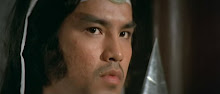
RETURN OF THE EVIL DEAD 1973 aka EL ATAQUE DE LOS MUERTOS SIN OJOS (ATTACK OF THE BLIND DEAD)
Tony Kendall (Jack), Esperanza Roy (Vivian), Fernando Sancho (Mayor Duncan), Frank Brana (Dacosta), Jose Canalejas (Murdo), Ramon Lillo (Beirao), Lone Fleming (Amalia), Loreta Tovar (Moncha), Juan (Jose Thelman), Maria Nuria (Amalia's daughter)
Directed by Amando De Ossorio
***WARNING! This review contains B/W stills with nudity***
***WARNING! This review contains B/W stills with nudity***
The Short Version: The eyeless living dead are back from the grave and ready to party in what is sort of the 'Disaster Movie' of the Blind Dead series. Director Ossorio amasses a bunch of familiar genre faces and puts them in grave danger, killing them off one at the time in a plot eerily similar to one by a certain John Carpenter from 1979. The reliance on mood and fear in TOMBS is replaced with action and gore in the RETURN. There are some things that improve on Ossorio's first, but overall this energetic sequel finishes a close second behind it. ATTACK is to TOMBS what ALIENS was to ALIEN. A highpoint in European horror and, like its predecessor, a must-see for horror enthusiasts.


 A village in Bouzano, Portugal is celebrating the 500 year anniversary of the extermination of the Templar Knights, a bloodthirsty, devil-worshiping cult captured and executed by villagers in the 14th century. The day of the celebration, Murdo, the town cripple, ridiculed by the villagers, sacrifices a young woman in the graveyard of the Templars. Spilling her blood, Murdo resurrects the blind dead knights who set upon the village, slaughtering the attendees. A small group of survivors manage to hole up in a church in an effort to see daylight and outlast the Attack of the Blind Dead.
 The eyeless living dead return via the direction of their creator, Amando de Ossorio, in a more action-oriented, macho sequel to the classic TOMBS OF THE BLIND DEAD (1971). As the director has stated, the four films are stand-alone features, with none of the entries carrying on from the one before it. This sequel, like the others, gives an alternate origin of the title zombies. Instead of being hanged and crows pecking out their eyes, the Templars here have their orbs burned out and their bodies set aflame.

 Focusing on an action-horror scenario, Ossorio crams as much of it as his meager budget will allow. The sequence where the Templars assail the village and kill the inhabitants, for example, the director includes a well-shot scene where the remaining civilians escape in a jeep, narrowly finding safety in a church as the blood-drinking marauders give chase. Ossorio then taps into the siege aspect immortalized in George Romero's NIGHT OF THE LIVING DEAD (1968). It had been done before in many movies, but Romero's NIGHT is what solidified it for the horror genre. It's difficult to watch this film and not think of the classic 1968 zombie movie.
 It's also difficult to watch Ossorio's movie and not be reminded of John Carpenter's THE FOG (1979), as it would appear Carpenter may have been influenced by it for his exceptional spook masterpiece. Ossorio's script detailing a village celebration of a past incident and the living dead returning for revenge is the same narrative thrust of Carpenter's picture. The scene where the Templars pound on a door for the occupants to open up feels eerily familiar to Carpenter's zombie pirates doing the same thing. The next blind zombie movie, THE GHOST GALLEON (1974), featured a ghost ship encased in an unholy fog, so it's possible the king of Halloween may have been inspired by that one as well.

 As ambitious as BLIND DEAD #2 is, the film is hampered by a reliance on stock footage from the first movie. Virtually all the Templar riding scenes (and some of them shuffling around) are lifted from TOMBS. The eerie slow-motion of the skeletal crusaders is tossed out in favor of normal speed Templars on horseback. While they move as slow as before, when they ride around swinging their swords, they do so with enough verve and motion to lessen some of the impact the creepingly inert movements gave them the first time around.

 Aside from an all new origin and situation for the zombies to attack, Ossorio gives the audience some little things we didn't see in his earlier work. Most notable is that we get a peek at the head of one of the Templarian equines in all its rotted, decomposed glory. Elsewhere, the Templars are fitted with these metallic-looking gauntlet's, a more elaborate ensemble addition when compared to the silly looking mittens some of them sported in the first movie. Unfortunately, we don't see near as many of the bony, outstretched arms gripping and clutching as we did before. A preference for sword-swinging takes their place. Again, this goes back to the sequel's agenda being more about action and motion than horror and tension.

In addition to action, something else there's more of is gore. TOMBS had some shocker moments (particularly the flashback sacrifice sequence), but Ossorio's original was all about setting a mood while his second installment jettisons all that and goes for the throat. Limbs are severed, heads are hacked off, and hearts are ripped from bosomy chests and, in one instance, eaten by one of the nasty knights during a flashback sequence.

 There's one other thing Ossorio put into his film that isn't in any of the others in this series, and that's some lightly comical moments (barring the unintentional kind found in the third picture, THE GHOST GALLEON). The funny business is during the bits where the Mayor (played by prolific Italian western favorite, Fernando Sancho) calls his superior to alert him of the encroaching Templars and requests the Army. Naturally, Mayor Duncan is accused of having a bit too much to drink.

 There's one other thing Ossorio put into his film that isn't in any of the others in this series, and that's some lightly comical moments (barring the unintentional kind found in the third picture, THE GHOST GALLEON). The funny business is during the bits where the Mayor (played by prolific Italian western favorite, Fernando Sancho) calls his superior to alert him of the encroaching Templars and requests the Army. Naturally, Mayor Duncan is accused of having a bit too much to drink.
Anton Garcia Abril's monumentally macabre score is back with some minor additions. It's effectiveness is slightly subdued by the onslaught of action-oriented horror, but it's still one of the genres best scores, as under-appreciated as it is. The lighter cues complement the brooding, unforgettably terrifying main Templar theme.
 As for the performers, this is Tony Kendall's movie with Esperanza Roy basically playing the
part Fleming essayed the first time around, but with some obvious
differences. Born in Italy as Luciano Stella and later changing his name
to Tony Kendall, the model turned actor dove into the genre pool of
popular cinema of the 60s and 70s. Having played heroes in Sword and
Sandal, European Westerns and Eurospy movies, the late actor (he passed
away in 2009) applied his Tough Guy persona to Ossorio's Templar
template and likewise played the lead in the director's THE LORELEY'S GRASP (1975).

 Director Ossorio wrote a fairly concise
character arc for Kendall and Roy as Jack and Vivian respectively. We
learn they were former lovers but he couldn't measure up to her
bourgeois tastes. Set to marry the less handsome Mayor Duncan, Vivian lets Jack know she'd
much prefer his company even if he won't have the financial stability
to offer her. This allows for Kendall to indulge in some Tough Guy
theatrics, fighting for his woman, who is also lusted after by Duncan's
chief henchman, Dacosta, played by perennial Euro cinema villain, Frank
Brana.
Aside from a few scenes of exposition that end up benefiting Kendall more than his co-star, Esperanza Roy has little to do that allows her to stand out. A fine actress, her presence is certainly welcome, but for a better presentation of her talents, seek out A CANDLE FOR THE DEVIL (1973). Ostensibly an ensemble piece, Roy's Vivian in BLIND DEAD #2 is mostly window dressing to be fought over. She's never the 'final girl' type that Lone Fleming pioneered in the previous picture; which brings us to.....

 The heroine of TOMBS, Lone Fleming returns but in a different role, and a
noticeably smaller one. She's in most of the movie, but predominantly
in the background. She doesn't get much dialog, but exits the picture in
one of the more memorable moments. After the mayor has used her
daughter as a decoy to make an escape, Amalia (Fleming) frantically
tries to save her, but Jack (Kendall) won't let her, volunteering to go
get the little girl. He gets cornered, so Amalia grabs a torch and
rushes right into the middle of the blood-drinking monsters so Jack and
her daughter can get away. Holding them off, she is then surrounded and
cut down.
 When the picture was released in America, much of the gore was removed including one crucially important, and particularly grim sequence; wrecking havoc with the narrative in such a way, its removal turns a murderous character into a pitiable one. That individual being Murdo, the village cripple, and played by Jose Canalejas. Hellbent on bringing the Templars back to life as they foretold in the opening sequence, Murdo has kidnapped a pretty, young woman from the village. Vigorously cutting into her chest, the blood spills into the ground near the graves of the dead knights. Naturally they rise and make their way to the village astride their unholy horses. The entirety of Murdo sacrificing the girl is missing from the glaringly inferior English dubbed version.

In the Spanish original, there's some nudity, but it appears Ossorio shot a great deal more bared breasts and full-frontal nudity. A number of B/W stills on the Blue Underground DVD reveal a lot of skin that was possibly used for another market (see above). These include nude shots of Esperanza Roy, Loreta Tovar and the girl killed by Murdo--fully nude in some instances. Depending on one's tolerance for subtitles, the qualities between the Spanish and English dubbed versions are like night and day. The former is easily the superior of the two versions.

The beauty of this sequel is that it re-tells the lore in a new and exciting way. Lacking the creepy moments of its predecessor, ATTACK OF THE BLIND DEAD compensates with a voracious creativity that undermines its low budget. The best of the quartet to some, this reviewer still prefers the meticulously crafted original, but Amando de Ossorio's talent peaked with this exemplar second installment in the Templar's celluloid legacy.
This review is representative of the Blue Underground Coffin Box Set release. Extras and Specs: Anamorphic widescreen 1.66:1; US version as RETURN OF THE EVIL DEAD; theatrical trailer; poster and stills gallery.