"There
is something wrong inside of them, in their hearts. If a man feels at
peace within himself he won't feel the need to challenge others.
Moreover, these people who raise challenges have often been ridiculed and they use this type of competition to achieve some ulterior
purpose."--Bruce Lee in a 1972 interview when asked about being
challenged by other martial artists
ENTER THE IMITATORS: MY NAME CALLED BRUCE LE
 Easily the most flamboyant and enterprising of the Bruce's is Huang Chien Lung (Huang Kin Lung).
Bruce
Li may be the most respectable of the Bruce doubles, but the most prolific on the international scene was Bruce Le. Where
Bruce Li wasn't keen on playing Bruce Lee, Bruce Le wore those roles
like a badge of honor. And there was a clear distinction in the quality
of both men's work. Where Ho Chung Tao's movies told a story and were, for the most part, reasonably well made, Huang's films lacked cohesion with barely any plot
to speak of. Oftentimes looking like they made it up as they went
along, the patchwork style of Le's flicks and the plethora of alternate
titles only added to the rampant incoherence in every aspect of the
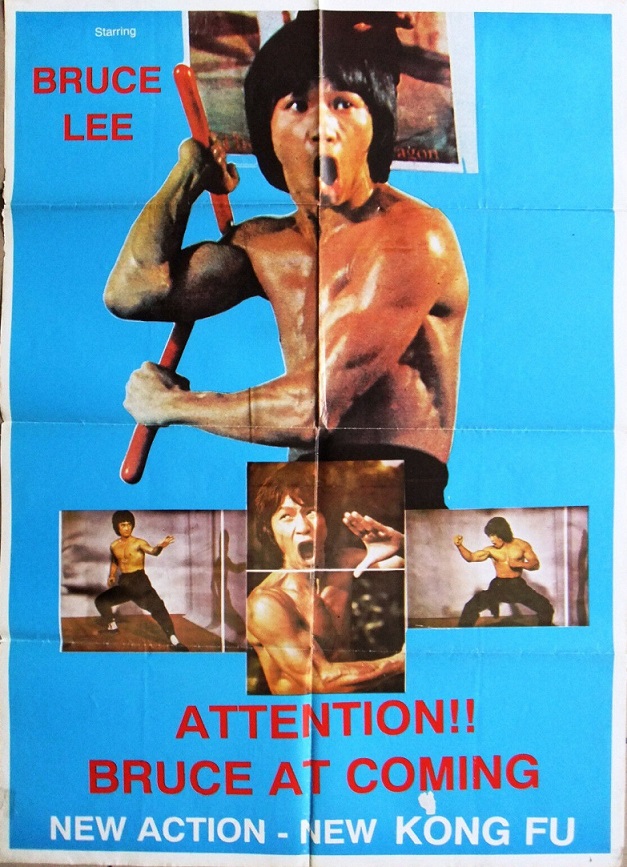
productions. (Insert: Lebanese poster announcing upcoming Bruce Lee action in THE CLONES OF BRUCE LEE)
Easily the most flamboyant and enterprising of the Bruce's is Huang Chien Lung (Huang Kin Lung).
Bruce
Li may be the most respectable of the Bruce doubles, but the most prolific on the international scene was Bruce Le. Where
Bruce Li wasn't keen on playing Bruce Lee, Bruce Le wore those roles
like a badge of honor. And there was a clear distinction in the quality
of both men's work. Where Ho Chung Tao's movies told a story and were, for the most part, reasonably well made, Huang's films lacked cohesion with barely any plot
to speak of. Oftentimes looking like they made it up as they went
along, the patchwork style of Le's flicks and the plethora of alternate
titles only added to the rampant incoherence in every aspect of the
productions. (Insert: Lebanese poster announcing upcoming Bruce Lee action in THE CLONES OF BRUCE LEE)
 A
discovery of director Wang Feng (Wong Fung), Burma-born Huang Chien
Lung (a few years before he'd take the name of Bruce Le) was a real
martial artist who ran a Kung Fu school in Macau. He'd began his MA
training in both Chinese and Japanese arts at the age
of 11 and later became just as hungry for the film business as he was
for martial arts. Huang signed with Shaw Brothers in 1973 after
accepting Wang Feng's invitation to appear in RIVALS OF KUNG FU, a story about famous Chinese martial arts hero Wong Fei Hung.
Huang made six movies at Shaw Brothers, the most famous of which was THE SUPER INFRAMAN (1975); a motion picture where he had no opportunity to show much skill as a KF actor.
A
discovery of director Wang Feng (Wong Fung), Burma-born Huang Chien
Lung (a few years before he'd take the name of Bruce Le) was a real
martial artist who ran a Kung Fu school in Macau. He'd began his MA
training in both Chinese and Japanese arts at the age
of 11 and later became just as hungry for the film business as he was
for martial arts. Huang signed with Shaw Brothers in 1973 after
accepting Wang Feng's invitation to appear in RIVALS OF KUNG FU, a story about famous Chinese martial arts hero Wong Fei Hung.
Huang made six movies at Shaw Brothers, the most famous of which was THE SUPER INFRAMAN (1975); a motion picture where he had no opportunity to show much skill as a KF actor.
 Reportedly,
at the time he was shooting RIVALS OF KUNG FU, someone at the studio
told him he looked and moved like the late Bruce Lee. Huang replied
back, "I look and move like Huang Chien Lung!" This exchange
must've recurred to Huang a few years later, giving him the idea to
re-brand himself as a Bruce Lee imitator since it was working fairly
well internationally for Ho Chung Tao, alias Bruce Li. (Insert: Huang Chien Lung and Run Run Shaw exchange New Year well wishes at the Shaw Studios Chinese New Year Party in 1975)
Reportedly,
at the time he was shooting RIVALS OF KUNG FU, someone at the studio
told him he looked and moved like the late Bruce Lee. Huang replied
back, "I look and move like Huang Chien Lung!" This exchange
must've recurred to Huang a few years later, giving him the idea to
re-brand himself as a Bruce Lee imitator since it was working fairly
well internationally for Ho Chung Tao, alias Bruce Li. (Insert: Huang Chien Lung and Run Run Shaw exchange New Year well wishes at the Shaw Studios Chinese New Year Party in 1975)
 Since
most of Huang's movies where he's billed as Bruce Le never played
theaters in Hong Kong, it's difficult to find information on them as
periodicals of the day seldom mentioned him; nor was he listed among
some 160 leading actors working in Hong Kong in 1978. The rarest of his
HK productions was, ironically, among the most publicized back in the
day; and seemingly, Bruce Le wasn't initially among the cast. (Insert:
Italian poster for 1979s BRUCE LE'S GREATEST REVENGE as BRUCE LEE THE
FLYING DRAGOON)
Since
most of Huang's movies where he's billed as Bruce Le never played
theaters in Hong Kong, it's difficult to find information on them as
periodicals of the day seldom mentioned him; nor was he listed among
some 160 leading actors working in Hong Kong in 1978. The rarest of his
HK productions was, ironically, among the most publicized back in the
day; and seemingly, Bruce Le wasn't initially among the cast. (Insert:
Italian poster for 1979s BRUCE LE'S GREATEST REVENGE as BRUCE LEE THE
FLYING DRAGOON)
 THE BIG BOSS 2 (THE SECOND BROTHER FROM TANGSHAN in Chinese) began filming in 1976; it was funded by entrepreneur Chow Yi Fung (Zhou Yi Feng) and his HK Skylight Film Company (Tian Xiang Films).
Mr. Chow was apparently far more successful in the aviation and
shipping industries than his foray into the film world. His production
house only made three movies before it shut down--the biggest of these
being CHINA ARMED ESCORT aka THE BODYGUARD starring Taiwanese TV and
movie actress, producer, writer and director, Pearl Cheung Ling. She was a martial artist who found international fame in a trilogy of Wuxia fantasies--WOLF DEVIL WOMAN (WOLFEN NINJA), MATCHING ESCORT (VENUS THE NINJA) and MIRACULOUS FLOWER (PHOENIX THE NINJA).
THE BIG BOSS 2 (THE SECOND BROTHER FROM TANGSHAN in Chinese) began filming in 1976; it was funded by entrepreneur Chow Yi Fung (Zhou Yi Feng) and his HK Skylight Film Company (Tian Xiang Films).
Mr. Chow was apparently far more successful in the aviation and
shipping industries than his foray into the film world. His production
house only made three movies before it shut down--the biggest of these
being CHINA ARMED ESCORT aka THE BODYGUARD starring Taiwanese TV and
movie actress, producer, writer and director, Pearl Cheung Ling. She was a martial artist who found international fame in a trilogy of Wuxia fantasies--WOLF DEVIL WOMAN (WOLFEN NINJA), MATCHING ESCORT (VENUS THE NINJA) and MIRACULOUS FLOWER (PHOENIX THE NINJA).
 Strangely,
THE BIG BOSS 2 was among the most heavily promoted Bruceploitation
pictures at the time and has since become the hardest of the
sub-genre to find. Judging by multiple articles about its filming in
1976, Bruce Le wasn't listed as part of the original cast. It's possible his
scenes were added and shot some time later. Director Chan Chue had a legitimate Lee
association; he'd been both an actor and the AD on the original THE BIG
BOSS in 1971. (Insert: Filming BIG BOSS 2 in Thailand; Lo Lieh at right, Wang Ping in the middle, and director Chan Chue at left)
Strangely,
THE BIG BOSS 2 was among the most heavily promoted Bruceploitation
pictures at the time and has since become the hardest of the
sub-genre to find. Judging by multiple articles about its filming in
1976, Bruce Le wasn't listed as part of the original cast. It's possible his
scenes were added and shot some time later. Director Chan Chue had a legitimate Lee
association; he'd been both an actor and the AD on the original THE BIG
BOSS in 1971. (Insert: Filming BIG BOSS 2 in Thailand; Lo Lieh at right, Wang Ping in the middle, and director Chan Chue at left)
Exterior
filming took place in Thailand. Actress Wang Ping (KING BOXER; THE SISTER OF THE SHANTUNG BOXER) was hired as the
female lead due to her popularity there. In the end, THE BIG BOSS 2 allegedly cost
over HK$1 million to make and only brought in HK$82,661 in 6 days when
it was released in Hong Kong in 1978.
 Apparently,
Lo Lieh and Bruce Le would shoot the fan favorite BRUCE'S DEADLY
FINGERS (1976) around the same time. This one makes about as much sense
as most Bruce Le flicks. Large chunks of this movie would turn up in
BRUCE'S NINJA SECRET, aka BRUCE'S LAST BATTLE; a movie strung together
using equally large amounts of footage from Joseph Kong's Filipino
lensed BRUCE AND THE SHAOLIN BRONZEMEN (1982); one of the wackiest of the Bruce Clone pictures.
Apparently,
Lo Lieh and Bruce Le would shoot the fan favorite BRUCE'S DEADLY
FINGERS (1976) around the same time. This one makes about as much sense
as most Bruce Le flicks. Large chunks of this movie would turn up in
BRUCE'S NINJA SECRET, aka BRUCE'S LAST BATTLE; a movie strung together
using equally large amounts of footage from Joseph Kong's Filipino
lensed BRUCE AND THE SHAOLIN BRONZEMEN (1982); one of the wackiest of the Bruce Clone pictures.
 Many
of Bruce Le's movies didn't play in Hong Kong. He frequently worked in
every other Asian market making approximately two dozen movies for P.T.
Insantra Films--owned by Robert Jeffrey (Robert Theh) and Duncan
Leong. This cooperation would give Huang Chien Lung a major boost on the
international market by the start of the 1980s. (Insert: Lebanese poster for 1978s MY NAME CALLED BRUCE. The martial arts choreographers are billed as Mulo Chiba and Nelson Lee)
Many
of Bruce Le's movies didn't play in Hong Kong. He frequently worked in
every other Asian market making approximately two dozen movies for P.T.
Insantra Films--owned by Robert Jeffrey (Robert Theh) and Duncan
Leong. This cooperation would give Huang Chien Lung a major boost on the
international market by the start of the 1980s. (Insert: Lebanese poster for 1978s MY NAME CALLED BRUCE. The martial arts choreographers are billed as Mulo Chiba and Nelson Lee)
By the mid-70s in Southeast Asia, cooperation between territories was not only beneficial but necessary.
 In
1976, Hong Kong and
Indonesia formed partnerships with their respective countries for
filmmaking endeavors after film industries in Southeast Asia were hit
hard by the oil crisis, the television market, and Vietnam falling to
the communists--resulting in the loss of that market and others like the
Khmer Republic. Moreover, the Philippines then unified with China so
that affected the industry as well. The 22nd Asian Film Festival, for
example, was supposed to have been held there but it was reassigned to
be held in South Korea due to the political conflict. (Insert: Spanish poster for FIVE PRETTY YOUNG LADIES as THE FIVE SISTERS OF BRUCE LEE)
In
1976, Hong Kong and
Indonesia formed partnerships with their respective countries for
filmmaking endeavors after film industries in Southeast Asia were hit
hard by the oil crisis, the television market, and Vietnam falling to
the communists--resulting in the loss of that market and others like the
Khmer Republic. Moreover, the Philippines then unified with China so
that affected the industry as well. The 22nd Asian Film Festival, for
example, was supposed to have been held there but it was reassigned to
be held in South Korea due to the political conflict. (Insert: Spanish poster for FIVE PRETTY YOUNG LADIES as THE FIVE SISTERS OF BRUCE LEE)

 As a result, other Asian
territories decided to focus their resources on building their domestic
product
and imposed regulations on film imports from Hong Kong. This in turn
affected the selling of HK movies to other countries like Thailand and
Indonesia. So now, distributors became more selective on
what titles they chose to pay licenses for. They also became more
stringent on the types of movies they purchased. With the growing
emphasis on stronger scenes of sex and
violence, such films were frowned upon outside Hong Kong. Naturally,
there would be multiple versions made exclusively for the various
censor-prone markets that now had tighter restrictions than before. (Top: Italian fotobusta for BROTHERS TWO as BRUCE LEE: THE ROARING TIGER STRIKES AGAIN; insert: Lebanese poster for EAGLE'S CLAW re-titled as BRUCE LEE AND THE EAGLE'S CLAW)
As a result, other Asian
territories decided to focus their resources on building their domestic
product
and imposed regulations on film imports from Hong Kong. This in turn
affected the selling of HK movies to other countries like Thailand and
Indonesia. So now, distributors became more selective on
what titles they chose to pay licenses for. They also became more
stringent on the types of movies they purchased. With the growing
emphasis on stronger scenes of sex and
violence, such films were frowned upon outside Hong Kong. Naturally,
there would be multiple versions made exclusively for the various
censor-prone markets that now had tighter restrictions than before. (Top: Italian fotobusta for BROTHERS TWO as BRUCE LEE: THE ROARING TIGER STRIKES AGAIN; insert: Lebanese poster for EAGLE'S CLAW re-titled as BRUCE LEE AND THE EAGLE'S CLAW)
 On
March 15th, 1976, a delegation of five film stars and four
representatives from Cinemart Magazine were invited for the opening
ceremony of the first color film laboratory in Indonesia, called P.T.
International Cine and Studio Center, Limited. This was to be a bridge
between the two territories for mutual cooperation in their industries.
Among the stars present for the ceremony were Chen Kuan Tai, James Yi Lei, Li Ching, and Shaw Yin
Yin.
On
March 15th, 1976, a delegation of five film stars and four
representatives from Cinemart Magazine were invited for the opening
ceremony of the first color film laboratory in Indonesia, called P.T.
International Cine and Studio Center, Limited. This was to be a bridge
between the two territories for mutual cooperation in their industries.
Among the stars present for the ceremony were Chen Kuan Tai, James Yi Lei, Li Ching, and Shaw Yin
Yin.
Bruce
Le would greatly benefit from this by making many incredibly cheap
action pictures not just in Indonesia, but South Korea, Thailand and the
Philippines. His movies were largely ignored in Hong Kong, and the few
that weren't made little money there.
 By
1977, Bruce Le had entered the Dragon sweepstakes and made what seemed
like a million movies aping everything memorable about Bruce Lee's
films. The actor made over a dozen pictures utilizing various
iconography from Lee's limited filmography. Le's catalog is also
confusing in the most frustrating way with a myriad of interchangeable
titles, multiple versions, and mix n' match edits. His films never had
much in the way of narratives either. What passed for plots in Le's
movies was bare minimum and built around an endless stream of fight
sequences.
By
1977, Bruce Le had entered the Dragon sweepstakes and made what seemed
like a million movies aping everything memorable about Bruce Lee's
films. The actor made over a dozen pictures utilizing various
iconography from Lee's limited filmography. Le's catalog is also
confusing in the most frustrating way with a myriad of interchangeable
titles, multiple versions, and mix n' match edits. His films never had
much in the way of narratives either. What passed for plots in Le's
movies was bare minimum and built around an endless stream of fight
sequences.

 To
add even more confusion, foreign distributors would market these films
to give the impression Bruce Le was starring in a picture he wasn't
actually in. One example is the German promotion for 1978s STORMING
ATTACKS starring Bruce Li and John Cheung. Marketed as BRUCE LEE THE
RAVENOUS COUGAR (see top image), the distributors decided to
deceive patrons into thinking Bruce Le was also starring in the movie by
putting his face on the advertising. Another example is a version of
the French publicity for BRUCE LI IN NEW GUINEA (1979) as BRUCE LEE IN
NEW GUINEA (see insert). It's a Bruce Li picture but this particular bit of promotion gives the impression both Li and Le are starring together!
To
add even more confusion, foreign distributors would market these films
to give the impression Bruce Le was starring in a picture he wasn't
actually in. One example is the German promotion for 1978s STORMING
ATTACKS starring Bruce Li and John Cheung. Marketed as BRUCE LEE THE
RAVENOUS COUGAR (see top image), the distributors decided to
deceive patrons into thinking Bruce Le was also starring in the movie by
putting his face on the advertising. Another example is a version of
the French publicity for BRUCE LI IN NEW GUINEA (1979) as BRUCE LEE IN
NEW GUINEA (see insert). It's a Bruce Li picture but this particular bit of promotion gives the impression both Li and Le are starring together!
 One
of Huang Chien Lung's films that played HK theaters was BRUCE AND
SHAOLIN KUNG FU (1977). A P.T. Insantra production funded with
Indonesian and South Korean financing, it featured many familiar faces
both in front of, and behind, the camera. Actors James Nam (who also co-directs),
Chiang Tao and Bolo Yeung appear while Joseph Kong acts as a
screenwriter. Shaolin movies were big business between 1976-1978 so
Bruce and his financiers were keen to chop off a share of the monastery market for
themselves. (Insert: French poster for BRUCE AND SHAOLIN KUNG FU as THE VENGEANCE OF SHAOLIN)
One
of Huang Chien Lung's films that played HK theaters was BRUCE AND
SHAOLIN KUNG FU (1977). A P.T. Insantra production funded with
Indonesian and South Korean financing, it featured many familiar faces
both in front of, and behind, the camera. Actors James Nam (who also co-directs),
Chiang Tao and Bolo Yeung appear while Joseph Kong acts as a
screenwriter. Shaolin movies were big business between 1976-1978 so
Bruce and his financiers were keen to chop off a share of the monastery market for
themselves. (Insert: French poster for BRUCE AND SHAOLIN KUNG FU as THE VENGEANCE OF SHAOLIN)
 When BRUCE AND SHAOLIN KUNG FU was released in HK in 1978, it only made HK$90,615. Astonishingly,
it was kept in theaters for 7 days. This longer run for a pittance box office take may be due to the film only playing English theater lines. HK theaters that played movies made by or for foreigners tended to stay in theaters longer than local product.
When BRUCE AND SHAOLIN KUNG FU was released in HK in 1978, it only made HK$90,615. Astonishingly,
it was kept in theaters for 7 days. This longer run for a pittance box office take may be due to the film only playing English theater lines. HK theaters that played movies made by or for foreigners tended to stay in theaters longer than local product.
 Despite not making money in HK, it
must've made money elsewhere because a sequel was released the same
year; likely shot simultaneously. The first film managed to get a Japanese release at the tail end of the Karate Boom there, released as FIST OF FURY PART 2. To accentuate how these imitator films
were largely made for foreign audiences, the word 'Bruce' is
nowhere to be found in the Chinese titles. Part one is called
BODHIDHARMA IRON FINGER KUNG FU while part 2 is titled BURNING AT THE
GATES OF SHAOLIN.
Despite not making money in HK, it
must've made money elsewhere because a sequel was released the same
year; likely shot simultaneously. The first film managed to get a Japanese release at the tail end of the Karate Boom there, released as FIST OF FURY PART 2. To accentuate how these imitator films
were largely made for foreign audiences, the word 'Bruce' is
nowhere to be found in the Chinese titles. Part one is called
BODHIDHARMA IRON FINGER KUNG FU while part 2 is titled BURNING AT THE
GATES OF SHAOLIN.
 When
GAME OF DEATH (1978) was finally completed and released in 1978 by
Golden Harvest, it was arguably the most polished Bruceploitation motion
picture yet made. Unintentionally funny and as offensive as any of the
no-budget imitator flicks, this was the second of three times Raymond
Chow produced a movie banking money from the dead superstar. The first was the 1973 Lee documentary that Chow rushed into theaters, BRUCE LEE, THE MAN
AND THE LEGEND; then GAME OF DEATH; and then GAME OF DEATH 2, aka TOWER
OF DEATH (1981).
When
GAME OF DEATH (1978) was finally completed and released in 1978 by
Golden Harvest, it was arguably the most polished Bruceploitation motion
picture yet made. Unintentionally funny and as offensive as any of the
no-budget imitator flicks, this was the second of three times Raymond
Chow produced a movie banking money from the dead superstar. The first was the 1973 Lee documentary that Chow rushed into theaters, BRUCE LEE, THE MAN
AND THE LEGEND; then GAME OF DEATH; and then GAME OF DEATH 2, aka TOWER
OF DEATH (1981).
GAME OF DEATH 2 was reported to have begun filming in the summer of 1978 with shooting having commenced in Japan and Yasuaki Kurata starring. It was also reported that director Ng See Yuen was using outtakes from Bruce's movies to formulate whatever the plot of the film was originally supposed to be. Director Ng remained attached to the project but Kurata didn't by the time the film started up again in 1980.
 TOWER
OF DEATH (1981) is certainly exploitative but easily a better movie
than its even more embarrassing predecessor. Korean martial artist Kim
Tai Chung, aka Tong Long (not to be confused with Lou Rei's older brother),
was Lee's stand-in on GAME OF DEATH (1978) and played his ghost in NO
RETREAT, NO SURRENDER (1986). Like many others, there was nothing about
Kim that resembled the dead Kung Fu star. As it were, Hong Kong
audiences showed an equal amount of disinterest in TOWER OF DEATH as
they did most of the others in the late 1970s.
TOWER
OF DEATH (1981) is certainly exploitative but easily a better movie
than its even more embarrassing predecessor. Korean martial artist Kim
Tai Chung, aka Tong Long (not to be confused with Lou Rei's older brother),
was Lee's stand-in on GAME OF DEATH (1978) and played his ghost in NO
RETREAT, NO SURRENDER (1986). Like many others, there was nothing about
Kim that resembled the dead Kung Fu star. As it were, Hong Kong
audiences showed an equal amount of disinterest in TOWER OF DEATH as
they did most of the others in the late 1970s.
Bruce Le, who was always game for riding a bandwagon, would do his own version of GAME OF DEATH in what would be one of his more popular movies.
 ENTER THE GAME OF DEATH is not good but it's endlessly entertaining; especially the action sequences inside the "pagoda",
that is nothing more than a small office lit with different color
lighting each time Bruce takes on a new opponent. Like most Le movies,
there's barely a plot and what little is there is held flimsily together
by near constant fight scenes. A co-production with South Korea, it
apparently got a HK release in 1981 after Le had attracted attention in
America in 1980 when his films were being shown on television, ENTER
being the first. (Insert: In Thailand, the distributors couldn't be
bothered to put Bruce Le as the main image on the poster, so they used
the real Lee instead)
ENTER THE GAME OF DEATH is not good but it's endlessly entertaining; especially the action sequences inside the "pagoda",
that is nothing more than a small office lit with different color
lighting each time Bruce takes on a new opponent. Like most Le movies,
there's barely a plot and what little is there is held flimsily together
by near constant fight scenes. A co-production with South Korea, it
apparently got a HK release in 1981 after Le had attracted attention in
America in 1980 when his films were being shown on television, ENTER
being the first. (Insert: In Thailand, the distributors couldn't be
bothered to put Bruce Le as the main image on the poster, so they used
the real Lee instead)
By the start of the new decade in 1980, mainstream theater play for Kung Fu films had vanished. Drive-in's and their seedier major city equivalents were safe havens; but Chinese Fist n’ Kickers would have to find a new, more stable home.
 The
owners of P.T. Insantra then struck a deal with Roy Winnick, proprietor
of Best Film and Video Corporation, to release Bruce's Insantra catalog
in America. If you grew up in the 1980s, you surely saw a multitude of
Bruce Le pictures in K-mart in the VHS section; and in video stores across the country. Winnick then licensed
the titles for television syndication. This, of course, was around the
same time the Black Belt Theater packages hit the airwaves in what
became the second Kung Fu Boom in America. (Insert: Italian poster for 1973s THE CHIVALROUS KNIGHT, aka THE CHINESE GODFATHER as THE CHINESE GODFATHER: THE LAST DAYS OF BRUCE LEE)
The
owners of P.T. Insantra then struck a deal with Roy Winnick, proprietor
of Best Film and Video Corporation, to release Bruce's Insantra catalog
in America. If you grew up in the 1980s, you surely saw a multitude of
Bruce Le pictures in K-mart in the VHS section; and in video stores across the country. Winnick then licensed
the titles for television syndication. This, of course, was around the
same time the Black Belt Theater packages hit the airwaves in what
became the second Kung Fu Boom in America. (Insert: Italian poster for 1973s THE CHIVALROUS KNIGHT, aka THE CHINESE GODFATHER as THE CHINESE GODFATHER: THE LAST DAYS OF BRUCE LEE)
 Another
of Bruce's films that played HK was his most ambitious feature at the
time, 1981s BRUCE STRIKES BACK; ambitious in scope and not its funding.
It was promoted as being the first Kung Fu picture fully funded by
European producers but directed by a Chinese; that being Bruce Le and
apparently an un-credited Joseph Kong, a frequent collaborator with
Bruce who also went by the name of Joseph Velasco. (Italian promotion for BRUCE STRIKES BACK, aka BRUCE'S NINJA SECRET, as BRUCE LEE STILL LIVES, crediting Bruce Lee and Joseph Kong as directors)
Another
of Bruce's films that played HK was his most ambitious feature at the
time, 1981s BRUCE STRIKES BACK; ambitious in scope and not its funding.
It was promoted as being the first Kung Fu picture fully funded by
European producers but directed by a Chinese; that being Bruce Le and
apparently an un-credited Joseph Kong, a frequent collaborator with
Bruce who also went by the name of Joseph Velasco. (Italian promotion for BRUCE STRIKES BACK, aka BRUCE'S NINJA SECRET, as BRUCE LEE STILL LIVES, crediting Bruce Lee and Joseph Kong as directors)
 One
of the highlights of the movie was the final fight with Korean kicking
sensation Hwang Jang Lee taking place inside the Roman Colosseum;
something that hadn't been allowed before. Bruce Lee got some shots of
the famed locale for his final duel in WAY OF THE DRAGON (1972), but the
actual fight was shot inside a studio. The budget for Le’s globe-trotting KF adventure was only US$50,000. (Insert: Bruce Le behind the camera setting up a shot on BRUCE STRIKES BACK)
One
of the highlights of the movie was the final fight with Korean kicking
sensation Hwang Jang Lee taking place inside the Roman Colosseum;
something that hadn't been allowed before. Bruce Lee got some shots of
the famed locale for his final duel in WAY OF THE DRAGON (1972), but the
actual fight was shot inside a studio. The budget for Le’s globe-trotting KF adventure was only US$50,000. (Insert: Bruce Le behind the camera setting up a shot on BRUCE STRIKES BACK)
 Actor
and bodybuilder Yang Tze, aka Bolo Yeung, was a frequent performer in
Bruce Le's movies. Bolo had taken a role as a bodyguard in ENTER THE
DRAGON (1973) after he and Bruce Lee met on the set of a cigarette
commercial for Winston cigarettes. Lee was promoting his movie WAY OF
THE DRAGON and he and the strongman became friends. Unfortunately, we
never got to see the two men fight in the released version of ENTER THE
DRAGON, but Bolo was nevertheless an integral part of the mythos; so
fans got to see the muscleman battle the fake one many times. You never
saw him in Bruce Li's films so Bruce Le rectified this by fitting him in
whenever possible.
Actor
and bodybuilder Yang Tze, aka Bolo Yeung, was a frequent performer in
Bruce Le's movies. Bolo had taken a role as a bodyguard in ENTER THE
DRAGON (1973) after he and Bruce Lee met on the set of a cigarette
commercial for Winston cigarettes. Lee was promoting his movie WAY OF
THE DRAGON and he and the strongman became friends. Unfortunately, we
never got to see the two men fight in the released version of ENTER THE
DRAGON, but Bolo was nevertheless an integral part of the mythos; so
fans got to see the muscleman battle the fake one many times. You never
saw him in Bruce Li's films so Bruce Le rectified this by fitting him in
whenever possible.
 To
the detriment of already shoddy productions, Bolo was rarely ever
utilized sufficiently in those films; he would get a fight scene or two
and be defeated far too quickly. There may have been reasons for this;
like his out of the blue appearance in fan favorite BRUCE'S DEADLY
FINGERS (1976). Bolo's screen-time amounts to about five minutes, which
may have been simply a favor while he was on a break from filming
another movie a few blocks down. (Insert: Bruce Le and Bolo battle in ENTER THE GAME OF DEATH)
To
the detriment of already shoddy productions, Bolo was rarely ever
utilized sufficiently in those films; he would get a fight scene or two
and be defeated far too quickly. There may have been reasons for this;
like his out of the blue appearance in fan favorite BRUCE'S DEADLY
FINGERS (1976). Bolo's screen-time amounts to about five minutes, which
may have been simply a favor while he was on a break from filming
another movie a few blocks down. (Insert: Bruce Le and Bolo battle in ENTER THE GAME OF DEATH)

 Whether
for good or ill, the mass exportation of cheap Kung Fu pictures killed
off the genres theatrical staying power in overseas markets. The most
likely scenario is that audience tastes and expectations for how movies
were made changed due to STAR WARS in 1977. Mainstream viewers had moved
on while the Drive-in and 42nd Street crowds remained. In 1978, even HK
journalists were noting that if Chinese filmmakers wanted to maintain
and even increase the US market for their KF films, they needed to make
fewer of them and increase the quality or else they will lose what
little market share they had at the time. (Top: Mexican promotion for
BRUCE'S SECRET KUNG FU, a cut-and-paste movie made up of footage from
BRUCE'S FINGERS and BRUCE AND THE SHAOLIN BRONZEMEN; aka BRUCE'S NINJA
SECRET)
Whether
for good or ill, the mass exportation of cheap Kung Fu pictures killed
off the genres theatrical staying power in overseas markets. The most
likely scenario is that audience tastes and expectations for how movies
were made changed due to STAR WARS in 1977. Mainstream viewers had moved
on while the Drive-in and 42nd Street crowds remained. In 1978, even HK
journalists were noting that if Chinese filmmakers wanted to maintain
and even increase the US market for their KF films, they needed to make
fewer of them and increase the quality or else they will lose what
little market share they had at the time. (Top: Mexican promotion for
BRUCE'S SECRET KUNG FU, a cut-and-paste movie made up of footage from
BRUCE'S FINGERS and BRUCE AND THE SHAOLIN BRONZEMEN; aka BRUCE'S NINJA
SECRET)
Like
the moniker "Spaghetti Western", a label that later became a term of endearment, the Kung Fu flick had a far more
condescending and derogatory term applied, that being "Chopsocky".
Further, the plethora of dubbed KF flicks snatched up on an almost daily basis
did nothing to change casual viewers and critics perceptions of these
movies. Leading the charge was the seemingly endless series of pictures
starring Bruce Le.

 The
enterprising Lee-alike had successfully made the move to the US home
video and burgeoning cable television market. TV became the new home of
Kung Fu via Black Belt Theater packages. Made
up mostly of Shaw Brothers pictures, there was an occasional Bruce-ish
flick mixed in like DYNAMO (1978) and barely bio's like BRUCE LEE'S WAYS
OF KUNG FU. Video store shelves were stocked full of titles from
companies like Saturn Video, Master Arts, All Seasons Entertainment and
Unicorn Video to name a few. Among them were a proliferation of Bruce Le
flicks like BRUCE LE'S GREATEST REVENGE, BRUCE VS. BILL, BRUCE THE
SUPERHERO, and BRUCE'S FISTS OF VENGEANCE to name a few. (Top: Greek poster for BRUCE VS. BILL; insert: Bruce Le VHS releases)
The
enterprising Lee-alike had successfully made the move to the US home
video and burgeoning cable television market. TV became the new home of
Kung Fu via Black Belt Theater packages. Made
up mostly of Shaw Brothers pictures, there was an occasional Bruce-ish
flick mixed in like DYNAMO (1978) and barely bio's like BRUCE LEE'S WAYS
OF KUNG FU. Video store shelves were stocked full of titles from
companies like Saturn Video, Master Arts, All Seasons Entertainment and
Unicorn Video to name a few. Among them were a proliferation of Bruce Le
flicks like BRUCE LE'S GREATEST REVENGE, BRUCE VS. BILL, BRUCE THE
SUPERHERO, and BRUCE'S FISTS OF VENGEANCE to name a few. (Top: Greek poster for BRUCE VS. BILL; insert: Bruce Le VHS releases)
 Bruce Le was also a director, and guided himself in a handful of his Pretend Lee pictures. He famously turned up in the Euro-US gore-horror spectacle, PIECES (1983). Produced by Dick Randall, Bruce was a close friend of the American exploitation peddler, so he got a bizarre cameo appearing on-camera with Lynda Day George. Le's career includes movies that are outside the Bruce Lee Imitator spectrum like THE MAD COLD-BLOODED MURDER (1981) and THE SUPER GANG (1982), but it's the incredibly cheap, barely decipherable Bruce-a-thon's that fans remember best. (Insert: Spanish lobby card for SUPER GANG as THE BRUCE LE GANG)
There were many more Heirs of the Dragon and others important to his legacy...
ATTACK OF THE CLONES: A SELECTION OF OTHER BRUCE LEE'S & CONNECTIONS
 1. From Korea came Dragon Lee, aka Moon Kyoung Seok (or Keo Ryong);
one of the top three most recognizable and prolific of the actual Bruce
Lee clone actors. The Korean Dragon is very popular among Kung Fu fans
although few of his movies played in HK theaters; those being films like
KUNG FU FEVER (1979) and fan favorite, THE CLONES OF BRUCE LEE (1980).
DRAGON ON FIRE (1979), alias THE DRAGON, THE HERO is another. It's not a
leading part for Dragon Lee, but was promoted as one in some areas.
1. From Korea came Dragon Lee, aka Moon Kyoung Seok (or Keo Ryong);
one of the top three most recognizable and prolific of the actual Bruce
Lee clone actors. The Korean Dragon is very popular among Kung Fu fans
although few of his movies played in HK theaters; those being films like
KUNG FU FEVER (1979) and fan favorite, THE CLONES OF BRUCE LEE (1980).
DRAGON ON FIRE (1979), alias THE DRAGON, THE HERO is another. It's not a
leading part for Dragon Lee, but was promoted as one in some areas.
 Directed by Godfrey Ho, it's memorable for the infamous scene where a
dog bites off Chan Lau's penis. It's actually John Liu (Liu Chung Chiang) in the leading role. Liu was from Taiwan and studied Japanese arts winning tournaments at 14 years old. He's also reported to have defeated Chuck Norris in Paris during a live event in 1976. Liu was discovered by Ng See Yuen through European martial arts magazines. He called Paris home and taught his own style there, Zen Kwan Do. John Liu is popular among fans, but he was never a major star in Hong Kong. In some markets, it appears John Liu was billed as Bruce Lei. THE DRAGON, THE HERO is the only movie John Liu did with a Bruce impersonator. (Insert: Lebanese poster for THE DRAGON, THE HERO with John Liu seemingly listed as Bruce Lei above Dragon Lee and Bruce Lee misleadingly top-billed over everyone else)
Directed by Godfrey Ho, it's memorable for the infamous scene where a
dog bites off Chan Lau's penis. It's actually John Liu (Liu Chung Chiang) in the leading role. Liu was from Taiwan and studied Japanese arts winning tournaments at 14 years old. He's also reported to have defeated Chuck Norris in Paris during a live event in 1976. Liu was discovered by Ng See Yuen through European martial arts magazines. He called Paris home and taught his own style there, Zen Kwan Do. John Liu is popular among fans, but he was never a major star in Hong Kong. In some markets, it appears John Liu was billed as Bruce Lei. THE DRAGON, THE HERO is the only movie John Liu did with a Bruce impersonator. (Insert: Lebanese poster for THE DRAGON, THE HERO with John Liu seemingly listed as Bruce Lei above Dragon Lee and Bruce Lee misleadingly top-billed over everyone else)
 Some of the bulkier Dragon's most
enjoyable entries had him co-starring with Korean super-kicking
sensation Hwang Jang Lee; three of their South Korean-made movies being SECRET NINJA, ROARING TIGER (1982), MARTIAL MONKS OF
SHAOLIN TEMPLE and 5-PATTERN DRAGON CLAWS (both 1983). These productions showcase lots of HJL kicking action and Dragon Lee in fine form. (Insert: Lebanese poster for FIVE PATTERN DRAGON CLAWS as KING OF DRAGON BOXERS)
Some of the bulkier Dragon's most
enjoyable entries had him co-starring with Korean super-kicking
sensation Hwang Jang Lee; three of their South Korean-made movies being SECRET NINJA, ROARING TIGER (1982), MARTIAL MONKS OF
SHAOLIN TEMPLE and 5-PATTERN DRAGON CLAWS (both 1983). These productions showcase lots of HJL kicking action and Dragon Lee in fine form. (Insert: Lebanese poster for FIVE PATTERN DRAGON CLAWS as KING OF DRAGON BOXERS)
 Built
like a brick wall, Dragon Lee was a more lithe version of Bolo Yeung.
He looked like he regularly lifted weights while Bolo had a body akin to
a power-lifter. Whenever Dragon Lee did his Bruce impersonations it
looked comical, particularly when he'd shake his head wildly. Even when
he was doing films not marketed as a Bruce clone work, some of Lee's
mannerisms crept in anyway. (Insert: Turkish poster for 1981s ENTER
THE INVINCIBLE HERO. In this instance, Dragon Lee must've had marquee value since the promotion doesn't resort to
billing Bruce Lee in the title)
Built
like a brick wall, Dragon Lee was a more lithe version of Bolo Yeung.
He looked like he regularly lifted weights while Bolo had a body akin to
a power-lifter. Whenever Dragon Lee did his Bruce impersonations it
looked comical, particularly when he'd shake his head wildly. Even when
he was doing films not marketed as a Bruce clone work, some of Lee's
mannerisms crept in anyway. (Insert: Turkish poster for 1981s ENTER
THE INVINCIBLE HERO. In this instance, Dragon Lee must've had marquee value since the promotion doesn't resort to
billing Bruce Lee in the title)

Easily
the most popular movie to star Dragon Lee was THE CLONES OF BRUCE LEE
(1980). It also starred Bruce Le and Bruce Lai, alias Kwok Si Chi. The
latter Lee-alike had been a bit player in some Shaw Brothers pictures
and CLONES was his biggest role. Of the three Lee's featured, he looks
the least like the Little Dragon. CLONES is a favorite of many for its
kooky story, non-stop action, send-up of spy movies and the HK film industry itself. (Top: Mexican promotion for THE CLONES OF BRUCE LEE)
 2.
Taiwanese actor Lung Tien Sheng mimicked Lee in some of his early
movies like THE REVENGE DRAGON (1973). By the end of the decade he was
doing it again in 1979s SEA GIRLS or, as it was also known in Asian
territories BRUCE LEE AGAINST SNAKE IN THE EAGLE'S SHADOW; that title
cashing in on both the Lee name as well as the explosion of Jackie
Chan--who in 1978 had found the fame he'd been looking for in Yuen Woo
Ping's SNAKE IN THE EAGLE'S SHADOW; and to a greater degree, in DRUNKEN
MASTER (both 1978).
2.
Taiwanese actor Lung Tien Sheng mimicked Lee in some of his early
movies like THE REVENGE DRAGON (1973). By the end of the decade he was
doing it again in 1979s SEA GIRLS or, as it was also known in Asian
territories BRUCE LEE AGAINST SNAKE IN THE EAGLE'S SHADOW; that title
cashing in on both the Lee name as well as the explosion of Jackie
Chan--who in 1978 had found the fame he'd been looking for in Yuen Woo
Ping's SNAKE IN THE EAGLE'S SHADOW; and to a greater degree, in DRUNKEN
MASTER (both 1978).
 That
same year in 1979, Lung Tien Sheng would play Bruce Lee in THE TRUE
GAME OF DEATH; and did a surprisingly good job in the role. On a par
with the utter ridiculousness of this sub-genre, some Chinese posters
pasted Lung's head onto Lee's body in an image taken from ENTER THE
DRAGON; while other versions of the poster used the unobstructed image
of Bruce Lee in the same pose. This example of false advertising may
have been inspired by the infamous shot in GAME OF DEATH where an image
of Bruce Lee's head is taped to a mirror concealing the actor's real
face.
That
same year in 1979, Lung Tien Sheng would play Bruce Lee in THE TRUE
GAME OF DEATH; and did a surprisingly good job in the role. On a par
with the utter ridiculousness of this sub-genre, some Chinese posters
pasted Lung's head onto Lee's body in an image taken from ENTER THE
DRAGON; while other versions of the poster used the unobstructed image
of Bruce Lee in the same pose. This example of false advertising may
have been inspired by the infamous shot in GAME OF DEATH where an image
of Bruce Lee's head is taped to a mirror concealing the actor's real
face.

 By
the end of December in '79, Lung Tien Sheng would be at Shaw Brothers
Studio in Hong Kong to start re-shoots on Chang Cheh's TEN TIGERS OF
KWANGTUNG (1980) and play a leading role in Chang's FLAG OF IRON (1980). He was a known actor in Taiwan, but in Hong Kong, he was a new face. Possessing a lot of charisma, he unfortunately never hit the big time in Hong Kong. His portrayal of Bruce Lee remains an underrated performance.
(Top: Italian fotobusta for THE TRUE GAME OF DEATH as BRUCE LEE, THE STRONGEST MAN IN THE WORLD; Insert: German poster as BRUCE LEE: HIS BEST FIGHTS)
By
the end of December in '79, Lung Tien Sheng would be at Shaw Brothers
Studio in Hong Kong to start re-shoots on Chang Cheh's TEN TIGERS OF
KWANGTUNG (1980) and play a leading role in Chang's FLAG OF IRON (1980). He was a known actor in Taiwan, but in Hong Kong, he was a new face. Possessing a lot of charisma, he unfortunately never hit the big time in Hong Kong. His portrayal of Bruce Lee remains an underrated performance.
(Top: Italian fotobusta for THE TRUE GAME OF DEATH as BRUCE LEE, THE STRONGEST MAN IN THE WORLD; Insert: German poster as BRUCE LEE: HIS BEST FIGHTS)
 3.
FIST OF FEAR, TOUCH OF DEATH (1980) stands out from virtually every
other movie in the Bruce impersonator sub-genre; and that's not because
it's a good movie. Depending on one's point of view, Matthew Mallinson's
1980 flick is either one of the most entertaining or the most tasteless
of the lot. It also stands out by not having an actual clone in the
movie, but Lee himself!
3.
FIST OF FEAR, TOUCH OF DEATH (1980) stands out from virtually every
other movie in the Bruce impersonator sub-genre; and that's not because
it's a good movie. Depending on one's point of view, Matthew Mallinson's
1980 flick is either one of the most entertaining or the most tasteless
of the lot. It also stands out by not having an actual clone in the
movie, but Lee himself!
What's wildly offensive about it (or hilarious, again depending on your POV)
is that it utilizes old footage of Lee as a young teenager and adult
and dubs new, totally unrelated dialog over the footage. There's also
footage of the Taiwan-lensed Swordplay feature FORCED TO FIGHT, released
here as THE INVINCIBLE SUPER CHAN, that is used to tell the story of
how Bruce's grandfather was a samurai warrior!
 It
showed that American producers could milk the Lee name as deceptively
as the Chinese producers; it's a one-of-a-kind movie that must be seen
to be believed. The reason for the sub-genres existence was to mine as
much money off the dead superstar as possible. Before his
death, the hope was to find an actor that could compete with Lee. After, it was finding one who could mimic him.... it wasn't just the men,
either.
It
showed that American producers could milk the Lee name as deceptively
as the Chinese producers; it's a one-of-a-kind movie that must be seen
to be believed. The reason for the sub-genres existence was to mine as
much money off the dead superstar as possible. Before his
death, the hope was to find an actor that could compete with Lee. After, it was finding one who could mimic him.... it wasn't just the men,
either.
 4. In February of 1973, journalists were referring to actress Chia Ling (Judy Lee) as "the female Bruce Lee". She was a hot commodity in Taiwan after an impressive debut in QUEEN BOXER (1972) aka THE AVENGER (HATRED in Chinese).
In this picture, Chia Ling plays Ma Su Chen, the sister to Ma Yung Chen
of the HK box office sensation BOXER FROM SHANTUNG starring Chen Kuan Tai and directed by the venerable Chang Cheh. A discovery of
actor-filmmaker Peter Yang Chun, Chia Ling was a student of the Fu Shing
Drama School. She studied Peking Opera alongside classmates Angela Mao
Ying and Charlie Chin Hsiang Lin for a ten year period.
4. In February of 1973, journalists were referring to actress Chia Ling (Judy Lee) as "the female Bruce Lee". She was a hot commodity in Taiwan after an impressive debut in QUEEN BOXER (1972) aka THE AVENGER (HATRED in Chinese).
In this picture, Chia Ling plays Ma Su Chen, the sister to Ma Yung Chen
of the HK box office sensation BOXER FROM SHANTUNG starring Chen Kuan Tai and directed by the venerable Chang Cheh. A discovery of
actor-filmmaker Peter Yang Chun, Chia Ling was a student of the Fu Shing
Drama School. She studied Peking Opera alongside classmates Angela Mao
Ying and Charlie Chin Hsiang Lin for a ten year period.
 Signing
with HK Fong Ming Motion Pictures in 1971, it was a new independent
company founded by the husband and wife team of Yang Chun and Florence
Yu. They had Chia Ling doing martial arts demonstrations on television
before introducing her to movie audiences in THE AVENGER and THE ESCAPE,
both directed by Florence Yu and released in 1972. THE AVENGER (released in America as QUEEN BOXER where she was promoted as “the female Bruce Lee” on the poster) purportedly made more money in Taiwan, but was the most profitable of the BOXER FROM SHANTUNG spin-offs in Hong Kong. It held out for 11 days in theaters, bringing in HK$753,121 at the end of its run there. In 1973, Chia Ling told
journalist Annie Wong, "My greatest wish in this industry is to be a good actor, and not a movie star". Chia Ling stayed busy in movies the entirety of the 1970s.
Signing
with HK Fong Ming Motion Pictures in 1971, it was a new independent
company founded by the husband and wife team of Yang Chun and Florence
Yu. They had Chia Ling doing martial arts demonstrations on television
before introducing her to movie audiences in THE AVENGER and THE ESCAPE,
both directed by Florence Yu and released in 1972. THE AVENGER (released in America as QUEEN BOXER where she was promoted as “the female Bruce Lee” on the poster) purportedly made more money in Taiwan, but was the most profitable of the BOXER FROM SHANTUNG spin-offs in Hong Kong. It held out for 11 days in theaters, bringing in HK$753,121 at the end of its run there. In 1973, Chia Ling told
journalist Annie Wong, "My greatest wish in this industry is to be a good actor, and not a movie star". Chia Ling stayed busy in movies the entirety of the 1970s.
 5.
When Bruce Lee died, there were already numerous other big stars and
many hit films; the desire was for a new performer that could hit the
off-the-chart box office highs for action movies in the HK$3-HK$5
million range the way Lee did. That didn't come till 1978 and from
Jackie Chan, a one-time pseudo Bruce imitator and an actor whose action
movie style was the exact opposite of Bruce Lee. Lo Wei tried turning
Chan into an assortment of genre personas from heroes to a villain. His
first flick for Lo Wei was an attempt to recapture an earlier glory with
NEW FIST OF FURY (1976), discussed in PART 1. (Insert: Israeli promotion for NEW FIST OF FURY)
5.
When Bruce Lee died, there were already numerous other big stars and
many hit films; the desire was for a new performer that could hit the
off-the-chart box office highs for action movies in the HK$3-HK$5
million range the way Lee did. That didn't come till 1978 and from
Jackie Chan, a one-time pseudo Bruce imitator and an actor whose action
movie style was the exact opposite of Bruce Lee. Lo Wei tried turning
Chan into an assortment of genre personas from heroes to a villain. His
first flick for Lo Wei was an attempt to recapture an earlier glory with
NEW FIST OF FURY (1976), discussed in PART 1. (Insert: Israeli promotion for NEW FIST OF FURY)
 Chan's
success at the end of the decade eventually led to the destruction of
the traditional Kung Fu movie. Like Lee, Chan was even more obsessed
with topping himself; and in so doing, he killed the genre off, then
brought it back again in a different form in the early 80s with films
like DRAGON LORD (1982) and PROJECT A (1983). In reference to both men,
Bruce Le's company, Dragon Films, distributed a Bruce-Jackie combo clone
flick called BRUCE AND JACKIE TO THE RESCUE (1981).
Chan's
success at the end of the decade eventually led to the destruction of
the traditional Kung Fu movie. Like Lee, Chan was even more obsessed
with topping himself; and in so doing, he killed the genre off, then
brought it back again in a different form in the early 80s with films
like DRAGON LORD (1982) and PROJECT A (1983). In reference to both men,
Bruce Le's company, Dragon Films, distributed a Bruce-Jackie combo clone
flick called BRUCE AND JACKIE TO THE RESCUE (1981).
 6.
Another HK Kung Fu flick that was re-packaged in America as a Bruce Lee
styled motion picture was 1972s KUNG FU, THE INVISIBLE FIST aka THE
GOOD AND THE BAD starring Chen Sing and Yasuaki Kurata. The latter was a
Japanese Karate master whom Chang Cheh gave a career in Hong Kong KF
movies to after putting him in THE ANGRY GUEST that same year. The poster
for KUNG FU, THE INVISIBLE FIST had the most instructive tagline of all
the US Kung Fu releases that repeatedly confused the Chinese and
Japanese arts with, "Learn the difference between Karate and Kung Fu!"
6.
Another HK Kung Fu flick that was re-packaged in America as a Bruce Lee
styled motion picture was 1972s KUNG FU, THE INVISIBLE FIST aka THE
GOOD AND THE BAD starring Chen Sing and Yasuaki Kurata. The latter was a
Japanese Karate master whom Chang Cheh gave a career in Hong Kong KF
movies to after putting him in THE ANGRY GUEST that same year. The poster
for KUNG FU, THE INVISIBLE FIST had the most instructive tagline of all
the US Kung Fu releases that repeatedly confused the Chinese and
Japanese arts with, "Learn the difference between Karate and Kung Fu!"

 Later re-titled THE REAL DRAGON, Kurata was then marketed as Sonny
Bruce--equal parts Sonny Chiba and Bruce Lee. Kurata was also being
promoted as Bruce Lo for THE DRAGONS CLAW, a Japanese Karate picture
titled WHICH IS STRONGER, KARATE OR TIGER? (1976). Kurata has the distinction of being the sole Japanese
film actor in the American distribution of Chinese-language movies to have two monikers milking the Bruce Lee lineage. (Top: Italian fotobusta for KUNG FU THE INVISIBLE FIST, aka THE REAL DRAGON, as THE VIOLENT ARM OF KUNG FU)
Later re-titled THE REAL DRAGON, Kurata was then marketed as Sonny
Bruce--equal parts Sonny Chiba and Bruce Lee. Kurata was also being
promoted as Bruce Lo for THE DRAGONS CLAW, a Japanese Karate picture
titled WHICH IS STRONGER, KARATE OR TIGER? (1976). Kurata has the distinction of being the sole Japanese
film actor in the American distribution of Chinese-language movies to have two monikers milking the Bruce Lee lineage. (Top: Italian fotobusta for KUNG FU THE INVISIBLE FIST, aka THE REAL DRAGON, as THE VIOLENT ARM OF KUNG FU)
 7. It was KING BOXER (1972) that started the world's fascination with Kung Fu movies in 1973. But in Japan, what really caused the Karate Boom in Nipponese society was Bruce Lee. Several dozen Chinese martial arts flicks were scooped up and released in Japan in 1974 after ENTER THE DRAGON was a smash hit there. This inspired Toei executives and superstar Sonny Chiba to produce their own martial arts actioners. The boom lasted from 1974-1977; and by 1978, period-set Samurai sagas took control. Bruce Lee, though, was still very popular in Japan with re-releases of his films bringing in good box office. In the Land of the Rising Sun, the Clones were no substitute for the real thing. (Insert: SOUL OF BRUCE LEE in Italy as BRUCE LEE'S SCREAM STILL TERRIFIES)
 Among the last of the Karate pictures was VIOLENT DEATH! WAY OF THE EVIL FIST (1977), known elsewhere as SOUL OF CHIBA and SOUL OF BRUCE LEE. Independently co-financed by stars Sonny Chiba and Tadashi Yamashita, this Thai-shot actioner co-stars Bolo Yeung, Etsuko Shihomi and Shikamura Ito, aka Lu Chuan; a Japanese martial artist who worked frequently in Hong Kong, and primarily at Shaw Studio. (Insert: combo Bruce Lee and Sonny Chiba ballyhoo on the US poster for SOUL OF CHIBA)
 Outside Japan, Tadashi Yamashita had a brief flirtation with the Bruce Clone movement. In America, New Line Cinema had some degree of success with the first in his trilogy known in Japan as THE KARATE (1974-1975). It was re-titled for US release as BRONSON LEE, CHAMPION. The film must've been popular elsewhere because Tadashi co-starred alongside Yasuaki Kurata in a Hong Kong movie produced by indy company Goldig titled THE MAGNIFICENT 3 (1980). For the HK promotion, and other territories, Tadashi was billed as Bronson Lee. Just as Bruce Lee had been, Charles Bronson was very popular in Hong Kong. (Insert: French poster for THE MAGNIFICENT 3 as THE 3 KUNG FU PROFESSIONALS)
 8. Henry Yu Yang, star of 1973s THE AWAKEN PUNCH (or EARTH-SHATTERING FIST),
became an unwitting Bruce Lee knock-off in America. The
1974 film THE BRAVE LION was re-titled REVOLT OF THE DRAGON for
stateside release. The film's poster infers the movie is about the late
Bruce Lee, using an image of Henry Yu Yang who isn't even in the movie.
The still used for the poster is from the 1974 Kung Fu Comedy WITS TO
WITS. Continuing Henry Yu's tenuous Lee connection, he co-starred with Chen Sing in 1972s TOUGH GUY. In America, TOUGH GUY was re-titled KUNG FU MASTER: BRUCE LEE STYLE; the poster featuring an image of the Little Dragon in the top corner.
8. Henry Yu Yang, star of 1973s THE AWAKEN PUNCH (or EARTH-SHATTERING FIST),
became an unwitting Bruce Lee knock-off in America. The
1974 film THE BRAVE LION was re-titled REVOLT OF THE DRAGON for
stateside release. The film's poster infers the movie is about the late
Bruce Lee, using an image of Henry Yu Yang who isn't even in the movie.
The still used for the poster is from the 1974 Kung Fu Comedy WITS TO
WITS. Continuing Henry Yu's tenuous Lee connection, he co-starred with Chen Sing in 1972s TOUGH GUY. In America, TOUGH GUY was re-titled KUNG FU MASTER: BRUCE LEE STYLE; the poster featuring an image of the Little Dragon in the top corner.
 A
graduate of Shaw Brothers Nanguo Experimental Theater Troupe, he
declined signing with the company and went with Cathay Pictures, the
other major company in HK at that time. When they shut down in 1971, Yu
Yang went the indy route. A student of his AWAKEN PUNCH co-star Fang
Yeh, he co-starred in Ng See Yuen's surprise hit THE BLOODY FISTS in
1972 alongside former Shaw support player and new leading man Chen Sing.
Henry Yu Yang, though, wasn't an imposing figure on-camera; so the
actor whose leading man status took off was his co-star Chen Sing. It's
important to note that Yu Yang wasn't being promoted as a new Bruce Lee
in Hong Kong; he was only being pushed as a new action star there.
A
graduate of Shaw Brothers Nanguo Experimental Theater Troupe, he
declined signing with the company and went with Cathay Pictures, the
other major company in HK at that time. When they shut down in 1971, Yu
Yang went the indy route. A student of his AWAKEN PUNCH co-star Fang
Yeh, he co-starred in Ng See Yuen's surprise hit THE BLOODY FISTS in
1972 alongside former Shaw support player and new leading man Chen Sing.
Henry Yu Yang, though, wasn't an imposing figure on-camera; so the
actor whose leading man status took off was his co-star Chen Sing. It's
important to note that Yu Yang wasn't being promoted as a new Bruce Lee
in Hong Kong; he was only being pushed as a new action star there.

 9. One actor who was being quietly pushed as "Bruce Lee number 2"
at Golden Harvest was Korean martial artist Byong Yu. He looked nothing
like Lee in any way, but apparently the producers saw something in him
that resonated the late JKD founder. The company's own publication,
Golden Movie News, heavily promoted Byong's expertise in the arts in the
hopes he would stand out in an already crowded field. After a star turn
in the modern day thriller called THE ASSOCIATION (1975), it was
one-and-done for Byong Yu's movie career.
9. One actor who was being quietly pushed as "Bruce Lee number 2"
at Golden Harvest was Korean martial artist Byong Yu. He looked nothing
like Lee in any way, but apparently the producers saw something in him
that resonated the late JKD founder. The company's own publication,
Golden Movie News, heavily promoted Byong's expertise in the arts in the
hopes he would stand out in an already crowded field. After a star turn
in the modern day thriller called THE ASSOCIATION (1975), it was
one-and-done for Byong Yu's movie career.
 10.
Then there was the 1976 Korean Kung Fu fight-fest VISITOR TO AMERICA
starring Korean TKD expert Jun Chong. That title doesn't exactly scream
action so Aquarius Releasing gave it a new name and a wacky opening
scene to match the thoroughly bizarre title they saddled it with--BRUCE
LEE FIGHTS BACK FROM THE GRAVE. It's worth a watch to see an early
performance by future ninja sensation Sho Kosugi (see insert with Jun Chong).
10.
Then there was the 1976 Korean Kung Fu fight-fest VISITOR TO AMERICA
starring Korean TKD expert Jun Chong. That title doesn't exactly scream
action so Aquarius Releasing gave it a new name and a wacky opening
scene to match the thoroughly bizarre title they saddled it with--BRUCE
LEE FIGHTS BACK FROM THE GRAVE. It's worth a watch to see an early
performance by future ninja sensation Sho Kosugi (see insert with Jun Chong).
When
he was a boy, Jun Chong's mother encouraged him to learn martial arts
although he had little interest in it. This was amplified when he
suffered a broken arm during his training. He persevered and eventually
won a gold medal in Korea's Olympic games in 1964. He came to America in
1966 and by 1970, Jun Chong was teaching TKD. Unlike Bruce Lee, Jun
competed in tournaments and won the USA National TKD Tournament's Grand
Championship in 1972.
 When
Jun first became interested in making movies, he auditioned for the
role of Bruce Lee in Robert Clouse's abandoned Bruce bi-opic 'Tribute To Bruce Lee', later called 'The Life and Legend of Bruce Lee'.
According to Jun in a 1976 interview, after VISITOR TO AMERICA was a
big hit in his native Korea, he returned home and made two additional
films, 'The Kingdom' and 'Triple Agency', but never
learned if either picture played theaters in his homeland or anywhere
else. By 1980, Jun Chong had went back to teaching his growing number of
students (in the thousands) and never acted again.
When
Jun first became interested in making movies, he auditioned for the
role of Bruce Lee in Robert Clouse's abandoned Bruce bi-opic 'Tribute To Bruce Lee', later called 'The Life and Legend of Bruce Lee'.
According to Jun in a 1976 interview, after VISITOR TO AMERICA was a
big hit in his native Korea, he returned home and made two additional
films, 'The Kingdom' and 'Triple Agency', but never
learned if either picture played theaters in his homeland or anywhere
else. By 1980, Jun Chong had went back to teaching his growing number of
students (in the thousands) and never acted again.
 11.
Then there was a Hawaiian martial artist named Myron Lee who co-starred
with ENTER THE DRAGON's Jim Kelly in DEATH DIMENSION (1978) directed by
Al Adamson. The cast featured two James Bond alums including one-time
007 George Lazenby; Harold Sakata was the other. As for Myron, he was
re-named Myron BRUCE Lee for the film's advertising. Like other
potential heirs to the KF crown, Myron never did another movie.
11.
Then there was a Hawaiian martial artist named Myron Lee who co-starred
with ENTER THE DRAGON's Jim Kelly in DEATH DIMENSION (1978) directed by
Al Adamson. The cast featured two James Bond alums including one-time
007 George Lazenby; Harold Sakata was the other. As for Myron, he was
re-named Myron BRUCE Lee for the film's advertising. Like other
potential heirs to the KF crown, Myron never did another movie.

 12. In Part One, the first so-called Bruce Lee imitator came from Taiwan; that man being Luo Zhen, or Lo Chen (not to be confused with Lo Chen the film director), or Tong Lung, better known as the older brother to Alexander Lo (or Lou or Luo)
of movies like INCREDIBLE KUNG FU MISSION (1980), NEW SOUTHERN FISTS
NORTHERN KICKS (1981), SHAOLIN VS. NINJA (1983), SHAOLIN VS. LAMA (1983)
and MAFIA VS. NINJA (1985). Since very little is known about him, this
section can expand on who he was and his Chinese Connection to the
Lee-alike sub-genre. (Top: Tong Long in THE GROWLING TIGER; Insert: Tong Long and his brother Lo Rei duel in SHAOLIN CHASTITY KUNG FU)
12. In Part One, the first so-called Bruce Lee imitator came from Taiwan; that man being Luo Zhen, or Lo Chen (not to be confused with Lo Chen the film director), or Tong Lung, better known as the older brother to Alexander Lo (or Lou or Luo)
of movies like INCREDIBLE KUNG FU MISSION (1980), NEW SOUTHERN FISTS
NORTHERN KICKS (1981), SHAOLIN VS. NINJA (1983), SHAOLIN VS. LAMA (1983)
and MAFIA VS. NINJA (1985). Since very little is known about him, this
section can expand on who he was and his Chinese Connection to the
Lee-alike sub-genre. (Top: Tong Long in THE GROWLING TIGER; Insert: Tong Long and his brother Lo Rei duel in SHAOLIN CHASTITY KUNG FU)
 Lo
the elder came from a martial arts family and studied TKD in Taiwan. He
had a two year period as a leading man before dropping out of the
industry and reappearing in 1976. In 1974, Tong Lung became friends with
former-actor-turned-filmmaker Lan Tien Hong. Mr. Lan would produce
Tong's last movie during his leading man phase with THE BEST OF THE
WORST (1974), aka CAPTURE THE KILLER for his Lan Tien Motion Picture
Company.
Lo
the elder came from a martial arts family and studied TKD in Taiwan. He
had a two year period as a leading man before dropping out of the
industry and reappearing in 1976. In 1974, Tong Lung became friends with
former-actor-turned-filmmaker Lan Tien Hong. Mr. Lan would produce
Tong's last movie during his leading man phase with THE BEST OF THE
WORST (1974), aka CAPTURE THE KILLER for his Lan Tien Motion Picture
Company.
 Lan's
connection to Tong also extends to the Bruce clone movement as he was
the producer of THE STORY OF THE DRAGON (1976), aka BRUCE LEE'S SECRET, aks BRUCE LEE'S DEADLY
KUNG FU--starring Ho Chung Tao and Carter Wong. It was through producer
Lan that Tong's brother (also a MA champion), Lou Rei, got into
the film industry where he would then meet Robert Tai Chi Hsien.
Lan's
connection to Tong also extends to the Bruce clone movement as he was
the producer of THE STORY OF THE DRAGON (1976), aka BRUCE LEE'S SECRET, aks BRUCE LEE'S DEADLY
KUNG FU--starring Ho Chung Tao and Carter Wong. It was through producer
Lan that Tong's brother (also a MA champion), Lou Rei, got into
the film industry where he would then meet Robert Tai Chi Hsien.
 The
younger Luo brother debuted in Robert Tai's DEVIL KILLER (1981), a film
that was largely made up of scenes from his older brother's CAPTURE THE
KILLER from 1974. All four men--Lan Tien Hong, Tong Lung, Lou Rei, and
Robert Tai--worked on this picture together and on subsequent films
after it. Tong never had a major leading role upon his return to the
industry, but he did receive leading villain roles in a handful of
Robert Tai's movies like SHAOLIN CHASTITY KUNG FU (1983) and MAFIA VS NINJA (1985). He should be
remembered as one of, if not the first actor, to be marketed as a Bruce
Lee-style action star in both Chinese-speaking territories and overseas
markets. (Insert: Turkish poster for DEVIL KILLER)
The
younger Luo brother debuted in Robert Tai's DEVIL KILLER (1981), a film
that was largely made up of scenes from his older brother's CAPTURE THE
KILLER from 1974. All four men--Lan Tien Hong, Tong Lung, Lou Rei, and
Robert Tai--worked on this picture together and on subsequent films
after it. Tong never had a major leading role upon his return to the
industry, but he did receive leading villain roles in a handful of
Robert Tai's movies like SHAOLIN CHASTITY KUNG FU (1983) and MAFIA VS NINJA (1985). He should be
remembered as one of, if not the first actor, to be marketed as a Bruce
Lee-style action star in both Chinese-speaking territories and overseas
markets. (Insert: Turkish poster for DEVIL KILLER)
 13. In 1975, it was announced that Robert Clouse would direct a Warner Brothers documentary about Bruce Lee's life titled 'Tribute To Bruce Lee'. It was to have been based on Linda Lee's 1975 book, 'Bruce Lee: The Man Only I Knew'.
The actor chosen to play Lee was a 23 year old martial artist named
Alex Kwon. Born in Hong Kong as Kwok Ki Chung, he had studied the
Northern KF style, My Jhong Law Horn, since he was 6 years old. What was
immediately evident, and something that wasn't lost on Warner
executives, was that Kwon didn't look like Bruce Lee; nor was his
traditional Kung Fu style remotely similar to Lee's JKD, a style that abandoned
traditional Chinese fighting forms.
13. In 1975, it was announced that Robert Clouse would direct a Warner Brothers documentary about Bruce Lee's life titled 'Tribute To Bruce Lee'. It was to have been based on Linda Lee's 1975 book, 'Bruce Lee: The Man Only I Knew'.
The actor chosen to play Lee was a 23 year old martial artist named
Alex Kwon. Born in Hong Kong as Kwok Ki Chung, he had studied the
Northern KF style, My Jhong Law Horn, since he was 6 years old. What was
immediately evident, and something that wasn't lost on Warner
executives, was that Kwon didn't look like Bruce Lee; nor was his
traditional Kung Fu style remotely similar to Lee's JKD, a style that abandoned
traditional Chinese fighting forms.
 Ultimately,
this film was never made. Allegedly, neither Linda Lee nor director
Clouse could agree on details of the production so they parted ways. The
ENTER THE DRAGON director would return to Hong Kong to begin work
finishing Lee's THE GAME OF DEATH (1978) at Golden Harvest in 1977. In
1993, Linda Lee Cadwell's book 'Bruce Lee: The Man Only I Knew' would finally be brought to the screen as DRAGON: THE BRUCE LEE STORY with Jason Scott Lee (no relation) in the role of the Dragon. Linda Lee would write another book about her late husband in 1989 titled 'The Bruce Lee Story'. As for Alex Kwon, he reportedly moved to London where he went back to training students in the martial arts. (Insert: Linda Lee and Alex Kwon looking over the script for the unmade Bruce bio)
Ultimately,
this film was never made. Allegedly, neither Linda Lee nor director
Clouse could agree on details of the production so they parted ways. The
ENTER THE DRAGON director would return to Hong Kong to begin work
finishing Lee's THE GAME OF DEATH (1978) at Golden Harvest in 1977. In
1993, Linda Lee Cadwell's book 'Bruce Lee: The Man Only I Knew' would finally be brought to the screen as DRAGON: THE BRUCE LEE STORY with Jason Scott Lee (no relation) in the role of the Dragon. Linda Lee would write another book about her late husband in 1989 titled 'The Bruce Lee Story'. As for Alex Kwon, he reportedly moved to London where he went back to training students in the martial arts. (Insert: Linda Lee and Alex Kwon looking over the script for the unmade Bruce bio)
 14.
Bruce's wife, Linda Lee Cadwell, is also an important, if unwitting,
individual in this much-maligned sub-genre. You would occasionally see
some occidental actress playing her in some of these films. Linda Lee
sued the American producers/distributors of some of the Bruce clone
movies for using her late husband's likeness without the estate's permission. Two films were cited-- 1974s SUPER DRAGON, aka THE DRAGON DIES HARD and 1976s CHINESE CHIEH CHUAN KUNG FU, aka BRUCE LEE: SUPER DRAGON. The Los Angeles Superior Court ordered Allied Artists, Hallmark Productions, Esquire Productions and Winthrop Amusements to pay $25,000 to Lee's estate. (Insert: Linda Lee in Great Britain on her book tour in 1975)
14.
Bruce's wife, Linda Lee Cadwell, is also an important, if unwitting,
individual in this much-maligned sub-genre. You would occasionally see
some occidental actress playing her in some of these films. Linda Lee
sued the American producers/distributors of some of the Bruce clone
movies for using her late husband's likeness without the estate's permission. Two films were cited-- 1974s SUPER DRAGON, aka THE DRAGON DIES HARD and 1976s CHINESE CHIEH CHUAN KUNG FU, aka BRUCE LEE: SUPER DRAGON. The Los Angeles Superior Court ordered Allied Artists, Hallmark Productions, Esquire Productions and Winthrop Amusements to pay $25,000 to Lee's estate. (Insert: Linda Lee in Great Britain on her book tour in 1975)
 When it came to the exploitation of her husband in Hong Kong, Linda Lee was reported to have objected to, then quietly dropped her rejection towards, the release of BRUCE LEE, THE MAN AND THE LEGEND (1973); the documentary Raymond Chow rushed into theaters a few months after Lee's passing. (Insert: Lee's butler Wu Ngan, Linda and Raymond Chow at court over the mysterious death of Bruce Lee in 1973)
 Curiously, Linda was friendly with Bruce's paramour, Betty Ting Pei. At a court hearing about Bruce's death in October of 1973, Linda was seen holding Betty's hand. The following day she attracted more attention by personally taking Ting Pei to dinner. With Betty next to her, she made a public statement for citizens to please not believe the stories of Bruce and Betty, citing their friendship for the past year. This was a futile attempt to calm the fury of the public that felt a seething hatred
towards Ting Pei. In 1981, Betty Ting Pei revealed in an interview that she and Linda remained friends and that she had written her a letter after Bruce's death and that she would never reveal its contents. (Insert: Bruce and Linda celebrate Lee's birthday in 1972)
Curiously, Linda was friendly with Bruce's paramour, Betty Ting Pei. At a court hearing about Bruce's death in October of 1973, Linda was seen holding Betty's hand. The following day she attracted more attention by personally taking Ting Pei to dinner. With Betty next to her, she made a public statement for citizens to please not believe the stories of Bruce and Betty, citing their friendship for the past year. This was a futile attempt to calm the fury of the public that felt a seething hatred
towards Ting Pei. In 1981, Betty Ting Pei revealed in an interview that she and Linda remained friends and that she had written her a letter after Bruce's death and that she would never reveal its contents. (Insert: Bruce and Linda celebrate Lee's birthday in 1972)
 15. Then there's Robert Lee (Li Zhen Hui, or Li Jun Fai), Bruce's younger brother. He chose a different career path from his older, more famous brother. A popular HK musician in the mid to late 1960s, he would move to the United States in 1969 to go to college. While there, he took computer courses. In 1975, he recorded an album dedicated to his late sibling titled 'The Ballad of Bruce Lee'. Robert Lee would return to Hong Kong in 1976 for singing engagements and to sign a three-picture deal with Golden Harvest. The reason he signed with the company was he wanted to make a film about his relationship with Bruce Lee. Raymond Chow had other plans, putting the singer and would-be actor in two comedies co-starring with Sylvia Chang. It was reported in 1978 that Robert was soon to begin shooting 'The Dragon's Brother' for the company. Announced as being directed by LADY WHIRLWIND's Huang Feng (sometimes listed as Wong Fung, but not the same Wong Fung that discovered Bruce Le), filming was to have taken place in Holland, South Korea and Macau. The younger Lee did do one more movie for the Central Motion Picture Company, A TITLE RE-WON (1979), a film that looks like a Chinese version of ROCKY (1976). Robert Lee did finally do a film about his brother's life in the 2010 Hong Kong film, BRUCE LEE, MY BROTHER.
 16.
One martial artist who is often referred to as a Lee impersonator
wasn't technically one of them; but did play Bruce Lee in one of the
more rare and popular clone pictures. Bruce Liang was the real deal. The
son of a well known martial arts instructor, Liang Hsiao Leung (Liang Hsiao Lung)
starred in THE DRAGON LIVES AGAIN (1977), his one time playing Lee in
what amounted to a playful spoof that was intended to be a tribute of
sorts to the late superstar. The rumor that his penis was hard at death
is visualized for tastelessly comedic effect here. There's no plot to
speak of other than Lee goes to Hell and meets a variety of famous film
and pop culture characters like Zatoichi, Popeye, The Exorcist,
Emmanuelle, The Man With No Name, the One Armed Swordsman, etc, and
fights mummies and skeletons. Like most of these impersonator flicks,
moviegoers in Hong Kong weren't all that interested in the Dragon's
resurrection as depicted in Law Chi's cult favorite. It made HK$423,932
in six days.
16.
One martial artist who is often referred to as a Lee impersonator
wasn't technically one of them; but did play Bruce Lee in one of the
more rare and popular clone pictures. Bruce Liang was the real deal. The
son of a well known martial arts instructor, Liang Hsiao Leung (Liang Hsiao Lung)
starred in THE DRAGON LIVES AGAIN (1977), his one time playing Lee in
what amounted to a playful spoof that was intended to be a tribute of
sorts to the late superstar. The rumor that his penis was hard at death
is visualized for tastelessly comedic effect here. There's no plot to
speak of other than Lee goes to Hell and meets a variety of famous film
and pop culture characters like Zatoichi, Popeye, The Exorcist,
Emmanuelle, The Man With No Name, the One Armed Swordsman, etc, and
fights mummies and skeletons. Like most of these impersonator flicks,
moviegoers in Hong Kong weren't all that interested in the Dragon's
resurrection as depicted in Law Chi's cult favorite. It made HK$423,932
in six days.
 17. Director To Lo Po has the distinction of shooting movies starring the Big Three--Bruce Li, Bruce Le and Dragon Lee.
He started his career helming RETURN OF THE HERO OF THE WATERFRONT (1973), and would later direct BRUCE AND THE IRON FINGER (1979), a movie with
ambiguous connections to the Little Dragon. The Chinese title (BIG MASTER AND THE PROSTITUTE)
zeroes in on the film's Kung Fu Murder Mystery plot, while the English
export title gives the impression you're in for some Lee-alike action.
Billed under his real name in the Chinese release, Ho Chung Tao plays a
cop named Bruce. Co-starring with him is Bruce Liang (Liang Hsiao Lung). It's an unusual actioner that's worth your time if you're a KF fan. (Insert: French poster for BRUCE AND THE IRON FINGER as THE FIGHT OF THE KING OF KUNG FU)
17. Director To Lo Po has the distinction of shooting movies starring the Big Three--Bruce Li, Bruce Le and Dragon Lee.
He started his career helming RETURN OF THE HERO OF THE WATERFRONT (1973), and would later direct BRUCE AND THE IRON FINGER (1979), a movie with
ambiguous connections to the Little Dragon. The Chinese title (BIG MASTER AND THE PROSTITUTE)
zeroes in on the film's Kung Fu Murder Mystery plot, while the English
export title gives the impression you're in for some Lee-alike action.
Billed under his real name in the Chinese release, Ho Chung Tao plays a
cop named Bruce. Co-starring with him is Bruce Liang (Liang Hsiao Lung). It's an unusual actioner that's worth your time if you're a KF fan. (Insert: French poster for BRUCE AND THE IRON FINGER as THE FIGHT OF THE KING OF KUNG FU)
 Director
To also directed JEET KUNE THE CLAWS AND THE SUPREME KUNG FU (1979),
aka FIST OF FURY III, discussed in PART 1; and BRUCE LE'S GREATEST
REVENGE (1979), another FIST OF FURY styled do-over. To Lo Po then
guided Dragon Lee in two Clone pictures, DRAGON BRUCE LEE PART 2 and
DRAGON LEE FIGHTS AGAIN (both 1981). The former is another FIST OF FURY
type actioner even though it also goes by the title of BIG BOSS 2,
confusingly enough. You'll see Bolo battling the Dragon in this one. The
latter title is also known as MUSCLE OF THE DRAGON. Shot entirely in
Korea, it's a Filmline Production that has footage from THE CLONES OF
BRUCE LEE (also a Filmline picture) inserted into it. Some of the film's advertising uses images of Bruce Le from CLONES.
Director
To also directed JEET KUNE THE CLAWS AND THE SUPREME KUNG FU (1979),
aka FIST OF FURY III, discussed in PART 1; and BRUCE LE'S GREATEST
REVENGE (1979), another FIST OF FURY styled do-over. To Lo Po then
guided Dragon Lee in two Clone pictures, DRAGON BRUCE LEE PART 2 and
DRAGON LEE FIGHTS AGAIN (both 1981). The former is another FIST OF FURY
type actioner even though it also goes by the title of BIG BOSS 2,
confusingly enough. You'll see Bolo battling the Dragon in this one. The
latter title is also known as MUSCLE OF THE DRAGON. Shot entirely in
Korea, it's a Filmline Production that has footage from THE CLONES OF
BRUCE LEE (also a Filmline picture) inserted into it. Some of the film's advertising uses images of Bruce Le from CLONES.
Another
vital figure in the American Kung Fu craze and Bruce Lee Mania phase in
the 1970s was producer-distributor Serafim Karalexis. Closing out this
two-part article series are 10 questions on his career in the business
of releasing Kung Fu films in America.
10 QUESTIONS WITH PRODUCER SERAFIM KARALEXIS
 VENOMS5: How did your interest in importing and producing Kung Fu movies start?
SERAFIM KARALEXIS:
I saw 5 FINGERS OF DEATH and the next morning I was on a flight to Hong
Kong to acquire a martial arts film for distribution. I distributed the
second martial arts film in the US, a Shaw Brothers film, THE DUEL,
that I retitled DUEL OF THE IRON FIST.
V5: What led you to Yang Tze Productions in Hong Kong?
SK: I met Yeo Ban Yee (Yang Man Yi),
the owner of Yang Tze Productions in 1973 in Cinecitta, Rome, Italy. I
had distributed a couple of martial arts films prior to meeting him, but
I wanted to produce one, and HK was where they were being made.
 V5:
What sort of man was Yang Man Yi? For an indy company he had a steady
number of films coming out per year. What was the average budget of a
Yang Tze picture?
V5:
What sort of man was Yang Man Yi? For an indy company he had a steady
number of films coming out per year. What was the average budget of a
Yang Tze picture?
SK:
I knew him as Yeo Ban Yee, though his name was pronounced differently
by different people. He was a very nice person, polite, courteous and a
man of his word. We made deals on a handshake. He owned a film
developing laboratory and he produced a number of low-budget films,
lower than Shaw Brothers, though I don't know the exact amount of his
average budget, since they varied.
V5: He made several movies in South Korea with Jason Pai Piao and Tony (Tommy) Lu. Did you get to know them well?
 SK:
Yeo Ban Yee made films all over Asia, including South Korea, Malaysia,
the Philippines, and HK, and possibly other places. His interest was to
show a variety of locations and of course to find the best production
value to produce the film. Jason Pai Piao, Tommy Loo Chung and other
actors were used by Yeo for a number of films. I got to know them well,
since I was on the set everyday and we would go out to dinner. Thompson
Kao Kang also came to New York where I used him in DEATH PROMISE with
Charles Bonet.
SK:
Yeo Ban Yee made films all over Asia, including South Korea, Malaysia,
the Philippines, and HK, and possibly other places. His interest was to
show a variety of locations and of course to find the best production
value to produce the film. Jason Pai Piao, Tommy Loo Chung and other
actors were used by Yeo for a number of films. I got to know them well,
since I was on the set everyday and we would go out to dinner. Thompson
Kao Kang also came to New York where I used him in DEATH PROMISE with
Charles Bonet.
V5: Did you interact much with cast and crew--and if so, were there any difficulties due to cultural differences?
SK:
I was there on a daily basis, while the film was being produced. Most
of the guys were somewhat westernized, due to HK being a British colony
and they spoke English well. Tommy was less westernized than the rest.
 V5: You had a great deal of success with THE BLACK DRAGON, aka TOUGH GUY. How did that picture come about?
SK:
AMERICAN TOUGH GUY was the working title which I later named THE BLACK
DRAGON. It was my first co-production with Yeo Ban Yee. I wanted to use a
black actor as a co-star and not have him killed, since Jim Kelly and
Kareem Abdul-Jabbar were both killed in their movies. I proposed the
production to Yeo Ban Yee and he accepted my offer. Based on that, I
made a second film with him, THE DEATH OF BRUCE LEE (1975).
 V5: Ron Van Clief made a few more films in the series for them. I take it he had a good experience with Yang's company?
SK:
I made two films with Yeo where I used Ron and he appeared in two other
films for Yangtze. Yeo Ban Yee did not interact with the cast very much
other than when they were hired. He was an arms-length producer and the
two co-productions I made with him, he never appeared on the set once.
 V5: How did THE LAST FIST OF FURY come about, and the casting of Dragon Lee, and how did it become THE REAL BRUCE LEE?
SK:
THE REAL BRUCE LEE was a series of four B/W films of Bruce Lee when he
was a child actor. After his death, it was important to showcase his
early films, to see the acting experience he had, but the audience,
though interested, wanted to see action and Bruce Li and Dragon Lee
provided the action.
V5: Did you meet either Bruce Li or Bruce Le?
SK: No, though I did distribute films starring Bruce Le.
V5: What was your opinion of the Bruce Lee imitators then, and your opinion of them now?
 SK:
There was no one who could imitate Bruce Lee. The look-alikes did not
look like Bruce Lee, act like him, or perform and fight like him. They
were acceptable at the time, since there was no other option, but today
they would not be considered to be used as imitators. There's one maybe
two other actors who are much better fighters than Bruce Li and Le, but
they would also not be able to pull off being a good Bruce Lee
imitator.
SK:
There was no one who could imitate Bruce Lee. The look-alikes did not
look like Bruce Lee, act like him, or perform and fight like him. They
were acceptable at the time, since there was no other option, but today
they would not be considered to be used as imitators. There's one maybe
two other actors who are much better fighters than Bruce Li and Le, but
they would also not be able to pull off being a good Bruce Lee
imitator.
Fifty
years after Lee's passing, controversy surrounding his life and mystery
hovering over his death remain. There are only three people with the
answers to both and two of them are dead; those three being Betty Ting
Pei, Raymond Chow (died November 2nd, 2018), and Bruce Lee (died July 20th, 1973).
 Looking back at the Bruceploitation movement, it was a sub-genre that was widely mocked by critics and largely rejected by the local audience. For occidental viewers, the films were akin to the Carnival Sideshow where the allure of seeing human oddities was hard to resist. The spirit of Bruce Lee and his short but successful life looms large over the men that copied him; and the movies that were less about keeping the man's name alive
than making a fast dollar off of it. Regardless, the evolution of the
Bruce Imitator phase was a distinctive time in HK
film history that cannot be captured again. It began and remains a contentious and
divisive subject that fans can relive, love, hate, and debate for years to come.
Looking back at the Bruceploitation movement, it was a sub-genre that was widely mocked by critics and largely rejected by the local audience. For occidental viewers, the films were akin to the Carnival Sideshow where the allure of seeing human oddities was hard to resist. The spirit of Bruce Lee and his short but successful life looms large over the men that copied him; and the movies that were less about keeping the man's name alive
than making a fast dollar off of it. Regardless, the evolution of the
Bruce Imitator phase was a distinctive time in HK
film history that cannot be captured again. It began and remains a contentious and
divisive subject that fans can relive, love, hate, and debate for years to come.
***This two-part article was sourced from Cinemart, Southern Screen, Hong Kong Movie News, International Screen, The Milky Way Pictorial, Fighting Stars Magazine, and Martial Arts Movies Magazine.***
If you'd like to purchase a copy of Serafilm Karalexis's 2023 book, 'How To Produce a Low Budget Film (Without Any of Your Money)', you can do so at Amazon HERE or directly from Bear Manor Media HERE.
If you'd like to read more on Kung Fu Cinema spanning the entirety of the 1970s, there's THE WILD, WILD EAST: DUEL OF THE INDEPENDENT FILM COMPANIES PARTS 1-5. PART 1, PART 2, PART 3, PART 4, PART 5.
If you'd like to read interviews with actors in the Hong Kong and Taiwan movie industries, you can click the names below...
LU FENG (the Centipede of the FIVE VENOMS) JAIME LUK KIM MING (if you're interested in the inner workings of the Shaw Brothers Studio and the industry on the whole, you need to read this interview)
If you want to read about the author's memories growing up with Kung Fu movies, there's FISTS, KICKS, AND KUNG FU THEATER: GROWING UP WITH MARTIAL ARTS MOVIES that you can find HERE.


 A sailor named Cheng Chiao Chun travels to Thailand to visit his brother Cheng Chiao An, who has been imprisoned there for years. He informs him he's there to learn the identity of the man that killed his father, the uncle of the jailed Cheng Chiao An. Meanwhile, a lady gangster seethes for revenge after her partner in crime, an elder boss named Wu Bun, decides to keep seven tons in stolen gold for himself. Chiao Chun ends up getting a job with the dragon lady and discovers she is looking for the same man he is.
 The Bruce Lee impersonator phenomenon began while the man was still alive. It started in 1972 in Taiwan when martial arts instructor and actor Lo Chen, aka Tong Lung, Alexaner Lo Rei's older brother, imitated Lee in a few Taiwanese-made Kung Fu pictures. Then in Hong Kong, martial artists like actress Chia Ling (of QUEEN BOXER fame) and actor Chen Kuan Tai (star of the super-hit BOXER FROM SHANTUNG) were being promoted as rivals to Bruce Lee. Then Lee died and the movement evolved into an outrageous, and oftentimes incredibly trashy, off-shoot of the martial arts genre.
  Every time the subject of Bruce Lee and HK cinema comes up, it's always said that when the man died, producers scrambled to find his replacement. There was never a shortage of martial arts film stars. The reality is--and as stated above--Chinese producers were already looking for the next real martial artist who could match Lee's money-magnet star power. And when he died, they continued looking for a new human goldmine to line their pockets and then some. There were dozens of struggling indy companies desperate to be the new Golden Harvest success story.
 To put this into perspective, THE BIG BOSS (1971) broke box-office records in HK with HK$3,197,416 in ticket sales when it hit theaters there in October of 1971. This is why Swordplay pictures were disappearing and empty-hand, fist and kick style Kung Fu movies were taking their place; and why imitations of Lee began turning up in Taiwan almost immediately. It wasn't just the on-screen actors mimicking Lee, but the Chinese film titles gave the impression of some relation to Lee's pictures.
  Then FIST OF FURY (1972) hit in March of 1972 and punched its way to HK$4,431,424 at the box office. This was a staggering feat; it meant hundreds more movies just like it were going into production virtually moments after the sales figures came in. Then came the most powerful blow to the genre in December of 1972. THE WAY OF THE DRAGON, written, co-produced, directed by and starring Bruce Lee (who also handled the MA action) hit theaters and hit them hard. Customers coughed up an incredible HK$5,307,350 in hard-earned money; and apparently they got their money's worth.
  So with Lee dead, producers across the island wanted to find a new star with real martial arts abilities to make that level of coin or surpass it. The latter would happen but wouldn't happen till five years later and from an actor the polar opposite to Lee. Till then, the Lee-alike phenomenon was slow coming till 1976 when the shockingly tasteless, hilariously offensive sub-genre hit its stride. Moreover, it wasn't just about copying Bruce that sold these movies, it was about selling sex, too (if you want to read our thorough examination of the Bruce clone sub-genre, you can find our two-part series beginning HERE).
 By 1974, sex in HK cinema had become more permissive than in previous years. Erotica like LAST TANGO IN PARIS (1972) and pornography like DEEP THROAT (1972) were banned in Hong Kong but did play there in underground theaters. Audiences were curious about the high quotient of sexual content in foreign pictures and it was used to lure people away from television; which was giving big screen motion pictures major competition. Sexual content was a natural fit for Bruce Lee imposter films either exploiting the life of Lee or his image.
 There's a fairly torrid sex scene between Lo Lieh and Thai actress Preeya Rongernaug. Having her grinding naked on top of Lo is allowed but not with her bare breasts in view. So there's several moments where you can see jumps in the scene preventing her bosom from view. There's an earlier gratuitous scene with naked women where Lo is being chased by bad guys through a building where gambling and prostitution takes place and you see several naked women inexplicably exiting their rooms and running down the hallway.
 When the production of THE BIG BOSS PART II was announced in the Fall of 1976, the image of Bruce Lee was part of its publicity. When the Bruce clone pictures went into overdrive that year, 1976 being the Year of the Dragon, footage of Lee--particularly of his funeral--was often used in some way. Aside from the brief sequence with Bruce Le at the beginning, THE BIG BOSS PART II is a legitimate continuation of the 1971 original. The star of this show wasn't a clone, but Lo Lieh. He had become a recognizable face internationally due to the global success of KING BOXER (1972), famously released in various territories as FIVE FINGERS OF DEATH in 1973.
 THE BIG BOSS PART II is often mentioned as being Bruceploitation. It barely passes as one, attaining the classification due to the inclusion of roughly five minutes of footage of Bruce Le badly overacting in jail as the character Bruce Lee played in the original THE BIG BOSS from 1971. However, there's no mention of Bruce Le, alias Huang Kin Lung, in any of the articles promoting the production back in 1976; this includes the plot synopsis that proclaims Lee's character has been murdered in jail and Lo Lieh has come to Thailand to avenge his death.
  Le's brief screentime certainly feels tacked on and makes little sense after the ridiculous revelation Lo Lieh gives at the end of the movie. Lo Lieh and Bruce Le were filming BRUCE'S FINGERS in 1976 and likely shot his BIG BOSS 2 scene at the same time, adding it to the film at a later date. Le would take the leading role in the former title, and embark on a Lee spree right after, starring in an endless barrage of Lee-alike movies. Le's interpretations were far more sloppy than the ones Bruce Li, alias Ho Chung Tao, was making; and saying that isn't high praise in many cases.
  In comparison, Li's movies--in some instances--were somewhat classy pictures that at least made sense. He started the Bruce bio-pics with SUPER DRAGON in
1974, then on to GOLDEN SUN and NEW GAME OF DEATH, both in 1975. Le's movies, on the other hand, often had the barest of scripts with scenes taken from one film (that may or may not have even been completed) and inserted into another. The plots (such as they were) would change at will, giving the impression there were gaps or production problems during filming resulting in compromises being made. THE BIG BOSS PART II suffers from this as well.
In comparison, Li's movies--in some instances--were somewhat classy pictures that at least made sense. He started the Bruce bio-pics with SUPER DRAGON in
1974, then on to GOLDEN SUN and NEW GAME OF DEATH, both in 1975. Le's movies, on the other hand, often had the barest of scripts with scenes taken from one film (that may or may not have even been completed) and inserted into another. The plots (such as they were) would change at will, giving the impression there were gaps or production problems during filming resulting in compromises being made. THE BIG BOSS PART II suffers from this as well. Production began in August of 1976 through the independent outfit, Hong Kong Skylight Film Company founded by businessman Zhou Yi Feng (Chau Yee Feng). Mr. Chau (pronounced like Chow) was a successful entrepreneur in the aviation and shipping industries and invested heavily into making movies. His first was an epic production titled CHINA ARMED ESCORT (1976); based on a popular television series. His second production was a war film titled ESCAPE FROM VIETNAM (1977). On this obscure picture, Chow used a dozen or more of his own ships from his shipping company in the movie. THE BIG BOSS PART II (1976) was his third production. A smaller scale picture, it was reported he spent well over HK$1 million to fund it. Seeing it now, one wonders where the money went.
 Director Chan Chue was the assistant director on THE BIG BOSS (1971), so that added to the film's ballyhoo, even though it didn't help in the end. Chan also had a small role in the first movie, and takes the role of the leading antagonist, Wu Bun, in the sequel. His makeup and his costume recall Han Ying Chieh's lead villain in the original film. Regardless, Chan Chue is no Han Ying Chieh. He's no Lo Wei for that matter; and Lo Wei was little more than a formula director at best.
  In his defense, Chan tries to make something more than a standard action picture in Gao Ge's disorganized script. Gao's work was mostly in dramas and he brings that to his writing here--which director Chan lifelessly recreates on-screen. The boring romance between Lo Lieh and Wang Ping begins around 30 minutes in and dominates the middle section. If these scenes had been directed with some skill they'd have been interesting. Dramatic indulgence to Chan Chue is Lo and Wang awkwardly sitting on the beach together; or running in slow motion across a bridge while ill-fitted jazz plays on the soundtrack.
 Wang
Ping was chosen because she was reportedly popular in Thailand. She'd
been a Shaw Brothers actress earlier in the decade, broke her
contract in 1972, then went back to the company in 1975. She adds nothing to the proceedings; mainly because the script has nothing for her to do other than cry at regular intervals. Probably the biggest insult to her participation is the first of two last-minute reveals that makes critical plot details of the previous 80 minutes entirely pointless.
Wang
Ping was chosen because she was reportedly popular in Thailand. She'd
been a Shaw Brothers actress earlier in the decade, broke her
contract in 1972, then went back to the company in 1975. She adds nothing to the proceedings; mainly because the script has nothing for her to do other than cry at regular intervals. Probably the biggest insult to her participation is the first of two last-minute reveals that makes critical plot details of the previous 80 minutes entirely pointless.
 Much to the benefit of bad movie fans, the film picks up steam again in the last half; but even there, the non-martial arts action is lazily shot to the point it becomes comedic. Ho Meng Hua's BLACK MAGIC (1975) had been a big success in virtually every Asian territory; so the filmmakers find room to include a sorcery scene with lots of snakes in a graveyard that makes no sense other than an excuse to juice the flat-lining narrative.
 Afterward, there's a ridiculous boat chase where Lo Lieh and Wang Ping are chased by the Dragon Lady and her men with the James Bond theme playing in the background; that is till Wu Bun's men show up. Then you have around ten or so people on these mini jet skis with motorcycle handlebars on them roughly five feet apart, firing M16s at close range and it takes forever for anybody to get hit. Meanwhile, Lo and Wang apparently have gills since they've been swimming underwater for some five minutes.
 Immediately following all that excitement, an alligator shows up and, two people who clearly aren't either Lo Lieh or Wang Ping--who are still underwater, by the way--encounter the scaly reptile in a water tank subbing for the river. An obvious stuntman has a brief 10-second tussle with the gator whose jaws are clamped shut.
 Towards the end, suave gang leader and real life Tough Bastard Chen Hui Min, aka Michael Chan Wai Man (you can read our two-part article on him HERE), shows up to have a fight with Lo Lieh. It's an unfortunately brief battle; and possibly he was already in Thailand on a project having recently wrapped filming on FEMALE FUGITIVE (1975). Chen was all over the place in 1976 including the Philippines and back to Thailand a couple years later with Lo Lieh on SHAOLIN HANDLOCK (1978). He was an in-demand actor and was probably on a break and ran over to the BIG BOSS 2 set, did his fight scene, got a free meal and ran back to whatever film he was shooting nearby. It’s also possible this sequence was shot back in Hong Kong.
 Actors doing a movie as a favor was commonplace in those days. That same year in 1976 it was highly publicized that Chen Hui Min was collaborating with famous erotic filmmaker Li Han Hsiang on his first action picture, a movie slated to be filmed largely in Europe, titled 'Gambling For Heads'. Due to mob threats (Chen was a big boss himself in the 14K Triad), the film was canceled and everyone returned to Hong Kong. Since Chen had already been paid for his role, he would owe the Shaw Brothers a favor, so he took the part of the main villain in JUDGEMENT OF AN ASSASSIN (1977); one of the actor's most memorable roles.
 Despite the loose-fitting script (exactly why do the villains have to go to such moronic lengths to get Lo Lieh to prove his loyalty?), the exotic Thai locations, and especially the action choreography, are the film's strong suits. Yuen Cheung Yan's Karate-like choreography is lively to watch. When the action moves to the familiar ice factory setting of the original for the finale, there's a fairly gruesome demise for director Chan Chue; and a brief, and very dangerous moment for Lo Lieh involving a block of ice and the giant buzz saw cutting through it.
 THE BIG BOSS PART II (1976) is easily one of the worst movies you're likely to see. Because of that, fans of celluloid crap will find solace in 90 minutes of ineptitude. For lovers of Bruce Lee imposter flicks, it's the holy grail of that much-maligned sub-genre; and it barely registers as a Bruceploitation picture. Incredibly rare and almost impossible to see--and for good reason--its rarity is the only recommendation to sit through it. Had the film embraced its exploitation content more and abandoned the serious drama of the film's midsection, we'd have bad movie nirvana; but as it is, it's just a bad movie.