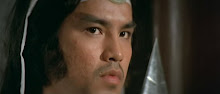
For this edition of Shaw Brothers Cinema: Behind the Scenes, it's a handful of lobby cards and stills for films that have yet to receive a legitimate DVD release anywhere, at least neither in America, nor in Hong Kong. For this entry, the spotlight is on Kuei Chi Hung's STRAW DOGS (1971)/LAST HOUSE ON THE LEFT (1972) styled action thriller, KILLERS ON WHEELS (1976) aka SPEED GANG.
***WARNING! This article contains nudity***
 In this one, Ling Yun plays Kuo Ching chung, an office worker on a respite to a small island on the outskirts of Hong Kong. Along with his wife, Chen Mei chuan (INFRAMAN's Terry Liu), his sister, Carrie (Chiang San) and her boyfriend, Huang Szu wei (Danny Li Hsiu hsien), the quartet are harrassed by a group of sadistic bikers. As each encounter escalates in violence, Kuo and his wife must use ruthless tactics to fight back against the homicidal biker gang.
 Above: scenes from the film and director Kuei Chi Hung directing the cast
 Plagued with a number of problems including injuries suffered by the crew, infuriated performers upset over wages, difficulties with police and a passionately tyrannical director, the film began shooting in the early part of 1976 and entered theaters during the latter part of August that same year.
 TO KILL A MASTERMIND (1979) is one of celebrated director, Sun Chung's most striking Wuxia/kung fu pictures. It contains an high amount of action sequences and, unlike his other films, foregoes any major names in the lead roles opting instead to feature new faces. Wang Lung Wei (SHAOLIN MARTIAL ARTS) is the one big marquee name here. The Chi Sha gang is a powerful organization of criminals headed by a man whose identity is unknown. A few spies are ordered to infiltrate the gang and destroy them from the inside out as well as To Kill the Mastermind pulling the strings of the Chi Sha killers. For a review of the film including lots of magazine photos click HERE.
 EVERY MAN FOR HIMSELF (1980) was a kung fu comedy directed by Chang Shen (KUNG FU MASTER NAMED DRUNK CAT, TWO WONDROUS TIGERS, DAGGERS 8). It stars Wang Sha of MR. FUNNYBONE fame and Lin Hui Huang (THE BRAVE ARCHER) as two conmen who meet up with a female martial artist named Ah Ying. Disguised as a man, the two crooks learn their feisty friend is being pursued by Hua, her wicked stepmother, and her lover, who have killed Ying's father. The duplicitous couple hire a kung fu hitman to bring Ying out of hiding. This film is important mainly for being the first screen appearance of Yang Tsing Tsing (CLAN OF THE WHITE LOTUS, TREASURE HUNTERS).
 Here's one of ten cards from the US presskit for the fan favorite, THE KILLER (1971/1972), aka THE SACRED KNIVES OF VENGEANCE. Chin Han (HEROIC ONES), Tsung Hua (TO KILL A JAGUAR) and Wang Ping (VENGEANCE!) star in Chu Yuan's follow up to his first Shaw production, DUEL FOR GOLD (1971).
 THE GAMBLING SYNDICATE (1975) aka DRUG GANG was a gambling action picture from award winning director, Chang Tseng Chai (FROM THE HIGHWAY, THE FUGITIVE, REDBEARD). Chang is notable for being the first director to shoot a film dealing with gambling (THE CASINO in 1972), a style of film that would gain enormous popularity in the coming years. This film stars Danny Lee as the determined police chief, Fang Ta who is after drug trafficker and gun smuggler, Cheng Tien Kuei (Ku Feng). Hiding his illegal operations behind the guise of a gambling den, police chief Fang arranges the co-operation of two convicts from the local prison to infiltrate the gang as spies. Their mission is to gain access to Cheng's safe which will likely contain the evidence to put Cheng and his gang away for good.
 QUEEN HUSTLER (1975) is yet another gambling movie from Chang Tseng Chai, this one with an apparently sleazier edge than his previous epics. This film is another action-violent vehicle for Chen Ping, HK's then reigning 'Queen of Exploitation'. Here, she plays Ho Ming chu, the daughter of the widowed Ho Hsing fa. Upon gambling in a private club, run by the slimy Yang Li shan (Wang Hsieh), the elder Ho loses an incredible amount of money. Ashamed, he commits suicide by jumping to his death. After Ho's death, the gangsters set their sights on the dead man's daughter, Ming chu. Abducting her, Ming's boyfriend, Li Tu (Danny Lee), is seriously wounded attempting her rescue. The thugs then assault and rape Ming chu. Desiring revenge, Ming learns gambling tricks and uses her sex appeal to kill Yang and his murderous cronies.
 Above and below are a couple of lobby cards for two unreleased to DVD Shaw Brothers sex films. One is a Li Han Hsiang erotic period sex film entitled WEDDING NIGHTS (1976). The lobby set showcase the level of bare female flesh in this film and this card, like a few others, shows off the charms of HK's 70s 'Queen of Exploitation', Chen Ping.
 This is some kind of murder mystery/sex film entitled THE NOTORIOUS FRAMEUP (1978). All the cards in the set display nudity. Antonio Ho (GHOST EYES, SEXY KILLER, THE CRIMINALS) has a lead role here.
 As a bonus, here's a couple of early 70s Shaw Brothers flyers advertising a few of their productions between 1970 and 1972.
 Next up, it's a 'Gorgeous Ladies of Shaw' edition with the first being a piece on swordswoman supreme, Cheng Pei pei! For more magazine clippings, rare photos, pictorials and other images of Shaw Brothers stars and their movies, check the 'Columns' section of the site for 'Shaw Brothers Cinema: Behind the Scenes'. I moved it from the 'Articles' section. There's so far 20 posts to choose from now. UNTIL NEXT TIME....
 ONG BAK 3 2010
Tony Jaa (Tien), Primorata Dejudom (Pim), Dan Chupong Chungpruk (Sang Ka), Sarunyoo Wongkrachang (Rat-Cha-Sei-Na), Nirut Sirichanya (Master Bua)
Directed by Tony Jaa and Panna Rittikrai
The Short Version: Visually stunning final chapter in Jaa's 'Thai Warrior' trilogy will likely displease fans expecting the rabid level of viciousness inherent in the fight scenes of Jaa's other action spectacles. Fights are noticeably shorter, too. With an accent on spirituality and less on action, it's a satisfying, if occasionally disappointing sequel. Jaa and his team still deserve kudos for veering off into uncharted territory unfamiliar to the path usually taken by the films star.

 Captured and brutally tortured by usurper, Rat-Cha-Sei-Na, Tien is rescued by two men sympathetic to the passive Kana Khone villagers. Under the tutelage of master Bua, Tien is spiritualistically reborn through arduous training, including the use of dance forms as therapeutic methods of healing his broken and twisted bones. Meanwhile, the evil Sang Ka, a demonic sorcerer, secretly puts his own plans of taking over the kingdom into motion. Both Tien and Sang Ka are destined to fight once more.

 Tony Jaa returns for a third go round not only starring, but also co-directing, writing and producing what should have been an amazing final installment in his 'Thai Warrior' trilogy. While it does at times demonstrate levels of striking creativity, all its energy and ingenuity is undermined by a fractured narrative that leaves several gaping holes big enough for a rampaging elephant to trample through. The storyline, as is, is much more cohesive than the previous movie, which isn't saying much. Still, what's here is not too difficult to put together even if it seems either a lot of additional footage was removed, or this was a rushed affair meant to quickly capitalize on the success of the previous venture.
 Tony Jaa looks a lot like Lo Mang especially this shot here with all the facial hair that recalls Lo's role in SECRET SERVICE OF THE IMPERIAL COURT (1984)

 One sequence that is especially unsatisfying is near the beginning after all of Tien's bones have been broken and he is sentenced to be decapitated the following day. The remnants of the Garuda Wing Outlaws make a bid to rescue him. Making up a good portion of ONG BAK 2, the gallery of outcast heroes are reduced to an after-thought here. When we see them, they're in mid-battle and once Sang Ka shows up, they're easily dispatched. There's no build up to their appearance here and their rescue attempt is over with before it even has time to begin. There's a couple other segments that could have done with some additional fleshing out and the deep enmity between Tien and lord Rat-Cha-Sei-Na doesn't find closure. Instead, the duplicitous lord meets his demise at the hands of Sang Ka during one of the few satisfying action scenes in the picture.

 Even in its native Thailand, ONG BAK 3 failed to ignite at the box office, or at least equal, or surpass the ticket sales of ONG BAK 2 (2008), a far more troubled production. It's not the awful film a number of critics make it out to be, but it isn't the sprawling saga capper one would hope for, either. When comparing the three films, it's obvious Tony Jaa was going for something a bit different this time. Whittled down to roughly a quarter of the films running time are a good deal of what made Jaa's name in the first place--the fight scenes. Therein lies arguably the biggest problem of ONG BAK 3. After the bravura showcase of choreographical excellence that was TOM YUM GOONG (2005), the creative ceiling had apparently been reached. For ONG BAK 2, a period setting was decided upon, and a more oldschool approach was taken with the staggering amount of action. For the third film, the oldschool approach is barely evident, instead taking a backseat to a heightened level of spirituality and philosophical enlightenment that has unanimously divided the stars fanbase.

 Looking at the four films that Jaa had a lead role in up to this point (all had US theatrical runs, the last two very much limited releases), his ferocity and inventiveness in action scenes was the major selling point in his pictures; it's what martial arts fans came to see and apparently this sat true in his homeland as well. But when this troubled performer attempts something new and different, it's quickly written off as a disappointment. Basically, Jaa backed himself into a corner. An incredible force on screen, he seemingly was "pushed" into constantly trying to top himself from one scene and film to the next. While the film is something of a disappointment, Jaa (and co-director, Rittikrai) should be commended for attempting something different even if he does seem out of his element (at least at this point in time) in this over stylized action fantasy.
 While hinted at in a few scenes of ONG BAK 2 (Jaa faces a vampiric attacker in a cave, the first appearance of the demon crow fighter, Sang Ka), metaphysical elements take center stage in this concluding chapter. Oldschool style training scenes are mixed with mystical sage ruminations and an eventual STAR WARSian level of science fiction (the second film ends like EMPIRE with a cliffhanger) that culminates in a coda that displays the Force is strong with Tony Jaa. The finale also manages to squeeze in a last minute SUPERMAN (1978) plot device that puts a strain on the dominating fantasy factor. The bombastic score by Terdsak Janpan is extravagant and is easily one of the best things about the picture.

 The film already had a bad vibe before it was even completed after word broke it was going to contain unused footage from the previous entry. These leftover shots are likely made up of the opening sequences where Tien is viciously tortured. But while the picture opts for a new direction by making exorcising personal demons through dance and meditational enlightenment, the one true place where Jaa's movie stumbles is in its finale. ONG BAK 3 starts off very well and a striking mid section fight sequence that sets up Sang Ka as an evil and intimidating force should have set the stage for a cataclysmic final confrontation. The fight between Jaa and Sang's army amidst an eclipse is exciting and peppered with gruesome, thoroughly brutal moments that would have made Chang Cheh proud. Remembering his spiritualist training after receiving a near fatal blow, Tien uses this "soft style"--utilizing traditional Thai dance movements--to combat Sang Ka and strip him of his dark powers.

 After what had come before, this end fight between Jaa and Chupong is a sizable letdown. Tien essentially wipes the floor with Sang, who only briefly gains the upper hand. Earlier in the film, master Bua tells Tien to turn his enemies into his "dance partners" after Tien is amazed at how meditative powers of dance forms aid in his recuperation. The dominance over Sang Ka would have been fine had their been just a bit more balance and the villain retained some of the power showcased in the previous movie and in earlier segments of ONG BAK 3. The bulk of this relatively short encounter is captured in slow motion, a technique which is terribly overused in this movie. Compared with Jaa's other films, the fighting sequences lack most of the blood pumping ferocity that was in abundance in Jaa's previous ventures. The grotty brutality is present here, but it's sporadic at best and the relative brevity of the action does the film no favors considering the beautiful ballets of choreography from the prior productions.
 As said above, it would seem as if Jaa had pushed himself into a corner; after unleashing a barrage of creative brilliance in his fights, there seemingly is nowhere else to go but down. ONG BAK 3 has some fine moments, but it's not enough to make the film rise above average. There's no balance. It's a valiant experiment, but for the most part, it's a missed opportunity in stylistic excess.
This review is representative of the Magnolia Home Entertainment DVD
copyright 2013. All text is the property of coolasscinema.com and should not be reproduced in whole, or in part, without permission from the author. All images, unless otherwise noted, are the property of their respective copyright owners.