THE NO MERCY MAN 1973/1975 aka TRAINED TO KILL*USA
Steve Sandor (Olie Hand), Rockne Tarkington (Prophet), Richard X. Slattery (Mark Hand), Sid Haig (Pill Box), Michael Lane (Big Jack), Ron Thompson (John), David Booth (Beetle), Daniel Oaks (Lyle Talbot), Tom Scott (Parrish), Michael Prichard (Bruce), Darlene Feasel (Dora Adams)
Directed by Daniel Vance
The Short Version: This forgotten 70s gem is of the Crazed Vietnam Vet school told through the prism of a wild west picture. Complete with carny and biker scum, this gang of thugs attempt to take over a town while pushing our unhinged hero to the brink of insanity. It all ends in a huge machine gun, explosive packed showdown just prior to a last ditch rape-assault on our title hero's family. If BORN LOSERS (1967), WALKING TALL (1973) and revenge movies laced with a Vietnam War allegory get your blood pumpin', you'll not forgive yourself for passing over this undeserved obscurity.

Olie Hand returns home from his tour in 'Nam along with two of his Army buddies to discover a vicious band of hearse driving carnival vagrants and biker thugs terrorizing his small Arizona home town. Conflicted and disturbed by the brutality of the war and the constant emotional baggage thrown at him by his father, Olie finally snaps in a whirlwind of savage violence after the gang of killers lead an all out assault on both the town and Olie's family.

 This vastly underrated obscurity from the exploitation wasteland of the 1970s is sorely in need of a legit DVD release. Released to theaters a month prior to the Drive In revenge movie champion, WALKING TALL (1973), Joe Don Baker's seminal tale of one man standing against a vicious gang of drug dealers and racketeers showed NO MERCY on Daniel Vance's only known directorial credit. As much loving affection as I have for Phil Karlson's movie, Vance's somewhat similar picture is the more interesting of the two from a story perspective, not to mention both films share some things in common, not the least of which being Richard X. Slattery. Typical of gritty 70s movies, the music is also reflective of the onscreen action which is conspicuous by the inclusion of a main title song and also a poignant little number entitled 'The Ballad of Olie Hand'.
The 70s also counted a long list of movies that dealt with the effects the Vietnam War had on the soldiers who fought in it; from horror films, to actioners, to psychological thrillers. Most films used the war as an excuse to trot out sensationalistic scenes of violence, while others attempted to explore the topic a bit further.
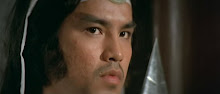
 THE NO MERCY MAN wants the best of both worlds and largely succeeds. Aside from a first half mostly devoid of blatant exploitation elements (racial bigotry rears its ugly head here and there), the bulk of the violence and brutality is saved for the last 15 to 20 minutes when Prophet, the lead psycho carny, recruits his old biker buddy, Pill Box (Haig; pictured at left) and his motorcycle gang to rob the bank in town. But some of the town toughs, including Olie's 'Nam buddies, try to stop them with as many bullets and explosions as the budget will allow.
If that last couple sentences sounds a lot like the plot of a western, that's because Vance's movie plays out identically to a wild west sagebrush saga complete with a group of antagonists as suitably despicable as you're likely to find.

Within the first ten minutes, two of the villains harass a liquor store owner, lead the sheriff on a high speed chase, then assault Mark Hand on his ranch. They then plan to rob him of his gun collection and almost rape his daughter moments before son Olie arrives home from 'Nam.
 Prophet and his five man band of multi-racial miscreants are a rowdy, murderous bunch and a good deal of screen time is spent with them making a nuisance of themselves, or plotting their next crime. Their acts of sadism (including a scene where they decide on whether or not to murder a family in an RV after strangling the father to death) are key in making the finale all the more powerful when the Hand farm is besieged a second time by Prophet's gang. The remnants of Pill Box's biker scum rape and brutalize the Hand family while Olie sits silently in the barn where he slips further into both madness and a liquor bottle. The increased screams of his family and his girlfriend finally set him off in a savage rage culminating in a grotesque display of slow motion shotgun blasts, knifings and eviscerations.
Prophet and his five man band of multi-racial miscreants are a rowdy, murderous bunch and a good deal of screen time is spent with them making a nuisance of themselves, or plotting their next crime. Their acts of sadism (including a scene where they decide on whether or not to murder a family in an RV after strangling the father to death) are key in making the finale all the more powerful when the Hand farm is besieged a second time by Prophet's gang. The remnants of Pill Box's biker scum rape and brutalize the Hand family while Olie sits silently in the barn where he slips further into both madness and a liquor bottle. The increased screams of his family and his girlfriend finally set him off in a savage rage culminating in a grotesque display of slow motion shotgun blasts, knifings and eviscerations. 
The finality of the ending (accentuated by slow motion bullet hits) is swift and satisfyingly grim including one character being gutted from his mid section to his throat, losing his innards in the process (this shot was heavily trimmed for an R rating). This combo of BORN LOSERS (1967) and WALKING TALL (1973) was seemingly ignored during its original theatrical run and has remained in relative obscurity ever since save for film festival revivals over the years.

Prior to the big run-in with Olie during the final minutes, the stand off-town destruction is, like nearly ever other aspect of this picture, straight out of a western; complete with truck mounted gatling gun. While the bulk of the town is at the carnival, Prophet holds up the bank. In the interim, his band, the bikers and Mexicans go to war with the sheriff and those willing to stand against them.

 The underrated Steve Sandor (above) stars as Olie Hand, the disturbed Vietnam veteran with a reputation among those in his town for being a tough bastard.
His father, Mark (played by Richard Slattery, who tore up Willie Ray's place in WALKING TALL!), is also a decorated war hero, himself wearing a reputation of his own. The script fleshes things out just enough for us to get the impression that Mark has pushed his son over the edge almost as much as the horrors of the Vietcong. An aura of patriotism and American jingoism hovers throughout the film. Mark's house is adorned with flags, medals and framed photographs of himself and his son decked out in their military dress.
 A veteran of WW2, Mark Hand mercilessly pounds his son over the head with macho, vehemence fueled speeches about being a man,"protecting what's yours", or eggs on friendly brawls between his son and his war buddies in an effort to get his son back as opposed to the borderline unhinged shell of a man who finds solace and normalcy in a whiskey bottle. There's a subtle dichotomy present between father and son representing the WW2 homecoming hero returning triumphantly to both a thriving economy and suburban nuclear family unit versus the crushing blow of losing a terrible war that came during divisive change in America at the time.
 Going back to Sandor, he was an incredibly photogenic actor who appeared in a few memorable cult items and a bunch of TV credits before calling it a day. It's a shame, really, as he was a good actor who could effectively play hero's or psycho's such as his naive, doomed detective in the nifty Drive In flick, BONNIE'S KIDS (1973). He played Apache, one of the Hell's Angels in the classic biker-heist flick, HELL'S ANGELS '69 (1969). Sandor also played an unstable, impotent cretin in the little seen THE ONLY WAY HOME (1972) directed by well known character actor G.D. Spradlin. Sandor later took command as STRYKER (1983), in a post apocalyptic actioner from Cirio H. Santiago.
 For THE NO MERCY MAN, Sandor bridges sane and insane as the mentally unbalanced Olie Hand. In many of his scenes Sandor successfully conveys a man struggling to find his humanity while mentally fighting his father and skirting with danger against a rambunctious clutch of carny trash. Some may be disappointed that Sandor's character doesn't participate during the big battle that makes up the first of two endings. This would have been expected, maybe even cliche, but considering the way Sandor's character is depicted, his violent eruption during the last few minutes is much more effective by holding him back. A flashback Vietnam scene where Sandor emerges from a river to snuff out some Vietcong would appear again in Cannon's MISSING IN ACTION (1984). Interestingly enough, THE NO MERCY MAN was distributed by Cannon Films.
 Rockne Tarkington (above right) is a long way from his harmless island character he played on the popular kids program, THE BANANA SPLITS. Possibly taking a cue from the blaxploitation movies that were still popular at the time, Tarkington plays Prophet, the main villain here. He's something of a hippie, has a white girlfriend and puts on this facade of a semi-decent citizen in her presence. Despite racial slurs being tossed around, Prophet's gang doesn't discriminate with its Caucasian and Mexican ethnicities. The film doesn't paint a very pretty picture of carny people (or bikers for that matter, but rarely did these movies ever) depicting them as trouble-making scum prone to thievery and cold-blooded murder.
Tarkington excels here as a villain easily dominating the film when Sandor isn't onscreen demonstrating his slow meltdown. Tarkington got to play one of the good guys the following year in BLACK SAMSON (1974), one of the better blax pictures when that genre was starting to show signs of age. That film also benefits heavily from a deliciously sadistic turn by the Biker King himself, William Smith.
 The script by both Daniel Vance and Mike Nolin is quite good especially considering the plethora of characters it juggles for its 90 minute running time. The good guys and bad guys get about equal screen time for us to delve into them. Curiously enough, this would be Daniel Vance's first and last directorial effort and also Mike Nolin's first and last screenwriting credit (outside of WILDLY AVAILABLE [1999]; see comments below). Dean Cundey, who later went on to work on numerous John Carpenter movies and big Hollywood productions photographed a healthy list of major 70s cult exploitation and trash movie items. This film is the first time his camerawork graced a motion picture. Buddy Joe Hooker, a famous Hollywood stuntman and AD, worked on this movie as well.
With its similarities to the Joe Don Baker classic unavoidable (it's unknown to me which was first, but considering their neck and neck release dates, both pictures were likely in production at the same time), THE NO MERCY MAN has remained largely unseen for the better part of four decades. It's much better than its IMDB rating and definitely deserved a wider audience back then. Fans of revenge movies and crazed Vietnam Vet pictures won't forgive themselves for passing up this forgotten piece of 70s cinema.