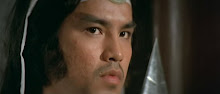
Chiang Sheng (middle) as Na Cha in the psychedelic madness of HEAVEN & HELL (1977)
CHANG CHEH'S TERRIBLE TEN: THE TEN WORST CHANG CHEH SHAW BROTHERS MOVIES
Recently I submitted what I considered to be the 13 top quality productions from Hong Kong's most influential filmmaker. Not all of those 13 were great movies, but great entertainment. I tried to create a balance among his spectrum of Shaw productions. This time out, I am listing what I consider to be his worst movies. None of his post Shaw work is included here as many of those would hog space on this list. There are only ten of them this time. Now this isn't to say that I don't enjoy some of the films mentioned herein, it's just I consider this ten to be either of far lesser quality, or downright awful when compared with some of the directors classier films.
 Monsters do battle in the totally bizarre experimental Peking Opera fantasy film, THE FANTASTIC MAGIC BABY (1975)
Some of these titles could have been much better than the way they turned out, but in some cases, various production problems prevented that. Some others seem to have simply been shot with left over money from far more prestigious pictures resulting in less attention paid to them. Some were experiments by the director eager to dabble in different styles of filmmaking; well aware that these experiments could flop badly, and that they did.
 Kuan Feng (left), Wang Li (middle) and Lung Tien Sheng (right) in 10 TIGERS FROM KWANG TUNG (1980)
There aren't a lot of directors that are, or were willing to leave their comfort zone and explore new outlets of cinema. In some ways, Chang Cheh was very much like his resolute heroes in his movies--staring death in the face against overwhelming odds knowing that this battle could be his last.
 The iconic Fu Sheng as NA CHA, THE GREAT (1974)
1. NA CHA, THE GREAT (1974)
Alexander Fu Sheng gets his first solo vehicle sans the participation of his frequent screen co-star, Chi Kuan Chun. This unusual, but often times meandering kung fu mythological fantasy film was shot in Taiwan under the Chang's Co. banner with distribution by Shaw Brothers. Since Shaw's had so much capital there that couldn't be extradited, Chang Cheh was sent there to shoot movies with the funds. This curious, yet very ambitious production is hindered by obviously weak effects work reportedly the work of a crew from Japan. Either way, most of the effects are all performed in camera, or the result of rear projection. As primitive as they are, some of the effects shots are inventive and the film isn't a total loss, it's just not very engaging.
 Na Cha annihilates the Dragon King's minions within his undersea kingdom
Fu Sheng plays his role as a mischiveous yet powerful young man. Parallels can be made with Christianity when Na Cha sacrifices himself to save his people to the enraged Dragon King. He is later resurrected as a God himself and frees the oppressed people. The film does contain the usual Chang Cheh violence and at one point, the Dragon King's undersea disciples erupt in geysers of blue blood! There are monsters, too. The film is based on ancient Chinese mythology. The Shaw's also produced NA CHA & THE SEVEN DEVILS (1973) prior to this film.
 Hung Si Kwan (Chen Kuan Tai in middle) rallies the troops in MEN FROM THE MONASTERY (1974)
2. MEN FROM THE MONASTERY (1974)
Quite possibly the sloppiest of Chang Cheh's Shaolin Cycle. The film is unraveled in an interesting fashion. It's broken up into multiple parts about twenty minutes long each detailing one of the three main protagonists before a big and bloody showdown closes the film. Aside from a good amount of gore, and fight scenes, the film is rather sloppy and never quite gels the three story arcs to where you even care about what is transpiring on screen.
 The gruesome finale of MEN FROM THE MONASTERY
This same exact movie was remade by Chang the following year and released in 1976. Entitled SHAOLIN AVENGERS, that film also used an unusual method in which to tell its story. Told intermittently in flashback amidst a big battle, Cheh was far more successful there. As it stands, MONASTERY is just mediocre, but a good time if you crave lots of disjointed fights and slashed and impaled bodies. Other than that, there's little of substance here. The bulk of the finale is shot in black and white due to the extreme amount of violence and blood on screen.
 Ting Hua chung as the title character in Chang Cheh's fantasy misfire
3. THE FANTASTIC MAGIC BABY (1975)
Chang Cheh was obviously fascinated with fantasy films as he made a number of them throughout his long career. None of them were very successful, but no one can say the director wasn't versatile, or daring to take on new ideas. Here, he directs a film version of one of his inspirations--the Peking Opera. Adapted from the famed story, 'Journey To the West', it is literally an Opera and filled with gaudy and colorful characters and costumes. The entire film appears to have been shot on a single sound stage.
 The Monkey King and company from THE FANTASTIC MAGIC BABY (1975)
The film itself is only a little over an hour long. The remaining 30 minutes is something of a documentary on the Peking Opera itself. One of the most peculiar of Cheh's output, the film was a massive stink bomb upon its initial release. The lead, Ting Hua chung, was also featured briefly in Cheh's MARCO POLO (1975). There are also monsters on hand such as tree people and stone men. The action scenes and the operatic sets are easy on the eyes, but the way in which the film is told will no doubt put much of the audience off.
 Li Yi Min (left), Chi Kuan Chun (middle) and Fu Sheng (right) pig out in Cheh's awful MAGNIFICENT WANDERERS (1977)
4. MAGNIFICENT WANDERERS (1977)
One of the absolute worst kung fu movies you are ever likely to lay your eyes on. It's difficult to fathom that this is indeed a movie from the revered director. Filled with unfunny comedy (a year before it became fashionable) and random stupidity, not even the combined talents of David Chiang, Fu Sheng, Chi Kuan Chun, Li Yi Min and three of the venoms in minor roles can muster enough energy to bring this miserable movie out of its miasma of mediocrity.
 Chiang Sheng is first to notice that something is terribly wrong in the terrible MAGNIFICENT WANDERERS
A truly terrible experience that has something to do with the search for a stolen fortune in gold. There is one funny moment that is a parody of Cheh's exaggerated death scenes wherein four men are run through with a spear only to not quite realize it momentarily. Chang Cheh was definitely in a transitional stage by 1977, unequivocally his worst year of directing. Whether he was simply exhausted, or tiring of filmmaking in general, the films of Chang Cheh went downhill from here on out. Changing audience trends were also a factor, but very few movies would reach the level of quality as his earlier, more respected pictures.
 Fu Sheng and Chi Kuan Chun prepare to go out in a blaze of glory in NAVAL COMMANDOS (1977), a film that had a lot of potential
5. NAVAL COMMANDOS (1977)
Another bad movie from 1977. This one isn't so much bad as it is plodding and hampered by what would appear to be a rushed schedule. Once the big budget extravaganzas Cheh had been dabbling in for the last few years were losing increasing amounts of money (whether from serious controversy or audience disinterest), the remaining big movies from the renowned filmmaker were severely scaled down and NAVAL COMMANDOS is one of them.
 From left to right-Kuo Chui, Tang Yen San, Chiang Sheng and Lu Feng are part of the NAVAL COMMANDOS
Shot with the cooperation of the Taiwanese Naval Fleet and Air Force, one gets the impression this film could and should have been so much more. The plot is very interesting and is something of a 'Dirty Half Dozen', but aside from a few choice moments, the film never truly comes alive. Even the finale is limp save for a few typically macho moments of heroic grandeur as only the director could showcase.
 Lo Mang in a sticky situation from the colorful and ambitious, yet outrageously bizarre mind trip, HEAVEN & HELL (1977)
6. HEAVEN & HELL (1977)
Easily the most bizarre and problem plagued production Cheh worked on. A number of his other films were saddled with various difficulties forcing the film to be shut down, but this one began production in 1975 while Cheh was in Taiwan and lack of funds caused the production to close. It resumed in 1977 when he returned to Shaw studio. Unhappy with the finished product, the Shaws didn't release it till 1980.
 After Fu Sheng and his real life wife, Jenny Tseng sing a duet together, a group of thugs enter and throw down some dance moves in one of the more inexplicable sequences in the film
What remains is a seriously confusing mess of a movie filled with singing, dancing kung fu sequences, an over abundance of surrealism and lots of kung fu fights featuring the soon to be christened Venom crew. The film was originally began as THE HELL and took place in Heaven, Earth & finally, Hell itself. Considering the problematic production, the film as it is displays lots of ambition and truly could have been something special.
 To get into Heaven, the wronged souls have to fight their way out of Hell. Kuo Chui duels with some of Hell's minions
Seeing it now, it's a missed opportunity. However, if one can make it past the more confusing aspects, there are a lot of good and somewhat bloody fight scenes featuring the Venoms. The bulk of the film takes place in Hell and these scenes are rather striking and do offer some quirky entertainment value. However, this film is not for all tastes.
 Kuo Chui and Lo Mang
7. KID WITH THE GOLDEN ARM (1978)
A major fan favorite, it is still rather sloppily put together with many of the actors appearing tired or just going through the motions much of the time. It's as if rehearsal footage was used instead of a real take. Even still, Cheh's colorful and gory comic book caper can be fun in the right mood. It's Lo Mang's showcase, but it's a shame it couldn't have been in a better movie. Wei Pai plays what seems to be a parody of Chang's swordsman hero from years prior.
 The best fight in the movie; a wonderful piece of choreo between Lu Feng (left) and Chiang Sheng (right) that ends in a wildly gory finish
The amazing battle between Lu Feng and Chiang Sheng is the lone major bright spot in the entire picture. It's definitely not the worst wuxia/kung fu movie, but it's easily one of the least of Cheh's later output. The director was far more successful at capturing a superhero flavor with his FIVE ELEMENT NINJAS in 1982. The film suffers from some seriously cramped sets and an overall cheap look. Nonetheless, many fans adore this movie. I am one of the few who does not.
 Left to Right-Lo Mang, Wei Pai, Sun Chien, Ku Feng, Kuo Chui, Dick Wei, Yang Hsiung, Ti Lung, Chiang Sheng and Fu Sheng
8. TEN TIGERS OF KWANG TUNG (1980)
Another slapdash production that ran into several problems resulting in the picture being put on hiatus for a time. Fu Sheng injured himself on another movie and Wei Pai suddenly left to work for Golden Harvest (where his career went nowhere). A lot of sequences had to be scrapped and the remaining footage was salvaged by creating an entirely new storyline told in flashback. If the flashback scenario sounds like SHAOLIN AVENGERS, you'd be right, only here it's not done nearly as well. TEN TIGERS also utilizes other story motifs from numerous other Chang Cheh motion pictures. An odd bridge between Cheh's old and new crew, it is still one of the directors sloppiest films, but out of his control nonetheless.
 Kuan Feng and Lung Tien Sheng
Begun in 1978, the film was finally completed in 1980 after Cheh went to Taiwan to find new performers with the intention of turning some of them into stars. Chen Hsao Hou and Lung Tien Sheng were two of those performers. The fight scenes are good, but jarring considering you can tell a big difference in the choreo from the original portions of the film and those that were shot later featuring Cheh's new crew. The only real plus the film has going for it are some brutally creative gore killings. The finale features one of the most endearingly gruesome death scenes in Cheh's filmography and that's saying something. The uncut HK DVD is a bit better and more enjoyable than the heavily truncated US bootleg edition, but for this movie, that's akin to preferring a stomach virus over a migraine.
 Sun Chien and Kuo Chui
9. ODE TO GALLANTRY (1982)
Chang Cheh enjoyed a good swordplay story and attempted a number of them patterned on the Chu Yuan style of Romantic Swordsman movie. He admitted he wasn't very good at doing them and this film is no exception. Cheh adapts Jin Yong's novel to the screen in what I hear is a fairly faithful representation up until the conclusion where he opts for a more traditional kung fu laced bloodfest. It's all fairly mundane and the film is light hearted for the most part save for a gruesome moment here and there.
 Wang Li (middle) plays a powerful figure that straddles the line between a hero and a villain
The story is good, if confusing and fans of Kuo Chui will enjoy his role here playing twins. Kuo's character of 'Bastard' is naive and extremely gullible, getting himself into one troubling situation after another frequently suffering for the actions of the twin character also played by Kuo Chui. The fight scenes are nothing spectacular, but things pick up towards the end. Venom fans will still want to see the movie, but it's one that is soon quickly forgotten.
 Ricky Cheng Tien Chi
10. THE WEIRD MAN (1982)
Totally demented wuxia trash is made all the more lamentable in that it was Chang's Shaw Brothers swan song. What's even worse is that the director, very ill at this point, would continue to direct more confoundingly ridiculous fantasy films independently in Taiwan. The fight scenes in WEIRD MAN are of top quality and the work of Cheng Tien Chi and Chu Ko encoring from their outstanding work on FIVE ELEMENT NINJAS.
 Ricky Cheng in the curious fantasy kung fu failure, THE WEIRD MAN, Chang Cheh's last production for Shaw Brothers
Here, Cheh creates a magic movie from the famous 'Romance of the Three Kingdoms' literary classic fashioning a bizarre supernatural wuxia picture that is very similar to his NINE DEMONS (1983) and also features much the same cast. Only here, the production values are of better quality, but that isn't saying much. A showcase for Chao Kuo (he fought the Earth element in 5EN), the opening credits features some amazing combat with him and several opponents. There's nothing wrong with the action, it's just everything else around it. No one in HK cared much as the film only managed to rake in $HK466,847. For completists only.
ADDENDUM:
After Chang Cheh's contract ended and was not renewed, he went to Taiwan and started his Chang Ho company. From there he made over ten more films between 1983 and 1993. These included ATTACK OF THE JOYFUL GODDESS, THE NINE DEMONS (both 1983; both horrible beyond belief), THE SHANGHAI 13, THE DANCING WARRIOR (both 1984), CROSS THE RIVER (1988), SLAUGHTER IN XI'AN, HIDDEN HERO (both 1990) and NINJA IN ANCIENT CHINA (1993) among them.