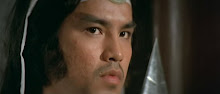
PURSUIT OF A KILLER 1985 aka THE STING OF DEATH
Lo Mang (Ye Hong), Pai Piao (Inspector Wang), Sun Chien (Lei Kung), Tong Chun Chung (Ya Zong), Ngai Tim Choi (Lu Bao #1), Chiang Han (He Min), Joh Yin Ling (Gao Mei), Chan Shen (Uncle Zhi), Wan Seung Lam (Lu Bao #2), Frankie Wei Hung (Sun Fu Cheng), Jenny Liang (Ye Hong's wife)
Directed by Huang Tai Lai (Taylor Wong) *The film initially began production as a Mou Tun Fei film.
***WARNING! This review contains images of nudity, sexual situations, overall sleaziness and Pai Piao's hairstyle that changes every few minutes***
The Short Version: One of the worst Shaw Brothers movies ever seemingly didn't start out that way. MEN BEHIND THE SUN director Mou Tun Fei began the production, but after abruptly leaving Shaw studio for the pastures of Taiwan, the film was taken over by Taylor Wong (BEHIND THE YELLOW LINE, TRAGIC HERO). The story of a group of illegal immigrants released from prison only to be hunted down by a mysterious killer remained largely unchanged although the same couldn't be said of the director and even some of the cast members. The finished product has rabidly energetic action scenes, but scant few moments of creative flourish. Instead, it settles for sex and sensationalism, Lo Mang eating a live lizard and is further punctuated by Pai Piao's constantly changing hairstyle which seems to have a life all its own. It's an unsung Category III classick despite coming a few years too early to bear that most infamous of rating classification.

 Five mainland Chinese peasants attempt to sneak into Hong Kong, but are spotted and chased by police. One is injured, but three of the men and one woman manage to escape across the border where they find life isn't so kind to illegal immigrants. They end up working for Triads and live the lives of criminals. The three male gangsters, tired of working for others, decide to go into business for themselves by robbing a jewelry store inside a major shopping center. They fail to escape, but the jewels are supposedly lost while the men are put in prison. Ye Hong, the most wily of the bunch, gets an extended sentence for assaulting and injuring a prison guard. Meanwhile, his two cohorts get out after five years only to be quickly killed off by an unknown murderer. With no leads to go on, Inspector Wang plans to get Ye Hong released and use him as bait to lure the killer out into the open.
 May, 1981; note director Mou Tun Fei in the bottom right corner
After wrapping up his controversially true tale of sadism and sodomy that was LOST SOULS (1980), itself an extension of his unreleased to DVD gritty crime thriller BANK BUSTERS (1978), Mou Tun Fei began work on what was essentially a sort of sequel. But whereas his previous endeavor into the outer reaches of bad taste was little more than an exploitational version of Pasolini's SALO, OR THE 120 DAYS OF SODOM (if that's even possible), PURSUIT OF A KILLER utilizes the previous movies idea of destitute mainlanders escaping to Hong Kong, but abandons the endless scenes of torture and rape.
 May, 1981
This time, our impoverished runaways end up becoming criminals as opposed to victims of brutal acts of violence. Mou favored socially relevant topics that involved criminality within the concrete jungles of Hong Kong as opposed to the dramas and swordplay features he unenthusiastically took command of while under the employ of millionaire movie mogul, Sir Run Run Shaw. But the New Wave directors stint at the big time was relatively short lived.
 The character wearing the hat isn't in the movie nor is the scene top right; Mou Tun Fei was still the director here in June, 1981
 Having had enough of the constraints of the major studio system, Mou left Shaw Brothers some time in the early part of 1982 much like King Hu had done the decade prior when he escaped to Taiwan to make movies his way. One could draw conclusions as to whether this hurt, or helped Mou. It did no favors for King Hu, but Mou did have a degree of success after Shaw's, if briefly, and in a subject that cuts deep with the Chinese. But that's another story. When Mou left the studio in 1982, it left PURSUIT OF A KILLER (then bearing the title THE STING OF DEATH) as only half a movie without an ending. See the storyboard/comics below to see how the scripted ending would have played out.
 Storyboards/comics above and below from July and August of 1981 when Mou was still attached to the production
After only five minutes of this movie you already know who the killer is so the element of mystery is lost early on. There's one or two limp red herrings thrown into the mix, but these get lost amidst all the gratuitous sex and violence. Taking a gander at the storyboards above, it would appear the ending was much different than what ended up being used. Instead, the film closes on a more bombastic and bloody finish as opposed to the direction the film was likely to take had Mou stayed on board.
 Some shots above aren't in the finished movie or are seen different angles
During the closing months of 1981, a young television director bearing a unique face not unlike that of Mou named Huang Tai Lai (Taylor Wong) was hired at Shaw. After completing two massive box office hits (BUDDHA'S PALM and BEHIND THE YELLOW LINE), Huang took up the reigns to finish the film that would eventually, and ever so briefly play HK theaters as PURSUIT OF A KILLER.
 October, 1981; some of these shots do not appear in the finished production
It's debatable how the film would have turned out had Mou stuck around long enough to finish it. As it stands it's easily the most trashy crime-action thriller the Shaw's ever released. Judging by the finished product, it's startling just what producers Shaw and his then mistress Mona Fong saw in the film to hold onto the incomplete footage with plans for someone to finish it.
 November, 1983; Taylor Wong has taken over at this point. The above photo takes place during a bloody warehouse action sequence that was one of the bigger scenes shot by Wong.
It wasn't the first time the studio was put in a predicament such as this. For instance, a film that began during the tail end of 1978 under its first (of many) title of SWORD OF OLD EAGLE took seven years to complete. The picture ultimately settled on THE SUPREME SWORDSMAN (1984) as its release title. To add insult to injury, it was never theatrically screened in Hong Kong. PURSUIT OF A KILLER took four years to complete before audiences saw the finished product and upon viewing it, one wonders just what in the hell took so long.

 The script is rather ambitious in its scope, but 86 minutes isn't long enough to do all the various character arcs and scenarios justice. Aside from the civic rough-housers, there's virtually zero heroes here with nobody to root for, although fan favorite Lo Mang is given tons of scenery to chew (including a live gecko). The amount of situations Ye Hong finds himself in would be enough for an entire mini series. He goes to prison, is put in solitary for beating up prison guards, is let out, has sex with multiple women, is chased around Hong Kong by both the police and the killer, attacked by various incidental characters and during the conclusion, Ye Hong confronts the main murderer in a conveniently placed film studio set that gives a nice view of what goes into creating a Shaw Brothers kung fu action sequence.
 With so many familiar faces on board, this picture is entirely Lo Mang's showcase. It's just a shame that one of his few lead roles ended up being such a below average production. Still, he makes the most of this job by getting to do a little bit of everything at one point or other over the course of the film. In one of the films most shocking moments, Ye Hong is in solitary and a lizard keeps crawling on him. After shoving it away, the persistent reptile tries again only for the hungry inmate to make a meal of the future representative of Geico Insurance in close up no less. He gets several fight scenes (including one comedic fight sequence), one and a half sex scenes and is reunited with one of his FIVE VENOMS alumni, Sun Chien who gets an unusually meaty role as a typically over anxious and hot tempered cop.
 After splitting from Chang Cheh's camp, the Taiwanese martial artist and ex-military man mostly got minor, or background roles so this was a nice surprise for the talented, if underused pseudo celebrity to gain such a role even if the finished product is pretty lousy. The two even get into a brief scuffle. It's really quite ironic that Sun Chien was being groomed for stardom with a poignant and right large role in Chang Cheh's THE CHINATOWN KID (1977) only to be more or less pushed into the background for the bulk of the Venoms films he featured in; even in the relatively few where he was the main star such as INVINCIBLE SHAOLIN (1978).
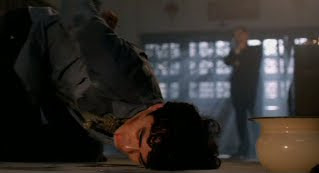 Tong Chun Chung prepares to get a literal "boot to the ass".
 Among the sleazy lowlights are a startling amount of full on nudity (male and female) and a disturbing moment of implied man rape. Whether Mou shot this flashback scene is debatable, but it's likely he did as he was seemingly (maybe even subconsciously) preoccupied with the shock tactic of (sometimes same sex) sodomy of one sort or other. He displayed it in a symbolic fashion in A DEADLY SECRET (1980) when Pai Piao is tortured by having a huge wooden spike rammed up his rectum and again in LOST SOULS (1980). For PURSUIT, it's Tong Chun Chung who is on the receiving end of "the stick" doing time in a hard labor camp. There's an earlier scene when one of the ex-cons gets shot to death and as the killer makes his exit, we see another corpse, a dead man with his pants pulled off lying naked in a pool of blood. The implications here are obvious. Years later, Takashi Miike would display a propensity for male on male violation in a number of his movies. There's also a PSYCHO (1960) styled shower scene that features a male victim this time out.
 Ngai Tim Choi (far left) disappears shortly after the opening and is replaced by Wang Seung Gam (see insert). The actor to the far right is replaced shortly after by Chiang Han.
 For whatever reason, one of the three criminal characters in the film is replaced shortly after the film has begun. Ngai Tim Choi, a familiar face to many a Chang Cheh picture, plays Lu Bao during the first ten minutes or so. But after they all go to prison and later get out, the character is then played by Wan Seung Gam (see insert), another bit player from Chang Cheh's camp (he was The Bookkeeper in FLAG OF IRON). The different actor is explained away as having put on weight in the interim. In addition, Chiang Han replaces an unknown actor seen at the outset as He Min. Chiang Han was yet another bit player whom you may remember as General Lin's envoy in Chang Cheh's THE REBEL INTRUDERS (1980). He also played one of the many rapists/murderers from Mou's LOST SOULS (1980).
 Watch as Pai Piao's magical mop top changes before your very eyes and back again!
 But the biggest, most noticeable and most laughable faux pas is Pai Piao's constantly changing hair style. If it worked for Jackie Chan in ARMOR OF GOD (1986), it should work for anybody else, right? This is where Mou Tun Fei's footage is easily discernible. Pai had a standard comb over in the original portion of the film spearheaded by Mou. When the film began shooting anew in 1983 under the direction of Taylor Wong, Pai was now sporting a perm(!) and had also increased his muscle mass.
 Above: Pai Piao circa 1981; Below: Pai Piao in November 1983
Both Pai's new 'do and his bulkier appearance could be seen in a similarly gritty and superior crime thriller called MEN FROM THE GUTTER (1983), which was shooting at the same time and was directed by exploitation maverick Lan Nai Tsai (THE SEVENTH CURSE, HER VENGEANCE, EROTIC GHOST STORY, STORY OF RICKY).

 The wardrobe of the actors is also jarringly different. In Mou's footage, the undercover cops are more dressed up while in Wong's portion of the film, they're wearing tank tops! Apparently sleeveless shirts were regulation attire for cops in the 1980s. Likely to keep from disrupting two different productions over a hairstyle, the shooting of PURSUIT OF A KILLER continued as opposed to waiting for the GUTTER film to finish to allow for proper continuity in relation to Pai Piao's new look. MEN FROM THE GUTTER was obviously the superior film even winning an award and critical accolades upon its release. Better to sacrifice a movie with an already fractured production history than hinder another in the process. Mou's abandoned picture had already been in limbo for an entire year. Possibly fearing even more set backs, the film was to resume in the hopes of getting it finished regardless of inconsistencies. In light of the flurry of trashy elements, the sight of Pai's changing mop top every few minutes derives a good deal of unintentional hilarity.
 In keeping with the thick air of exploitation excellence, Jenny Liang--who replaced Chen Ping as HK's Queen of Sleaze--has a minor, thankless role as Ye Hong's wife. Her character emerges from left field basically appearing out of nowhere. Her brief appearance is simply to add some additional sex appeal flashing her groceries and showing off her curvacious frame. Frankie Wei Hung, perennial villain in numerous sleaze flicks, has an even more inconsequential role as Jenny Liang's boyfriend. The action sequences are exciting and fast paced and in keeping with typical Shaw Brothers "policy", are brutal and bloody. The music is a curious blend of electric guitar and noirish saxophone which is put to use in some of the moodier scenes as well as one of the gratuitous sex sequences which one assumes is to give the impression that our killer is trying to desperately get over his man love fixation.
 Above: It's the killer; Below: A shot not in the film
 PURSUIT OF A KILLER was heavily promoted during the time Mou Tun Fei was working on it and in hindsight, all the ballyhoo proved to be in vain. The film was a miserable failure in the end and with the sheer amount of sex and sin, it would have been a prime category III flick had it been released a few years later. At least the plot remained the same as opposed to being altered like so many other motion pictures that suffered a similar fate. Curiously, despite half of the film being the work of Mou, sole credit is bestowed upon Taylor Wong. Possibly given the amount of headaches Mou had given his boss (and presumably vice versa), this could be viewed as Shaw's revenge on the eccentric filmmaker after he left the studio on anything but the best of terms.
 March, 1984
Of the numerous crime pictures produced by Shaw Brothers (and among those released in the digital format), PURSUIT OF A KILLER (1985) is the most outrageous of the lot. While it's doubtful anybody seeing it would consider this film anything more than entertaining garbage, one man's trash is surely another viewers treasure and taken in that context, PURSUIT OF A KILLER is a goldmine.
This review and movie screen caps are representative of the IVL VCD release. This film has yet to be released to DVD anywhere in the world.