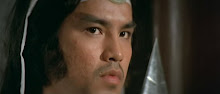
MEMOIRS OF JAPANESE ASSASSINS (NIPPON ANSATSU HIROKU)
Shinichi "Sonny" Chiba (Onuma 'Shichiro' Tadashi), Tamiya Jiro (Fuji), Kataoka Chiezo (Inoue Nissho), (Kiyama), Fuji Junko (Taka-chan), Sugawara Bunta (Asahi Heigo), Wakayama Tomisaburo, Yoshida Teruo, Takakura Ken (Aizawa Saburo), Tsuruta Koji (Isobe), Takahashi Choei (Furuta Daijiro), Machida Kyosuke, Mimasu Aiko
Directed by Nakajima Sadao
The Short Version: Nine historical assassinations from the 19th and 20th centuries are cinematically documented in this sprawling, doom and gloom epic from Toei Studios starring many of Chambara's big swords in roles of various shapes and sizes. The politics are thick as molasses, and no doubt this movie -- quite different from Toei's more familiar (on these shores, anyways) comic book exploitation -- was highly controversial back in the day. Sonny Chiba no doubt helped cement his enormously successful career with a strikingly poignant, non-fighting, dramatic performance here. Yes, The Street Fighter engages in a different sort of battle as a young, bewildered terrorist in training.
"Terrorism is the rightful measure to fight against the ruling class."

 Onuma Tadashi, a confused 18 year old eking out a living surrounded by poverty, corruption and dissidents is torn between making an honest living during economic strife, and joining a secret band of ultra-nationalists with dreams of governmental reform. Experiencing a succession of emotional and financial set backs pushes him to reluctantly side with the anti-establishment reformists led by a priest named Inoue Nissho. Initially it's decided they will all die through the bloodshed they will bring, but a series of events and failed plots lead to the eventual failure, arrest and execution of this group of terrorists consisting of civilians and young, rebellious military men.
 Nakajima Sadao is likely most familiar in America for his fantasy works such as WATARI NINJA BOY (1966) and RENEGADE NINJAS ([1976]SANADA YUKIMURA NO BOURYAKU). His larger body of work --largely unseen outside of Japan -- seems to center comfortably around Yakuza and Chambara movies. MEMOIRS OF JAPANESE ASSASSINS is taken from Japanese history, adapted for the screen by Nakajima (from an original story by Suzuki Tadashi) as per the works of men who lived during the tumultuous 20th century period that the bulk of the film takes place in.
The film jumps around from one decade to the next documenting various assassinations and their historical context within the extremist political turmoil during three of Japan's periods of socio-political change -- Meiji, Taisho and Showa. We begin in 1860 Edo with the assassination of Grand Elder Naosuke Tairo. This is the only time MEMOIRS OF JAPANESE ASSASSINS caters to jidai-geki conventions; the remaining two plus hours occupying the film fall into the gendai-geki style of Nipponese cinema, those being modern day dramas. So those expecting this to be a sword-slinger might wish to stop reading now.
 From there the narrator takes us through the earliest portions of the 20th century where industrialization may have taken hold, but man's propensity for violence remains unchanged. It's here where the politics mercilessly hammer the viewer over the head. Both sides of the spectrum are explored, although Nakajima's treatment of the material, at times, seems to be an indictment towards this sort of anarchist thinking that to get what you want, one must kill for it. Such as a sequence early in the picture described below.
 Furuta Daijiro is a 26 year old anarchist. Like others in the film, he's taken from history. He founded the Osaka Guillotine Terrorist Group in the early 1920s. He wishes to blow himself up to assassinate the Regent. He has an acquaintance with a bomb, but Furuta hasn't the money to pay for it. He tries to coax his more reasonable friend into loaning him the money, but he refuses. Instead, Furuta's friend tries to pacify his violent intentions by passing along advice to a more logical solution to achieve the alleged change that is needed, or the change that Furuta feels is in order.
 This sort of extremist thinking, that wealth and success are evil needed to be stamped out, is reflective of the current, and ever weakening state of America that teeters more and more towards a Socialist system with high unemployment and little hope for achievement. Why work for what you want when you can take it by force? Rich or poor, corruption is everywhere. In the case of Daijiro, he murders for it. Upon his capture for killing a banker, Daijiro is sentenced to death. Two years later, he walks to do his doom while he thinks to himself all the wonderful things he took for granted in life, that he will never again get to enjoy. It's this sequence, and this sequence alone that foreshadows what will come after we're introduced to Sonny Chiba's character.
 The bulk of the story concerns an incident that took place in 1932. Onuma Tadashi (Sonny Chiba) is in court and details the crime he committed that put him there. Through flashbacks, we follow the spirited and seemingly honorable Onuma Tadashi. He despises his lowly job as a delivery boy for a dyeing mill. An offer is soon made to him for a better job at a bakery. But the naive boss is inexperienced, falls prey to loan sharks and is unable to make the proper changes to his factory ordered of him by inspectors.
 From there, Onuma (or Shichiro, as he's often called) moves from one dramatic downfall to the next; each life-altering experience shaping and molding him further into the tragic character he will ultimately become. After a failed suicide attempt, Onuma joins a religion based terrorist organization that is founded on the principals that Japan is totally corrupt and depraved and must be saved from this betrayal of their perception of the nations values. The leader of this group of patient anarchists, the priest Inoue Nissho devises a calculated plot of national reform that will culminate in the suicide of each member, whether their plan succeeds, or not.
After aligning with Manchurian forces in 1931, it is soon realized that corruption has seeped into the group. This then leads to their elaborate bloodshed bound revolution being exposed by the military. Onuma again loses confidence in himself wherein he resorts to prayer and fasting that leads to him becoming seriously ill. After a period of convalescence, Onuma makes the decision that he, and he alone will instigate this so-called revolution with the death of Japan's Finance Minister, Inoue Junnosuke.
 Nakajima's film is loaded down with characters. It's almost impossible to keep up with them all with a single viewing; and at nearly two and a half hours, there's simply not enough time to soak them all in. It appears some editing may have played havoc with some of these characters, or else Nakajima's screenplay was too enormous to maintain focus to explore them all sufficiently. Editing seems the most likely choice. But one character serves as the focal point; a young actor who was about to break big as a martial arts action star.
 Sonny Chiba essays the role of Onuma Tadashi, the individual whom the bulk of the movie revolves around. With most of Chiba's earlier work unavailable to the mainstream masses, it's unusual to see him in such a role that isn't action related. Many of his fans will remember him from earlier science fiction films like TERROR BENEATH THE SEA and GOLDEN BAT (both 1966). He was already involved with KEY HUNTER, a wildly popular show that debuted in the late 1960s.
 If you're more familiar with Chiba's Karate roles, you'll either be pleasantly surprised, or resoundingly bored by his performance. Chiba is stunning here, and nothing short of amazing. He never wields a sword, nor knows any martial arts. His emotional range runs the gamut from anger, to tearful sorrow, to hopelessness and finally a cold-blooded assassin. There's no hint of an action hero here. Chiba's character is unsure of himself and his ideals virtually the entire movie till towards the end. It's really quite striking when compared with more well known works like THE STREET FIGHTER (1974) and THE EXECUTIONER (1974) among numerous others.
 Since the bulk of his filmography and television work is unavailable in North America, it's unknown just how many similar roles Chiba did. Based on this one alone, he does a marvelous job while other big names such as Tomisaburo (SHOGUN ASSASSIN) Wakayama, Takakura (BULLET TRAIN) Ken and Sugawara (BATTLES WITHOUT HONOR & HUMANITY) Bunta all play assassins in what amounts to cameo roles, or guest starring roles.
 Tomita Isao's score suits the depressing mood and by the end of the film, a recurring theme song may still be looming large in your head. Far from a movie that will leave you feeling refreshed when it's over, it's deadly serious and prime for post-viewing debates from a historical perspective. Die hard Chiba and Japanese cinema fans will find a lot to chew on here, but most others expecting frequent gore and bloodshed (it's here, but relegated to the beginning and ending) will likely give up about 40 minutes into these MEMOIRS.
This review is representative of a Fansubbed DVD which can be bought HERE.