PLANET OF DINOSAURS 1978
James Whitworth (Jim), Charlotte Speer (Charlotte), Louie Lawless (Captain Norsythe), Pamela Bottaro (Nyla), Michael Thayer (Mike), Chuck Pennington (Chuck), Derna Wylde (Derna Lee), Harvey Shain (Harvey)
Directed by James K. Shea
The Short Version: This
minor cult item was once a mainstay of Saturday Afternoon local
airings; and seen by many monster kids growing up in the 80s. The
impressive, and plentiful stop motion animated effects work are the main
attraction here in this tribute to the accomplished work of Ray
Harryhausen. Aside from the creatures, it's populated by lots of disposable characters that serve no other purpose than to end up as dino food.
Recommended for nostalgia lovers and those who can appreciate low
budget movies from a time period where even overly bad, "made from
scratch" films had an air of child-like wonder about them.

A
group of space explorers crash land on an unknown planet with a similar
atmosphere to Earth. The stranded Futurians soon discover the land is
populated by dinosaurs and other giant creatures.

 James
K. Shea's sole directorial effort is one that doesn't generally receive
much in the way of positive notice. While it's glaringly apparent it's
not the most polished movie of its type, it's easily one of the most
ambitious in technical terms. Shea and his crew were obviously very
passionate about this project, even going so far as to pour the bulk of
the minimal budget into the numerous stop motion effects shots.
The dinosaur sequences are so good, in fact, that a later film, GALAXY
OF DINOSAURS, borrowed much of PLANET's creature footage.
James
K. Shea's sole directorial effort is one that doesn't generally receive
much in the way of positive notice. While it's glaringly apparent it's
not the most polished movie of its type, it's easily one of the most
ambitious in technical terms. Shea and his crew were obviously very
passionate about this project, even going so far as to pour the bulk of
the minimal budget into the numerous stop motion effects shots.
The dinosaur sequences are so good, in fact, that a later film, GALAXY
OF DINOSAURS, borrowed much of PLANET's creature footage.

 The devotion and respect for famous animator Ray Harryhausen is noticeable not just in the animation by Doug (THE TERMINATOR, ALIENS, EVIL DEAD 2) Beswick, but in a few key scenes. The opening crash in the lake is an homage to the near identical shot in 20 MILLION MILES TO EARTH (1957). Harryhausen's fabled Rhedosaurus also puts in a cameo appearance during the finale where it briefly tangles with the Tyrannosaur. Another well respected animator, Jim Danforth, also worked on the movie as a matte artist as well as animating at least one sequence.

 PLANET
OF DINOSAURS is the sort of movie you enjoy as a kid, but upon getting
older, you recognize its deficiencies, yet still maintain appreciation
for what made you love it as a kid in the first place. It's basically a
70s version of countless, and lifeless SyFy Channel drivel; but instead
of bland confrontations with CGI critters, it's stop motion dinosaurs
devouring a bland cast. It may also dredge up memories of the popular
LAND OF THE LOST (1974-1977) television series, which also used stop
motion creatures during its three season run.
PLANET
OF DINOSAURS is the sort of movie you enjoy as a kid, but upon getting
older, you recognize its deficiencies, yet still maintain appreciation
for what made you love it as a kid in the first place. It's basically a
70s version of countless, and lifeless SyFy Channel drivel; but instead
of bland confrontations with CGI critters, it's stop motion dinosaurs
devouring a bland cast. It may also dredge up memories of the popular
LAND OF THE LOST (1974-1977) television series, which also used stop
motion creatures during its three season run.

 Speaking of which, this movie lives and breathes by its stop motion dinosaurs (including an Allosaurus, Compsognathus, Styracosaurus, and the all important Tyrannosaurus Rex).
Neither the performances nor the flimsy plot leave much of a mark when
put up against the numerous monster sequences. According to the DVD
commentary, there were some additional scenes shot afterward to beef up
the exposition. With bland acting across the board, no amount of
characterization is going to make these individuals appealing outside of
the audience anxiously waiting for them to meet their fate.
Speaking of which, this movie lives and breathes by its stop motion dinosaurs (including an Allosaurus, Compsognathus, Styracosaurus, and the all important Tyrannosaurus Rex).
Neither the performances nor the flimsy plot leave much of a mark when
put up against the numerous monster sequences. According to the DVD
commentary, there were some additional scenes shot afterward to beef up
the exposition. With bland acting across the board, no amount of
characterization is going to make these individuals appealing outside of
the audience anxiously waiting for them to meet their fate.

 And
waiting for the actors to get eaten one by one is just what you'll be
doing with this one. The plot, such as it were, consists of our group of
spacemen and women trekking across California locations like Hansen
Dam and Vasquez Rocks where episodes of the original STAR TREK were
shot. You may recognize some rocks and mountain terrain from the likes
of 'Arena' and 'Friday's Child' in between (the thankfully frequent)
dinosaur attacks. Interestingly enough, there are some who die you
don't necessarily expect to get eaten. The film is also surprisingly
bloody in places for what is ostensibly a kids movie.
And
waiting for the actors to get eaten one by one is just what you'll be
doing with this one. The plot, such as it were, consists of our group of
spacemen and women trekking across California locations like Hansen
Dam and Vasquez Rocks where episodes of the original STAR TREK were
shot. You may recognize some rocks and mountain terrain from the likes
of 'Arena' and 'Friday's Child' in between (the thankfully frequent)
dinosaur attacks. Interestingly enough, there are some who die you
don't necessarily expect to get eaten. The film is also surprisingly
bloody in places for what is ostensibly a kids movie.

James
Whitworth is the only major name among the cast, at least among cult
film fanatics. Most likely remembered best for his maniacal Papa Jupiter
role in Craven's THE HILLS HAVE EYES (1977), Whitworth had a steady
stream of trash film roles throughout the 1970s. Some of these were
BLACK ANGELS (1970), SWEET SUGAR (1972), TERMINAL ISLAND (1973) and briefly in THE CANDY SNATCHERS (1974).
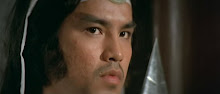
 He does fine as Jim evoking some sort of futuristic Grizzly Adams who butts heads with the annoying Captain Norsythe (Louie Lawless);
whom you'll expect to be scooped up into the maw of any number of
carnivorous dinosaurs populating the picture. Both men have that old Ben
and Harry argument from NIGHT OF THE LIVING DEAD (1968). But instead of
deciding whether to stay upstairs or lock themselves in the basement,
Jim and Norsythe argue whether they should hunt the dinosaurs or stay
neutral and build a stockade.
He does fine as Jim evoking some sort of futuristic Grizzly Adams who butts heads with the annoying Captain Norsythe (Louie Lawless);
whom you'll expect to be scooped up into the maw of any number of
carnivorous dinosaurs populating the picture. Both men have that old Ben
and Harry argument from NIGHT OF THE LIVING DEAD (1968). But instead of
deciding whether to stay upstairs or lock themselves in the basement,
Jim and Norsythe argue whether they should hunt the dinosaurs or stay
neutral and build a stockade.

 The only other recognizable face is Michael Thayer (here sporting a bushy porn 'stach) whom trash fanatics will recognize as Ilsa's love interest in ILSA, HAREM KEEPER OF THE OIK SHEIKS
(1976). He gets paired up with another lovely lady, the curvaceous
Derna Wylde who doesn't seem to have gotten much work since. According
to the DVD commentary, Thayer ended up in the Philippines where he had a
stable career.
The only other recognizable face is Michael Thayer (here sporting a bushy porn 'stach) whom trash fanatics will recognize as Ilsa's love interest in ILSA, HAREM KEEPER OF THE OIK SHEIKS
(1976). He gets paired up with another lovely lady, the curvaceous
Derna Wylde who doesn't seem to have gotten much work since. According
to the DVD commentary, Thayer ended up in the Philippines where he had a
stable career.
 It's also worth mentioning that the filmmakers were cognizant of the cheesecake and beefcake factor populating their movie. Some of the cast are built well, and very photogenic. The girls get the beefy Chuck Pennington and Thayer, and us guys get Mary Appleseth and Derna Wylde among the four attractive women in the cast. Particular note should go to Mary Appleseth. She's barely in the film at all, but she's the only one who strips down to her bikini only to be eaten by an aquatic creature as soon as she hits the water. She utters her lines with all the conviction of a turtle, but she is very easy on the eyes and shame on Shea for killing her off so quickly.
 The
soundtrack by Kelly Lammers and John O'Verlin wallows in synthesizer
orchestrations, and is mostly unremarkable save for the ominous,
otherworldly opening theme.
Bill Malone (William Malone), the director of SCARED TO DEATH (1981) and the underrated CREATURE (1985) is listed as the "Special Props" person.
The films poster design features some striking, Flash Gordon styled artwork that is pretty accurate in the context of what transpires onscreen, and the look of the actors.
The
soundtrack by Kelly Lammers and John O'Verlin wallows in synthesizer
orchestrations, and is mostly unremarkable save for the ominous,
otherworldly opening theme.
Bill Malone (William Malone), the director of SCARED TO DEATH (1981) and the underrated CREATURE (1985) is listed as the "Special Props" person.
The films poster design features some striking, Flash Gordon styled artwork that is pretty accurate in the context of what transpires onscreen, and the look of the actors.

The
film ends on an uncharacteristically high note where most futuristic
pictures were concerned. During the last few minutes, our inter-galactic
"cavemen and cavewomen" (now wearing the most modern in prehistoric wear) have essentially started over again in what amounts to a crude, if ambitious new beginning -- but with dinosaurs as neighbors.
 Had
the acting been better, we'd of had a much more significant piece of
science fiction to discuss. As it is, PLANET OF DINOSAURS isn't quite as
bad as its reputation suggests, but will likely find its best audience
with those who remember it fondly from their younger days.
Had
the acting been better, we'd of had a much more significant piece of
science fiction to discuss. As it is, PLANET OF DINOSAURS isn't quite as
bad as its reputation suggests, but will likely find its best audience
with those who remember it fondly from their younger days.
This review is representative of the Retromedia DVD.
 "I never really 'made it' like Chris Lee and Peter Cushing. But I
wouldn't trade places with them for anything. I'm doing what I
like."--Gough in a 1989 Fangoria interview, issue #84 pp15
"I never really 'made it' like Chris Lee and Peter Cushing. But I
wouldn't trade places with them for anything. I'm doing what I
like."--Gough in a 1989 Fangoria interview, issue #84 pp15
 The devoted fans of horror cinema are very familiar with the iconic names associated with it. The mere mention of Lugosi, Chaney Sr. and Jr., Karloff, Cushing, Price and Lee all derive imagery of vampires, mummies, werewolves, Frankenstein and his creation, and tortured souls living isolated in ominously spooky castles. There are others, too, like John Carradine and Peter Lorre that evoke macabre memories of creepy classics shown in movie theaters or on late night television. One name that rarely gets discussed, or spoken of in the same breath is the late, great British actor, Michael Gough.
Gough (pronounced Goff) was born in Kuala Lampur (his father was a rubber planter there) on November 23rd, 1916. Returning to England, Gough eventually dropped out of Agricultural College to pursue a career on the stage, which kept him increasingly busy. He was such a dedicated, intense stage actor, broken ribs and bloodied lips dotted some of his performances. In 1978, he won a Tony Award for his work in the play, Bedroom Farce.
 In between his stage appearances, Gough also took roles in motion pictures of various genres and varying quality. Arguably, Gough will likely be best known to mainstream audiences for his recurring role as Alfred the butler in the first four BATMAN movies beginning with Tim Burton's interpretation from 1989. However, lovers of horror cinema will likely remember him most fondly from a string of character roles in genre fare beginning famously with Terence Fisher's HORROR OF DRACULA in 1958. Gough had appeared in the forgotten British thriller THE HOUSE IN THE WOODS the previous year. The Hammer film, while a showcase for Christopher Lee and Peter Cushing, featured Gough in a worthy supporting role that led to more in a similar vein. He also appeared in similar genre fare on television in shows like THE AVENGERS, DR. WHO and BLAKES 7.
"I have done a lot of rubbish, but then I've been a hostage to
fortune with too many wives and too many children and one thing or
another, so I had to earn that bread and butter."--Gough in a 1989
Fangoria interview, issue #84 pp16.
In between his stage appearances, Gough also took roles in motion pictures of various genres and varying quality. Arguably, Gough will likely be best known to mainstream audiences for his recurring role as Alfred the butler in the first four BATMAN movies beginning with Tim Burton's interpretation from 1989. However, lovers of horror cinema will likely remember him most fondly from a string of character roles in genre fare beginning famously with Terence Fisher's HORROR OF DRACULA in 1958. Gough had appeared in the forgotten British thriller THE HOUSE IN THE WOODS the previous year. The Hammer film, while a showcase for Christopher Lee and Peter Cushing, featured Gough in a worthy supporting role that led to more in a similar vein. He also appeared in similar genre fare on television in shows like THE AVENGERS, DR. WHO and BLAKES 7.
"I have done a lot of rubbish, but then I've been a hostage to
fortune with too many wives and too many children and one thing or
another, so I had to earn that bread and butter."--Gough in a 1989
Fangoria interview, issue #84 pp16.

The actor was reportedly not fond of his roles in horror pictures; though there's no denying he made the unwatchable watchable by his indomitable presence significantly categorized in a few wildly over the top leading roles. He possessed what was undoubtedly the most garishly penetrating scowl the world of cinema had ever seen. His curled lip and vicious grin were trademarks of his notably ferocious leading roles. Truly nobody could display a face filled with rage the way Michael Gough could.
"You're a delicious little thing... I'm going to enjoy teaching you..."--Ambrose d'Arcy from Hammer's PHANTOM OF THE OPERA (1962)

 Outside of HORROR OF DRACULA, Gough starred in only one other Hammer picture -- their version of THE PHANTOM OF THE OPERA (1962). While a lesser work, Gough made a good go of it as the main villain of the piece, Lord Ambrose d'Arcy; he succeeded in being of greater interest than the title character played by Herbert Lom. Gough's performance is one of pure, unbridled villainy. He was essentially playing a Victorian Era version of the sort of duplicitous scoundrel he essayed in two earlier Herman Cohen modern day 'B' pictures of the trashiest sort. Gough is arguably the best thing about Hammer's PHANTOM, and well worth watching if only for being awestruck at Gough devouring the scenery as the lustful, outright despicable Ambrose.
 Curiously, we never even see his fate in the film. His character is simply forgotten about towards the end after Ambrose gets a gander at the Phantom's face. It was another case of Hammer attempting to make latent love stories disguised as horror pictures and never quite satisfying either side.
Beginning in 1959, the mesmerizing actor would show moviegoers how it's done. He headlined a string of fiendishly vicious roles playing some of horror cinemas great unsung examples of sadism laced with underlying themes of sexual desire, dominance, impotency, and spousal abuse. Some of these films would never be mistaken for high art, but Gough never fails to turn even the most lowbrow of cinema into something gloriously entertaining.
"Three young women have been killed in London within the space of two weeks... each murder more horrible than the last..."--Edmund Bancroft from HORRORS OF THE BLACK MUSEUM (1959)

Prior to his second Hammer Films role, Michael Gough took the lead in two notably sleazy British horror movies for producer Herman Cohen. The years 1959 and 1961 saw the actor with the devilishly serious visage star in the marvelous B movie trash heaps HORRORS OF THE BLACK MUSEUM and KONGA respectively.
 The former has Gough playing Edmond Bancroft, a crippled newspaper crime columnist who makes his living writing sensationalist articles regarding murders of the grisliest sort. The weapons of death (a rigged pair of binoculars, a guillotine, a nasty pair of ice tongs) just happen to be similar to those found in Scotland Yard's 'Black Museum' -- a murder gallery of criminality. Bancroft happens to have his own secret Black Museum along with a basement laboratory complete with a convenient vat of acid that dissolves the remains of snooping victims-to-be.
 The venomous, and murderous author also moonlights as a mad scientist utilizing a serum that transforms his young assistant, Rick into a Mr. Hyde type animalistic murderer. The young man naively, and dotingly follows Bancroft in the form of a twisted father-son type relationship. The film was financially successful back in the day. The US release had a William Castle type 'Hypnovista' addendum tacked on to the beginning that extended the picture from its original 77 minutes to 90 minutes.
"Through Konga I shall not only dominate a corner of the Earth, but blaze a new trail in science. That little chimp will become the first link in modern evolution in plant and animal life."--Dr. Decker from KONGA (1961)
 What initially began as I WAS A TEENAGE GORILLA, ended up as KONGA, a 1961 production from American producer Herman Cohen; who had enjoyed success with teen horror flicks I WAS A TEENAGE WEREWOLF and I WAS A TEENAGE FRANKENSTEIN (both 1957) among others. In KONGA, Michael Gough was in overkill mode once more, portraying a full bore mad scientist-botanist who gleefully kills cats and grows flesh-eating plants in his greenhouse. Meanwhile, he experiments with a chimpanzee he names Konga, brought back from the Congo.
"You fool! You think I want the biggest experiment of my life menaced by
a cat?! Even those few drops might of made tabby swell up to huge
proportions! We're not ready to have a cat the size of a leopard running
through the streets!"--Dr. Decker from KONGA (1961)

Gough was famously dismissive of this movie, and it's easy to see why if you've sat through it from beginning to end. It's riotously bad in every sense of the word, but it's never boring. Gough makes it even more memorable than the giant ape of the title. During the laughable finale, Konga (or, more accurately, a British stuntman wearing George Barrows famous ape suit) grows to giant size and rampages through the streets of London.

Gough is incredible. His villainy is of an outrageous exuberance rivaled, and possibly exceeding anything from Vincent Price, or even Gough's other horror colleagues. I say exceeding because Price's characters of evil (and those of others) are almost always sympathetic to some degree. Not so with Gough's characters in a similar vein. His portrayals are simply diabolical with no sympathetic qualities, or socially redeeming values.
"Children... I've brought you here because we'll have to face a problem. Do you know what they on the outside, the so-called humans, the schemers, the scavengers of land and life. Do you know what they are plotting to do? Listen carefully... evil men want to steal our land... and our home. In their greed, they might even want to kill you. But don't fear. As long as I am here to protect you that will never happen, and I will always look after you. As for our evil enemies, together we will take care of them."--Michael Conrad from BLACK ZOO (1963)

The US production, BLACK ZOO from Allied Artists (again produced by Herman Cohen), attempted to replicate the narcissistic sadist Gough had infamously chiseled out in the two aforementioned British horror pictures. BLACK ZOO has an air of sordidness about it, but director Robert Gordon (IT CAME FROM BENEATH THE SEA) keeps things from getting too carried away; although the same can't be said for Gough's performance as the insane zookeeper-animal worshiper, Michael Conrad.

Unlike the other horror movies with Gough as the lead murderer, he's not a scientist in any sort of capacity, but a devout lover of animals with an unhealthy aversion towards humans. Whereas his BLACK MUSEUM's Bancroft had a hatred towards women, that sentiment is extended to the human race in BLACK ZOO. In fact, ZOO's Conrad shows little to no interest in women whatsoever; the polar opposite of Dr. Decker in KONGA.
Furthering the connection with Gough's earlier Cohen produced movies, Conrad's mute assistant Carl mirrors Rick from BLACK MUSEUM, but his character is more clearly drawn and sympathetic. Of the four main pictures discussed here, BLACK ZOO is the more slickly produced of the bunch; and the most meticulous in its characterizations.
"In one of my experiments, I applied Academician Pavlov's theory of
conditioned reflexes to sexual behavior. In my view, Freud had failed. I
succeeded in controlling human desire, but there was still a missing
link. My subjects could not yet fulfill the desires I had created in
them."--Dr. Storm from HORROR HOSPITAL (1973)

 HORROR HOSPITAL (1973) is arguably the wackiest of these four. It's
missing Herman Cohen as a producer, but British born Richard Gordon made
a suitable successor with his own worthy resume of trash. Gough plays
Dr. Christian Storm, who runs a health clinic that doubles as a hi-tech
lab where lobotomies are conducted. Gough is slightly restrained here,
but flamboyant in other ways. He's a kinky version of Doctor Frankenstein (effortlessly dwarfing the famous Baron's arrogance) by way of Dr. Phibes in this one.
HORROR HOSPITAL (1973) is arguably the wackiest of these four. It's
missing Herman Cohen as a producer, but British born Richard Gordon made
a suitable successor with his own worthy resume of trash. Gough plays
Dr. Christian Storm, who runs a health clinic that doubles as a hi-tech
lab where lobotomies are conducted. Gough is slightly restrained here,
but flamboyant in other ways. He's a kinky version of Doctor Frankenstein (effortlessly dwarfing the famous Baron's arrogance) by way of Dr. Phibes in this one.

 Resembling a bit of ROCKY HORROR, this "hospital" is under the guise of a health clinic where the patients literally lose their minds -- and heads via the Mad Doctor's specialized car with its own built in guillotine and sack to collect the bloody noggins! Midget actor, Skip Martin enlivens things as Dr. Storm's assistant. Gough looks zombie-like himself with his pale complexion. Wheelchair bound, his true identity is revealed in a weirdly shocking ending. Silly, gory and splattered with an irreverently black sense of humor, Gough is essentially Dr. Frankenstein -- The Dirty Old Man.
"One must never put any trust in a woman. It was no accident that Satan was able to tempt Eve before Adam."--Edmund Bancroft from HORRORS OF THE BLACK MUSEUM (1959)
Of these four mad doctor/psychopathic killer roles, there are similarities between them (some of which was mentioned above) as well as varying layers of sexual subtext scattered throughout the psyche's of these four madmen.

As seen in HORRORS OF THE BLACK MUSEUM, Edmond Bancroft -- who walks with a cane -- hates women. His pretty, if crude girlfriend chastises him for his impotence (his limp symbolizes his impediment) and she, along with other beautiful girls, suffer for his shame in spectacularly nasty fashion for 1959. Gough's insidious character was virtually recycled for 1963s BLACK ZOO; but unlike BLACK MUSEUM, his character in ZOO has a hatred for all mankind.
 In KONGA, Gough's Dr. Charles Decker is not only the sort of maniac that would make Frankenstein blush, he's also a voracious sexual predator. He lusts after the young, busty students of his science class, and grows these bizarre plants that look like giant, erect penises -- veins and all. The lascivious looks he gives his gorgeous blonde student comes to a head at the end when he attempts to rape her with his conspicuously placed penile plants standing at attention in the background. The plot device of an evil man getting revenge on those who wronged him, or threatened his success found its way into BLACK ZOO from 1963.

 Michael Conrad of BLACK ZOO is essentially a less sleazier version of Edmund Bancroft from BLACK MUSEUM. He shows the same lack of interest in sex (in the earlier film, it's not of his own volition; in the other, his animals are of greater importance), even displaying an abhorrence at kissing his wife (played by Jeanne Cooper); except once he's struck her in the face after a rage. There are also shades of KONGA's Dr. Decker present as well as another killer gorilla. The sexual subtext is slight (if even intended), but there's a disturbingly thick air of child and spousal abuse running throughout this movie.
"You're too old... to run a whore house..."--Dr. Storm from HORROR HOSPITAL (1973)
Michael Conrad of BLACK ZOO is essentially a less sleazier version of Edmund Bancroft from BLACK MUSEUM. He shows the same lack of interest in sex (in the earlier film, it's not of his own volition; in the other, his animals are of greater importance), even displaying an abhorrence at kissing his wife (played by Jeanne Cooper); except once he's struck her in the face after a rage. There are also shades of KONGA's Dr. Decker present as well as another killer gorilla. The sexual subtext is slight (if even intended), but there's a disturbingly thick air of child and spousal abuse running throughout this movie.
"You're too old... to run a whore house..."--Dr. Storm from HORROR HOSPITAL (1973)

 1973s HORROR HOSPITAL (also known as COMPUTER KILLERS of all things) was a very unique example of subversive British horror; and one that reflected the 70s era of 'Sex, Drugs & Rock n Roll'. Its edgy style is diametrically opposed to the previous decades Gothic horrors, and of those that Hammer were still desperately clinging to. The act of sex is intermittently on display here, but Gough's aforementioned 'Dirty Old Man' really comes to the fore at the end, and in a particularly sleazy fashion. He creates living zombies in both male and female, with the latter performing their duties as sex slaves. Gough only goes on a rant a couple of times here, but even then, it's never to the extravagant degree of the above three films. While his demeanor and appearance are wildly over the top, he's far creepier here than previously seen.
"I don't think it's a classic, no. It didn't have the imagination. The
wild mountains hardly seemed wild enough. I remember Lugosi's DRACULA,
with the bat flying around the coach where the driver should be. Now
that gave the film a sense of atmosphere. The newer film lacked
it."--Gough referring to Hammer's HORROR OF DRACULA in a 1989 Fangoria
interview, issue #84 pp15
1973s HORROR HOSPITAL (also known as COMPUTER KILLERS of all things) was a very unique example of subversive British horror; and one that reflected the 70s era of 'Sex, Drugs & Rock n Roll'. Its edgy style is diametrically opposed to the previous decades Gothic horrors, and of those that Hammer were still desperately clinging to. The act of sex is intermittently on display here, but Gough's aforementioned 'Dirty Old Man' really comes to the fore at the end, and in a particularly sleazy fashion. He creates living zombies in both male and female, with the latter performing their duties as sex slaves. Gough only goes on a rant a couple of times here, but even then, it's never to the extravagant degree of the above three films. While his demeanor and appearance are wildly over the top, he's far creepier here than previously seen.
"I don't think it's a classic, no. It didn't have the imagination. The
wild mountains hardly seemed wild enough. I remember Lugosi's DRACULA,
with the bat flying around the coach where the driver should be. Now
that gave the film a sense of atmosphere. The newer film lacked
it."--Gough referring to Hammer's HORROR OF DRACULA in a 1989 Fangoria
interview, issue #84 pp15
Below is a litany of the actors other genre roles, predominantly of the supporting variety, and nowhere near the scene slaughtering depravity of his four major madman roles discussed above. Even so, the actor had stated he preferred these types of roles over the leading ones.

 Michael Gough had supporting roles in two films for Freddie Francis in 1965. These were THE SKULL and DR. TERRORS HOUSE OF HORRORS. The former saw him playing an auctioneer overseeing a bidding war between Cushing and Lee over the skull of the Marquis De Sade. The latter offered the actor a bit more substance as an artist ridiculed by Christopher Lee's stuffy art critic. Of course, things come to a bad end for the subject of this article when he gives the critic a taste of his own medicine resulting in gruesome consequences.

The actor worked with Joan Crawford the first of two times in the circus set BERSERK (1967). His role is relatively small and inconsequential, coming to a gory end when the killer rams a metal spike through his skull. Basically a remake of the sleazy 1959 British horror flick CIRCUS OF HORRORS, this glossier version lacks the salacious aura that permeated that earlier film.

In 1967, the actor found himself working with Freddie Francis for the third time in the lackadaisical science fiction alien invasion movie, THEY CAME FROM BEYOND SPACE. In it, Gough plays The Master of the Moon, the leader of a roomful of guys who look like interplanetary satanists doused in flour. This was Amicus' attempt at capturing some of the Sci Fi pie Hammer was baking with their lucrative Quatermass series.

Vernon Sewell, the man who gave the world of horror its only film about a man-eating were-moth, THE BLOOD BEAST TERROR (1968), also managed to gather a number of the genres greatest performers together in one movie and make it a plodding, boring production. That film being 1968s THE CRIMSON CULT aka CURSE OF THE CRIMSON ALTAR. With Boris Karloff, Christopher Lee, Barbara Steele and Michael Gough, what could possibly go wrong? It has the makings of a genre classic, but fails to capitalize on its potential. Gough's role is minimal, playing a servant named Elder.

Michael Gough again worked with Joan Crawford in TROG (1970), another awful ape picture; the second monkey movie Gough appeared in, the first being the aforementioned KONGA from nearly a decade earlier. Unfortunately, TROG couldn't be saved by a leading showcase of over the top, scenery scarfing villainy from Gough -- Crawford takes centerstage for this one.
1971s CRUCIBLE OF HORROR was a re-telling of DIABOLIQUE (1955). For this British version, Michael Gough plays a sadistic head of household who beats and humiliates his wife and daughter, yet adores his son. The two women poison him and if you've seen DIABOLIQUE, you have some idea of what happens next, only there's some additional twists here. Frequently tedious, it's enlivened by Gough's outbursts and rantings, and general despicableness.

LEGEND OF HELL HOUSE (1973) remains one of the best haunted house movies. It features an uncredited Gough as a corpse; so no dramatic ranting and raving from him this time. He also played a stiff in NO PLACE LIKE HOMOCIDE! from 1961 -- a role the actor described in a Fangoria interview as therapy for the absurdities of KONGA (1961).
 Gough (having already been afraid of typecasting for some time) took a three year hiatus from horror, not appearing in the genre again till 1976 with Norman J. Warren's gory trash fest, SATAN'S SLAVE aka EVIL HERITAGE. In this one, Gough is a satanist living in a mansion with his psychotic son awaiting the fateful arrival of his niece. It's not too difficult to figure out what happens next.
 Five years later, Gough appeared briefly in the star-studded pseudo horror suspense thriller, VENOM (1981). Gough plays a zookeeper again, but this time he catches animals as opposed to feeding people to them. His screentime amounts to about two minutes and he never gets to go mano-a-mano with the escaped Black Mamba snake loosed in a London household.
Further evidence of Gough shying away from the genre, it would be seven more years before he'd appear in another horror picture; this time for Wes Craven in a small role on THE SERPENT AND THE RAINBOW (1988).
Tim Burton thought very highly of the distinguished actor and cast him as Alfred Pennyworth, the butler in the first two BATMAN movies. Gough reprised the role two more times in two Burton-less sequels. Tim Burton continued to cast Gough in his movies with the lushly Gothic SLEEPY HOLLOW (1999) and the British actor lent his voice to Burton's CORPSE BRIDE (2005) and ALICE IN WONDERLAND (2010). The latter film was also Gough's last credited work. Following that, he was unwell for approximately a year leading up to his death on March 17th, 2011. A cause of death was not released. He was 94 years old.
"...I've been blessed in that I have done some lovely things that have
been denied to other people. I've done things that I want to do, and it
probably shows."--Gough in a 1989 Fangoria interview, issue #84 pp17
Five years later, Gough appeared briefly in the star-studded pseudo horror suspense thriller, VENOM (1981). Gough plays a zookeeper again, but this time he catches animals as opposed to feeding people to them. His screentime amounts to about two minutes and he never gets to go mano-a-mano with the escaped Black Mamba snake loosed in a London household.
Further evidence of Gough shying away from the genre, it would be seven more years before he'd appear in another horror picture; this time for Wes Craven in a small role on THE SERPENT AND THE RAINBOW (1988).
Tim Burton thought very highly of the distinguished actor and cast him as Alfred Pennyworth, the butler in the first two BATMAN movies. Gough reprised the role two more times in two Burton-less sequels. Tim Burton continued to cast Gough in his movies with the lushly Gothic SLEEPY HOLLOW (1999) and the British actor lent his voice to Burton's CORPSE BRIDE (2005) and ALICE IN WONDERLAND (2010). The latter film was also Gough's last credited work. Following that, he was unwell for approximately a year leading up to his death on March 17th, 2011. A cause of death was not released. He was 94 years old.
"...I've been blessed in that I have done some lovely things that have
been denied to other people. I've done things that I want to do, and it
probably shows."--Gough in a 1989 Fangoria interview, issue #84 pp17

 Having appeared in a flurry of productions of stage and screen, Michael Gough gave fans of horror and science fiction some wonderful gifts in his performances in many films -- big and small. Possessing an ego totally opposite that of some of his exemplary bad guy interpretations, the unforgettable actor enjoyed playing supporting roles best because of the lack of responsibility. He also shied away from discussing his roles in horror, nor sought recognition for them. A truly unique talent, Michael Gough will remain unforgettable in the eyes of his fans; and any new ones who may notice the shining light emanating from his infamous scowl and gravely line delivery found in any number of his memorable performances.
For a more extensive overview of Michael Gough's stage career, you can read the UK Guardian obituary HERE.
***Poster images from Wrong Side of the Art***
Having appeared in a flurry of productions of stage and screen, Michael Gough gave fans of horror and science fiction some wonderful gifts in his performances in many films -- big and small. Possessing an ego totally opposite that of some of his exemplary bad guy interpretations, the unforgettable actor enjoyed playing supporting roles best because of the lack of responsibility. He also shied away from discussing his roles in horror, nor sought recognition for them. A truly unique talent, Michael Gough will remain unforgettable in the eyes of his fans; and any new ones who may notice the shining light emanating from his infamous scowl and gravely line delivery found in any number of his memorable performances.
For a more extensive overview of Michael Gough's stage career, you can read the UK Guardian obituary HERE.
***Poster images from Wrong Side of the Art***
copyright 2013. All text is the property of coolasscinema.com and should not be reproduced in whole, or in part, without permission from the author. All images, unless otherwise noted, are the property of their respective copyright owners.


 James
K. Shea's sole directorial effort is one that doesn't generally receive
much in the way of positive notice. While it's glaringly apparent it's
not the most polished movie of its type, it's easily one of the most
ambitious in technical terms. Shea and his crew were obviously very
passionate about this project, even going so far as to pour the bulk of
the minimal budget into the numerous stop motion effects shots.
The dinosaur sequences are so good, in fact, that a later film, GALAXY
OF DINOSAURS, borrowed much of PLANET's creature footage.
James
K. Shea's sole directorial effort is one that doesn't generally receive
much in the way of positive notice. While it's glaringly apparent it's
not the most polished movie of its type, it's easily one of the most
ambitious in technical terms. Shea and his crew were obviously very
passionate about this project, even going so far as to pour the bulk of
the minimal budget into the numerous stop motion effects shots.
The dinosaur sequences are so good, in fact, that a later film, GALAXY
OF DINOSAURS, borrowed much of PLANET's creature footage.
 The devotion and respect for famous animator Ray Harryhausen is noticeable not just in the animation by Doug (THE TERMINATOR, ALIENS, EVIL DEAD 2) Beswick, but in a few key scenes. The opening crash in the lake is an homage to the near identical shot in 20 MILLION MILES TO EARTH (1957). Harryhausen's fabled Rhedosaurus also puts in a cameo appearance during the finale where it briefly tangles with the Tyrannosaur. Another well respected animator, Jim Danforth, also worked on the movie as a matte artist as well as animating at least one sequence.
 PLANET
OF DINOSAURS is the sort of movie you enjoy as a kid, but upon getting
older, you recognize its deficiencies, yet still maintain appreciation
for what made you love it as a kid in the first place. It's basically a
70s version of countless, and lifeless SyFy Channel drivel; but instead
of bland confrontations with CGI critters, it's stop motion dinosaurs
devouring a bland cast. It may also dredge up memories of the popular
LAND OF THE LOST (1974-1977) television series, which also used stop
motion creatures during its three season run.
PLANET
OF DINOSAURS is the sort of movie you enjoy as a kid, but upon getting
older, you recognize its deficiencies, yet still maintain appreciation
for what made you love it as a kid in the first place. It's basically a
70s version of countless, and lifeless SyFy Channel drivel; but instead
of bland confrontations with CGI critters, it's stop motion dinosaurs
devouring a bland cast. It may also dredge up memories of the popular
LAND OF THE LOST (1974-1977) television series, which also used stop
motion creatures during its three season run.
 Speaking of which, this movie lives and breathes by its stop motion dinosaurs (including an Allosaurus, Compsognathus, Styracosaurus, and the all important Tyrannosaurus Rex).
Neither the performances nor the flimsy plot leave much of a mark when
put up against the numerous monster sequences. According to the DVD
commentary, there were some additional scenes shot afterward to beef up
the exposition. With bland acting across the board, no amount of
characterization is going to make these individuals appealing outside of
the audience anxiously waiting for them to meet their fate.
Speaking of which, this movie lives and breathes by its stop motion dinosaurs (including an Allosaurus, Compsognathus, Styracosaurus, and the all important Tyrannosaurus Rex).
Neither the performances nor the flimsy plot leave much of a mark when
put up against the numerous monster sequences. According to the DVD
commentary, there were some additional scenes shot afterward to beef up
the exposition. With bland acting across the board, no amount of
characterization is going to make these individuals appealing outside of
the audience anxiously waiting for them to meet their fate.
 And
waiting for the actors to get eaten one by one is just what you'll be
doing with this one. The plot, such as it were, consists of our group of
spacemen and women trekking across California locations like Hansen
Dam and Vasquez Rocks where episodes of the original STAR TREK were
shot. You may recognize some rocks and mountain terrain from the likes
of 'Arena' and 'Friday's Child' in between (the thankfully frequent)
dinosaur attacks. Interestingly enough, there are some who die you
don't necessarily expect to get eaten. The film is also surprisingly
bloody in places for what is ostensibly a kids movie.
And
waiting for the actors to get eaten one by one is just what you'll be
doing with this one. The plot, such as it were, consists of our group of
spacemen and women trekking across California locations like Hansen
Dam and Vasquez Rocks where episodes of the original STAR TREK were
shot. You may recognize some rocks and mountain terrain from the likes
of 'Arena' and 'Friday's Child' in between (the thankfully frequent)
dinosaur attacks. Interestingly enough, there are some who die you
don't necessarily expect to get eaten. The film is also surprisingly
bloody in places for what is ostensibly a kids movie.
 He does fine as Jim evoking some sort of futuristic Grizzly Adams who butts heads with the annoying Captain Norsythe (Louie Lawless);
whom you'll expect to be scooped up into the maw of any number of
carnivorous dinosaurs populating the picture. Both men have that old Ben
and Harry argument from NIGHT OF THE LIVING DEAD (1968). But instead of
deciding whether to stay upstairs or lock themselves in the basement,
Jim and Norsythe argue whether they should hunt the dinosaurs or stay
neutral and build a stockade.
He does fine as Jim evoking some sort of futuristic Grizzly Adams who butts heads with the annoying Captain Norsythe (Louie Lawless);
whom you'll expect to be scooped up into the maw of any number of
carnivorous dinosaurs populating the picture. Both men have that old Ben
and Harry argument from NIGHT OF THE LIVING DEAD (1968). But instead of
deciding whether to stay upstairs or lock themselves in the basement,
Jim and Norsythe argue whether they should hunt the dinosaurs or stay
neutral and build a stockade.
 The only other recognizable face is Michael Thayer (here sporting a bushy porn 'stach) whom trash fanatics will recognize as Ilsa's love interest in ILSA, HAREM KEEPER OF THE OIK SHEIKS
(1976). He gets paired up with another lovely lady, the curvaceous
Derna Wylde who doesn't seem to have gotten much work since. According
to the DVD commentary, Thayer ended up in the Philippines where he had a
stable career.
The only other recognizable face is Michael Thayer (here sporting a bushy porn 'stach) whom trash fanatics will recognize as Ilsa's love interest in ILSA, HAREM KEEPER OF THE OIK SHEIKS
(1976). He gets paired up with another lovely lady, the curvaceous
Derna Wylde who doesn't seem to have gotten much work since. According
to the DVD commentary, Thayer ended up in the Philippines where he had a
stable career. It's also worth mentioning that the filmmakers were cognizant of the cheesecake and beefcake factor populating their movie. Some of the cast are built well, and very photogenic. The girls get the beefy Chuck Pennington and Thayer, and us guys get Mary Appleseth and Derna Wylde among the four attractive women in the cast. Particular note should go to Mary Appleseth. She's barely in the film at all, but she's the only one who strips down to her bikini only to be eaten by an aquatic creature as soon as she hits the water. She utters her lines with all the conviction of a turtle, but she is very easy on the eyes and shame on Shea for killing her off so quickly.
 The
soundtrack by Kelly Lammers and John O'Verlin wallows in synthesizer
orchestrations, and is mostly unremarkable save for the ominous,
otherworldly opening theme.
The
soundtrack by Kelly Lammers and John O'Verlin wallows in synthesizer
orchestrations, and is mostly unremarkable save for the ominous,
otherworldly opening theme.