Episode 3: BURN! SUPER BEAST HELL (MOERU CHOJU JIGOKU) ***
Directed by Yamagiwa Eizo
 On patrol, Minami witnesses the sky crack open and a monster emerges. Destroying a bridge with a little boy on it, a passenger plane flies overhead and it, too, is destroyed. TAC investigates the wreckage and finds no sign of the little boy, nor the monster Minami described. Hokuto finds the yellow hat belonging to the boy which happens to have his name, Shiro Nakamori, printed on it. Hokuto locates his parents and upon meeting the boy, realizes something is wrong with him after he swipes his gun and attempts to kill him with it! It's discovered the boy has been possessed by the Yapool, using him as a host for the monster Vakishim. Luring the main TAC members away with a decoy, Vakishim is sent to destroy the TAC headquarters at the base of Mount Fuji.
 The third episode of ACE holds the momentum of its predecessors, linking a lot of action to just the bare minimum of storyline. In this case, the action is scaled back slightly to make room for a recurring plot device wherein the Yapool resort to using human hosts for the Super Beasts. This possession motif--which isn't a completely new idea for the ULTRA series--is sort of a bastardized version of the relationship between the Ultramen and their human hosts. As for the M-78 aliens, they respect the innate heroism of man, using the humans as vassals to protect the Earth while martyring their own lives. The Yapool, on the other hand, use them (like the Ultra's, they will raise the dead for their purposes) to take over the Earth with no regard for other lifeforms.
  For this episode's purposes, the object of the Yapool's possession is a little boy, Shiro Nakamori. The scene where the kid confronts his parents in full-on EXORCIST mode (which hadn't even come out yet) is unintentionally comical. Instead of spitting pea soup, he spits lightning bolts. The makeup used to denote an alien presence makes it look like the boy has been playing around with his sister's lipstick and hairspray. Regarding this sequence, it reveals a gaping plot hole in the last scene that one of the Super Beast's could walk through. If you don't want to know what that is, just skip the next paragraph....
In it, TAC learns that Shiro and his parents had died in a mysterious car accident three days prior; yet if all three were dead, and their corpses are being used by the Yapool, why would the child need to kill his parents, who, as we discover at the end, are already dead?
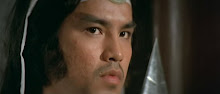
 As was noted in the review for episode two, Takamine Keiji plays the Ultra role in a different way than previous actors. Like an adolescent in a grown man's body, his Seiji Hokuto seems a bit too impulsive, maybe even unrefined to be a member of a global protection agency. When in human form, Hokuto comes off as a buffoon. Despite steadily declining ratings, kids probably liked this sort of interpretation considering the first two 'giant hero' shows were headlined by two serious portrayals; and the third with a rebellious slant. Aside from Hokuto's immature traits, there's a funny scene where he's pulled over by a policeman for FLYING drunk! This was the first of 14 scripts from Tsuburaya screenwriter, Taguchi Shigemitsu.
 Akihiko Iguchi (creator of the '74 incarnation of Mechagodzilla) designed many of the mecha and monsters on both RETURN
OF ULTRAMAN and ULTRAMAN ACE. The walking caterpillar creature,
Vakishim, is one of his brainstorms, and one essayed by this series' primary suit actor, the late Toru Kawai. It's an elaborate, colorful monster, if a bulky suit. As per the thematics of the Super Beasts, Vakishim is a bio-mechanical monstrosity armed with a wild array of attacks. It fires rockets out of its beak and its feeler-like appendages--which also harbors flamethrower capabilities. A big horn on its head can eject and home in on a target, exploding on contact.
Akihiko Iguchi (creator of the '74 incarnation of Mechagodzilla) designed many of the mecha and monsters on both RETURN
OF ULTRAMAN and ULTRAMAN ACE. The walking caterpillar creature,
Vakishim, is one of his brainstorms, and one essayed by this series' primary suit actor, the late Toru Kawai. It's an elaborate, colorful monster, if a bulky suit. As per the thematics of the Super Beasts, Vakishim is a bio-mechanical monstrosity armed with a wild array of attacks. It fires rockets out of its beak and its feeler-like appendages--which also harbors flamethrower capabilities. A big horn on its head can eject and home in on a target, exploding on contact.
 Ace shows off a weapon's cache of his own; the neatest being the Ultra Neo Barrier (see above), a square-shaped shield of energy that repels a monster's attack. The Slash Ray (thrown from the right hand;see insert at bottom) is similar to a shuriken, but with explosive results. The Ace Spark stops Vakishim, momentarily freezing him till Ace can sever his head with the Ace Slash, a buzzsaw shaped laser attack.
The battle between Ace and Vakishim is fast-paced and well choreographed, filling the screen with somersaults, throws, and optical effects. Prior to the big battle, Vakishim's attack on the TAC base affords viewers a chance to see some of the Defense Force's other weapons. A variety of rockets and heavy artillery are unleashed on the Super Beast. The interior set with the Mt. Fuji painting is a striking backdrop to the action as opposed to the usual blue background.
 For the time being ULTRAMAN ACE is a strong superhero show. The tone is even lighter than before, but as the series progresses, the eccentricities become more profound with violent monster deaths mingling with what is ostensibly kiddie-tainment. The show throws some curve balls later on, but till then, it's a fun ride getting there for those with affection for rubber suit action.
MONSTERS: Vakishim; Yapool (dimensional image)
WEAPONS: TAC Falcon; TAC Arrow; Electro Cannon
To be continued in Episode 4: APPEARANCE OF THE 30,000 YEAR OLD CHOJU (SUPER-BEAST)!!!