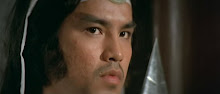
CUT-THROATS NINE 1972 aka CONDENADOS A VIVIR (CONDEMNED TO LIVE) aka BRONSON'S REVENGE
Robert Hundar (Sergeant Brown), Emma Cohen (Cathy), Rafael Hernandez (Dick Patterson), Ricardo Diaz (Joe "El Comanchero" Farrow), Carlos Romero Marchent (Slim), Antonio Iranzo (Ray "The Torch" Brewster), Alberto Dalbes (Thomas Loren), Jose Manuel Martin (John "Weasel" McFarland), Manuel Tejada (Dean Marlowe)
Directed by Joaquin Romero Marchent
The Short Version: American westerns, having been one-upped in the violence category by the Italians, would outmaneuver them by the dawn of the 1970s. Spain, like a matador, entered the arena with one of the genre's most notorious entries, literally goring the hell out of the wild west. A nihilist western in the vein of Corbucci's THE GREAT SILENCE (1968), there's no one to root for and everyone is absorbed with either vengeance or greed or both. Heartfelt hatred drives the narrative in this one. A drastic turn halfway through causes the picture to lose some momentum, but gets it back again during the last half. Not for everybody, Marchent is very successful at maintaining a massively depressing atmosphere from beginning to end. With all the closeup shots of spurting blood and exposed viscera, one pictures Lucio Fulci having an epiphany.


 Sergeant Brown, along with his daughter, Cathy, is tasked with transporting seven ruthless criminals on a 400 mile trek to the gallows at Fort Green. A family of half-starved robbers ambush the wagon, believing it to be carrying gold among its cargo. They kill the cavalry escorts but Brown, his daughter, and the chain-gang murderers manage to escape, crashing their wagon in the process. Impeded by rough terrain and a snowstorm, Sergeant Brown, determined to see the seven cutthroats arrive at their destination, has ulterior motives--to find out which of the seven convicts murdered his wife.
 The Italians had been gradually taking the western into increasingly darker territory ever since Sergio Leone's FISTFUL OF DOLLARS debuted in 1964. Corbucci's THE GREAT SILENCE (1968) is arguably the zenith of demoralization where the genre was concerned. For abject pessimism, it's hard to beat. American oaters were veering in that direction as early as 1967, fully embracing cynicism with 1969s THE WILD BUNCH, and giving wide berth to a slew of imitations and defeatist westerns--many of which audiences couldn't have cared less about. Spain got in on the act with CUT-THROATS NINE garnering similar audience apathy. Marchent's movie did something none of the others had done, though, and that's place primary focus on mutilation and the sheer joy of his characters while inflicting it.
 Sergio Corbucci had pioneered body maiming with DJANGO (1966) wherein a captive is force-fed his own ear and, in the same film, the title gatling gun-toting avenger has his hands trampled by horses. In NAVAJO JOE (1966), a major character has an axe placed square in the middle of his head; skull trauma cropped up again in JOHNNY ORO (1966) along with the gunning down of women and children. Other directors like Giulio Questi followed Corbucci's lead, adding Grand Guinol grue to his bizarro western, DJANGO KILL... IF YOU LIVE, SHOOT! (1967). Sergio #2 was merely cultivating the crop that Leone had planted. Director Marchent, on the other hand, would take the genre into shocking terrain that hadn't been explored up to that time.
Just as Marchent's earlier westerns occasionally looked and felt like their American-made counterparts of the classical Era, CUT-THROATS NINE follows the trajectory of the dystopian western of the Vietnam War Era. Totally avoiding the comedy trend that was big box office in Europe at that time, Marchent took the violence to places yet seen in the western genre; this wasn't violence on the level of dozens of extras bloodlessly mowed down with a gatling gun--this was akin to watching Olga Karlatos getting her eye skewered on a wood splinter in closeup in Lucio Fulci's ZOMBIE (1979).


 In this picture you'll see limbs hacked away, bodies burned beyond recognition, eviscerations, throat slittings, and other grotesqueries in slow motion and closeup. Most westerns relegated their brutality to lingering death via hanging or blood squibs. This one takes an almost slasher movie mentality towards murdering its cast; only here, there's no masked maniac. Everybody is crazy, seeking revenge, or suffering from some past transgression. The one pure character, Brown's daughter Cathy, ends up gang raped and emotionally molested. In an earlier scene, she nearly freezes to death; considering how things play out, succumbing to the icy sting of a snow storm is preferable to violation by half a dozen slobbering cretins.
 About as mean-spirited as they come, Marchent co-wrote the script with Santiago Moncada, packing it full of the most sadistic hombres this side of the Rio Grande. Not counting the four murderous gold-seekers who pop up every once in a while, there's only seven CUT-THROATS, despite the nine of the US title. Just past the halfway mark, the film descends further into the abyss, leaving little chance at something resembling a happy ending. The only respite comes in the form of brief flashbacks as the various characters reflect on better days or how they came to be in their situation. These scenes are the only moments of real exposition. The dialog serves little purpose other than to make the convicts as inhospitable and uncivilized as possible.
 In a unique deviation from the norm, the driving force behind the main characters is less greed than it is outright hatred. Misanthropy is the stagecoach driver here. That's not to say the ubiquitous lust for gold plot device is absent, just it's overshadowed by the relentless lack of humanity. Many in the cast are murdered for the simple joy of it.
Regarding the requisite avarice, the writers put an ironic spin on it. The metal ties that bind the seven murderers together is more than just a chain. It's a striking metaphor that the seven men are literally enslaved by what they'd love to get their hands on--money; and if they can't escape death's embrace by the elements they'll never get the chance to spend it. However, they wish to see their captor, Sgt. Brown, dead even more.
 Sgt. Brown (Hundar), while a protagonist, is barely discernible from the villains. Driven by an inner loathing for the very men he's tasked with transporting to a military fort, he knows one of them is responsible for the death of his wife, but he doesn't know which one. For revenge, he's willing to kill them all if necessary. This is one area where the script is moderately weak. It doesn't fully explore his arc. Brown's true intentions are ambiguous. We know he wants revenge but the notion he may have eyes on taking the gold for himself is also raised.
 Shot in the Pyrenees of Huesca, Luis Cuadrado's camerawork highlights the vast expanse of the snow-capped mountains and the isolation of the situation the characters find themselves in. The filmmakers take advantage of the locales, capturing some stunning shots of the ominous mountains dwarfing the cast as they make their way through harsh conditions. As for the actors, there's a rather long stretch of footage where Hundar is making his way through a rough snow storm carrying an unconscious Emma Cohen, occasionally dropping her into the snow after fatigue sets in. Neither actor has their head or hands covered. Cohen is especially convincing here as you never see her shivering at all.
  Marchent was a director of six-gun cinema before Sergio Leone redefined it. Considered the pioneering force behind the genres explosion in Spain, Marchent has some shining examples bearing his name--whether writing, producing or directing. He performs in all three capacities with CUT-THROATS NINE. The film, diametrically opposed to all his previous endeavors, was obviously of enough interest to put so much effort into it. His brothers, Carlos and Rafael Romero Marchent, are also actors; the former is in the film as one of the title miscreants and the latter is a director in his own right.
Joaquin's first shot at the genre as a director was with the Spain-Mexico co-pro's THE COYOTE and JUDGMENT OF THE COYOTE, both shot simultaneously in 1955 (and starring Abel Salazar; a familiar face to fans of Mexi-horror cinema). Collaborating with future trash flick kingpin, Jesus Franco, the two reportedly wrote scenes for both films in the morning that were shot in the afternoon.

His westerns are varied, but overshadowed by the notorious CUT-THROATS NINE. An irrefutably powerful movie, it's the only film in his western repertoire that is excessively bleak to the point of bordering on horror. Directing films in the classical, pre-Leone American style, Marchent would then adopt the sweaty Italian brand Leone instigated. CUT-THROATS NINE was his last as director, emulating the doom and gloom of the American filth westerns of the 1970s. Marchent died August 16th, 2012 at 91 years of age.

Whereas John Ford had John Wayne, Joaquin Romero Marchent had Robert Hundar (Claudio Undari). The actor worked on six of Marchent's westerns: THE SHADOW OF ZORRO (CABALGANDO HACIA LA MUERTE [1962]); THE IMPLACABLE THREE (TRE HOMBRES BUENOS [1963]); SONS OF VENGEANCE (EL SABOR DE LA VENGANZA [1963]); SEVEN GUNS FROM TEXAS (ANTES LLEGA LA MUERTE [1964]); $100,000 FOR LASSITER (LA MUERTE CUMPLE CONDENA [1966]); and finally, CUT-THROATS NINE (CONDENADOS A VIVIR [1971]). Working in peplums and modern crime pictures, Hundar was even better at playing heavies--which he often did.

The gore is surprisingly good; the work of Carlos Paradela (FURY OF THE WOLF MAN [1972]), HORROR OF THE ZOMBIES [1974]). As told by star Robert Hundar, the blood and guts was added at the behest of an American producer. It's unclear if these scenes were added in post, or suggested while the film was being made. At any rate, the scenes exist in both the Spanish original and the export version. The closeups and slow motion of the act of butchery foreshadows Fulci. Possibly the man famous for orbital destruction saw Marchent's movie at some point.

 CUT-THROATS
NINE has some rough spots, but otherwise it's a uniformly strong entry
in the annals of Euro-westerns. For a film to have very little gunplay (there are no traditional gunfights), it does a fine job of keeping the viewer riveted... for a time. The aforementioned drastic turn midway through cranks up the depressing mood extensively; yet this is the point
where the picture nearly freezes to death, stumbling around trying to
find its momentum again. Thankfully, it finds it once the setting
changes to a Way Station where the last acts of cruelty take place. Finishing with a denouement as dispiriting as the previous 90 minutes, CUT-THROATS NINE is well made quasi-trash from a capable director versed in translating a sense of humanity to the screen. For this, his last, Joaquin Romero Marchent decided to show humankind shorn of it--showing he was good at that, too.
CUT-THROATS
NINE has some rough spots, but otherwise it's a uniformly strong entry
in the annals of Euro-westerns. For a film to have very little gunplay (there are no traditional gunfights), it does a fine job of keeping the viewer riveted... for a time. The aforementioned drastic turn midway through cranks up the depressing mood extensively; yet this is the point
where the picture nearly freezes to death, stumbling around trying to
find its momentum again. Thankfully, it finds it once the setting
changes to a Way Station where the last acts of cruelty take place. Finishing with a denouement as dispiriting as the previous 90 minutes, CUT-THROATS NINE is well made quasi-trash from a capable director versed in translating a sense of humanity to the screen. For this, his last, Joaquin Romero Marchent decided to show humankind shorn of it--showing he was good at that, too.
This
review is representative of the Code Red bluray. Specs and extras:
anamorphic widescreen 1.85:1; original theatrical trailer; running time:
1:31:16.