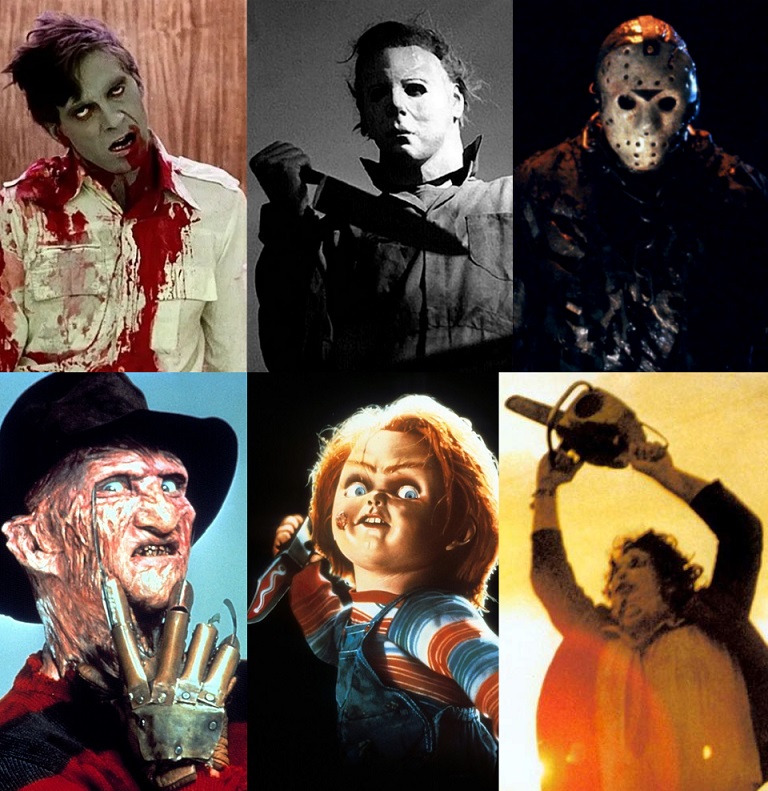
This year's Halloween article is a ranking of six of the major horror movie franchises. This is strictly one fans opinion ranking the films based on my own preference. Naturally, various factors figure into our enjoyment of these films. For the purposes of these lists, it’s largely based on entertainment value, a degree of the quality that went into the production, and in some instances, a bit of nostalgia, too. These rankings are not a “Best to Worst”. In some cases that applies, but largely it’s just my enjoyment of a particular series and where I’d rank them on a scale from number one to the last entry. The capsule reviews accompanying each entry explain why a title is at the top and down at the bottom.
Ranking the LIVING DEAD series: 10 entries
1. NIGHT OF THE LIVING DEAD (1968)
 George A. Romero’s original depiction of civilizations apocalypse remains a haunting and relentlessly eerie vision of the beginning of Hell on Earth. The visuals of slow moving people off in the distance; or lurking in the background, has stayed with me for decades. A masterpiece that, over the years, has been colorized and had new footage shot for it; and in both cases, has shown you can’t improve perfection. Over 50 years later, they’re still coming to get you.
2. DAWN OF THE DEAD (1978)
 Romero’s darkest day of horror remains the greatest in zombie history. Without question, the most influential rotting shuffler movie of them all. The visualization of man’s collapse is to the viewers gain; and the documentary filmmaking style pulls you into the movie just as before. DAWN expands on everything we experienced during the NIGHT. The 3D version that made the theatrical rounds in 2022 was stunning, and an incredible way to experience the DAWN all over again.
3. DAY OF THE DEAD (1985)
 Critics gave DAY a hard time for its over the top performances but for me it fits the depiction of society’s remnants. All that remains of civilization are pockets of humans who are forced to live underground like rats. Attempts are being made to domesticate the dead but the living continue to rot mentally. Arguably, Tom Savini’s best makeup effects work. Ironically, Romero’s future zombies would deteriorate due to the use of CGI. His NIGHT, DAWN and DAY are the only franchise entries on this list to be ranked chronologically.
4. NIGHT OF THE LIVING DEAD (1990)
 Tom Savini, the horror genres most famous makeup effects artist, directs a full length feature for the first time, and it's a do-over of one of the greatest horror films ever made. If you’re looking for tributes and call-backs to Romero’s original you’re getting them in abundance. If you’re looking for goosebumps to be raised you’ll need to watch the original instead. Savini’s remake does what it’s supposed to do—show reverence for its source while putting a new spin on the material; just there’s few scares and the expected zombie chow down effects showcase never happens; the '68 zombie picnic where the living dead dine on Tom and Judy is more explicit than what we see here. Tony Todd does a remarkable job in the Duane Jones role; and Patricia Tallman's Barbara is an unexpected about-face of the original portrayal by Judith O'Dea; so there's definitely some surprises during the NIGHT. LIVING DEAD 90 does close on a surprising revision followed by a fantastic final shock—both of which equal Romero’s grim ending to his ‘68 original.
5. DAWN OF THE DEAD (2004)
 Right when this remake was announced it was widely panned but when it hit theaters it was a shockingly good new version of a timeless classic. It glossed over most of the consumerist subtext of Romero's original and the desperate need by the survivors to return to normalcy--the world they're cut off from--within their enclosed ecosystem. The running zombies aren't just lifted from the sprint-running infected of 28 DAYS LATER (2002), but they're symbolic of a generational change that wants everything fast with little wait time; technology at your fingertips that has aided in a societal rot metaphoric of the zombies in the movie. As for the film itself, there's a high level of intense action and varied attack sequences that kick off within the first five minutes. For me, the movie reminded me of the Italian zombie films; especially at the end when the last survivors make their way to what they believe is an uninhabited island. And it was actually scary, too. Despite inspiring numerous marathon running zombie flicks, DAWN '04 is one of the best horror remakes.
6. DIARY OF THE DEAD (2007)
 I am one of the relatively few fans of Romero's post tri-decade Zombie trilogy. Each of the three zombie movies Romero made between 2005-2010 brings something new to the table. I feel like many of the fans were expecting another DAWN OF THE DEAD; but it's impossible to improve on perfection. It would've been hard to top such an epic. So for this second trilogy, Romero experimented with new ideas and budgets both big and small to get his stories up on the screen. DIARY was his return to indy cinema after LAND, and is of the Found Footage school of horror. It's essentially a road movie where a group of filmmakers document their harrowing encounters with both the living and the dead. At times haunting, and relentlessly eerie, the finale reminded me of the original Resident Evil video game where the remaining cast make their way to a mansion not realizing the horror that awaits them there. Romero builds his story around the permeation of social media and how information is distributed during a zombie apocalypse. The advancements in technology proved ironic since Romero had to resort to using CGI in some instances.
7. LAND OF THE DEAD (2005)
 Romero's big studio return to the living dead is a window into what DAY OF THE DEAD might've looked like. And with the results of more money to spend, I believe Romero's compromised vision of his DAY turned out all the better for it. LAND is possibly Romero at his most heavy-handed and labored with the social themes; this time it's depicting class division between rich and poor; the residents of luxury living in Fiddler's Green and the squalor of the crime-infested areas surrounding it. If civilization has fallen, where are all the high class clothing and food coming from? Then there's the zombies who, led by a dead head named Big Daddy, foment an uprising for whatever reason. The living doesn't want the dead to eat them so what's a hungry zombie to do? Aside from some plot holes big enough to drive the Dead Reckoning through, Romero's heftiest funded movie ever has a cool action movie narrative and likable characters due to Romero's witty script. I saw LAND in the theater, and afterward, had a greater appreciation for DAY OF THE DEAD (1985) and Bub the zombie.
8. SURVIVAL OF THE DEAD (2010)
 The least of Romero's second DEAD trilogy nonetheless has some intriguing ideas shuffling around in the narrative. Easily the most bizarre of his flesh-eating flicks, it also suffers from intrusive humor and too much embarrassingly bad CGI. Both of these are distracting from an already weird plot about feuding families that's ostensibly a western that looks like it's set in Europe somewhere. Romero reuses old ideas, expanding on them in ways that allow him to tell yet another all new zombie tale. Regardless of how good or bad SURVIVAL is, it's another example of the director refusing to make the same movie over and over again. Something I noticed in DIARY and this film was that, compared to his first trilogy, low budgets with advanced tech do not mean better movies; but certainly entertaining and thought-provoking ones.
9. DAY OF THE DEAD (2008)
 If nothing else, the first DAY OF THE DEAD remake is of curiosity value due to its cast and director. Clearly inspired by the success of the DAWN do-over, this DAY seems to go on forever with a relentless barrage of zombie attacks aided by an endless supply of practical and CGI effects. There's nothing here remotely close to Romero's vision; it's entirely a lower-budgeted sequel to the 2004 DAWN remake. The zombies are even more spry than before. They leap into the air at abnormally high altitude; run like The Flash; and scurry across ceilings when the mood takes them. After the first 15 minutes it never slows down, nor does the camera--jostling all over the place to capture the hysteria going on all around. This would be far more palatable if it were called something else; but even so, Steve Miner (director of FRIDAY THE 13TH 2,3, HOUSE, WARLOCK, etc) keeps the action moving at the most frantic of paces. If you can separate this from its cash-grab title, you may derive some enjoyment out of this wacky gorefest.
10. DAY OF THE DEAD: BLOODLINE (2018)
 This is the second remake to Romero’s classic from 1985. Unlike the 2008 do-over, this one follows Romero’s script. But like the 2008 version it’s devoid of any characterization whatsoever. The acting is poor compared to the performances of the original. The characters are never given time to breathe because its basic existence revolves around zombie attacks and machine gun battles. Probably the single dumbest thing about this remake is the main lady scientist is seeking a vaccine that will prevent a human from turning after being bitten. But I don’t see that making a difference since whenever a zombie bites a victim, they take a massive chunk of flesh with it. This film's version of Bub is also wildly nonsensical. Just like with the 2008 film, if you can separate it from the vastly superior Romero version, you might derive minimal entertainment value from the only thing this movie does well—zombie attacks and gore.
For the LIVING DEAD series only, there are three additional films I'm not going to bother ranking; these three simply rank, period. DAY OF THE DEAD 2: CONTAGIUM (2005) is just TEDIUM, daring to be a sequel to Romero's DAY. Then there's the worthless 3D abominations: NIGHT OF THE LIVING DEAD 3D (2006) and NIGHT OF THE LIVING DEAD: RE-ANIMATION (2012). I couldn't finish either film, so proceed at your own risk.
Ranking the TEXAS CHAINSAW MASSACRE series: 8 entries.
1. THE TEXAS CHAINSAW MASSACRE (1974)
 Simply one of the greatest horror movies ever made. I've never felt it was a slasher movie even though it follows some of the sub-genres parameters. It's always been a backwoods Gothic nightmare to me, and one that gets better with every viewing. One of the finest cinematic achievements regardless of genre, Tobe Hooper was seldom this good again. An agonizing endurance test wringing fear and terror out of an audience, TCM remains a masterclass in combining imagery and nerve-jangling sounds that stay with viewers for years after. The torture suffered by the cast and crew led to one of the most terrifying films in the annals of horror history, THE TEXAS CHAINSAW MASSACRE...
2. THE TEXAS CHAINSAW MASSACRE 2 (1986)
 The first time I saw Hooper's sequel I rented it from the video store. It was probably my most eagerly awaited horror movie that year. I didn't know how to feel about it when it was over. There was a bit of disappointment in that I wasn't expecting the amount of humor in it. I really dug the soundtrack and bought the cassette tape with my allowance. After a few more viewings over the years, the movie and its charms that were initially lost, grew on me. The jet-black comedy is but an extension of the black pit of hell humor of the '74 original; only this was 1986 and not ten years earlier. There's a fabulous cast including a scenery-munching Jim Siedow, the elder brother and cook of the Sawyer cannibal clan. The production design is a spectacle to behold, Caroline Williams a memorable Scream Queen, Bill Moseley's Chop Top an unforgettable psychopath, and there's a classic chainsaw battle between Dennis Hopper and Leatherface. Hooper made his last great horror picture sequelizing the film that made him a great director of horror.
3. THE TEXAS CHAINSAW MASSACRE: THE BEGINNING (2006)
 Set four years prior to the events in the 2003 remake, the BEGINNING doesn't really expand on the Leatherface mythos, but does capture that gritty Drive-in ambiance the remake never did. Possibly the most mercilessly violent and gory of all the CHAINSAWs, director Jonathan Liebesman's movie was, to me, more in tune with Hooper's original movie than any other entry. Unlike the remake, the script doesn't shy away from the Hewitt clan's propensity for cannibalism. R. Lee Ermey once more recalls the greatness of Jim Siedow, Andrew Bryniarski's Leatherface is even more relentless as before, and the film overall is mean-spirited and sadistic as hell.
4. THE TEXAS CHAINSAW MASSACRE (2003)
 Marcus Nispel (2009s FRIDAY THE 13TH) directed this remake of Tobe Hooper's genre-defining descent into Hell. That film's Director of Photography Daniel Pearl returns to camera duties on the remake and creates a new look for the torrid landscape captured in '74's CHAINSAW. The new version has a similar look, but with a dark fairy tale quality. The filmmakers manage to create a grotesque visual style that doesn't equal Hooper's vision of madness, but carves its own path while paying respectable homage to its source.
5. LEATHERFACE (2017)
 It's bizarre to think there's a TEXAS CHAINSAW movie directed by two French filmmakers and shot in Bulgaria, but there is. If you've seen Julien Maury's and Alexandre Bustillo's INSIDE (2007), you know they can do ferocious horror. The two directors do an admirable job with the origins of Leatherface that turns out much better than you'd expect. The film's biggest obstacle is not being shot in Texas. No matter how much the filmmakers try with the Southern Fried accents, Bulgaria doesn't look like Texas. The lunatic lovers that kidnap the future human skin-wearing cannibal reminded me of 50s serial killers Charles Starkweather and Caril Ann Fugate.
6. LEATHERFACE: THE TEXAS CHAINSAW MASSACRE III (1990)
 Jeff Burr, who made an impressive splash with the sleazy and splattery anthology FROM A WHISPER TO A SCREAM (1987), sadly went on to direct a slew of unmemorable sequels like this one. CHAINSAW 3 roars for 30 minutes then runs out of gas about the time Leatherface receives an Excalibur chainsaw as a present from his family. From there it's mediocre till the end. Ken Foree (DAWN OF THE DEAD) is the most welcome addition to the cast but is underused and would've helped this movie had his role been much bigger. Typical 90s franchise horror.
7. TEXAS CHAINSAW 3D (2013)
 When you can't even put the word 'MASSACRE' in your TEXAS CHAINSAW movie, that's an enormous red flag. This ridiculous sequel is so awful you'd swear Rob Zombie ghost-directed it. The Sawyer's are no longer cannibalistic killers who've amassed unknown numbers of victims, but oppressed hillbillies driven to mass murder by the townsfolk they were killing off. Not only is the script a waste of paper, but Leatherface looks like he's wearing a hornets nest for a mask.
8. THE TEXAS CHAINSAW MASSACRE: THE NEXT GENERATION (1995)
 Absolute gutter trash of a sequel reduces Leatherface to a whimpering transvestite while making an over the top Matthew McConaughey the main villain. The only reason to watch this would be to see where McConaughey and co-star Renee Zellweger got their start. I remember reading about this in Fangoria when it was under the awkward title RETURN TO THE TEXAS CHAINSAW MASSACRE. It looked like a traditional sequel that would align with Hooper's picture; and with the original's co-writer Kim Henkel as director, that was all but assured. Unfortunately, there's a ridiculous subplot about the Illuminati controlling the crazed clan of killers, and barely a massacre--but it was shot in Texas, so there's that.
Ranking the FRIDAY THE 13th series: 12 entries
1. FRIDAY THE 13th PART V: A NEW BEGINNING (1985)
 My favorite F13 is the one most people hate. It was the first one I saw in a theater and had the highest body count at the time. There's an astonishing atmosphere of sleaze the series never attempted again; and features the best acting performance next to Betsy Palmer in John Shepherd’s tortured portrayal of Tommy Jarvis—the second of three films to revolve around the character. For the first time, (grungy) humor is injected into the mix by way of a filthy mother and son with even filthier mouths. The main setting of a halfway house filled with troubled youths makes for an unsettling blend of madness and murder. Director Danny Steinmann (SAVAGE STREETS) does a great job creating a mystery as to whether it’s Jason Voorhees or someone else doing the killings—some of which are the most brutal seen up to that time. Arguably the most fascinating entry of the first 8 films, despite being widely vilified even to this day due to the killer not being the real Jason. In 1985, it received a level of flogging not seen since H3 hit theaters in 1982. Harry Manfredini’s score is a refreshing composition and his best since part 1. For me, Part 5 is a vastly underrated and immensely entertaining sequel.
2. JASON X (2002)
 After years of stalking Camp Crystal Lake, a brief trip to New York City, and then going to Hell, Jason is finally sent into outer space. This tenth chapter has a little bit of everything. The filmmakers are clearly having fun and are hoping audiences will go along for the ride. Jason kills nearly everyone at a research facility, gets frozen in stasis, found by futurians, accidentally unthaws, goes on a killing spree aboard a spaceship, battles a cyborg, then becomes a cyborg slasher and kills even more. Some goofy dialog and the worst score of the entire series can’t ruin the fun of this 50s SciFi throwback and slasher epic. JASON X is Kane Hodder’s last role as the iconic killer and it’s possibly his best. For pure entertainment value, X marks the spot.
3. FRIDAY THE 13TH (1980)
 The one truly terrifying movie in the entire F13 series. In terms of scares and tension, it’s the best of the bunch. The use of a thunderstorm with muted lighting, the sound of a woman in the distance crying out “help me”, the sudden impact of the kill punctuated by Harry Manfredini’s timeless and chilling music are all unforgettable moments. Something else F13 does extremely well is creating an atmosphere of being at camp that feels tangible and real. Some handheld camerawork gives the film a documentary feel at times. And then there's that incredible ending where Jason pulls Adrienne King into the water that's like the shock moment in a campfire ghost story. “… that means he’s still there!”
4. FRIDAY THE 13TH PART VI: JASON LIVES (1986)
 Paramount Pictures, the company that had utter contempt for the F13 audience, brought the machete wielding psychopath back to life in a very energetic sequel from director Tom McLoughlin (ONE DARK NIGHT); the third and last of the Tommy Jarvis saga. Part 6 could’ve easily picked up where part 5 ended without making Tommy the new Jason, but that would require they maintain the same grim atmosphere; so instead, the filmmakers lighten everything up and drastically alter the Tommy Jarvis character. Consequently, Thom Matthews’s Tommy is not John Shepherd’s. As it were, 1986 was the year goofball comedy infiltrated the major horror franchises and only Texas’s chainsaw chili makers knew best how to mix it with horror. Other than the Three Stooges antics during a paintball sequence, the comedy isn’t too distracting. On the plus side, there’s some gothic atmosphere, fun characters, a few memorable deaths, Jennifer Cooke is hot, and there’s some cool metal tunes by Alice Cooper on the soundtrack. JASON LIVES is also Harry Manfredini’s last good F13 score.
5. FRIDAY THE 13TH: THE FINAL CHAPTER (1984)
 This splattery sequel gives Crystal Lake’s famous slasher a spectacular send-off… till the next sequel. It’s the same story again, but with a few tweaks. With an F13 plot, you've got a rotating cycle of camp counselors and young teens renting some house in the woods for a party. FINAL CHAPTER belongs to the latter camp. If you’re a monster kid, you’ll thoroughly appreciate Tommy Jarvis, the little boy who loves horror and makes monster masks, in his first of three F13 appearances. Something I was hoping more from was the addition of a young man hunting Jason down; it doesn't enhance the narrative the way it could have. On a brighter note, Tom Savini returns on special effects makeup and stuntman Ted White gives us a more forceful Jason who runs after his victims. Thankfully, part 4 wasn’t the final chapter, because we got some entertaining sequels after it.
6. FRIDAY THE 13TH PART 3D (1982)
 F13-3D was the first series entry I saw on television, that being the USA Network. Chapter 3 is important in horror history since this is the movie where Jason Voorhees acquires his famous hockey mask after spending a lot of the film's running time without one. There’s some grandly creepy shots of Jason either hiding behind objects or one of his unsuspecting victims that builds tension. The script adds some new characters in the form of a biker gang to go along with the teens vacationing at a friends family cabin in the woods. For horror mag lovers, Fangoria #1 has a cameo appearance. The plentiful 3D can’t distract from the occasional lag in the pacing but the final girl showdown is among the best of the series with an especially resourceful Dana Kimmell.
7. FRIDAY THE 13TH PART 2 (1981)
 The first sequel to the massive hit killer thriller recaptures a lot of what made the calendars most feared day such a success. The MPAA weren’t kind to F13-2, and were overly hostile to the series as a whole. Even with a lot of the gore scissored, it’s quite good, if slightly above average for me. Jason Voorhees makes his debut here wearing a potato sack with an eye-hole in it. I remember going trick r’ treating once with that look. When I was six or seven my father recorded the first two from an HBO airing. I had to sneak around to see them and both scared the hell out of me back then. Director Steve Miner started the trend of bringing the previous films survivor(s) back and killing them off. Aside from the ending, Adrienne King’s death at the beginning was a fantastic and unexpected shock moment.
8. JASON GOES TO HELL: THE FINAL FRIDAY (1993)
 Of
all the major horror franchises, the F13 series was the first to go
total apeshit with the most simplistic of storylines. Jason Voorhees
went from being a basic slasher killer to a body-hopping demonic force.
But why stop there? After multiple movies where Jason is hacked, shot,
burned, drowned and nearly decapitated, we now learn only a family
member with a magical dagger can kill him; or allow him to return in his
original body. It’s as super stupid as it sounds but director Adam
Marcus plays it straight. There’s self-referential humor, beautiful
girls, a high gore quotient, cameos by the Necronomicon and Freddy
Krueger, and around 15 minutes of Kane Hodder as Jason. At the time, a
lady in the theater shouted “what is this?!” So the not-so FINAL FRIDAY
may have the same effect on you as H3 did back in 1982 and FRIDAY 5 in
1985.
Of
all the major horror franchises, the F13 series was the first to go
total apeshit with the most simplistic of storylines. Jason Voorhees
went from being a basic slasher killer to a body-hopping demonic force.
But why stop there? After multiple movies where Jason is hacked, shot,
burned, drowned and nearly decapitated, we now learn only a family
member with a magical dagger can kill him; or allow him to return in his
original body. It’s as super stupid as it sounds but director Adam
Marcus plays it straight. There’s self-referential humor, beautiful
girls, a high gore quotient, cameos by the Necronomicon and Freddy
Krueger, and around 15 minutes of Kane Hodder as Jason. At the time, a
lady in the theater shouted “what is this?!” So the not-so FINAL FRIDAY
may have the same effect on you as H3 did back in 1982 and FRIDAY 5 in
1985.9. FREDDY VS JASON (2003)
 Pitting
both slasher icons against each other had been in development hell
before the FINAL FRIDAY, but ten years after we saw Freddy pull the
fabled hockey mask beneath the Earth, the hellraising matchup finally
arrived. The plot is good and having Hong Kong director Ronny Yu at the
helm was a fresh approach. Yu utilized the Kung Fu and wire work
techniques of his HK films, giving the picture a distinctive visual
style. It’s overloaded with gore and the comic bits from Krueger are
thankfully not allowed to overtake the film. The biggest gripe I have
with FvJ is no Kane Hodder. Having a Jason who lumbers around like
Frankenstein’s Monster is not what this movie needed. It needed Hodder’s
hulking rage perfectly exhibited through his patented mannerisms and
body language. One of horror’s great missed opportunities.
Pitting
both slasher icons against each other had been in development hell
before the FINAL FRIDAY, but ten years after we saw Freddy pull the
fabled hockey mask beneath the Earth, the hellraising matchup finally
arrived. The plot is good and having Hong Kong director Ronny Yu at the
helm was a fresh approach. Yu utilized the Kung Fu and wire work
techniques of his HK films, giving the picture a distinctive visual
style. It’s overloaded with gore and the comic bits from Krueger are
thankfully not allowed to overtake the film. The biggest gripe I have
with FvJ is no Kane Hodder. Having a Jason who lumbers around like
Frankenstein’s Monster is not what this movie needed. It needed Hodder’s
hulking rage perfectly exhibited through his patented mannerisms and
body language. One of horror’s great missed opportunities.10. FRIDAY THE 13TH PART VII: THE NEW BLOOD (1988)
 A story pitting Jason against a troubled girl with telekinetic powers had a lot of potential; and you see it during the last ten minutes. Unfortunately, the rest is more TIRED BLOOD than anything new. Compared to previous entries, the characters are remarkably bland. The kills are varied and would look great if we were able to actually see them. Then the movie expects us to take it seriously that the corpse of Tina’s father was left at the bottom of a lake with powers of preservation greater than the Egyptians. Arguably the best thing about part 7 is the amazing makeup job for Jason. Director and makeup effects artist John Carl Buechler could do great work when a film budget allowed him to. Stuntman Kane Hodder (the other reason to watch this) dons the hockey mask the first of four times. Hodder conveys a level of rage and power unlike any other actor that played the iconic killer.
11. FRIDAY THE 13TH PART VIII: JASON TAKES MANHATTAN (1989)
 The F13 movie with the worst example of false advertising other than THE FINAL CHAPTER; except that one is a well made slasher picture. It took 8 movies for Jason to leave the damn woods and only spend 30 minutes in the Big Apple while taking an hour to get there aboard a cruise ship. For a slasher flick with a 20+ body count, it’s boring beyond belief. Easily the most disappointing sequel with an even worse ending than Part 7. This time a flood of toxic waste in the sewer system somehow transforms Jason back into a deformed little boy. The only redeeming quality of this sequel is watching Kane Hodder’s second incredible performance as Jason Voorhees.
12. FRIDAY THE 13TH (2009)
 When these remakes of horror hits arrived in theaters, a number of them looked the same, bearing monotonous color schemes with little variation. F13 from ‘09 is one such remake. At times, it feels less like F13 than it does TCM. The kills are surprisingly bland and standard although the opening does show promise. If nothing else, it’s infinitely better than the 2010 ELM STREET do-over, but not as good as the TCM remake this film—also directed by Marcus Nispel—emulates in its visual style.
Ranking the A NIGHTMARE ON ELM STREET series: 8 entries
1. A NIGHTMARE ON ELM STREET 3: DREAM WARRIORS (1987)
 The Freddy Krueger series started out as a dark series of films about a dead child murderer entering the dreams of, and killing off, the offspring of the parents that burned him alive. By the time DREAM WARRIORS came around, Freddy had soared past his slasher brethren at the box office. This meant widening audience appeal by commercializing the killer. The set pieces would become bigger and Freddy’s antics would become more comical. All of that happens in ELM STREET 3; but the element of fear and horror abounds for the third and last time till the mid 90s. Director Chuck Russell (1988s THE BLOB) captures the spirit of Craven’s original while the special effects makeup artists expand on it. Heather Langencamp and John Saxon reprise their roles, too. DREAM WARRIORS carries on the metal-horror tradition prompted by JASON LIVES the previous year. You're not dreaming; ELM STREET 3 is one of the finest sequels ever made and expertly handled by all involved in every way.
2. A NIGHTMARE ON ELM STREET (1984)
 I saw ELM STREET on videocassette in 1985. It remains the only legitimately scary film in the series. A few years later, I’d lose interest in the films once Freddy became a comedian and his victims the subjects of his shtick. The power of the first NIGHTMARE is in Craven’s spin on the slasher formula and his restraint in showing too much of Krueger; lighting him mostly in shadow and or low lit sources. A few years later, the corporatization of the character killed off any chance of Freddy being scary again till Craven came back to the series. In addition to the look and feel of the movie, there’s that iconic piano theme and the familiar sound of Krueger scraping his razor claws against a metal surface; things that are sorely missed as this series went on.
3. WES CRAVEN’S NEW NIGHTMARE (1994)
 NEW
NIGHTMARE is the ingenious 7th entry on ELM STREET. It delivers the
“new blood” FRIDAY 7 promised with a unique blending of fantasy and
reality. Wes Craven returns to the directors chair and shows he hasn’t
lost his creative energy writing the innovative script bolstered by
strong lead performances—especially by the beautiful Heather Langencamp.
Krueger returns to his evil roots and the Freddy makeup is the most
sinister since the first two movies. The materialization of a fictional
monster into the real world is a welcome return to the scarier tones of
the original, and plentiful homages to that inaugural NIGHTMARE.
NEW
NIGHTMARE is the ingenious 7th entry on ELM STREET. It delivers the
“new blood” FRIDAY 7 promised with a unique blending of fantasy and
reality. Wes Craven returns to the directors chair and shows he hasn’t
lost his creative energy writing the innovative script bolstered by
strong lead performances—especially by the beautiful Heather Langencamp.
Krueger returns to his evil roots and the Freddy makeup is the most
sinister since the first two movies. The materialization of a fictional
monster into the real world is a welcome return to the scarier tones of
the original, and plentiful homages to that inaugural NIGHTMARE.4. A NIGHTMARE ON ELM STREET 4: THE DREAM MASTER (1988)
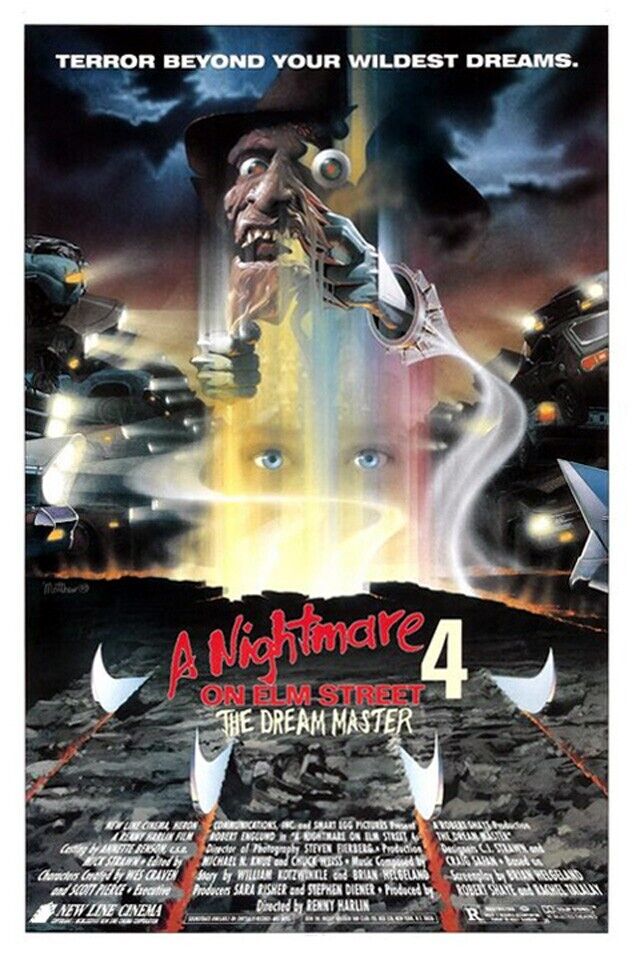 ELM
STREET 4 is music video horror that officially turned Freddy Krueger
into a standup comedian. In the theater, the audience did lots of
laughing, cheering and clapping. That’s a good sign your movie has wide
approval but having Freddy come back after a dog pisses fire on him
doesn’t exactly evoke an atmosphere of horror. Still, there’s some
creative set pieces and some great 80s metal music that plays near
constant on the soundtrack. At the time, I didn’t like it as I was
expecting a darker spectacle akin to DREAM WARRIORS. Upon re-visitation,
I've warmed up to it a bit more. Director Renny Harlin’s overstuffed
blend of metal, teen angst, humor, nudity and gore turned the DREAM
MASTER into the most 80s entry in the ELM STREET series. Totally.
ELM
STREET 4 is music video horror that officially turned Freddy Krueger
into a standup comedian. In the theater, the audience did lots of
laughing, cheering and clapping. That’s a good sign your movie has wide
approval but having Freddy come back after a dog pisses fire on him
doesn’t exactly evoke an atmosphere of horror. Still, there’s some
creative set pieces and some great 80s metal music that plays near
constant on the soundtrack. At the time, I didn’t like it as I was
expecting a darker spectacle akin to DREAM WARRIORS. Upon re-visitation,
I've warmed up to it a bit more. Director Renny Harlin’s overstuffed
blend of metal, teen angst, humor, nudity and gore turned the DREAM
MASTER into the most 80s entry in the ELM STREET series. Totally.5. A NIGHTMARE ON ELM STREET 5: THE DREAM CHILD 1989)
 Without
entirely dumping the humor, the series returns to its darker horror
roots for the fifth film, and the second and last of the Alice
storyline. Some nice Gothic touches enhance this entry even if the plot
doesn’t make that much sense. Unlike the same years HALLOWEEN 5, it
doesn’t do anything wrong, it simply doesn’t do anything the previous
films haven’t already done and better. Compared to DREAM MASTER, the
DREAM CHILD won’t have you remembering much about it the next day. The
Freddy makeup is as average as the movie is. Director Stephen Hopkins
was more successful at building tension and a sense of impending doom
with the ultra-violent PREDATOR 2 in 1990.
Without
entirely dumping the humor, the series returns to its darker horror
roots for the fifth film, and the second and last of the Alice
storyline. Some nice Gothic touches enhance this entry even if the plot
doesn’t make that much sense. Unlike the same years HALLOWEEN 5, it
doesn’t do anything wrong, it simply doesn’t do anything the previous
films haven’t already done and better. Compared to DREAM MASTER, the
DREAM CHILD won’t have you remembering much about it the next day. The
Freddy makeup is as average as the movie is. Director Stephen Hopkins
was more successful at building tension and a sense of impending doom
with the ultra-violent PREDATOR 2 in 1990.6. A NIGHTMARE ON ELM STREET 2: FREDDY’S REVENGE (1985)
 Director Jack Sholder (1982s ALONE IN THE DARK) takes Craven’s seat and opens his film with a fantastic set piece. Unfortunately, it slowly dive-bombs from there. Having Freddy possess the body of a high school kid and using him to kill is an intriguing premise. Where the film goes off the rails for me is in bringing Krueger into reality, lessening the fearful nature his dreamworld status gave him. He’s just another slasher here; nor is the script clear as to why Freddy wants to use the boy to enter the real world when he’s clearly more powerful stalking his victims in their nightmares. Turning the Thompson home into a cursed house was a nice touch if only they’d left the dream killer in his domain. The nonsensical ending doesn’t improve things, either. It’s an okay sequel although the REVENGE is more of a whimper than a scream.
7. FREDDY’S DEAD: THE FINAL NIGHTMARE (1991)
 This fifth sequel has the most elaborate special effects but everything else is stale. The comic shenanigans are ramped up yet again, but to ridiculously unfunny levels. Meanwhile the plot retreads past films in a surrealist style that doesn’t fit this franchise. Innovation is having FRIDAY 5 style wayward teens traveling to Springfield that’s now bereft of any children and seemingly low on adults except for Roseanne Barr and Tom Arnold; and a final 15 minutes in 3D. The overlong Nintendo sequence is an embarrassment and the Freddy makeup looks like Robert Englund wearing a mask.
8. A NIGHTMARE ON ELM STREET (2010)
 An incredibly lifeless remake, ELM STREET 2010 will put you to sleep and potentially induce a nightmare about having sat through the whole thing. The ambiance is right but the look of Freddy is astonishingly bland and makes one reminisce about Robert Englund and how good he was in the role. There's some tinkering with Freddy's origins, making him a child molester instead of a child murderer. There was a glut of horror remakes around this time and NIGHTMARE is among the worst.
Ranking the CHILD’S PLAY series: 8 entries
1. CHILD’S PLAY 2 (1990)
 A sequel that surpasses its predecessor is a rare occurrence. CP2 is one such movie. Superior to the first film, there’s legitimate fear and horror created in the sequel; nor do people have to bump into tables or fall down to ground level for Chucky to be a threat. The story unfolds so well, you forget it’s the same movie all over again. The reason sequels fail is they either don’t improve on their source, or they're unable to find alternate ways to visualize fear; CP2 accomplishes both.
2. BRIDE OF CHUCKY (1998)
 The fourth film in this series straddles a good balance of horror and humor. It’s a vast improvement over part 3 while going in an entirely new, and thoroughly bizarre, direction. Chinese filmmaker Ronny Yu brings a fresh approach to the material and instills Hong Kong movie aesthetics creating a unique visual style. Director Yu would amplify the HK style a few years later when directing FREDDY VS JASON. BRIDE is a darkly comical, Goth-metal melding of BONNIE AND CLYDE and BRIDE OF FRANKENSTEIN and works amazingly well.
3. CHILD’S PLAY (1988)
 Something special about the TEXAS CHAINSAW, HALLOWEEN, and FRIDAY THE 13th franchises was they had entries made between 1975-1985 that were genuinely scary. After 1985, horror films became homogenized and comedic. CHILD’S PLAY is a supernatural horror-action picture with comedic touches brought to you by an expletive-spouting killer doll. Tom Holland previously directed the superior Horror-Comedy FRIGHT NIGHT (1985), and later did THINNER (1996) based on the Stephen King story. CHILD'S PLAY is entertaining, only it's less interested in scares than it is one-liners. If you want to see killer dolls done right, see the ‘Living Doll’ episode of the original THE TWILIGHT ZONE and the third segment in the Made-For-TV anthology horror classic, TRILOGY OF TERROR (1975). Even though there wasn't much scary about it at the time, CHILD'S PLAY was definitely a hot-ticket celluloid toy for big kids and was very popular in 1988.
4. CHILD’S PLAY (2019)
 Chucky is back but no longer a doll possessed by the spirit of a serial killer. The remake turns him into a malfunctioning robot with a propensity to kill… three years before M3GAN utilized an identical plotline. Surprisingly engaging, the filmmakers manage to make Chucky oddly sympathetic before it goes into full blown psychotic mode. The finale, though, is a slight letdown after the tension-driven first 75 minutes.
5. CURSE OF CHUCKY (2013)
 Series creator Don Mancini returns to direct his second Chuck flick (SEED OF CHUCKY being the first)--the darkest entry yet; this sixth film disposes of the urban settings of the previous five films and moves the story to a rural locale set in a big spooky house. It feels like a reboot of the series, but halfway through it’s discovered this film indeed shares relation with the previous movies. As the film unfolds, flashbacks reveal more about Charles Lee Ray as played by Brad Dourif. Mancini, though, can't help himself and lightens the tone in the closing sequence where Jennifer Tilly shows up. Then, in a post-credits sequence, Chucky finally finds Andy Barclay (and probably wishes he'd left him alone).
6. CULT OF CHUCKY (2017)
 There's
one constant with the Chucky series and that's all the films are
connected; none of the seven films of the initial series are stand-alone
titles. Don Mancini directs CULT--weaving a tale that brings together all the main participants from
CHILD'S PLAY's Andy Barclay to CURSE OF CHUCKY's Nica Pierce. The
setting this time is a sanitarium; and like CURSE, the tone is dark with a bit of humor sneaking in at the very end. There's another post-credits sequence, too. The plot is surprisingly deep for a sixth sequel featuring a trio of murderous Chucky's and an extended cameo by the very much alive, decapitated, and nearly blown apart head of the original Chucky. Tiffany (Jennifer Tilly reprising her role) has a few scenes as does her doll form at the end.
There's
one constant with the Chucky series and that's all the films are
connected; none of the seven films of the initial series are stand-alone
titles. Don Mancini directs CULT--weaving a tale that brings together all the main participants from
CHILD'S PLAY's Andy Barclay to CURSE OF CHUCKY's Nica Pierce. The
setting this time is a sanitarium; and like CURSE, the tone is dark with a bit of humor sneaking in at the very end. There's another post-credits sequence, too. The plot is surprisingly deep for a sixth sequel featuring a trio of murderous Chucky's and an extended cameo by the very much alive, decapitated, and nearly blown apart head of the original Chucky. Tiffany (Jennifer Tilly reprising her role) has a few scenes as does her doll form at the end.7. CHILD’S PLAY 3 (1991)
 CHILD'S PLAY 3 is
the same plot as before but 8 years later and set at a military
academy. With Andy now 16 years old, it makes no sense why Chucky would
continue to track him down when he can use any other random kid he comes
across (which he ends up doing after he's found Andy). The element of
horror present in CP2 has been written out and replaced with comedy by
increasing Chucky’s cussing quotient. The script is stupid and is
seemingly channeling the plethora of military movies that were popular
in the late 80s and early 90s. CP3 does stand at attention when the
location switches to a carnival in the last 15 minutes. Otherwise it’s
mostly AWOL for the first 75.
CHILD'S PLAY 3 is
the same plot as before but 8 years later and set at a military
academy. With Andy now 16 years old, it makes no sense why Chucky would
continue to track him down when he can use any other random kid he comes
across (which he ends up doing after he's found Andy). The element of
horror present in CP2 has been written out and replaced with comedy by
increasing Chucky’s cussing quotient. The script is stupid and is
seemingly channeling the plethora of military movies that were popular
in the late 80s and early 90s. CP3 does stand at attention when the
location switches to a carnival in the last 15 minutes. Otherwise it’s
mostly AWOL for the first 75.8. SEED OF CHUCKY (2004)
 This series is all over the place in relation to settling on a genre style; SEED OF CHUCKY takes that to the next level. SEED has a similar vibe to BRIDE; but here it's self-referential sarcasm towards Tinseltown. The film gradually abandons that sharp as a butcher knife wit when the story shifts to the doll child of Chucky and Tiffany. The homicidal parents bicker over whether their plastic offspring is a boy or a girl. Meanwhile, the Cabbage Patch killers plot to sire yet another member of their brood using Jennifer Tilly as the surrogate. SEED works best when it’s about Tilly, as herself, looking very sexy and playing a struggling horror actress in Hollywood. The self-parody are the funniest bits. Had the film stuck with the Hollywood mocking, you'd have a horror/comedy mini-classic.
Ranking the HALLOWEEN series: 13 entries.
1. HALLOWEEN 2 (1981)
 I saw the sequel shortly before seeing the original movie. My dad recorded part 2 off HBO in 1982. He liked it better than the first film stating it moved faster. Not long after, he rented the original and I got to see it for myself. As a seven year old, I liked them both but came to like the sequel more by a very slim margin. What attracted me to director Rick Rosenthal's sequel was the evil ambiance permeating the movie and the sinister side of the holiday. The mask was also unforgettable. You see Michael's eyes in later films that simply do not work, such as the mask in H20. But here, the mask is almost a part of his face; and the eyes piercing through the eye-holes are surely the blackest. Rosenthal does a good job at recreating Carpenter's techniques that made the first movie so terrifying. A lot of fans have dislike for the film due to the revelation that Michael Myers is Laurie Strode's sister. I thought it was a suitable plot point and made sense considering he killed one sister and now pursues the other. Just as much as we never know what motivates Michael Myers, we never learn why he killed his sister that terrible night on HALLOWEEN.
2. HALLOWEEN (1978)
 HALLOWEEN is more than a slasher movie to me. There's more going on than just killing teenagers. Director John Carpenter tells a chilling tale of an evil child who grows up to be an evil adult. John Carpenter's music is as unsettling as his framing of a scene. Donald Pleasence's career got a second lease on life as the determined Dr. Loomis, his most famous role. The visuals and lighting are key to why this movie is still scary 40+ years after The Night He Came Home.
3. HALLOWEEN III: SEASON OF THE WITCH (1982)
 At the time this was the most daring horror sequel yet attempted. If you watched the trailer, everyone should've known there was no Michael Myers in this second sequel. I suppose it didn't dawn on moviegoers till they were in the theater that the cold, hard reality set in. H3 then became the most reviled horror sequel up to that time. Despite all the hate thrown at it, H3 was a valiant effort to do something fresh with the familiar slasher tropes while using the name of an iconic series. It might've been more palatable had they called it something else. In later years, audiences warmed up to its strange story of Stonehenge, witchcraft and an evil cult leader who intended to kill all the world's children with the use of Halloween masks that made their heads explode in a shower of snakes and cockroaches. A great shock ending, too.
4. HALLOWEEN: H20 (1998)
 A HALLOWEEN for the SCREAM crowd, Steve Miner's go at the Myers mythology was the best sequel since part 2. The film had a damn shocker of an opening and an even bigger shock at the end that brought some finality to the series which had become increasingly absurd since 1989. If only the mask had been on par with the first two films this might rank one level higher. HALLOWEEN: 20 YEARS LATER was a breath of fresh air after being bombarded with stupidity dealing with assassins in silver-tipped boots and druid curses.
5. HALLOWEEN 4: THE RETURN OF MICHAEL MYERS (1988)
 H4 was a big deal back in '88. Director Dwight H. Little had a decent command of what made the series iconic. While the RETURN took us back to familiar grounds, Michael Myers now came with a level of sophistication indigenous to the territory of Jason Voorhees. That ending, though, would be the beginning of the series heading far, far off course into areas it never needed to go. It wasn't a home-run, but it was nice to see old friends again.
6. HALLOWEEN: RESURRECTION (2009)
 Most fans despise this sequel, but I think it's better than many of the others by the slimmest of margins. H2's Rick Rosenthal returns to the director's chair and guides a script that insults logic a multitude of times. People do incredibly stupid things and the explanation for how Michael survived being decapitated at the end of H20 is as moronic as it gets. The plot of having Myers killing a bunch of young filmmakers shooting a reality series inside the Myers house is an interesting idea; but Michael having a Kung Fu fight with Busta Rhymes and Laurie Strode getting herself killed due to a severe lapse in common sense keeps the film way down the list. The mask is a winner, though.
7. HALLOWEEN: THE CURSE OF MICHAEL MYERS (1995)
 Back in the 90s, reading the responses from directors about the directions they were taking the HALLOWEEN series were head-shakingly depressing. Each succeeding sequel became more idiotic than the last. There are two versions of CURSE and you'll feel like you're the victim of one upon the realization that this series has wandered off from where it started and can't find its way back. By this point, Myers is no longer a boogeyman stalking babysitters and horny teens, but an unstoppable killer used as an ancient tool of death by modern Druids. What a shame Donald Pleasence's last appearance was in this dreck.
8. HALLOWEEN KILLS (2021)
 The "best" of director David Gordon Green's trilogy that ignores everything past Carpenter's 1978 original. It's more annoying than Green's 2018 HALLOWEEN with that chalkboard grating phrase "EVIL DIES TONIGHT" shouted over and over again. The most appealing thing about this sequel is in how it relishes in showing Michael Myers as a one-man death squad who, by the end, is pummeled into a mass of twisted flesh and bone by a mob of angry citizens. There's an unexpected shock at the end, too.
 9. HALLOWEEN (2018)
 David Gordon Green's self-contained trilogy that connects itself to Carpenter's original is pretty good, even if scenes in this movie and KILLS seem to mirror scenes in the older films this terror trifecta ignore. Jaime Lee Curtis returns yet again, and yet again stated in interviews that THIS ONE is the best. If you want to see weak male characters and women seemingly impervious to everything, you may rank this one higher. It's almost neck and neck with KILLS, but I give that one the slight edge due to the unbridled brutality KILLS revels in versus the more mannered approach of this one. And the sinister doctor character who sounded like he was doing a Dr. Loomis impersonation felt out of left field and as unnecessary as any of the bizarre plot points from parts 5 and 6.
10. HALLOWEEN 5: THE REVENGE OF MICHAEL MYERS (1989)
 One of the worst entries in the HALLOWEEN series is also one of the biggest wasted opportunities. French Director Dominique Othenin-Girard has a distinct visual look and opens his film in a superbly tense way, but he drives it off the cliff not long after. There are a few other good sequences, but not enough to rank this one any higher from the bottom than it already is. There's actually cartoon sound effects used in a scene with two bumbling cops; and another scene that's not supposed to be funny where the cops cuff and stuff Michael Myers and leave his mask on. It's stunning this sequel ever got the go-ahead.
11. HALLOWEEN ENDS (2022)
 HALLOWEEN ENDS currently stands as the most vilified series entry since H3 way back in 1982. After finally seeing ENDS, it would seem you'd want your finale to be the one packed with action instead of the yack-fest, dark romance this film ended up being. The storyline of a young outcast who identifies with a serial killer and ultimately becomes one himself and getting revenge on those who wronged him is a good idea for a horror film; but feels woefully out of place hogging space in the HALLOWEEN universe. You might have 15 minutes of Myers doing his thing and the ending is basically Laurie "The Invincible" Strode kicking his ass for five minutes before doing away with the killer once and for all. I must say though, on a performance level, this was Curtis's best turn as her most famous character. There are some genuinely good things here, they just make for a bizarre inclusion in a film that's supposed to be about Michael Myers. For many, this was more PATIENCE ENDS than a suitable send-off for a HALLOWEEN series.
12. HALLOWEEN 2 (2009)
 Rob Zombie was brought back to make a mess of HALLOWEEN again, so there's more Hobo Michael and even more uses of the word "Fuck" in store for you. Zombie is possibly the only director in history to have to go back and do re-shoots for two films in the same series because the studio had no confidence the pictures were good enough for theatrical release. The one thing the abominable H2 does right is the 'Hospital Nightmare' sequence. It's one of the most ferocious in modern horror cinema. If Zombie could reign himself in and control that energy level, he'd be able to put together an acceptable horror flick.
13. HALLOWEEN (2007)
 2007s HALLOWEEN is one of the absolute worst horror movies ever made. In Rob Zombie's world, there are hillbillies around every corner, citizens say "Fuck" a thousand times, and young girls fake orgasms in front of their parents. Seldom had a film been as touted as this and turned out so terrible. Best thing about the film wasn't even in the movie; that being the brief beef between John Carpenter and Rob Zombie. If ever a movie reeked of piss and flat beer, it's this one.
And that's the end. Leave your rankings in the comments below if you wish. If you want more Halloween, there's this article from Halloween 2018 that's more expansive about the best and worst of the iconic series you can read HERE.
HAPPY HALLOWEEN!