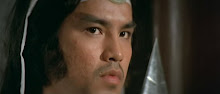
KILLER CONSTABLE 1980 aka KARATE EXTERMINATORS aka LIGHTNING KUNG FU (VHS title)
Chen Kuan Tai (Leng Tian Ying), Ku Feng (Fang Feng Jia), Pai Piao (Fan Jin Peng), Kwan Young Moon (Zhang Long), Chiang Tao (Zhao Jian), Dick Wei (Sun Heng), Yuen Wah (Ba Jia), Yu Tsui Ling (Xiao Lan)
Directed by Kuei Chi Hung
The Short Version: This is an oppressively somber Shaw Brothers swordplay adventure. One of the most unique movies of its kind, Kuei's world is hopelessly sadistic populated with all manner of scum. Chen Kuan Tai is amazing here as the relentless and bloodthirsty constable. The script expertly blurs the line between who is good and bad. Definitely a Hong Kong swordplay film that stands out from the rest. If you're easily depressed, this is not the movie for you.

The resolutely callous head constable, Leng Tian Ying is hired by the Empress to track down a group of gold robbers who have made off with 2 million taels from the royal vaults. The thieves range from vicious assassins to the Forbidden City's own soldiers. Leng is hired for his ruthless tactics and is given just ten days to accomplish the mission. During his excursion, he learns a shocking truth that an unlikely mastermind is behind the robbery.

 Shaw's master of malicious cinema, Kuei Chi Hung helms this hard hitting, dramatic swordplay masterpiece that was known under several tentative titles such as THE MILLION KILLER and THE CRIME BUSTER. Irrefutably one of the best films of its kind to ever come out of the fabled Shaw Brothers studio, it's one of the most unusual looking Hong Kong productions. There is a high quotient of gore utilizing techniques not used prior to this picture, at least none that I can recall. There are numerous scenes showing people being stabbed and sliced with blades and instead of cutaways, or obscured camera angles, the actors have padding lined with blood packs under their clothes. Sometimes it's obvious, but it also adds a brutal, visceral level to the violence. A couple years later, CONAN THE BARBARIAN would use these same kinds of techniques.
 Chiang Tao lets himself get badly burned so Constable Leng can escape the circle of flames to go after the robbers
Oftentimes KILLER CONSTABLE resembles a Japanese picture (some scenes are executed in a very theatrical manner), but with Western touches. It's also one of the most gloomy and downbeat movies ever made; and that's saying something as the Shaw's seemed to pride themselves in making the most depressingly violent movies imaginable. A Korea-Shaw co-production, the Korean version features a different, and far more upbeat conclusion. Also of mention, the version that played on television (under the KARATE EXTERMINATORS moniker) was a compromised version in that red screens covered up some of the bloody violence.
 One of many strikingly atmospheric sets from the film. Such sets were mainstays in Shaw Brothers movies
 Chen Kuan Tai turns in yet another memorable performance as the brutally cold hearted, but whole heartedly righteous royal constable Leng. His methods are cruel and final, but efficient. He never shows mercy, always killing those he's sent to capture. However, there are a few moments scattered here and there that subtly reveal Leng to not be a complete sadist as his actions would lead you to believe. His character is also one of the most determined and resolute characters HK action cinema has ever seen. Leng takes all manner of punishment including various stab wounds, shot with arrows, darts and attacked en mass by hordes of hooded killers, yet Leng keeps on going. Things especially heat up when he learns the shocking truth behind the gold robbery. At that time, Leng gets REALLY mad.
 Famous Korean super kicker, Kwan Young Moon as villain, Zhang Long. Interestingly, his character wears a cross around his neck. This shot is made even more striking in that he stands before a circle of fire.
 Shortly after the Ming reprisals to dethrone the invading Manchu hordes had failed, the common people caught amidst all the turmoil and war were left homeless and starving. Many of these folk resorted to crime to survive. This point is mentioned by one of Leng's men who cannot understand his methods. He feels pity for those less fortunate. Only when the officers take shelter in a destroyed peasant village does Leng's passive subordinate realize what kindness will get you. The notion of passive and aggressive is a constant theme throughout the movie. Yet those taking either side come to a bad end. At one point in the movie, Leng has a lapse in his seemingly cold natured ways and ends up seriously injured from an ambush because of it.
There's no easy way out for any of the many characters seen here. There's really only one truly good person in this movie, a blind girl named Xiao Lan. Her character is the most sad in that she anxiously awaits the return of her father like a loyal puppy dog only for him to leave her in tears again. Maybe that was the directors intention by her being blind. Her inability to see the ugliness of the world around her keeps her pure and untainted.
 The blind Xiao Lan is unaware these two are itching to fight one another
It should also be noted that this movie is a remake of Chang Cheh's classic Wuxia "spaghetti eastern", THE INVINCIBLE FIST from 1969. In that film, baby queen, Li Ching played the blind girl who finds an injured Lo Lieh as the determined constable in that picture. While the stories are virtually the same, Kuei's movie is diametrically opposed to the more conventional means of Cheh's film; a film that was unconventional in several ways from Chang Cheh's other output in that there's a happy ending for the good guys.

 Kuei's film also differs in the depiction of Constable Leng's brother. Here, his brother despises Leng's merciless attitude towards criminals. "If you don't kill them, they'll kill you." His brother refuses to join him on this mission stating that after the countless men felled by his sword that "you stink of blood". He does have a change of heart and later joins up with him. In Chang Cheh's film, soon to be superstar, David Chiang plays the brother, but the question of 'all life is precious' versus instant execution is never raised.
Kuei's script follows Chang's for the most part, but drastically alters the tone creating what is possibly the most gloomy and depressing view of society that isn't too far removed from society of today. Kuei's film also raises some questions about humanity and the dark nature of man and why they do things they wouldn't normally do; things that put formerly innocent people into a life of crime.


 In regards to the film taking place some time after the battle with Ming followers had ceased, an interesting note is that all the main characters are Manchu's. They were the hated enemies of the Chinese after their invasion in 1644. For this picture and in a wild display of seeing things from the other side of the fence, the thieves and robbers are, for the most part, the good guys. Constable Leng is a brutal, yet righteous man as he's perceived in the film, but there's no escaping that the Manchu's (or Qing) are essentially the villains here even though they're the main characters. Liu Chia Liang did something similar in his 1978 production of SHAOLIN MANTIS starring David Chiang, wherein his character was a Manchu, yet he was the main character and the purported "hero" of the piece.
Television director, Yuan Hao Chuan directed a similar movie around the same time entitled WHAT PRICE HONESTY (1980). The heroes were once again the villains, but this time it was three young constables fresh out of graduation who question the corrupt system they work for and the violence perpetrated on the innocents they are supposed to quell. This film takes things in a different direction character wise, but approaches the material in much the same way in relation to the tone.

 Yuen Wah cuts up some loose ends
The level of violence is starkly presented here both in the characters and also the environment. In this world, not only are there few reputable characters, but the elements pound the land into oblivion. During many scenes in the movie, it's either a massive downpour of rain, thunder and lightning, or violent windstorms. The gore soaked finale is also wonderfully captured with lots of gushing blood and severed limbs. Yuen Wah plays a formidable foe for Constable Leng at the conclusion.

 Pai Piao also has a role as an expert assassin who uses poison darts as his weapon of choice. Amazingly, Pai Piao starred in another movie shot around the same time using this films plot. The Taiwanese cheapie entitled DEMON STRIKE (1979) had Pai as the head constable seeking the gold robbers. Throw in some fantasy elements with Hwang Jang Lee as an evil Mao Shan priest with magical powers and you have a hurriedly slapped together mess. Interestingly enough, Lu Chin Ku directed a similarly downbeat movie for Shaw's in 1984 entitled SECRET SERVICE OF THE IMPERIAL COURT. It utilized elements from KILLER CONSTABLE, THE FLYING GUILLOTINE (1974) and the LONE WOLF & CUB series from Japan. Liang Chia Jen plays an almost identical lead role to what Chen Kuan Tai essays here even down to using the same imposing sword.
 The great Ku Feng also has an important role here, but it seems some of his scenes have been the victim of the editing room. He's one of the gold robbers and we later find out through flashback that he was one of the royal guards. However, the first time we see him, there's this big reveal for a character we, the audience haven't seen up to this point. It's only afterward we realize just who he is. Presumably, a scene showing the robbers stealing the gold was removed, but bits of it are seen later in the film.
Kuei was a master at showing depravity onscreen and was said to be something of a tyrant behind the camera. He specialized in gritty modern crime thrillers and nasty horror films. However, he was also prone to directing comedies (THE RAT CATCHER) and children's fantasy pictures such as the rare THE GOURD FAIRY from 1972. His first stab at kung fu was another rare movie, the kung fu comedy, THE RECKLESS CRICKET (1979). KILLER CONSTABLE was his first swordplay movie and his first go at transposing his downbeat style to a period setting. It's a successful transition that in many ways, outdoes his modern day gloom and doom movies. This picture was very important to Kuei and he was most proud of it.
 There's so much flying blood, even the camera isn't safe
This gory and immersive tale of greed and subterfuge is a highly recommended swordplay movie that benefits from a command performance by Chen Kuan Tai, some excellent lighting, atmospheric set pieces (such as a duel atop a giant sun dial) and expert direction from Kuei Chi Hung. It's one of the most depressing movies you're likely to ever see. Not without some flaws, KILLER CONSTABLE (1980) is one of the Shaw Brothers most fondly remembered productions and one that has yet to be released on DVD in the United States.
This review is representative of the IVL R3 HK DVD