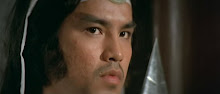
THE BODYGUARD 1973 aka BODYGUARD KIBA
Sonny Chiba (Sonny Chiba/Kiba), Eiji Go (Toro), Mari Atsumi, Ryohei Uchida (Takami), Tsunehiko Watase (Yakuza thug with axe), Yayoi Watanabe (Maki)
Directed by Tatsuichi Takamori
"Whadaya know, the Karate fighter from TV!"
The Short Version: Yet another Sonny Chiba movie that's based on a popular Japanese comic book and one of the superstars least popular movies. Despite its faults, THE BODYGUARD ([1973] released here in 1976) is one of the most important martial arts film imports and in its original Japanese release, precipitates the violent fury unleashed the following year in the actors seminal THE STREETFIGHTER. While it possesses some choice, if goofy exploitational vibrancy and being thematically important for a few reasons, its languid pace keeps it from attaining semi classic status and makes one pine for the release of the Japanese original.
***WARNING! This review contains images of nudity***
 All movie stars should hold press conferences announcing they are becoming crime fighters.
 Movie star, Sonny Chiba--upon returning to Tokyo after a stay in New York--holds a major press conference announcing his campaign to wage a one man war against drug dealers and the mob in an effort to clean up the streets of Japan. He hires himself out as a personal bodyguard to anyone in need of protection. A mysterious woman, the Japanese mistress for the now dead Italian gangster Salvattore Rocco, has been targeted by the both the Cosa Nostro and the Yakuza. She asks for the bodyguard's aid and through several dangerous altercations, Chiba realizes this woman is hiding pertinent information and may or may not be all that she appears to be.
BODYGUARD KIBA is one of many Sonny Chiba movies that was based on a popular manga or anime, this one adapted from the comic of the same name from creator, Ikki Kajiwara. While this recut American version is dubbed in such a way to disassociate itself with its comic source, it also has a jaw droppingly hilarious opening sequence shot specifically for the US market. This opening is worth checking the film out all on its own, even if the film in its entirety isn't the best picture to feature Chiba, an impressive actor with a magnetic demeanor. Taken into context, both versions (the Japanese original is not available on DVD) are vitally important for different reasons.
 The COKE BOTTLE CONNECTION
 Martial arts movies will never attain the near god-like status they acquired during the 1970s following the huge box office takings of FIVE FINGERS OF DEATH (1972), a retitling of the Shaw production, KING BOXER. The big screen emergence of Bruce Lee cemented martial dominance throughout the remainder of the decade till big budget fantasy and special effects pushed kung fu (along with the western) out of the picture and onto television. To understand the popularity of a movie like THE BODYGUARD (especially considering its mostly a mediocre affair) is to understand just how much martial arts in general had permeated the American lexicon at that time. Kung Fu and Karate paraphernalia was everywhere. There were magazines about the arts and other periodicals often contained several ads for various styles both "lethal" and dubious. Schools were cropping up left, right and center and guys like Sonny Chiba and the Five Venoms were quickly becoming iconic among the ever growing American Kung Fu cognoscenti.
 Notice the picture hanging in the background of Chiba's real life master, Masutatsu Oyama, the possessor of...the God Hand!!!!
 The US dubbed version--released in 1976 through the legendary trash peddlers at Aquarius Releasing lorded over by his morbid majesty Terry Levene--is an important footnote in the annals of (imported) American exploitation cinema. Arguably the most famous bit of notoriety among fan circles is the biblical excerpt that scrolls up the screen at the beginning. This passage is also famously heard from Samuel L. Jackson in PULP FICTION (1994). The difference in THE BODYGUARD is that the words have been sacrilegiously and emphatically altered to give the impression of Chiba as god! This then leads us to the bizarre opening where we see karate schools practicing in the woods while the hypnotic utterance of "Viiiiva, Chiiiiba!" mesmerizes the viewer into believing that the Cheebster rules all and knows all. This opening also retains shots of Chiba's master, Masutatsu Oyama and his students practicing in the woods.
From here, we're whisked away to New York City onto the fabled 42nd Street when it represented a true and bonafide concrete jungle complete with every pleasure and pain imaginable. We follow the POV of the camera down the busy streets ogling the various peepshow stalls and porn shops until we come across a Karate Academy to which we follow the camera inside where hilarity awaits. We meet two famous components of American martial arts--Chinese American Goju Ryu Karate founder Bill Louie and Grandmaster Aaron Banks. Both enter into a conversation about who was better, Bruce Lee or Sonny Chiba. This starts off with the great line, "Pretty good...but that's not the way Sonny Chiba did it."
 "Can Sonny Chiba do something like that?"--Bill Louie asks after cutting loose with his nunchucks. Apparently he never saw THE EXECUTIONER (1974).
  Both show off their skills--Bill doing a Bruce shtick that rivals Evan Kim's spiel from the 'A Fistful Of Yen' segment in THE KENTUCKY FRIED MOVIE (1977); only that one was intentionally funny. Banks does his best impression of the Chiba Nut-Ripper style showcased in THE STREETFIGHTER (1974). Incidentally, some in camera edits in the film are noticeable to give the impression of speed. The funniest moment occurs when Banks attempts to flip an overweight karate student. The annoyance of this sort of camera trick would permeate Chinese kung fu movies on the indy front around this time. After watching Banks's display, Bill states, "Yeah, but Bruce had more speed...and science", and follows that up with "By the way, where is Sonny Chiba?" From there the actual movie begins.
 Yayoi Watanabe was no stranger to Nippon exploitation having appeared in CONVENT OF THE HOLY BEAST (1974) and the 70s FEMALE CONVICT SCORPION series.
 Religious imagery is rife throughout (it also turned up in Chiba's DRAGON PRINCESS in 1976) and is made all the more bizarre in the US cut especially in light of the biblical passage that begins the film and also the monotonous, monk-like tonality of "Viiiva, Chiiiba!" In the Japanese portion of the movie, Christian symbolism reaches a blasphemous level when Chiba's busty karate trained sister, Maki, is attacked by mob killers. When Chiba finds her, her naked form is transfixed Christ-like in the shadow of a cross with the words 'Cosa Nostra' written in blood on her arm! The mob--as depicted in this wacky movie--aren't your GODFATHER's mafia; they're a mafiosi that you could only get away with in an Asian movie.
In the opening moments, we see Salvatore Rocco and his family massacred outside a church in New York at the hands of the Cosa Nostra--only these machine gun toting assassins are Japanese! How or when the Italian mafia began allowing Japanese members into their circle is anyone's guess. In some alternate universe where a popular movie star can moonlight as a crime fighter I suppose there's room for Japanese mafiosi, too. Incidentally the dub refers to them as the " Seven Killers of the Yellow Mafia". Amazingly, there's also Japanese strippers with Afro's!

 "Say your prayers, fat man!"--Sonny Chiba takes on gun wielding mafia terrorists aboard a plane.
 After Chiba announces his plan to eradicate the mob and their insidious operations, he's now a prime target. They even hijack a plane to get to him even though they're no more a match for Our Man Chiba at 30,000 feet than they would be chasing him around the streets of Japan. Another great scene has these "seven yellow killers" hiding inside some hotel furniture in the room of the woman Chiba's protecting. How they got in there is anyone's guess, but when Chiba attempts to get inside, the gangsters apparently mistake him for a midget as they shoot feverishly at the door nearest the door knob of all places. Lives and limbs are lost before the dwindling array of "yellow killers" make their escape.
 The violence is occasionally strong and bloody and there's a heavy dose of nudity and sex that made this sort of thing a lucrative prospect for the overseas market of the day. No doubt BODYGUARD KIBA (1973) was picked by Levene for its strange plot devices, its high exploitation value and general weirdness. Granted, the word bizarre and Sonny Chiba frequently go hand in hand at least in the man's most famous works stateside. BODYGUARD KIBA is subtly reminiscent of THE STREETFIGHTER (1974) even though the action isn't as prominent nor as splatastic. The camerawork is typical of Japanese sleaze pictures of the time--it's often hand held, but looks to have been the work of a cinematographer suffering from ADD. And DP Yoshio Nakajima's manic approach is also stamped all over some of the actors more distinguished works such as THE KILLING MACHINE (1975) and the Oyama trilogy all directed by frequent JAC collaborator Kazuhiko Yamaguchi. The score by Toshiaki Tsushima resonates an Italian western vibe in many of its cues.
 In Japan, THE BODYGUARD was released a year before Chiba's iconic portrayal of Takuma Tsurugi in THE STREETFIGHTER, but his role--playing himself in the US release and Kiba in the Japanese version--shows a penchant for the sort of eye-opening (and eye gouging) brutality that would become a staple of Chiba's most popular character. Chiba administers a compound fracture to a nipponese assassin (before his arm is torn away), breaks bones and gouges out another enemy's eyes. There's also some impressive stunt work including Chiba somersaulting over enemies and one amazing bit where his character leaps over a speeding car sliding across the hood narrowly avoiding becoming one with the pavement.
 From left: Yayoi Watanabe, Mari Atsumi, Sonny Chiba
 Strangely enough, the films title and its plot are uncannily similar to the Kevin Costner hit, THE BODYGUARD from 1992. Did Costner or someone affiliated with the script see Chiba's vastly sleazier version during its theatrical run? It's possible and made a bit more quizzical considering Costner was at one time rumored to be attached to the aborted remake of Daiei's DAIMAJIN (1966) movie. It should also be noted that various online sources cite Etsuko Shihomi among the cast of Chiba's BODYGUARD. She is nowhere to be found in this picture (at least I never spotted her if she's in there somewhere) and her name isn't mentioned on the nearly barren American credit sequence. Said credits also state "introducing Judy Lee". Whoever Judy Lee is supposed to be in THE BODYGUARD (1973), it isn't popular indy kung fu starlet, Chia Ling aka Ka Ling aka Judy Lee who starred in the popular QUEEN BOXER from 1972. Additionally, Takashi Miike helmed two direct to video BODYGUARD KIBA movies in the 1990s. So even though the film isn't a high point in the long and frenetically paced career of Sonny Chiba, it's at least unique for various reasons.
 Sonny Chiba (left) and frequent co-star/support player and perennial slimy villain, Eiji Go at right.
There are a lot worse Sonny Chiba movies, but few are as fascinating, or often overlooked as much as THE BODYGUARD is. It's occasionally a banal, badly paced affair and the photography sloppily captures the action much of the time, but the sheer audacity in reveling in the mud of insanity is the one saving grace that makes this goofy endeavor worth watching at least once. Its status within the heritage of imported 70s trash filmmaking will be its most notorious gift to fans of exploitation movies far more than anything else in the film. And that's not counting the loyal disciples that worship at the temple of Tarantino.
This review is representative of the BCI DVD