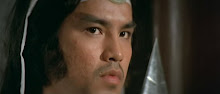
DR. JEKYLL AND THE WOLFMAN 1971 (released in 1972) aka DR. JEKYLL Y EL HOMBRE LOBO
Paul Naschy (Waldemar Daninsky/Mr. Hyde), Jack Taylor (Dr. Henry Jekyll), Shirley Corrigan (Justine), Mirtha Miller (Sandra), Elsa Zabala (Yusika Bathory)
Directed by Leon Klimovsky
***WARNING! This review contains images of nudity***
"We'll use the formula discovered by my grandfather... to change his personality to that of the evil assassin he called Hyde..."--Dr.Jekyll's plan doesn't sound like the best way to cure a man of Lycanthropy, but horror fans win for his choice of treatment.
The Short Version: The melding of Dr. Jekyll with Daninsky's wolfman was yet another bizarre pairing where Paul Naschy's catalog of monster pictures were concerned. This intriguing team-up offers some choice themes and ideas, but there's so much crammed into the 88 minute running time, there isn't sufficient time to thoroughly explore them all. By the end, it feels like there were two movies made, and then put together. Sadly, the least interesting, but no less thematically packed first half takes too long getting to the much more fascinating second half where this ghoulishly groovy film really goes off the deep end; mostly in a good way. This being the unclothed, international version, there's plenty of nudity to supplement the gore and violence -- which is stronger than some of the man's works prior to this films release. Worth it for Naschy's performance as the sexual sadist-murderer Mr. Hyde alone, and a generally well made horror picture from Leon Klimovsky.

 While on an excursion in the Carpathians to visit the graves of his murdered parents, Justine and her husband Emory are attacked by bandits that leave him dead. Justine is saved by Waldemar Daninsky and recuperates back at his isolated castle. Discovering he is a werewolf, Justine tells him that a cure may lie in the hands of her friend, Dr. Jekyll. Daninsky returns with her to London where Jekyll intends to cure the tortured wolfman with his personality altering serum. Seemingly free of his lycanthropic curse, the operation goes terribly wrong leaving Daninsky indefinitely transformed into into Mr. Hyde, a murderous, sex-crazed rapist with a hatred for women.
  Spanish and Mexican horror cinema shared much in common. They both were drenched in atmosphere inspired by the likes of Universal horrors and Hammer Films productions. The two differed in that Spanish horror was generally much stronger (especially in their international versions) where sex and violence was concerned. They were also different in how they presented their stories. Mexican horror films, as wacky as they were, most often made sense structurally, whereas the plots in their Spanish counterparts were frequently fractured, often beaming with disrupted narratives that many fans are quick to celebrate for their "dream-like" qualities.
The storyline for the sixth Hombre Lobo movie is scattershot much like other Spanish horror productions. The first 40 minutes or so are leisurely paced, then the last half suddenly realizes it's only 88 minutes and tries to stuff everything it can into the remaining time allotted. Fortunately, Naschy was a better director than anyone he ever worked with, showing off his skills behind the camera a few years later proving that an unleashed Naschy was better than the one performing under someone else's guidance.
 Known for his westerns as much as his horror movies, Leon Klimovsky did
many tales of terror throughout the 1970s and most all of them were
average affairs benefiting from strong atmosphere, but weak plotting. The director, like his contemporaries, had a keen eye for atmosphere, but their finished product seemed to always lack cohesion as if chunks of their script were tore out, or never written at all. But whether it was Klimovsky or Carlos Aured behind the camera, a horror fan could always count on a forbidding amount of atmosphere along with the crumbling castles and cemeteries.
Known for his westerns as much as his horror movies, Leon Klimovsky did
many tales of terror throughout the 1970s and most all of them were
average affairs benefiting from strong atmosphere, but weak plotting. The director, like his contemporaries, had a keen eye for atmosphere, but their finished product seemed to always lack cohesion as if chunks of their script were tore out, or never written at all. But whether it was Klimovsky or Carlos Aured behind the camera, a horror fan could always count on a forbidding amount of atmosphere along with the crumbling castles and cemeteries. The actual plot (as simplistic as it is) doesn't even begin till 40 minutes into the movie. It drags on far too long before the films title meeting even takes place. By dragging, that doesn't mean it's boring in any way. In fact, after spending a few minutes with the passive Dr. Jekyll at the beginning, the next 35 minutes are spent in familiar Naschy territory complete with sadistic, thieving bandits, a leper, a mysterious woman named Bathory(!) who raised Daninsky and oodles of Gothic ambiance. By the end, DR. JEKYLL AND THE WOLFMAN feels like two mini-movies (monster) mashed together.
The aforementioned backwoods villagers (as depicted in these Spanish horrors) must have had a reputation for violence in real life; those seen here range from rapists-murderers, to frightened, modern day torch bearers superstitious of witches and sorcery. They also get a lot of screen time and make up a major portion of the drawn out first half.

 While the likewise crowded first portion settles into familiarity with Naschy's previous monster pictures, the second half of the movie goes for the jugular unleashing a geyser of bloody creativity; even if intentionally turning Daninsky into Mr. Hyde makes no sense as a cure for his lycanthropy problem (although Jekyll gives a decent enough explanation as to the reasoning behind it). That Naschy seeks the help of Dr. Jekyll, and in turn becomes Mr. Hyde, is a unique twist on the Stevenson classic tale. It's just a shame the film doesn't spend more time with this angle before introducing another just minutes later in the form of Jekyll's jealous female assistant and lover!
 Yet again, the time factor doesn't allow for all the late-blooming subterfuge and incidental characters to be explored to any lengthy degree as the film nears its last reel and a rather abrupt finish. Oddly enough, it's the last reel where the film fumbles the most since it took so long getting to the main focal point -- the arc of Jekyll and Daninsky; the latter being exceptionally essayed by writer and star of the picture, everybody's favorite Werewolf of Spain, Paul Naschy aka Jacinto Molina.
 Naschy's acting is nothing short of astounding here juggling three roles. As Daninsky, he's just as tortured as ever before. His wolfman, while not as fiercely energetic when the moon is full, is more sympathetic and lovelorn than usual. The make up and fang work are among the best; the teeth possessing a stained look to them for added realism. There are no pearly white flesh shredders here. But where Naschy really cuts loose as an actor is in one of the script's (which the actor wrote) few novel twists -- his interpretation of Mr. Hyde.
 His vision of Mr. Hyde is arguably the most sadistic ever put to celluloid. The man is intense in his portrayal. Initially Hyde is a devilishly smiling madman with a raving sexual appetite. He's also, at first, under the control of Sandra (Mirtha Miller of COUNT DRACULA'S GREAT LOVE), the homicidal, and scorned mistress and assistant to Dr. Jekyll -- her character being an abridged version of the equally sinister Ilona Hellman from THE FURY OF THE WOLFMAN (1971). It's in her character (and Hyde's) where Naschy's script takes a brief turn into some fascinating territory regarding the nature of love and hate.
 It's not just Daninsky who's a tragic, lovestruck character. Dr. Jekyll loves Justine, who preferred another man. After he's killed, she rather quickly falls for Waldemar. Meanwhile, Sandra plays the role of Jekyll's assistant and his lover. She, of course, loves him madly -- literally. Once she realizes Jekyll has no intentions of being with her forever, she betrays him, and through Mr. Hyde, she exacts revenge.
 However, her revenge is short-lived as Hyde eventually shows her he has no intentions of being her brutish instrument. There's so much potential here, but the running time and director decide a straight horror-exploitation picture is the way to go, and this is what will appeal most to the cult horror crowds, anyways.

Jack Taylor as Jekyll is restrained, but the role demands it. We're not given a great deal of time with him, but he's believable in what scenes we get with the character. Taylor was a veteran of dozens of cult European horror movies and even did some Mexi-horrors such as his wacky turn as a wild-eyed sorcerer battling it out against German Robles' vampire in the Nostrodamus series entries THE MONSTERS DEMOLISHER and THE GENIE OF DARKNESS (both 1962).

British actress Shirley Corrigan is stunning, and easily among the most abused actresses in horror movie history. Her husband is murdered before her eyes, she's nearly raped by thugs, later raped by Mr. Hyde, bloodily lashed by him and other forms of torment. She's arguably the one character the viewer will identify with the most based on the abuse alone.
 With Klimovsky at the helm, nothing is given time to brew properly outside of the standard Gothic horror retread of the films first 40 minutes. Once Hyde enters the fray during the last 20 minutes, there's simply not enough time left to traverse the arcs of Hyde and the jealous, murderous Sandra. That's not to say this isn't an unusually good, entertaining horror picture, because it is. Some of the best scenes include Naschy being stuck in an elevator with a nurse as the full moon rises, Hyde thrashing a bound and naked Justine, and a brief, climactic disco scene where Hyde reverts back to Daninsky, then to his more hairy persona as dozens of screaming patrons exit the building.
 Some of the action scenes seem slow and a bit sloppy, but the plethora of horror elements and gore (Daninsky even pulls chunks of flesh out of one victim) override the shortcomings. Anton Garcia Abril's score is a welcome addition and some cues sound like they were borrowed from his superlative compositions from the exemplar Templar horror of TOMBS OF THE BLIND DEAD (1971). DR. JEKYLL AND THE WOLFMAN (1972) is well worth your investment; and for Naschy fans, this tour de force of werewolfery and Hyde's hedonistic sadist is a howlingly good time.
This review is representative of the Code Red DVD paired with THE VAMPIRES NIGHT ORGY (1973).