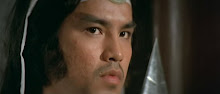
EL MUNDO DE LOS MUERTOS ( THE WORLD OF THE DEAD) 1969 (released in 1970) aka SANTO AND BLUE DEMON IN THE WORLD OF THE DEAD
Santo (Caballero Enmascarado de Plata/himself), Blue Demon (Caballero Azul/himself), Pilar Pellicer (doña Damiana Velázquez), Betty Nelson (Aurora), Antonio Raxel (Chief Inquisitor/don Alfonso), Guillermo Bianchi (Bishop/Padre Francisco)
Directed by Gilberto Martinez Solares
The Short Version: Santo Goes To Hell is one way to describe this loco Lucha horror yarn that takes itself deadly serious in spite of the usual cheap effects and some blatant continuity errors and anachronisms. Santo not only battles a demonic Blue Demon, but also the living Lucha dead, and a gaggle of undead muscular minions with towels on their heads matched to mucho stock footage from HERCULES IN THE HAUNTED WORLD! If that weren't enough, Santo is savagely stabbed in the ring(!) leading to some graphic, and real open heart surgery footage(!!). In the next scene Santo is as good as new and slugging it out with the devil's disciples again(!!!). Strictly for schlock merchants and Mexi-movie lovers the world over.

 In 1670, four members of a cult of devil worshipers are burned at the stake by Mexican Inquisitors. Damiana, a woman of nobility who is secretly the high priestess of the satanists begs help from Astaroth, Crown Prince of Hell. He sends Blue Demon to aid in her revenge. The Caballero in the Silver Mask suspects Damiana's treachery, and after refusing her lustful invitation to the dark side, she murders the Caballero's betrothed. Condemned to the same fate as her followers, Damiana lays a curse upon the descendants of her persecutors. 300 years later, the curse is visited upon Santo and his fiance, Alicia, by the demonic spirit of doña Damiana and her hellish minions.
 In what would appear to be a hodgepodge of ideas taken from some of the B/W Vergara Santo pictures from a few years earlier (most notably EL HATCHA DIABOLICA), EL MUNDO DE LOS MUERTOS is another Lucha horror title dealing with satanism, reincarnation, possession, and curses; and a film -- despite some grande schlock moments -- that has quite a bit going for it. For one, it's a precursor to the wildly popular THE MUMMIES OF GUANAJUATO (1970; released in 1972); a film that spawned several follow-ups, and featured Santo in a lesser capacity while giving the bulk of the limelight to Blue Demon and Mil Mascaras.
 Second, it has a strong romance angle for our Silver Masked savior. Ironically, the devil worshiping woman that coldly murders his buxom blonde bride-to-be in the 17th century segment ends up as his girlfriend during the modern day portion of the movie. In his earlier film career, Santo was mostly a wrestler with a second profession as a crime-fighter -- both of which kept him far too busy to maintain a social life with the ladies. Towards the end of the 1960s, he became more of a secret agent who wasn't so secret when it came to in-ring confrontations. Oddly enough, some of these later pictures had no wrestling bouts at all. They also replaced Santo's earlier Superman persona with a more emotionally libidinous one when it came to mingling with the fairer sex.
 Blue Demon (Alejandro Munoz Morena) is co-billed alongside Santo
on the advertising, but he's reduced to what amounts to an extended
cameo in the actual film. He's seen during the first 30 minutes as Santo's hell-sent
nemesis, but returns during the last five to aid Santo, explaining that for this deed his
soul is now free after 300 years! This bit of movie backstory that Blue Demon was enslaved by Astaroth before winning his freedom after three centuries adds to his in-ring mystique given his name; mirroring the sideshow theatrics of American pro wrestling, only the wrestlers in this country never had film careers that replicated those of Mexico's Lucha stars. Hulk Hogan starred in several movies, but nothing to the degree of Santo, Blue, Mil, and some others.
Blue Demon (Alejandro Munoz Morena) is co-billed alongside Santo
on the advertising, but he's reduced to what amounts to an extended
cameo in the actual film. He's seen during the first 30 minutes as Santo's hell-sent
nemesis, but returns during the last five to aid Santo, explaining that for this deed his
soul is now free after 300 years! This bit of movie backstory that Blue Demon was enslaved by Astaroth before winning his freedom after three centuries adds to his in-ring mystique given his name; mirroring the sideshow theatrics of American pro wrestling, only the wrestlers in this country never had film careers that replicated those of Mexico's Lucha stars. Hulk Hogan starred in several movies, but nothing to the degree of Santo, Blue, Mil, and some others.

 Blue's return coincides with a
sequence wherein Santo goes to the title 'World of the Dead' to
save his girlfriend, Alicia. Possessed by the spirit of that persevering
demon, Damiana (who happens to look just like her), Alicia is unconscious and near death. If she dies, her
soul will remain in hell so Santo, with an hourglass inexplicably
deciding how much time she has left, makes the trek to the hot place
where the screen turns a red tint, and the landscape is home to stock
footage from HERCULES IN THE HAUNTED WORLD (1961). Both Blue and Santo
lob tree trunks(!) and huge rocks at the towel-wearing dead world
denizens in a bid to match up to the footage from the Reg Park classic.
Blue's return coincides with a
sequence wherein Santo goes to the title 'World of the Dead' to
save his girlfriend, Alicia. Possessed by the spirit of that persevering
demon, Damiana (who happens to look just like her), Alicia is unconscious and near death. If she dies, her
soul will remain in hell so Santo, with an hourglass inexplicably
deciding how much time she has left, makes the trek to the hot place
where the screen turns a red tint, and the landscape is home to stock
footage from HERCULES IN THE HAUNTED WORLD (1961). Both Blue and Santo
lob tree trunks(!) and huge rocks at the towel-wearing dead world
denizens in a bid to match up to the footage from the Reg Park classic.
 Not everything is lively in THE WORLD OF THE DEAD. There are several moments of sloppiness that are kind of at home in Mexican genre cinema if you're familiar with it. These moments tend to make EL MUNDO a more enjoyable experience. With the first thirty minutes taking place in the 17th century, virtually everyone in the film plays a dual role akin to Santo's character in EL HATCHA DIABOLICA (1965); but unlike that film, 17th century Santo looks totally out of place wearing his wrestling ring attire that's not even remotely concealed by the Colonial Era shirt and matching cape he's wearing. The same applies to Blue Demon and his familiar wrestling gear.

The fight scenes, while plentiful and fun, are on the mediocre side, and without variance. It's likely there was no actual choreographer and only one take was done. There are three recurring undead stooges that relentlessly assault Santo throughout the movie. During the period section, these three musketeers engage in a fencing duel with the Silver Knight. Santo was 52 years old at this time, and got around really well, but his skills with the rapier leave a lot to be desired. Thankfully for him, a trusty cross was hanging on his wall, successfully sending the musclebound trio packing.

 Santo gets barely a chance for a breather as it's Blue's turn to pummel him into submission. This fight is much better and it looks like the two men are really working out some of their real-life frustrations with each other. Again, the sign of the cross repels the villain, accomplished by stopping and starting the camera accompanied by a puff of smoke that goes off a couple feet away from where Blue was standing.
 Arguably the most shocking, and unexpected sequence in this Santo showcase is the wrestling bout where he's Pearl Harbored once more by those three pale-faced villains. They pound Santo mercilessly, and in a surprising moment, the Saint is stabbed square in the chest with blood running out of the wound! The filmmakers then insert some gruesome open-heart surgery footage to insinuate Santo is being operated on. Astonishingly, a few minutes later, he's slugging it out with the three satanic stooges yet again. Considering this is Mexican genre cinema, anything is possible, and what follows is this films biggest faux pas....
 In this sequence of Ed Woodian proportions, Santo is attacked once more by
Damiana's demonic and determined brawlers. They battle it out inside his home that has a modern 60s decor; but upon
taking the fight outside, the setting has suddenly, and inexplicably turned into what looks like an old western
town?! Elsewhere in the movie, there are some genuine location shots that adds some production value, but apparently a rural, or suburban area home (with a paved road) wasn't in the budget. There is no attempt to mask (haha) this glaring continuity error
at all. In Mexican genre films, you just have to accept this sort of thing, and especially in Luchador productions.
In this sequence of Ed Woodian proportions, Santo is attacked once more by
Damiana's demonic and determined brawlers. They battle it out inside his home that has a modern 60s decor; but upon
taking the fight outside, the setting has suddenly, and inexplicably turned into what looks like an old western
town?! Elsewhere in the movie, there are some genuine location shots that adds some production value, but apparently a rural, or suburban area home (with a paved road) wasn't in the budget. There is no attempt to mask (haha) this glaring continuity error
at all. In Mexican genre films, you just have to accept this sort of thing, and especially in Luchador productions.
 EL MUNDO DE LOS MUERTOS was the third and last of a trio of Santo movies made by prolific Mexican movie producer Jesus Martinez Sotomayor; the other two being SANTO AGAINST BLUE DEMON IN ATLANTIS (1970) and SANTO AND BLUE DEMON VS. THE MONSTERS (1970). Making 65 pictures between 1956 and 1970, Sotomayor cranked out at least one movie a month; reportedly a record in Mexico. EL MUNDO DE LOS MUERTOS is his last known credit. Some of the genre films on his resume include THE CASTLE OF THE MONSTERS (1958), THE SHIP OF MONSTERS (1960), MUSEUM OF HORROR (1964), LA LOBA (1965), and ADVENTURE AT THE CENTER OF THE EARTH (1965). He died in March of 2009.
 The three Sotomayor Santo flicks are among the most enjoyable of the long running series, even if they're technically awful productions. If nothing else, they're lively (even if the antagonists are not!), colorful, and never boring. Those expecting a Santo-Blue team-up in EL MUNDO will be disappointed. Their onscreen interaction mirrors their offscreen rivalry with only a few minutes displaying the two working alongside each other. Interestingly, the Sotomayor's played off this rivalry in their three movies featuring the two superstars. Further, Blue has the least amount of screen time of the three Sotomayor productions he co-starred in. Successfully borrowing elements from past features, and adding some surprises of its own, EL MUNDO DE LOS MUERTOS (1970) is a place worth visiting for fans of Masked Wrestler movies.
This review is representative of the Lionsgate double feature DVD paired with SANTO EN EL MUSEO DE CERA (1963). There are no English options.
EL HATCHA DIABOLICA 1964 (released in 1965) aka SANTO VS. THE DIABOLICAL HATCHET
Santo (himself), Lorena Velazquez (Isabel), Fernando Oses (The Black Hood), Bety Gonzalez (Alicia), Mario Sevilla (Dr. Zanoni/Abraca)
Directed by Jose Diaz Morales
The Short Version: The first of four Santo adventures from Vergara Films revisits what the earlier Rodriguez trilogy from 1961 did by giving the Saintly One an entirely different origin story. Action and imagination levels are extremely high (the Axe Man chopping the opening credits in half is a nice touch), while production values are low, very low (the cramped, cardboard sets). THE DIABOLICAL HATCHET is ultimately too ambitious for its own good; a veritable loaded burrito of tasty ingredients, albeit undercooked. Far from one of the worst, it's creativity brings it close to being one of the best, if not for the budgetary hatchet job.
In 1603, the original Santo has died. Buried by the monks of a local monastery, he is visited by his satanic nemesis, The Black Hood. Swearing to follow him through the ages, the axe-wielding maniac intends to avenge himself on the Silver Masked One for nearly killing him, and for taking away the object of his obsession, a beautiful woman named Isabel.
 Shot back to back with ATACAN LAS BRUJAS (THE WITCHES ATTACK [1964]), EL HACHA DIABOLICA was the first of a quartet of horror/fantasy laced Santo movies from penny pinching producer Luis Enrique Vergara and his Vergara Films company; the other two being EL BARON BRAKOLA and PROFANADORAS DE TUMBAS (GRAVE ROBBERS), both produced in 1965. Another Vergara movie, BLUE DEMON CONTRA EL PODER SATANICO (1964), featured a cameo by the Saintly One.

 For all its faults and budgetary limitations, HATCHET is one of the more attractive entries in the Santo canon for a variety of reasons. For one, a good chunk of the movie takes place in the 1600s. Opening in 1603, Santo is dead(!), and being taken to his final resting place. Later in the movie the 60s Santo, in spirit form via a time traveling device, goes back in time to learn about his history with the deadly Black Hood. It's here where we see Elizabethan Era Santo (yet to obtain his iconic mask) engaging in some sword duels with his black attired nemesis lusting for the hand of Santo's lady, the lovely Isabel. Not long after, he receives his magical mask and cape (more on that shortly), so it's a bit of a surreal sight seeing 17th century Santo in his familiar ring attire wearing bucket boots!
Time travel was a concept that found its way into the elusive Santo horror film, BARON BRAKOLA (1965). In 1969s SANTO IN THE TREASURE OF DRACULA, the masked man of many talents displayed a penchant for science; building an actual time machine to travel back to the 19th century where he tangles with Dracula.
For all its faults and budgetary limitations, HATCHET is one of the more attractive entries in the Santo canon for a variety of reasons. For one, a good chunk of the movie takes place in the 1600s. Opening in 1603, Santo is dead(!), and being taken to his final resting place. Later in the movie the 60s Santo, in spirit form via a time traveling device, goes back in time to learn about his history with the deadly Black Hood. It's here where we see Elizabethan Era Santo (yet to obtain his iconic mask) engaging in some sword duels with his black attired nemesis lusting for the hand of Santo's lady, the lovely Isabel. Not long after, he receives his magical mask and cape (more on that shortly), so it's a bit of a surreal sight seeing 17th century Santo in his familiar ring attire wearing bucket boots!
Time travel was a concept that found its way into the elusive Santo horror film, BARON BRAKOLA (1965). In 1969s SANTO IN THE TREASURE OF DRACULA, the masked man of many talents displayed a penchant for science; building an actual time machine to travel back to the 19th century where he tangles with Dracula.
 Another script addition -- unusual for this period -- is giving Santo a love interest. He has two, actually. The oldeworld romance with Isabel (played by Mexican Scream Queen, Lorena Velazquez) and in modern times with Alicia (played by Bety Gonzalez). At just 74 minutes in length, neither is explored sufficiently to the point where it makes an impact. In later movies, Santo films were more prone to feature romantic angles and potential liaisons akin to a James Bond movie. In one Santo film, he even dabbles in some voyeuristic intention. In this particular endeavor, romance is incidental.

 Santo's silver mask is, like all Luchadores, a vitally important piece to the Mexican wrestler ensemble. To remove it generally means the career is over. In HATCHET, to remove the mask of The Black Hood means his life is literally over with a quick ticket straight to hell after selling his soul to a demon named Ariman. The Black Hood, however, is more interested in removing Santo's head as opposed to his mask. Moreover, in some other Santo movies the villains are preoccupied with removing Santo's mask than eliminating the crime-fighting luchador. SANTO VS. THE ZOMBIES (1961) is a perfect example of this.

 The Saintly One willingly removes his mask in EL HATCHA DIABOLICA; something you rarely saw
in his films. You only see him from behind, and never his face; he does this for his girlfriend, stating she will be the first and last to see his visage. This wasn't the first time viewers were teased with a maskless mystique in a Santo picture. It happened a few years earlier in SANTO AGAINST THE KING OF CRIME, a 1961 production released in 1962. This fascination with separating the man from his guise became a staple in the Lucha genre. Another example is in the ridiculously entertaining SANTO VS. THE MARTIAN
INVASION (1966) when one of the muscular aliens is hellbent on taking it off, and does, but only to reveal a second mask underneath! It comes off again -- willingly -- for the well endowed martian babes elsewhere in the movie. Other
wrestlers like Mil Mascaras did this in their movies, too.
The Saintly One willingly removes his mask in EL HATCHA DIABOLICA; something you rarely saw
in his films. You only see him from behind, and never his face; he does this for his girlfriend, stating she will be the first and last to see his visage. This wasn't the first time viewers were teased with a maskless mystique in a Santo picture. It happened a few years earlier in SANTO AGAINST THE KING OF CRIME, a 1961 production released in 1962. This fascination with separating the man from his guise became a staple in the Lucha genre. Another example is in the ridiculously entertaining SANTO VS. THE MARTIAN
INVASION (1966) when one of the muscular aliens is hellbent on taking it off, and does, but only to reveal a second mask underneath! It comes off again -- willingly -- for the well endowed martian babes elsewhere in the movie. Other
wrestlers like Mil Mascaras did this in their movies, too.

 The themes of good vs. evil are probably at their most tangible in this series entry. EL HATCHA DIABOLICA feels like a stand-alone movie next to the 10+ that came before it. Santo is given another origin; an entirely different one
from what was established in the first of a Rodriguez Pictures trilogy,
the aforementioned SANTO AGAINST THE KING OF CRIME (1962) -- the first
Santo film to do so. In HATCHET, the comic book leanings are even more
obvious. We're told Santo's cape is made of an indestructible material,
passed down from previous Saints in the lineage; upon weakening, his
silver mask replenishes his strength! Believe it or not, his mask has a
triangular symbol on it that spells out 'Abracadabra'! The name signifies a monk-like wizard named Abraca (played by Mario Sevilla), a sort of monastic Obi Wan Kenobi.
The themes of good vs. evil are probably at their most tangible in this series entry. EL HATCHA DIABOLICA feels like a stand-alone movie next to the 10+ that came before it. Santo is given another origin; an entirely different one
from what was established in the first of a Rodriguez Pictures trilogy,
the aforementioned SANTO AGAINST THE KING OF CRIME (1962) -- the first
Santo film to do so. In HATCHET, the comic book leanings are even more
obvious. We're told Santo's cape is made of an indestructible material,
passed down from previous Saints in the lineage; upon weakening, his
silver mask replenishes his strength! Believe it or not, his mask has a
triangular symbol on it that spells out 'Abracadabra'! The name signifies a monk-like wizard named Abraca (played by Mario Sevilla), a sort of monastic Obi Wan Kenobi.

 All this variety in Rafael
Garcia Travesi's script (from a script by both Travesi and Fernando
Oses) extends to the wrestling matches, too. In many of the Lucha
movies the rumbles in the ring were sometimes unrelated to the storyline.
For HATCHET, both bouts propel the plot. The first match about ten
minutes in is business as usual till the black masked, axe-wielding
assassin we saw during the opening 17th century sequence magically
appears in the ring (via stopping and starting the camera). The
Black Hood assaults Santo, while tossing out both his opponent and the
referee as the crowd flees in panic. Things get so wild and wooly, the
police enter the ring and fire a number of bullets into the Black Hood
who vanishes in the same fashion in which he appeared.
All this variety in Rafael
Garcia Travesi's script (from a script by both Travesi and Fernando
Oses) extends to the wrestling matches, too. In many of the Lucha
movies the rumbles in the ring were sometimes unrelated to the storyline.
For HATCHET, both bouts propel the plot. The first match about ten
minutes in is business as usual till the black masked, axe-wielding
assassin we saw during the opening 17th century sequence magically
appears in the ring (via stopping and starting the camera). The
Black Hood assaults Santo, while tossing out both his opponent and the
referee as the crowd flees in panic. Things get so wild and wooly, the
police enter the ring and fire a number of bullets into the Black Hood
who vanishes in the same fashion in which he appeared.

 Played by Fernando Oses, the
devil-worshiping Black Hood is among Santo's most formidable foes.
Sometimes viewed as a shadow on a wall, this axe-slinging maniac -- appearing and disappearing at will -- shows
up at inopportune times to separate Santo's head from his shoulders. The
Saint uses his head, though; even asleep, he is fully dressed so as to
combat the hooded menace at a moments notice. The Black Hood can also
possess a body; which he does during the second wrestling bout where
Santo gets pummeled the worst of his cinematic career up to this time.
Oses was a series regular in front of, and behind the camera. He had his
own series in the form of THE AVENGING SHADOW, a string of movies that
began back in 1954.
Played by Fernando Oses, the
devil-worshiping Black Hood is among Santo's most formidable foes.
Sometimes viewed as a shadow on a wall, this axe-slinging maniac -- appearing and disappearing at will -- shows
up at inopportune times to separate Santo's head from his shoulders. The
Saint uses his head, though; even asleep, he is fully dressed so as to
combat the hooded menace at a moments notice. The Black Hood can also
possess a body; which he does during the second wrestling bout where
Santo gets pummeled the worst of his cinematic career up to this time.
Oses was a series regular in front of, and behind the camera. He had his
own series in the form of THE AVENGING SHADOW, a string of movies that
began back in 1954.
 In Mexico at that time, many films were shot in an episodic format. EL HACHA DIABOLICA is one of these; segmented into three 25 minute pieces to formulate a feature-length movie. The titles of these "episodes" are not on this print, but according to Spanish sources, the titles are as follows: 'The Diabolical Ax', 'Terror in the Past', and 'Disciple of Satan'. The reason for shooting a movie in this way had to do with the unionized Mexican movie studios. If you were shooting a full-length feature, you had to do so at a facility associated with the STPC (Sindicato de Trabajadores de Producción Cinematográfica [Workers Union Film Production]). If you were working on TV productions, documentaries, etc, your affiliation was with the STIC (Sindicato de Trabajadores de la Industria Cinematográfica). Naturally, the unions aligned with the latter were much cheaper in terms of capital and labor. This was ideal for producers who were looking to pocket as much money as possible (and with the alleged amount of corruption in Mexico's film industry at that time, they were pocketing quite a lot!). With that in mind, a number of Mexican theatrical productions were shot in episodic format using STIC crews to take advantage of the inexpensive resources.

 Even with an array of intriguing ideas and creativity (dig those axe chopped opening credits!), EL HATCHA DIABOLICA has some serious problems. At just 74 minutes, it drags in spots due to some poor editing. Some scenes go on too long, while others seem cut short. The sword duel, for instance; it's shot almost exclusively in a single master shot. No closeups or variance in camera set-ups, just stagnancy. The choreography is fine, but it's undone by an immobile camera. Additionally, the production values are painfully low. When the hooded menace is about to be burned at the stake, he transforms into an equally immobile bat. Most of these movies were shot on shoestrings, and HATCHET's cramped, quasi-grade school play sets are an indication of that.

 As much as this picture has going for it, these drawbacks make it all the more a missed opportunity to be on the same level as such better produced series entries as SANTO CONTRA MUJERES VAMPIRO (1962), SANTO EN EL MUSEO DE CERA (1963), and OPERACION 67 (1966). Nonetheless, EL HATCHA DIABOLICA (1965) remains a great deal of fun. If you're a fan of Lucha movies, the negatives alone fail to impede the entertainment value, and are not enough to lose ones head over.
This review is representative of the Rise Above Entertainment DVD.
copyright 2013. All text is the property of coolasscinema.com and should not be reproduced in whole, or in part, without permission from the author. All images, unless otherwise noted, are the property of their respective copyright owners.