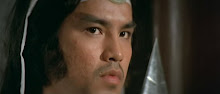
SANTO VS. DR. DEATH 1973 aka SANTO CONTRA EL DR. MUERTE aka THE MASKED MAN STRIKES AGAIN
Santo (himself), Carlos Romero Marchent (Paul), Helga Line (Sarah), Jorge Rigaud (Dr. Robert Mann), Antonio Pica (Peter), Mirta Miller (Susan), Maribel Hidalgo (Esther)
Directed by Rafael Romero Marchent
 The Short Version: The most Euro-centric of all Santo movies, this Mexican-Spanish co-pro has a mostly European cast--many of which will be recognizable to fans of Euro-westerns and Paul Naschy horror pictures. Aside from its pronounced Spanish flavor, the approach taken in this Santo spy outing is more adult than most--reinforced by a professional sheen (likely from more money pumped into it) not normally seen in the Mexican Lucha productions with their frequently playful comic book preference. One thing DR. DEATH does share with the South of the Border offerings is a wacky plotline, this one involving mad scientists, artwork forgeries, assassination attempts, a booby-trap filled castle, an acid vat of death, impressive stunts, and of course, wrestling matches. If that weren't enough, Santo considered this his best movie.
 The diabolical Dr. Death devises an elaborate plot to steal the world's famous paintings to amass the greatest collection of art the world has ever seen. This plan is accomplished by breaking into art galleries and defacing the canvas with a special acid created from tumors grown inside the bodies of captive women injected with the Doctor's poisonous formula. Having murdered and taken the place of the original art restorer hired to reconstitute the paintings, Dr. Mann, alias Dr. Death, keeps the original works, substituting them with the flawless forgeries created with the help of his equally evil nephew and sexy assistant Sarah. Meanwhile, secret agent Santo, already scheduled to wrestle in Spain, works with Interpol agents in Madrid to investigate after Velazquez's 'Los borrachos' painting has been damaged prior to its shipment to Mexico from the Museum of Prado. Fearing Santo will discover his plot, Dr. Mann sends assassins to eliminate him. In the interim, a female Interpol agent, Susan, infiltrates the castle to get information back to Santo and his assigned partner, Paul. Susan's identity is eventually discovered and Santo must penetrate Dr. Death's booby-trap infused castle to rescue her and the other abducted women.
 Santo is back in secret agent mode after the team-up with Blue Demon in SANTO AND
BLUE DEMON AGAINST DR. FRANKENSTEIN (released the month prior to DR. DEATH's Mexico release in November of 1974). Among its many distinguishable qualities is that it was the fourth of as many Santo pictures dubbed into English (the others being SANTO CONTRA LOS ZOMBIES ['62], SANTO CONTRA LAS MUJERES VAMPIRO ['62], SANTO EN EL MUSEO CERA ['63]). DOCTOR DEATH was also the third of as many co-productions with Spanish companies, the other two being the Colombian lensed spy capers SANTO FACES DEATH (1969) and MYSTERY OF THE BLACK PEARL (1971).
Santo is back in secret agent mode after the team-up with Blue Demon in SANTO AND
BLUE DEMON AGAINST DR. FRANKENSTEIN (released the month prior to DR. DEATH's Mexico release in November of 1974). Among its many distinguishable qualities is that it was the fourth of as many Santo pictures dubbed into English (the others being SANTO CONTRA LOS ZOMBIES ['62], SANTO CONTRA LAS MUJERES VAMPIRO ['62], SANTO EN EL MUSEO CERA ['63]). DOCTOR DEATH was also the third of as many co-productions with Spanish companies, the other two being the Colombian lensed spy capers SANTO FACES DEATH (1969) and MYSTERY OF THE BLACK PEARL (1971). In the vein of the hugely entertaining OPERATION 67 (1967) and its even more polished sequel, TREASURE OF MONTEZUMA (1968), SANTO VS. DOCTOR DEATH is arguably the most serious of the Santo spy era; and, according to the Silver Masked Man himself, his best picture.

Markedly different from any of the Mexican entries, this one resembles a Euro-cult film in nearly every way. If ever there was a Santo movie to convert European film fans to the wonders of Mexican superhero cinema, it's this one. Granted, any first-timer will find it difficult to take seriously a masked secret agent who wrestles professionally in between missions. The influence of Mexico's patron wrestling Saint cannot be denied. Both Italy and Spain had done their own versions such as the very entertaining SUPERARGO AGAINST DIABOLICUS (1966) and its lesser sequel.
Lacking the manic, "falls count anywhere" style of the more famous, flamboyant Lucha entries, DR. DEATH bypasses those films overly kid-friendly nature, injecting the genres paradigm with a dose of Euro-sleaze.
 Many times the Mexican entries recalled the classical style of fisticuffs found in the cliffhangers of the 30s and 40s-- and with possibly less resources to work with than the serials did. In SANTO VS. DR. DEATH, the action, as well as the entire film, has an identifiable, adult feel. The handling of the action by director Rafael Romero Marchent is arguably the best seen in the entire Santo canon, accompanied by an unmistakable level of professionalism. If only someone had reigned in the script before shooting began.
 Director (and co-writer) Marchent is partly to blame for the muddled (even by Lucha standards) screenplay that, if it were an amusing adventure, would feel at home in one of the Masked Man's more chaotic outings. The filmmakers manage to hold it together despite pushing the boundaries of credibility with the convoluted, if gruesome means behind creating the lethal, acid-like substance over a mere painting scam. Unlike dozens of other Santo adventures, the tone is dour and humorless; and unlike some of the others that take an earnest approach to the material, SANTO VS. DR. DEATH easily beats them all with higher than normal production values.
A familiar name to fans of Euroaters via a string of average western films, Marchent's sole Santo adventure is noticeably more enjoyable than many of his cowboy pictures--GARRINGO (1969) and SARTANA KILLS THEM ALL (1971) being two of the better examples. A shame Marchent didn't direct another Lucha film, or two. Or three.

 The closest approximation of DR. DEATH's quality to the Mexican financed Santo's would be the Cardona's back-to-back adventures shot in 1966, OPERATION 67 (1967) and its sequel THE TREASURE OF MONTEZUMA (1968). The differences between them are that the two Cardona movies have a more playful atmosphere versus the dark tone of Marchent's take on the material. Additionally, DR. DEATH feels less like James Bond than the two above-mentioned films that popularized Santo as a combination wrestler and super spy. They are similar in that they both feature Santo teamed up with another agent (here played by the director's brother, Carlos Romero Marchent); yet the playboy attitudes of Santo and his partner of the earlier pictures (there played by Mexican hunk master, Jorge Rivero) is missing in favor of keeping it strictly business.
Aside from the bizarre script, Marchent does manage to capture some exciting, often intense action scenes with the aid of Godofredo Pacheco's camerawork--a photographer who has contributed to a few cult items of interest. Pacheco seems to have had an eye for the Gothic, especially evident during the scenes in Dr. Mann's castle. It serves the film very well in the design of this unique entry in the Santo series.
 Pacheco, a Spanish DP, lent his talents to a variety of genres including westerns (Giuseppe Rosati's THOSE DIRTY DOGS [1973], the Bronson oater, CHINO [1973]), war movies (Leon Klimovsky's SEVEN INTO HELL[1968]), horror (Jess Franco's THE AWFUL DR. ORLOF and THE SADISTIC BARON VON KLAUS [both 1962], the Paul Naschy monsterfest ASSIGNMENT TERROR [1970]), and an Italian-Spanish Santo knock-off (SUPERARGO AND THE FACELESS GIANTS [1968]). Pacheco's photographic duties in the Santo arena was among his final credits, passing away at 55 years old in 1974.


 The closest approximation of DR. DEATH's quality to the Mexican financed Santo's would be the Cardona's back-to-back adventures shot in 1966, OPERATION 67 (1967) and its sequel THE TREASURE OF MONTEZUMA (1968). The differences between them are that the two Cardona movies have a more playful atmosphere versus the dark tone of Marchent's take on the material. Additionally, DR. DEATH feels less like James Bond than the two above-mentioned films that popularized Santo as a combination wrestler and super spy. They are similar in that they both feature Santo teamed up with another agent (here played by the director's brother, Carlos Romero Marchent); yet the playboy attitudes of Santo and his partner of the earlier pictures (there played by Mexican hunk master, Jorge Rivero) is missing in favor of keeping it strictly business.
Aside from the bizarre script, Marchent does manage to capture some exciting, often intense action scenes with the aid of Godofredo Pacheco's camerawork--a photographer who has contributed to a few cult items of interest. Pacheco seems to have had an eye for the Gothic, especially evident during the scenes in Dr. Mann's castle. It serves the film very well in the design of this unique entry in the Santo series.
 Pacheco, a Spanish DP, lent his talents to a variety of genres including westerns (Giuseppe Rosati's THOSE DIRTY DOGS [1973], the Bronson oater, CHINO [1973]), war movies (Leon Klimovsky's SEVEN INTO HELL[1968]), horror (Jess Franco's THE AWFUL DR. ORLOF and THE SADISTIC BARON VON KLAUS [both 1962], the Paul Naschy monsterfest ASSIGNMENT TERROR [1970]), and an Italian-Spanish Santo knock-off (SUPERARGO AND THE FACELESS GIANTS [1968]). Pacheco's photographic duties in the Santo arena was among his final credits, passing away at 55 years old in 1974.
 While it looks more like a Spanish movie in nearly every department, the Mexican roots are given room to grow in the form of three wrestling matches--one of which is integrated into the plot; said match being one of the handful of assassination attempts on The Holy. Instead of the usual sniper hiding out in the arena, it's Santo's in-ring opponent, who, in this mask vs. mask match, is intent on taking more from Santo than his iconic disguise.
 When he's not wrestling, Santo, and often his partner (played by the director's brother, Carlos Marchent), are regularly ambushed by Dr. Mann's killers in fairly well choreographed, hard-hitting, 70s style fights. Lacking the light-hearted nature of the Mexican entries, Santo blesses his fans with things never seen before or after in these rougher edged sequences. The best of these occur during the concluding showdown in and around the castle....

 After a literally explosive entry into Dr. Death's dungeon of doom, Santo dispatches many of the villains (one goes sliding down into the Doctor's flesh-melting acid pit), eventually giving chase to the remaining antagonista through the labyrinthine, trap-filled caves below the castle. Santo navigates various perils set for him including arrows, machine guns, and a wall of fire. The Silver Masked Hero is slowed down long enough to allow the villain time to escape via motorboat. But wait! High atop a precipice, Santo watches with nowhere to go but down; so Our Man Saint swan dives in a magnificent plunge that looks to be a 75 to 100ft drop. Santo swims over to another boat and the chase is back on; but it doesn't end there! After Santo's boat is filled full of lead it appears the bad guy is getting away.... that is till Paul shows up in a helicopter, giving Santo a lift with a rope ladder--leading to the best, likely most dangerous stunt ever seen in a Santo movie.
 It's not all a boy's playground in SANTO VS. DR. DEATH, either. The script adds a female spy in the shape of Sarah, played by the lovely Argentinian actress, Mirta Miller. She gets a very prominent, spicy role akin to the part played by Lorena Valezquez in SUICIDE MISSION (1971) and Irma Serrano in THE ROYAL EAGLE (1971). Spain further shows its colors by offering more stunning cheesecake alongside another beauty, Maribel Hidalgo. European film fans will know Miller from a handful of movies like DR. JEKYLL AND THE WOLFMAN (1972), COUNT DRACULA'S GREAT LOVE (1972), BATTLE OF THE AMAZONS (1973), VENGEANCE OF THE ZOMBIES (1973), and EYEBALL (1975) directed by Umberto Lenzi.
 You'll spot a wardrobe malfunction from Mirta Miller at just under the 70 minute mark. There appears to be a continuity error during this sequence, too. When Dr. Mann is called away while painting both Susan and Esther, they're wearing these flimsy nightgowns that barely conceals the milky white flesh underneath. In other shots, it appears there's some additional clothing covering them. Nudity was generally unheard of in Mexican movies, although some prints of OPERATION 67 got away a nude dance during the opening credits; and nudity in Spanish cinema wasn't allowed till the post-Franco period after 1975. Anyway, as Susan and Esther investigate the bowels of Dr. Mann's laboratory, they don't realize they're being watched. Upon discovering they've stumbled into a trap, the two ladies try to escape. It's here that one of Mirta Miller's breasts comes flying out of her barely-there gown in a 70s version of a nip slip.
 Outside of Mirta Miller's appearance, European genre fans will be delighted to see Helga Line among the cast as one of the main villains. Unfortunately, her character is woefully underwritten, but her appearance in a Santo movie is nothing short of refreshing. The German born beauty is best known from such meatier roles as Paul Naschy's satanic lover in HORROR RISES FROM THE TOMB (1973) and his devout follower in THE VENGEANCE OF THE MUMMY (1973); the leader of a village of vampires in THE VAMPIRE'S NIGHT ORGY (1974); and the sea-dwelling, reptilian terror of THE LORELEY'S GRASP (1974). She co-starred in other horror films, and genre work in sword and sandal, action-spy pictures, and westerns.
 Another aspect of this production that deserves mention is the music.
The lack of repetitive, misplaced jazz helps a lot in keeping the viewer
focused on what's going on. Gregorio Garcia Segura's cues, especially
his catchy main theme, are a welcome change of pace. The earlier B/W
Santo pictures had diverse scores in them, but as the series progressed
into the 70s, an overabundance of organ and jazz began permeating many
of the entries. Those scores (if you can call them that) seemed like
they were just laid over the film just so there would be a soundtrack.
Occasionally you'd hear a decent track, but for the most part, it was
something you'd hear in an elevator. Segura puts some life into
his compositions.
Another aspect of this production that deserves mention is the music.
The lack of repetitive, misplaced jazz helps a lot in keeping the viewer
focused on what's going on. Gregorio Garcia Segura's cues, especially
his catchy main theme, are a welcome change of pace. The earlier B/W
Santo pictures had diverse scores in them, but as the series progressed
into the 70s, an overabundance of organ and jazz began permeating many
of the entries. Those scores (if you can call them that) seemed like
they were just laid over the film just so there would be a soundtrack.
Occasionally you'd hear a decent track, but for the most part, it was
something you'd hear in an elevator. Segura puts some life into
his compositions. Missing almost all the local flavor of the Mexican series entries, SANTO VS. DR. DEATH is one of the most unusual pictures to feature Enmascarado De Plata. A lively caper with a bit of exploitation, the only real problem is a confused script wherein the villains means are more insidious than the ends they achieve. Still, even with its few faults, it's a shame there weren't more in this vein to balance the more famous comic book movies in The Saint's oeuvre. Rafael Marchent's stand-out effort is a genre heavyweight that could go two out of three falls with the best Santo cinema has to offer.
This review is representative of the IM Records DVD. Spanish language only.