Shot back-to-back with season three, the fourth season upped the violence and morbidity to a considerable level. Arguably the strongest of the quartet, it's unfortunate the series didn't continue for another run of episodes. Romero and Laurel did move on to another series, MONSTERS, that ran from 1988-1990. With the success of TALES FROM THE DARKSIDE (a movie version came in 1990), the producers attempted another horror-styled series, only that one never got off the ground. As for DARKSIDE's 4th, the subjects varied, as did the tone of the TALES. Some big names were on board as writers and directors, and the results were sometimes horrifying... as the following list attests.
Beetles (originally aired September 27th, 1987)
"The mummy is dead but the curse is alive!"

Specializing in collecting centuries old Egyptian artifacts, Archaeologist Arthur Hartley has uncovered a mummy believed to contain priceless jewels. Hammid Bey warns Hartley to return the sarcophagus, containing the mummy of a cursed temple virgin bearing the symbol of Kef-Rah, a Beetle God; if he doesn't, he will suffer under the same curse.
 The 4th season opener is as deadly serious as the previous seasonal flagship episodes. The first of two mummy motifs (the other, comedic one stars Arnold Stang), this one discards the traditional shambler coming to life in favor of a living curse of the title insects. If you recall the gruesome fifth tale of CREEPSHOW (1982), you can guess how this one goes, only with less spectacular FX. There are a few other characters on hand, but basically, this is a one-man-one-locale segment. It's not as suspenseful as it could be, but Bryan Moore's mummy design is hideous enough.
Robert Bloch wrote the teleplay from his own story of the same name, first featured in the December issue of Weird Tales from 1938. This would be Frank De Palma's last episode of DARKSIDE he would direct.
No Strings (originally aired October 25th, 1987)
 Mafiosi Eddie Minelli has finally gotten revenge after 18 years on Fat Paulie, a former business associate who had his hands in way too many pies somebody else baked. Minelli hires a famous puppeteer, Aldo De Calasuro, to help him celebrate the occasion with a morbid marionette act using Paulie's bullet-riddled body as the puppet.
A prime example of DARKSIDE utilizing a single location to its advantage, 'No Strings' is one of the most unpleasant episodes of the series. In the EC tradition, writer and director David Odell employs only the darkest of amusement in his tale of revenge from beyond the grave. Strangely, the retribution is meted out by a less than honorable character. T.J. Castronovo makes a great mobster with a truly sick sense of humor.

Director Odell penned the 80s Fantasy movies, THE DARK CRYSTAL (1982), SUPERGIRL (1984), and MASTERS OF THE UNIVERSE (1987). T.J. Castronovo produced nearly half the series run. 'No Strings' was his only acting gig on DARKSIDE. The actor directed two episodes as well.
Payment Overdue (originally aired February 14th, 1988)
"Things must be balanced so the dead can rest."

Jeanette Simpson lives in a snazzy NYC apartment. She is a new worker at Sentinel Collection Agency. Delighting in the misery of those who cannot pay their bills, she begins receiving strange calls on her private line from Rita Valdez, a woman who had committed suicide for being so far in debt.
 Richard Brenner wrote two DARKSIDE episodes--the other being 'The Swap' from the previous season. 'Payment Overdue' is a similar story in its context; a superlative example of 'Just Desserts' wherein a callous woman is forced to swap places with a lady whose death she inadvertently caused. Jeanette (played with the right amount of cold-hearted candor by Maura Swanson) is written as both a spiteful bitch and, as she tells it, a woman raised to be independent and self-sufficient. She says things like, "there are no real sad stories, only leeches... pretending". Then elsewhere she's boasting of getting an absent-minded client to use post-dated checks so as to threaten him with check fraud. The problem with this script is that it portends everyone who makes it on their own is a heartless and self-centered while those living on welfare are all noble, sad stories. Neither is true, but within this universe, it makes for a good ghost tale.
Love Hungry (originally aired February 21st, 1988)
"Your weight is over... no gimmicks, just guarantees".
 Betsy Cowland loves food; she can never seem to stop eating. After a blind date with a former classmate, Betsy makes it her mission to shed some pounds. Unable to do so on her own, she tries Weight Away, a mysterious new diet plan made up of an ear-piece and a pair of glasses... both of which have bizarre side-effects enabling you to lose weight and keep it off.... forever.
One of the most disturbing DARKSIDE tales ever conceived contains some of the blackest comedy imaginable. An incredibly grotesque story of a fat woman so desperate to lose weight, that her last resort results in her death... after her food comes to life and begs her not to eat them! 'Love Hungry' distinguishes its cruelty by literally torturing its main character whose only crime is loving food.
 What's even more bizarre than this episode is the story by Roberts Gannaway (adapted into a teleplay by director John Strysik), a writer who went from his sole small screen horror credit to a lengthy career at Disney. His work on DARKSIDE is the flip-side of his prolific kid-friendly work with animated animals; here it's talking nourishment in the form of muppet fruits and fridge food. 'Love Hungry' is food for thought (the original title of Gannaway's short), never wasting any of its potential.
The Apprentice (originally aired May 1st, 1988)
"Please remove everything... no sign of the 20th century allowed."
 Sarah McBride gets a job at Colonial Village where the 17th century comes alive in 1986. Believing she's being hired for a tourist attraction promoting the life and times of the Puritans, she is unknowingly transported back to Salem in 1692 where she's accused of being a witch.
 Eleanor Gaver directs a tale of dire culture clash from a teleplay by Ellen Sandhaus. There's a modicum of suspense built you don't need to be a clairvoyant to know this young, out-of-time lady isn't going to come to a good end. The big reveal during the conclusion makes the whole story more substantive. Sandhaus's script is a mini-diatribe against oldeworld theology branded with the motto, 'you must do evil to do good'. It's an interesting premise although the lead actress isn't entirely likable, but isn't a heretic, either.
There's a funny scene at the beginning when Sarah (Haviland Morris of SIXTEEN CANDLES and GREMLINS 2: THE NEW BATCH) says to her "employer", Thomas, "I love the past, don't you?" He agrees with a 'yes', accompanied by a sly, ironic smile as he flips a light switch and a small bulb in a candle turns on.
The Cutty Black Sow (originally aired May 8th, 1988)
"And the fire burned through the night on All Hallows' Even... the fire that kept away the Cutty Black Sow. Kept it away from any soul who died on that witches' night...."

Little Jaime's great grandmother, a native of Scotland, is on her death-bed. Before she expires she warns Jaime of the Cutty Black Sow and how to protect himself and his family from this Scottish demon. Requiring he assemble a series of stones, the only way to keep the monster away is by keeping the marked stones within a circle of fire. However, should one of the stones ever leave the circle, that person is doomed.
Hands down the scariest episode of DARKSIDE to ever creep onto the airwaves. Curiously, this segment--taking place the day before and on Halloween--didn't debut in the more appropriate month of October. Ed French (assisted by Ken Walker) created the title pig from hell.
 Based on Thomas F. Monteleone's 1984 short story of the same name, the
folkloric monster is of Welsh origin, but changed to Scottish for this
episode. The old lady's diction of "All Hallows' Even" is said to be the Scottish pronunciation. Michael McDowell's adaptation of Monteleone's story follows the legend closely, deviating from some details. According to the superstition, villagers would burn big bonfires on Halloween and throw marked stones in them. When the fire down, the revelers would run for their lives to avoid being snatched by the Devil Pig, a female sow with red eyes, walking upright, roamed the countryside seeking souls to collect. The next day they would search for their stone; if it was still within the circle, good luck came to them--if it was missing, bad luck or death was in their future.
Based on Thomas F. Monteleone's 1984 short story of the same name, the
folkloric monster is of Welsh origin, but changed to Scottish for this
episode. The old lady's diction of "All Hallows' Even" is said to be the Scottish pronunciation. Michael McDowell's adaptation of Monteleone's story follows the legend closely, deviating from some details. According to the superstition, villagers would burn big bonfires on Halloween and throw marked stones in them. When the fire down, the revelers would run for their lives to avoid being snatched by the Devil Pig, a female sow with red eyes, walking upright, roamed the countryside seeking souls to collect. The next day they would search for their stone; if it was still within the circle, good luck came to them--if it was missing, bad luck or death was in their future.
Do Not Open This Box (originally aired May 15th, 1988)

 Charles Pennywell an inventor and junkman who runs a shop with Ruth, his nagging, greedy wife. Finding a box that was left by mistake, Ruth grabs it and opens it despite the words, 'Do Not Open This Box' on the lid. Finding nothing inside, she tosses it aside. Moments later, a deliveryman shows up looking for that very same box. Feigning to not know where it is, Ruth lies and promises the deliveryman they'll look for his misplaced box if he does something in return.... for Ruth, her gluttony and deception comes at a price.
 Jodie Foster's directorial debut is a witty number that puts a spin on the ole Devil-as-Soul-Collector plotline. Writers Franco Amurri and Bob Balaban have fashioned a 'Just Desserts' Tale worthy of Rod Serling but with a modern, Spielbergian touch to it. Eileen Heckart is a wonderfully intemperate hag whose whole life has, by her own estimation, been wastefully spent with her husband who has never aspired for anything more than being a junkman longing to invent a useful device. By episode's end, he does indeed invent something that comes in handy for the supernatural deliveryman. The show closes on a delightful note wherein Charles is about to finally enjoy a slice of life... and, in a final bit of metaphoric humor, a piece of Devil's Food Cake.
Family Reunion (originally aired May 28th, 1988)
 Robert Perry has left his wife Janice and taken their son with him, claiming the boy needs to be cured of some illness. Portending he's kidnapped and abusing their son, Janice puts child's services and the police on their trail. But what's ailing Bobby runs in the family.
Tom Savini's third and last of his DARKSIDE directed segments is another monster-centric showcase. Yet again, Savini shows the same deft hand in the director's chair as he did creating monsters and slasher victims. After helming stories on midget closet creatures and Halloween goblins, Savini turns his attentions to a Lycanthropic family affair. One of the finest episodes of the series, the teleplay by Edithe Swensen gives away the boy's deadly "sickness" early on, but throws a curve-ball your way towards the conclusion.

Savini created the makeup FX with Mike Maddi (who worked on two other entries and several movies like FRIDAY THE 13TH: THE FINAL CHAPTER) applying it. Patricia Tallman, Barbara in the remake of NIGHT OF THE LIVING DEAD, plays Janice Perry. Fangoria #47 and a poster for CREEPSHOW (1982) puts in cameo appearances.
Tales of Missed Opportunities: The Dotted Line
The Deal (Originally aired February 28th, 1988)
"I'm the real stuff... and the Devil can do anything he wants... for a price."
 A
struggling writer named Tom Dash would do anything to make it in
Hollywood. Living in a low-rent apartment building, his neighbor,
Donald, promises him success if only he'd sign over his soul to him.
A
struggling writer named Tom Dash would do anything to make it in
Hollywood. Living in a low-rent apartment building, his neighbor,
Donald, promises him success if only he'd sign over his soul to him.
Another
'Sell Your Soul To the Devil' scenario. Akin to season two's 'Printer's
Devil', but not nearly as witty, it took two writers for this do-over.
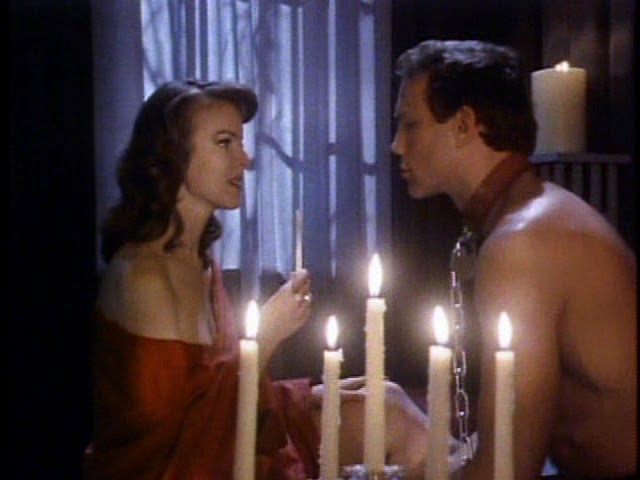
Allen Garfield's interpretation of Old Scratch is different from the
norm--disguising himself as a few different characters; occasionally
sporting Devil horns and a ridiculous tail that curls upward from
underneath his robe. Unlike the above-mentioned, similar episode from season two, the ending here is predictable. A decent entry, only a derivative one.
Producer T.J. Castronovo (the gangster from 'No Strings') sits in the director's chair for his second time on DARKSIDE.
Tales of Missed Opportunities: Hell To Pay
The Yattering and Jack (originally aired November 8th, 1987)
"He broke rule #1... you mustn't touch the damned until they are damned, so now he's mine!"

A midget demon attempts to drive Jack Polo, a pickle salesman, insane and steal his soul on Christmas; only he fails miserably. The demon summons Beelzebub as to how to proceed, but Jack proves a bit too smart for the pint-sized hellion. Forcing him to inadvertently break one of Hell's Commandments, the Yattering becomes Jack's slave.
 There's a really funny story buried beneath one of Darkside's most disappointing episodes. Barker adapted the teleplay from his own short story from his Books of Blood volume 1 first published in 1984. Barker wasn't satisfied with the result since there's much more sexuality in his material that didn't make it to the television version. Regardless, there's plenty of his patented S&M imagery on display. Both the Yattering and Beelzebub wear studded collars (the sound of whips can be heard when ole Beel' appears!). The demon's reasoning for snatching Jack's soul is poorly written, with barely an explanation during the final moments. The turkey dinner that comes to life is a series low-point. 'The Yattering and Jack' is one of those instances where the printed page fails at being ported over to the visual medium.
Originally intended as the Christmas episode for season three, it was
replaced by the superior and scary 'Seasons of Belief' while the 'Yattering' yuck-fest was
bumped up to season four.

With the end of TALES FROM THE DARKSIDE's fourth and final season, this brings our look back at this popular TV series to a close. But never fear.... "The Darkside is always there--waiting for us to enter, waiting to enter us.... so until next time, try to enjoy the daylight!"