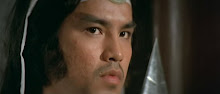
OSHI SAMURAI -- KIICHI HOGAN (THE MUTE SAMURAI)
KUCHINASHI NO KOMORIUTA (A SILENT PRAYER FOR A LITTLE BOY) ***
Tomisaburo Wakayama (Kiichi Hogan), Shintaro Katsu (Manji), Taichi Kiwako (Osayo), Tomikawa Masahiro (Sankichi)
Directed Kimiyoshi Yasuda
 Hogan befriends a little boy named Sankichi after his father is found murdered in the street. The bounty hunter finds an admissions pass to a wealthy foreigners mansion in Gotenyama on the dead man's body. Hogan investigates as to who, and why the man was murdered. Crossing paths with Manji again, Hogan learns the dead boy's father, Inokichi, was involved in underworld activities and also that Manji is somehow connected. The mysterious character informs Hogan that there are two foreign mansions in Shinagawa -- one owned by Espinoza and the other by Gonzales, the Spaniard Hogan has been tracking.
 Episode two picks up with Hogan carting off a dead bounty. Having a drink in a local tavern, a set up is introduced that's familiar to anyone who has seen any of the Zatoichi movies. Hogan, with a distraught local woman in tow, is saddled with taking care of a little boy in between tracking his Spanish quarry.
 Unfortunately, Kimiyoshi Yasuda's direction never rises above standard small screen genre conventions. It's not bad, just nothing you haven't seen before, although there are some things here that make the episode worthwhile in the end.

 However, the episode is hampered by a few key scenes involving Anglo actors, and one glaring flub during the conclusion. Japanese productions never seemed all that interested in obtaining good foreign actors, or even those who could look convincing in action scenes. Toshio Taniguchi's swordplay scenes have little impact in this respect, but look superlative when it's Japanese vs. Japanese. What does work, and will be the major selling point for viewers, is the interaction between the two offscreen brothers, Wakayama and Katsu.
 Takaiwa Hajime's script is merely a retread of any number of the aforementioned Zatoichi adventures, but with a far more serious slant. The tone is not quite as grim thanks in part to Hogan's little dog playing an important role in the narrative here. Aside from that, the script covers some ground regarding peasant villagers falling into criminal organizations and unable to get out. It also succeeds in progressing the storyline, albeit modestly. The one plot point that proves the most interesting of all doesn't even revolve around Wakayama's temporarily surrogate samurai.
Manji (Katsu) gets a bit more screen time here; and his character unravels as some sort of Japanese Zorro. And like Zorro, Manji leaves his mark wherever he goes. His name refers to the sign of the swastika -- a symbol from many ancient civilizations in Europe and Asia with favorable connotations. It's more widely recognized as emblematic of Germany's Nazi party where it represented anything but noble implications.

Wakayama further diversifies himself from his famous Ogami Itto character. He's often just as stone-cold in his countenance, but even without saying a word, he effectively conveys emotion -- especially towards children. If anything, this episode does push this nuance ahead, which will come in handy in some of the more outright shocking later episodes. And while he's a mute, we do get to hear Wakayama's voice from the perspective of his subconscious.
 Taichi Kawako was a lovely actress, and a familiar face having starred in Kaneto Shindo's KURONEKO from 1968. She also starred in Katsu's ZATOICHI IN DESPERATION (1972) and Kenji Misumi's THE LAST SAMURAI (1974). She plays the neighbor to the dead Inokichi character. Her Nancy Drew antics put her in danger in trying to locate his murderer. To further complicate things, she's initially unaware her husband belongs to the Yakuza cell that had Inokichi killed for trying to leave the group.
 Japanese cult film fans will recognize Willie Dorsey as Espinoza's servant, Bali. He featured in Nipponese genre product such as Jun Fukuda's undeservedly obscure action-gore epic ESPY (1974) and Toshio Masuda's unremittingly grim PROPHECIES OF NOSTRADAMUS (1974). The former was one his more memorable appearances wherein he has his tongue psychically ripped out while trying to have his way with a Japanese woman.
Despite the familiarity of the material, director Yasuda was, and is known for some spectacular examples of Japanese cinema including the likes of DAIMAJIN (1966), some of the SLEEPY EYES OF DEATH series, 100 MONSTERS (1968), and a handful of memorable Zatoichi productions.

 Aside from some minor moments and scripting details that do more for later episodes than this one, the second episode falls short of the Katsu directed series starter. That doesn't make it a bad episode, mind you, it's just a standard programmer from a top shelf director. However, the violence heats up in the next episode; and one from a much celebrated filmmaker.
You can buy volume 1 HERE. It contains both episodes 1 and 2.
To be continued in episode 3: THE DANGEROUS HIGHWAY!!!