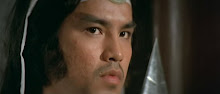
Gary Busey (Buck Matthews), Yaphet Kotto (J.B. Deveraux), William Smith (Blade), Seymour Cassel (Sheriff Copeland), Bert Remsen (Father Healey), Denis Galik (Christie), Jorge Gil (Jamie)
Directed by Richard C. Sarafian
The Short Version: EYE OF THE TIGER is a gritty 70s exploitation plot trapped in a 1980s action hero body. Lead Tough Guy Gary Busey doesn't exactly dredge up imagery of masculinity, but his working class hero fits perfectly within the time period. Busey's everyman style makes for a believable Nam vet pushed to the limits of all your finer revenge flicks; and with William Smith as the nasty biker leader bad guy, it's like a homecoming for the 70s icon and motorcycle king even if the bikes of choice are of the dirt racing variety and not the chopped up sort of the biker movie era. With such a promising pedigree, it's never as good as it could be. The EYE has it, but often loses sight of its purpose in this mid level machismo movie from the director of MAN IN THE WILDERNESS and VANISHING POINT.
 After spending time in prison, former Nam vet Buck Matthews returns home on parole to find his town overrun by a sadistic drug-running biker gang. When Buck shows the gang he isn't one easily walked over, they return fire by murdering his wife before repeated attempts to take him out, too. With a corrupt sheriff useless in stopping the oppressive killers, Buck and his cop friend J.B. decide to take the law into their own hands to see that justice is done.
 Coming ten years too late, this 70s throwback pits an ex-con Vietnam vet against sadistic drug dealers who have taken over his hometown in his absence. The fantastic premise is a bumper crop of exploitation gold, only director Sarafian misses the mother lode entirely. As fun as it occasionally is, it's a mostly vapid affair that never seems comfortable with itself. Just when you think it will cross the line, the reigns are pulled in. Possibly jaded from the vicious nature of similar films from the previous decade, EYE OF THE TIGER is an entertaining homage, if only an empty shell of grittier fare like WALKING TALL (1973) and THE NO MERCY MAN (1973).
 Gary Busey was off to what seemed like a good start playing Tough Guy lead roles in this. By the following year in 1987, he was playing one of the main villains in box office smash LETHAL WEAPON. Despite playing a man pushed too far in TIGER, Busey never quite goes totally of the deep end considering he's been through hell in the jungle and at home. He's surprisingly reserved, letting subtle emotion shine through on a few occasions. As an ill-treated everyman, he's believable enough, yet the script never brings him into John Rambo territory. However, his magnum opus as a screen Tough Guy came as the man called BULLETPROOF in 1988; a jaw-droppingly over the top film that also featured William Smith as one of the Russian villains. Which brings us to....
 The participation of William Smith is a welcome addition to any movie he graces with his presence; but unfortunately, much like Sarafian wastes the sleazy potential in the script, he wastes Smith in the role of Blade, too. The vicious leader of the drug gang, we barely see him at all, nor is he given much to say. He has one major dialog sequence and is likewise underused during the explosive climax. The fight between Blade and Buck is a major letdown considering how brutal the bad guys have been up to this point. It's just not a satisfying revenge. Smith and Busey worked on Lamont Johnson's THE LAST AMERICAN HERO thirteen years prior in 1973.
The drug-running bikers under Blade's command are a brutal bunch. It's one of the few things in Michael Thomas Montgomery's script that's suitably elaborated on. Their itinerary consists of drive-by shooting in broad daylight, raping, and violating graves. Technically these guys aren't a biker gang, they just happen to ride them. These guys ride dirt bikes, so don't expect the chopped up sort of the classic biker movie period of the late 60s and early 70s.
The following year, Montgomery would pen another piece of throwback cinema with ROLLING VENGEANCE (1987); which was basically WALKING TALL (1973) with a modified monster truck.
 William Smith is famous for many things, one of which is his association with the biker film genre. Busey had a brief fling with them in Joe Viola's ANGELS HARD AS THEY COME back in 1971. In that picture, he played a hippie. Two years after EYE OF THE TIGER's release, Busey would have a near fatal motorcycle accident resulting in a fractured skull and purportedly permanent brain damage.
Aside from the sanitized sleaze, there's some inspired moments such as a wire decapitation, a rallying speech from Busey (in a Bingo Hall with a bunch of old folks!); and the highlight, a weapons laden pickup truck with bulletproof glass, guns and grenades that comes courtesy of Buck's devoted prison friend, the friendlier, seemingly benevolent drug dealer, Jamie. Speaking of which.....
 EYE OF THE TIGER isn't the type of movie to make statements, yet it does open with a fantastic bit of visual subtext. Buck is on his way out of prison along with a cellmate, an Hispanic Candyman named Jamie. Looking a bit like Al Pacino, he puts on his white suit and Rolex while Buck does the same with his blue jeans, checkered shirt, and old pocket watch. Jamie has a fancy ride and chauffeur awaiting him while the only thing waiting for Buck is the open road. The two men struck up a friendship after Buck saved Jamie somehow or other so we're told. Wishing to return the favor, Buck isn't interested, but the man persists. Buck isn't the type of guy that expects favors, but his unlikely friend, having ample streams of revenue, decides to repay him with a unique gift in the form of the heavily armed pickup truck mentioned above.
We never see the Jamie character again, but it's safe to say the reason he was so willing to help Buck get rid of Blade and his motor-psychos is to close down the competition.
Yaphet Kotto adds some additional star power as Buck's cop friend on his way to retirement; and torn between losing his pension or helping his friend. Like William Smith, Kotto's character could have done with a bit more screen time.
Never quite going the distance, EYE OF THE TIGER is an average revenge movie that has a damn good build up, but a vacuous finale with little emotional payoff. Probably saddest is that it's a nice start for Busey as a big screen Tough Guy that fizzled out too quickly. Fans of Sarafian's VANISHING POINT (1971) should definitely see it for comparative purposes; or if it's a more nature based instance of macho cinema you seek, check out Sarafian's MAN IN THE WILDERNESS (1971). Those with a fondness for the earlier pictures EYE OF THE TIGER emulates will likely wish to revisit those better times. And those movies.
This review is representative of the Shout! Factory 2 disc set paired with EXTERMINATOR 2 (1984). ALIENATOR and CYCLONE (both 1987) are on the other disc. Extras and Specs: 1.85:1 anamorphic widescreen (for EYE OF
THE TIGER). All other titles are anamorphic. Audio commentary on EXTERMINATOR 2.
Rod Taylor (Chuka), Ernest Borgnine (Sgt. Otto Hahnsbach), John Mills (Colonel Stuart Valois), Luciana Paluzzi (Veronica Kleitz), James Whitmore (Lou Trent), Victoria Vetri (Helena Chavez), Louis Hayward (Major Benson), Michael Cole (Spivey), Marco Antonio (Hanu)
Directed by Gordon Douglas
"I'm goin' down to the stable, I'm gonna get my horse and I'm gonna ride outa' here just like I came in! And I'll kill the first man who tries to stop me... and I'll get an even half dozen before you get me."
The Short Version: Rod Taylor is the title wanderer who ends up at a fort populated by misfit soldiers and a cadre of other characters awaiting their fate from hungry Arapahoes plotting an all-out assault. The picture could have been quite spectacular, but the cramped sets and what appears to have been a production starved budget keep CHUKA confined to the brig. Richard Jessup adapts his own novel, populating the limited space with errant, oftentimes less than honorable characterizations throughout his riveting script. An overzealous amount of testosterone keeps the film alive, though, and much of this man fuel comes from the rugged ambiance written and Taylored for Rod.
 In 1876, Chuka, a well known gunman, and the occupants of a stagecoach are stranded at Fort Clendennon, a Calvary outpost maintained by a small number of outcast soldiers led by the displaced and drunken Colonel Stuart Valois. With an attack by an overwhelming number of starving Arapaho Indians inevitable, Chuka warns the Colonel to evacuate. However, the Colonel refuses, only revealing his reasons once it's too late.
 CHUKA (pronounced Chuck-a) is the sort of movie where guys can beat the hell out of one another and bond over it; it's the kind of movie where guys can down a bottle of Tequila, kill a few attacking Arapaho's, then kick back and get liquored up on another bottle of Tequila knowing they will likely die a short time later; it's the type of movie where guys on opposing sides can have mutual respect for one another even if they're trying to kill each other. It's also a damn good western weak in some areas (not a lot of action) and heavily fortified in some others (a lot of exposition).
 Rod Taylor makes his mark in macho movies with this gritty, sweaty siege western. Having played more relaxed, mannered heroes in past pictures, Taylor was swerving into new territory; and it was a direction the actor wished to go. Coming during a transitional period when the American oater was influenced by the dirtier machinations of the European west, CHUKA is an entertaining, if routine assimilation. It brings nothing new to the table that hasn't been done in hundreds of other westerns, but Taylor (acting as not only star, but co-producer, and uncredited scripter) makes the formula smoke and bubble with fervor; not only him, but the rest of the cast are a menagerie of stock characters who are given an unusual amount of personality to maintain interest considering a surprising lack of big action set pieces.

 With so much exposition, it's like you're watching a stage play at times; and the limited, cramped, and unrealistic sets reinforce that notion. The bulk of the movie is shot on interiors with little variance in camera placement. For instance the camera rarely leaves the right side of the fort. Most westerns rely heavily on location shooting, and there's very little of it in CHUKA. An unusual move on the part of the producers, and possibly a budgetary one. Oddly, the opening credits manages to cram a number of shots showing Earth's natural wonders about to be draped in snow before switching to the films reliance on interiors.
Richard Jessup's screenplay (from his own 1961 novel) draws some remarkably interesting characters--all of which are flawed in some way. Virtually everyone has some sort of checkered past that's revealed just prior to the downbeat finale where the bulk of the action is reserved. For approximately 40 minutes the audience learns far more about the cast trapped inside Fort Clendennon than you would in a typical action picture. This is the films strongest suit.
 Chuka is written like a grizzled, rough-hewn version of a John Wayne character. Incredibly fast with his gun, Chuka is something of a legend who gains the respect of the Arapaho, although this respect between he and the Indian chief Hanu doesn't mean neither man would lose it if they had to kill one another. A burly, quick-witted character, Rod Taylor wears the role comfortably; with the ease that he draws his sidearm. Taylor seems to have poured a lot of himself into the role. Unfortunately, his devotion to the project didn't translate in ticket sales.
 Ernest Borgnine is equally magnetic as Hahnsbach, the doting, loyal sergeant to Colonel Valois. You don't learn just why he worships the Colonel the way he does till near the end. Meanwhile, the sarge takes great umbrage with the lack of respect shown Valois by Chuka. Warned not to prod him, Hahnsbach ignores warning and tests Chuka's constitution to the point you know the inner caveman of both men will eventually come to the surface. When it does, it's one of the films memorable moments....
 After another heated conversation with the Colonel where Chuka intensely flaunts his superiority, Hahnsbach, in an attempt to save face for his Colonel, challenges Chuka to a brawl. He graciously obliges and the two engage in deep conversation where their fists do all the talking. The fight ends in both men--noticeably exhausted, bloodied and bruised--gaining respect for one another. This instance of male bonding is the same as if they'd been toasting over beer in a pub, only this ale is paid for with bruises and bloody lips. It's the sort of machoistic camaraderie you didn't often see in American actioners; and when you did see it, it was labeled homoerotic. There's nothing homoerotic about it.

Male bonding is a big part of CHUKA's script. You'll see it elsewhere between Chuka and Lou Trent (James Whitmore; see above), the alcoholic Clendennon scout who might be long in the tooth, but a gruff, elder Tough Guy just the same. He and Chuka share a moment by throwing knives at each other; then bonding over large bottles of Tequila. The theme of masculinity is strong with this one, and one strand of it takes a different approach.

 It's a slow build, but by the mid point, Colonel Valois takes notice of Chuka in a way that, at times is one of frustration, and admiration at others ("you do intrigue me"). We're not really sure till approximately 85 minutes into the movie what curious secret(s) Valois carries with him. He reveals one of them to Chuka, but another, more devastating secret is unveiled by Hahnsbach when asked why he sticks with the Colonel like a puppy dog. Without revealing what that is, earlier in the picture, Valois takes immediate notice of Senorita Kleitz (Paluzzi). There's a palpable feeling that the Colonel, when not preoccupied with liquor, desires to be in the presence of this woman--which he does. The Colonel's face is, for a brief time, lit up like a young boy spying the new girl at school. But upon the realization that she and Chuka have shared a past together, he begins to see in Chuka what he can never, nor no longer be.

It's a man's world in CHUKA, but the women figure into it. The relationship between the title gunman and Luciana Paluzzi's elegant Senorita Kleitz is touching, if doomed to fail; she dropped him for a wealthier man years earlier, and this time, their future is impeded by an impending assault by the entire Arapaho nation.
 Victoria Vetri (as Angela Dorian) is likewise promised elsewhere, but shows Chuka she's certainly interested in his manhood. Vetri is almost unrecognizable with so many clothes on; she would strip them off in September '67 for Playboy (CHUKA came out in July), and become their Playmate of the Year in 1968. Following in the footsteps of Raquel Welch, she went to where the dinosaurs are in WHEN DINOSAURS RULED THE EARTH (1970). She dropped off the celluloid radar in the early 1970s; and in 2010, was arrested for shooting her husband. She is currently serving a 9 years sentence for attempted voluntary manslaughter.
 The only other woman in the movie is a captured Arapaho ("prettier than the last one"), a secret lover to Major Benson; a sex slave might be more accurate. Anyway, just before the siege begins, he tries to get her to leave, displaying some emotional attachment to her. Before she exits she leaves a knife in the Major's back, and sets fire to the fort to make things easier on the approaching Arapaho horde. Mistakes made by Fort Clendennon's gaggle of outcasts not only put them there, but proves to be their downfall.
Gordon Douglas, that THEM! (1954) guy, helmed two other macho westerns of interest with RIO CONCHOS (1964) and BARQUERO (1970). The former was Tough Guy Jim Brown's first movie role. The latter would pit two perennial hard bastards, Lee Van Cleef and Warren Oates against each other in a film that showed Americans could make as sweaty an oater as the Italians.
 CHUKA would lose quite a lot of its scripted violence while retaining a stripped down version of the roll in the hay between Taylor and Paluzzi. Possibly the foreign releases yielded stronger footage if the racy production stills are anything to go by. The ending seems to have been the most problematic for censors, yet a few bits of gruesome business survive even
if much of the brutality and harsh language was either toned down or
removed entirely. Jessup's script was largely faithful to his novel, adding a past relationship between Chuka and Veronica Kleitz and eliminating the original ending, settling on a more ambiguous one.
CHUKA would lose quite a lot of its scripted violence while retaining a stripped down version of the roll in the hay between Taylor and Paluzzi. Possibly the foreign releases yielded stronger footage if the racy production stills are anything to go by. The ending seems to have been the most problematic for censors, yet a few bits of gruesome business survive even
if much of the brutality and harsh language was either toned down or
removed entirely. Jessup's script was largely faithful to his novel, adding a past relationship between Chuka and Veronica Kleitz and eliminating the original ending, settling on a more ambiguous one.

BONNIE & CLYDE (1967) hadn't riddled theater screens with its violent imagery, nor had THE WILD BUNCH (1969) rode into town for their bullet ballet. Hollywood was in a transitional stage influenced largely from real events of the time period. Like all genres, the western adapted to these changes and adopted some European flavor at the same time. CHUKA has no Italian seasoning in its recipe, but signs of a more violent edge simmered.
 It's not that well known a movie, but a fantastic showcase for Rod Taylor whose Tough Guy persona would blossom in the macho masterpiece DARK OF THE SUN (1968) and continue its growth with the underrated crime thriller DARKER THAN AMBER (1970). Alamo-ish in its siege scenario, CHUKA is fairly dynamic in the way it utilizes its routine Cowboys and Indians aesthetic--by spending an unusual amount of time with its characters, making them flawed, sometimes deceptive individuals while presenting us with their grim prospects.
This review is representative of the Paramount DVD. No extras. 1.85:1 anamorphic widescreen.
copyright 2013. All text is the property of coolasscinema.com and should not be reproduced in whole, or in part, without permission from the author. All images, unless otherwise noted, are the property of their respective copyright owners.