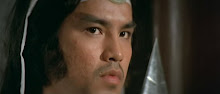
Chuck Norris (Scott James), Karen Carlson (Justine), Lee Van Cleef (McCarn), Art Hindle (A.J.), Tadashi Yamashita (Seikura), John Fujioka (Isawa), Kurt Grayson (Doggo), Richard Norton (Kyo/Longlegs), Yuki Shimoda (Katsumoto), Gerald Okamura (Instructor), Aaron Norris (Hatband)
Directed by Eric Karson
The Short Version: Chuck's fifth major role is his most ambitious up to that time about ninjas training recruits for an international terrorist ring. Fight scenes are generally impressive even if the storyline is just too damn big to be pulled off as successfully. Karson's film is enjoyable enough, but often feels like a more violent than usual television miniseries edited down to 100 confusing minutes. Some viewers might be irritated by the onslaught of half-rendered characters and ideas in what could have been Chuck and Van Cleef kicking ninja ass, but instead prefers being Bond on a budget.
 Former martial arts competitor Scott James discovers that ninjas are alive and well in the 20th century after he is attacked by several of them upon accompanying a dancer home from a show. Having been trained in the art since childhood by an adoptive Japanese father, James believes his step-brother, Seikura, must be responsible for training the black-clad killers. Meanwhile, mercenary McCarn attempts to recruit Scott to take down a terrorist organization located in South America where applicants are trained to be assassins.

 Chuck Norris differed from many of his colleagues and contemporaries in
that he fought a variety of villainous types, and not just your standard
America-hating terrorists and drug kingpins. Perusing his resume, one
can point out, "Oh, that's where Norris was turned into Indiana Jones"; to "this is where Norris went up against an indestructible slasher"; or "isn't that the one where Chuck plays a shape-shifting mountain man?"; and "yeah, that's that time Chuck battled it out with demons from Hell".
For THE OCTAGON, this is the one where Chuck rumbles with ninjas.
Chuck's varied oeuvre would seemingly rub off on some of his Tough Guy
colleagues over the years -- Schwarzenegger ended up battling the Devil
and Rambo was once plotted to do battle with a genetically engineered
monstrosity in a fifth entry that never came to fruition.
Chuck Norris differed from many of his colleagues and contemporaries in
that he fought a variety of villainous types, and not just your standard
America-hating terrorists and drug kingpins. Perusing his resume, one
can point out, "Oh, that's where Norris was turned into Indiana Jones"; to "this is where Norris went up against an indestructible slasher"; or "isn't that the one where Chuck plays a shape-shifting mountain man?"; and "yeah, that's that time Chuck battled it out with demons from Hell".
For THE OCTAGON, this is the one where Chuck rumbles with ninjas.
Chuck's varied oeuvre would seemingly rub off on some of his Tough Guy
colleagues over the years -- Schwarzenegger ended up battling the Devil
and Rambo was once plotted to do battle with a genetically engineered
monstrosity in a fifth entry that never came to fruition.
 With each succeeding film Chuck Norris's status as an action hero icon grew; and as each film got bigger, Norris's stone-faced acting style garnered an equal amount of negative critical attention. It didn't really matter, though, as Norris became larger than life in the eyes of the audience. His lack of thespian skills was frequently trumped by his fighting skills; which is what you go to see a Chuck Norris film for in the first place. Largely responsible for cementing the American style of martial arts picture, Norris was the first such 80s action hero when the terminology became a marketing juggernaut.
 In THE OCTAGON, Chuck plays Scott James, The Man With Two First Names. It's unclear what his profession is, we only know he was raised in Japan, is proficient in the ninja arts, a war vet, a martial arts champ, and isn't much on conversation. He does talk to his subconscious a lot, though, via this process called 'Echoplex'--a technique that seems to annoy virtually everybody who has seen the movie. It's not that intrusive, only it's occasionally difficult to ascertain what's being said with the echo effect. Hearing his thoughts is actually a pretty neat idea since most of the Tough Guys in all your finer beat'em ups have little to say. It's most successful at humanizing his character, and counteracts nicely with Norris's invincible persona that was in its infancy at this time.
 The first theatrical feature of Eric Karson, the script by Leigh Chapman (from a story by Paul Aaron) has far too much scope than can be handled within an already overlong hour and forty-four minutes. It's like watching a HK movie based on one of the voluminous novels of Gu Lung or Jin Yong; it's an overwhelming amount of exposition to cram into a motion picture narrative. The difference with THE OCTAGON is that it's not based on a novel. By the time you're becoming somewhat comfortable with a character, another is introduced, or killed off. The editing is choppy at times, incidents are referred to that we never see, and with so many characters being juggled at once, it's difficult to keep up with who's who and what's what. With fifteen minutes shaved off, a few less characters, and more emphasis on the main villains, and THE OCTAGON might be more than a minor recommendation in martial arts cinema.

 The ninja is a big part of Chapman's script, yet these silent assassins--outside of Kyo--aren't given much back story, or given enough to do to be a truly threatening force. There's more correlation with the ninja to terrorist groups than some ancient Japanese society of assassins. When Chuck Norris discovers the cloaked killers are afoot, there's no attempt at an explanation as to what a ninja is. Outside of a few brief mentions (Lee Van Cleef's "if you saw ninja, you saw a ghost" is the extent of the mystery factor), Ninjitsu feels like a secondary scripting addition with no historical significance written for them sensational or otherwise. It would take a few years before the black clad Shinobi would be better served in an American production, and THE OCTAGON is taking baby steps.
 In later westernized ninja movies, there was always that plot device that ninja are extinct, or that there's no such thing as an American ninja (like in REVENGE OF THE NINJA and AMERICAN NINJA). There had been two movies prior that had ninja in them with the James Bond favorite, YOU ONLY LIVE TWICE (1967) and Sam Peckinpah's THE KILLER ELITE (1975). Before that, Japan had already featured them with such film series' as SHINOBI NO MONO (1962-1966) and LONE WOLF & CUB (1972-1974). It might of snowballed with Cannon's mediocre ENTER THE NINJA (1981), but THE OCTAGON laid the American blueprint.
 You could also say THE OCTAGON is a precursor to the far superior AMERICAN NINJA from Cannon. The later film with Michael Dudikoff shares some similarities to the Norris picture. Norris never wears the identifying clothing, but his character was raised by a Japanese martial artist played by John Fujioka who played essentially the same role in AMERICAN NINJA. Norris's Japanese step-brother played by Tadashi Yamashita also played the main villain in AMERICAN NINJA (1985).
Only Norris knows who the ninja are, and only he can defeat them. All the chatter and flood of exposition that goes nowhere is forgiven by the finale when Norris enters The Octagon, squaring off with an assortment of shadow warriors before facing Kyo, the silent ninja killer played by Richard Norton (who did double duty as the character Long Legs) in his big screen debut. This then sets up a final confrontation between the two brothers.
You could also say THE OCTAGON is a precursor to the far superior AMERICAN NINJA from Cannon. The later film with Michael Dudikoff shares some similarities to the Norris picture. Norris never wears the identifying clothing, but his character was raised by a Japanese martial artist played by John Fujioka who played essentially the same role in AMERICAN NINJA. Norris's Japanese step-brother played by Tadashi Yamashita also played the main villain in AMERICAN NINJA (1985).
Only Norris knows who the ninja are, and only he can defeat them. All the chatter and flood of exposition that goes nowhere is forgiven by the finale when Norris enters The Octagon, squaring off with an assortment of shadow warriors before facing Kyo, the silent ninja killer played by Richard Norton (who did double duty as the character Long Legs) in his big screen debut. This then sets up a final confrontation between the two brothers.
Chuck and his brother Aaron choreographed the action in THE OCTAGON. It's well done, especially the climactic set piece in the title training camp. All the patience lost during the previous 80 minutes is restored in the last 20. Thankfully the camera stays back with very few close ups and edits that would hinder the choreo in most American martial arts pictures that came after it.
 Interestingly, and in major contradiction with Hong Kong made martial action pictures, American Karate and Kung Fu films went in a different direction by the dawn of the 80s; feeling that dance-like choreography didn't look impressive enough, the thought process was to focus on a limited set of maneuvers to heighten realism. The action in THE OCTAGON stands out in that there's some of that HK style in there, most noticeably in the fight between Norris and Kyo. Norris doesn't just go in and wipe the floor with Kyo, who, incidentally, is the only villain in the picture who is built up with any lasting menace.
The other ninjas seen in the film were all students of Norris; this made things easier since you couldn't see their faces and they could be used over and over again.
Interestingly, and in major contradiction with Hong Kong made martial action pictures, American Karate and Kung Fu films went in a different direction by the dawn of the 80s; feeling that dance-like choreography didn't look impressive enough, the thought process was to focus on a limited set of maneuvers to heighten realism. The action in THE OCTAGON stands out in that there's some of that HK style in there, most noticeably in the fight between Norris and Kyo. Norris doesn't just go in and wipe the floor with Kyo, who, incidentally, is the only villain in the picture who is built up with any lasting menace.
The other ninjas seen in the film were all students of Norris; this made things easier since you couldn't see their faces and they could be used over and over again.
 Living, eating and breathing martial arts for some 60 years, Tadashi Yamashita holds 10th Degree Black Belts in Karatedo and Kobudo. First bursting on the movie scene with 1974s THE KARATE (best known here as BRONSON LEE, CHAMPION), Yamashita displayed a unique look that rivaled Japan's then reigning martial arts star, Sonny Chiba. He never achieved the same level of big screen fame of Chiba, but did headline two sequels to his initial KARATE flick. He did co-star with Chiba in WAY OF THE EVIL FIST in 1977 (SOUL OF CHIBA). Yamashita is best known here for playing the Black Star Ninja in the box office hit AMERICAN NINJA (1985). Some of his other films include SEVEN (1979), THE SHINOBI (1980), SWORD OF HEAVEN (1985) and GYMKATA (1985). He contributed to the action in THE OCTAGON, helping future action star Richard Norton (in his debut) look good as Kyo.

 Unfortunately, Yamashita is wasted in his role of Seikura. He does so little in the film aside from walking around looking like he's got a small rock in his shoe. He does get to briefly show off one of his classic katas with the Kama, a sickle weapon. After a significant amount of buildup, the final confrontation between him and Norris, his onscreen Anglo brother, is also a letdown. All the energy was seemingly used up for Kyo-Norris duel; so Yamashita gets shortchanged in his fight. A shame. Yamashita is still in great shape, and very active in martial arts today.
 Lee Van Cleef is something of a mercenary guardian angel, dropping in and out of the narrative with regularity. He's conspicuous in his absence during the big finale. Previously a huge star in Europe, Van Cleef came back to America to supporting roles like this one, and in films like ESCAPE FROM NEW YORK (1980). In another AMERICAN NINJA similarity, Van Cleef played one as THE MASTER, the short-lived series from 1984. Heavily doubled, Van Cleef wasn't believable at all in the role, but it was great to see him in a lead role at that point in his career.
 THE OCTAGON was another hit for both Norris and American Cinema Productions, although his next picture would be for another company. While his star was rising, his sole excursion into the land of the ninja would become a minor footnote in action cinema. A missed opportunity on a variety of levels, Karson went to war with OPPOSING FORCE in 1986, and worked with ninja Sho Kosugi in his last 80s hurrah, BLACK EAGLE (1988). With more fumbles than touchdowns, Karson and crew still play a good game. For the most part, only Chuck and ninja fans will get the most out of THE OCTAGON (1980).
This review is representative of the Scorpion Releasing Bluray. Extras and Specs: 1080p, 1.78:1 anamorphic widescreen; introduction by Eric Karson; Making of The Octagon; interview with Tadashi Yamashita; commentary with director Eric Karson; original theatrical trailer.
"Probably the toughest guy in the world in the 70s. He could eat nails, eat glass and could ride a motorcycle upside down. Good actor, good friend, very gentle person--a gentleman." -- Fred Williamson on William Smith
For William Smith, his film career was often art imitating life. In his vast catalog of roles, a little bit of him was in many of the characters he was playing--and he played A LOT OF THEM. The good guys and the bad guys--he's essayed them in movies big and small with such astonishing precision, it's bewildering the big man has never gotten wider recognition for any number of his 300+ performances. That he possessed such a massive frame appears to be one
reason he's been seemingly overlooked, or underrated for many years; yet
the man has enough accomplishments for a dozen lifetimes and quite a sizable legion of fans who remember all he's given to the world and to the world of entertainment.
"People [out here] seem to have the idea that if you have 18-inch arms, you're a dummy or something, y'know? And I got my Masters cum laude from UCLA, so I think that makes it sort of irrelevant." -- William Smith, Shock Cinema interview, #12, 1998
The old saying, "Jack of All Trades, Master of None" is a contradiction in the life of Big Bill Smith. He's been a UCLA teacher, learned five languages, and fought wildfires as a volunteer fireman. He was also a Russian interrogator and intelligence expert in the Korean War, and a champion bodybuilder--amassing major macho credits with his participation in a variety of sporting events, competitions (like doing 5,100 situps over a five hour period and reverse curling 163lbs), and appearing on covers of various weightlifting magazines.

There's also that time Smith trained with the 1st Mr. Olympia, Larry Scott; being mentored by Tough Guy Jock Mahoney; or that stage of his career when he was a stuntman; or when he turned down the role of Tarzan; or when he was made an honorary member of the Stuntmen's Association; or his time as an amateur boxer in the military; or an eight year stint training in San Soo Kung Fu with Jimmy Woo and Kempo with Ed Parker; his years as an arm wrestling champion.... the list goes on. If you want to talk living legends, William Smith is a good place to start.
The following article is a companion piece to the Tough Guys Files #1 on William Smith. It contains selected highlights from his career and things in between that demonstrate why he is the greatest Tough Guy that has ever lived.
HIGHLIGHTS OF BIG BILL SMITH: THE GOOD GUYS....
 An avid motorcycle enthusiast and rider, William Smith was ostensibly the life force of that genres popularity. His star turn in RUN, ANGEL, RUN (1969) was an extremely successful independent effort from Drive-in specialist, Jack Starrett. From riding horses to hogs, this was the first of five biker movies Smith starred in during the genres heyday. RUN, ANGEL, RUN was different from the rest of the pack in that its title hogmaster (named Angel) just wanted to be free with his lady and live his life. Unfortunately, his former gang-mates have no intentions of allowing Angel to do that. A biker love story with rape and humiliation added to the mix, if all you've seen of Smith is as a bad guy, you're in for a treat.
"My mother found it difficult to tell me that I wasn't like other children. I could never share life with whole human beings. I slowly learned that the thing that raped my mother and fathered me was no living, feeling man, but a malignant force, a cancer that refused to be destroyed.... I've tracked him from country to country to the colleges and universities where he finds the fresh young blood he craves.... Soon I'll meet my father face to face. Soon I'll have him where I want him." -- An abbreviated passage of Smith's monologue.
An avid motorcycle enthusiast and rider, William Smith was ostensibly the life force of that genres popularity. His star turn in RUN, ANGEL, RUN (1969) was an extremely successful independent effort from Drive-in specialist, Jack Starrett. From riding horses to hogs, this was the first of five biker movies Smith starred in during the genres heyday. RUN, ANGEL, RUN was different from the rest of the pack in that its title hogmaster (named Angel) just wanted to be free with his lady and live his life. Unfortunately, his former gang-mates have no intentions of allowing Angel to do that. A biker love story with rape and humiliation added to the mix, if all you've seen of Smith is as a bad guy, you're in for a treat.
"My mother found it difficult to tell me that I wasn't like other children. I could never share life with whole human beings. I slowly learned that the thing that raped my mother and fathered me was no living, feeling man, but a malignant force, a cancer that refused to be destroyed.... I've tracked him from country to country to the colleges and universities where he finds the fresh young blood he craves.... Soon I'll meet my father face to face. Soon I'll have him where I want him." -- An abbreviated passage of Smith's monologue.
Nobody would mistake GRAVE OF THE VAMPIRE (1972) as a great movie, but for a film made for $75,000, it is among the most unusual vampire movies ever made; and is a unique lead role for Smith playing the bloodsucker offspring seeking out his father to put an end to his lust for plasma. Easily one of the quirkiest flicks on his resume.
As government agent Neil Agar, William Smith, along with Playboy Playmate Victoria Vetri, tried to prevent the INVASION OF THE BEE GIRLS (1973) led by PRICE IS RIGHT model Anitra Ford. One of the best 'B' movies of all time, it was truly a total package of 70s Drive-in greatness. Much like his vampire movie lead role, BEE GIRLS was a distinctive film on Smith's resume.
 One of Bill's most fascinating movies he starred in is HOLLYWOOD MAN (1976); a film about William Smith as a director making a William Smith film (well, the type of film he would make). Jammed packed with in-jokes and violence, lots of stunt guys and pals of Smith are in it. Coincidentally it's an extreme case of art imitating life in that, much like the movie Bill is financing onscreen, was financed by gangsters offscreen!
"You know what a wrestling champion is? He's a People's Champion.... If you make it to the top don't forget those people that are sittin' out there watchin' ya'.... cuz' you owe'em."--Dan giving Jim 'Jungle Boy' Davenport the rules of the ropes.
One of Bill's most fascinating movies he starred in is HOLLYWOOD MAN (1976); a film about William Smith as a director making a William Smith film (well, the type of film he would make). Jammed packed with in-jokes and violence, lots of stunt guys and pals of Smith are in it. Coincidentally it's an extreme case of art imitating life in that, much like the movie Bill is financing onscreen, was financed by gangsters offscreen!
"You know what a wrestling champion is? He's a People's Champion.... If you make it to the top don't forget those people that are sittin' out there watchin' ya'.... cuz' you owe'em."--Dan giving Jim 'Jungle Boy' Davenport the rules of the ropes.
 In BLOOD AND GUTS (1978), Smith is "Dandy" Dan O'Neil, "The Wild Irish Rose", a wrestler past his prime, heavy on the drinking side, who's trying to whip a young babyface into shape. Still a hard bastard, Smith has some run-ins with bar bullies, his girlfriends crazy ex-husband, and ruthless promoters. Not a straightforward action, nor wrestling film, but a drama about the dark side of the wrestling industry. One of, if not Bill Smith's best acting role in terms of the range he gives in this one. Words to live by: If you see Bill in a bar, the last thing you want to do is shove him and say, "Come on, faggot."
"You're fast and you like pain. You eat it like candy. I seen a few cases like that in my time. Ya' know, the more they get hurt, the more dangerous they become... but ya' gotta be durable, too... real durable... most ain't!"--Wilson espousing macho talk with Beddoe.
In BLOOD AND GUTS (1978), Smith is "Dandy" Dan O'Neil, "The Wild Irish Rose", a wrestler past his prime, heavy on the drinking side, who's trying to whip a young babyface into shape. Still a hard bastard, Smith has some run-ins with bar bullies, his girlfriends crazy ex-husband, and ruthless promoters. Not a straightforward action, nor wrestling film, but a drama about the dark side of the wrestling industry. One of, if not Bill Smith's best acting role in terms of the range he gives in this one. Words to live by: If you see Bill in a bar, the last thing you want to do is shove him and say, "Come on, faggot."
"You're fast and you like pain. You eat it like candy. I seen a few cases like that in my time. Ya' know, the more they get hurt, the more dangerous they become... but ya' gotta be durable, too... real durable... most ain't!"--Wilson espousing macho talk with Beddoe.
 ANY WHICH WAY YOU CAN (1980) is arguably Smith's last great role of
substance and one of the single greatest examples of male bonding between two macho combatants ever seen on film. He did over a hundred others after it--many of which were supporting roles and bad guys, but few (mind you, I haven't seen them all) were of
the caliber of Jack Wilson (also the name of Jack Palance's character in SHANE [1953]), the bone-breaking, bare-knuckle
brawler who has a samurai level appreciation for Beddoe. This is also one of the rare occasions of a
powerfully believable protagonist for Smith to tangle with in Clint's powerhouse boxer. Wilson isn't technically a good guy, nor totally a bad guy. He's just the sort of guy you'd want on your side. The scrapfest that caps ANY WHICH WAY is one of the greatest fist to fist exchanges you're ever likely to see. No doubles. Just Bill and Clint.
ANY WHICH WAY YOU CAN (1980) is arguably Smith's last great role of
substance and one of the single greatest examples of male bonding between two macho combatants ever seen on film. He did over a hundred others after it--many of which were supporting roles and bad guys, but few (mind you, I haven't seen them all) were of
the caliber of Jack Wilson (also the name of Jack Palance's character in SHANE [1953]), the bone-breaking, bare-knuckle
brawler who has a samurai level appreciation for Beddoe. This is also one of the rare occasions of a
powerfully believable protagonist for Smith to tangle with in Clint's powerhouse boxer. Wilson isn't technically a good guy, nor totally a bad guy. He's just the sort of guy you'd want on your side. The scrapfest that caps ANY WHICH WAY is one of the greatest fist to fist exchanges you're ever likely to see. No doubles. Just Bill and Clint.
MACHO MINUTIAE
 1. Arguably one of the greatest Tough Guy stories is one involving Bill and another Tough Guy heavyweight. As it goes, back in the late 1960s when he was working on LAREDO, William Smith had a run-in with Charles Bronson. Surprised at Bronson's short stature, the famously leather-faced actor noticed Smith staring at him, walked over to him and asked what he was looking at. Bill's response was "I'm looking at nothing!", to which Bronson walked away, avoiding a potential Clash of the Titans. Back in the day when machismo was a respected way of life, Tough Guys were full of piss and vinegar both on and off screen, so occurrences like this were commonplace. Despite this altercation, Smith was said to have a great deal of respect for Bronson, the popular Tough Guy not known for being overly talkative or friendly.
2. During the making of RUN, ANGEL, RUN (1969), Smith spoke in an interview about he and one of his co-stars getting into a brawl with members of a real band of bikers called Satan's Slaves. To quote Smith in the interview, "They weren't as tough as they thought."
3. Before David Carradine became Caine in KUNG FU, Smith had shot (along with director Jack Starrett) an audition for the part, but supposedly his size was considered too imposing and menacing looking. One wonders the trajectory his career would have taken had he gotten this role that is now part of the American lexicon. He did appear in the
season two episode, 'The Chalice'.
4. Smith was originally intended to play Roper in ENTER THE DRAGON (1973), but work on THE LAST AMERICAN HERO (1973) prevented him from appearing so John Saxon was chosen instead. One rumor for ENTER is that Rockne Tarkington was to have played the Williams role that eventually went to Jim Kelly (who was an unknown at that time). Tarkington was BLACK SAMSON (1974) co-starring Smith as the heavy.
5. Not only did Bill teach Conan everything he knows, but prior to
instilling Crom-ology into everyone's favorite Cimmerian, he also
trained another barbarian, the man who speaks to animals and sees what
they see--THE BEASTMASTER (1982), (a very young) Marc Singer, in 'The Gladiators' episode of the short-lived
PLANET OF THE APES (1974) TV series.
6. Prior to the start of production on CONAN THE BARBARIAN (1982), Smith arm-wrestled bodybuilding colleague and then future superstar Arnold Schwarzenegger and beat him. Arnold walked away, reportedly not very pleased with himself.
7. Sometimes nice guys do finish last.... William Smith has been a part of a handful of cultural phenomenons in their twilight years. Big Bill was Adonis, the muscle-bound henchman cum massage therapist to Minerva (Zsa Zsa Gabor) on the last episode of BATMAN (1966-1968); even better, he co-starred opposite Jack Lord on the last season of HAWAII FIVE-O (1968-1980) as Detective James 'Kimo' Carew, the replacement to James "Danno" MacArthur; and was the last Marlboro Man before cigarette commercials became extinct.
 8. Whether playing good guys or bad guys, Smith had a signature way of conveying his emotional state onscreen--particularly anger articulated through this routine he does with his face. He cocks his head to one side; his eyes begin to wander; and his face becomes a total blank, momentarily drained of emotion. This almost always precedes a conspicuously evil grin followed by trauma to the head or other body part. Depending on how bad you pissed him off would determine your chances of seeing the sun rise the next day. Then there's that piercing, icy stare when Smith is simply focusing on the conversation at hand. As for communicating unease in everyone within range, William Smith could have trademarked his steely visage; which came in very handy in a lot of cases....
HIGHLIGHTS OF BIG BILL SMITH: .... AND THE BAD GUYS
To document the best of Smith's bad guy roles is like choosing which food to start with at a buffet. Everything looks good. You just have to dig in and cover every inch of your plate till you can go back and start all over again. Smith had a certain something about him that allowed him to stand out from other actors. He was so imposing, so intimidating, it was nearly impossible for any filmmaker to depict him being plausibly defeated by the protagonist.
 If you thought that was a fight between Sean Connery and Robert Shaw in FROM RUSSIA WITH LOVE (1963), forget all about that one and focus on the titanic tussle between William Smith and fellow Tough Guy and heavy duty scrapper Rod Taylor in DARKER THAN AMBER (1970). The intensity of this fight is something you can't really describe in words, you just have to experience it. These two combatants were so impassioned in their exchange of blows, Smith suffered three broken ribs and Rod walked away with a broken nose. Taylor was legendary for being a brawler and Smith takes him to task.
"Don't think! You are not paid to think. You are PAID to TALK. And another thing you fuckin' WOOORRRM... my name is MISTER Nappa, MISTER NAPPA! Don't you forget it!!"--Boss Nappa to one of his staff.
When the black action boom was in full swing, William Smith lent his talents to that genre in five entries, two of which were with Tough Guy Fred Williamson. The one he did with Rockne Tarkington, the aforementioned BLACK SAMSON (1974), is arguably his best performance out of the lot of them. Smith is the personification of demented in this movie playing the thoroughly, and frighteningly unpredictable Johnny Nappa. The film itself isn't all that well known or discussed among black action enthusiasts, but Smith's performance all by itself carries the picture. He's so sadistic, it borders on parody; yet as purely evil as Nappa is, the viewer is anxious to see what nasty bit of business he'll do next in between scenes. Tarkington comes off as a believable foil, and the villains comeuppance is satisfying.
"I'll kill him! I'll rip his town to pieces... burn it to the ground.
Till their ain't nothin' left but hot dirt, smoke and nails!"--GUNSMOKE
season 18, episode 13 'Hostage!', 1972
 Bill played Indians on occasion, too. Well, to say occasionally in Smith's film and TV resume can be fairly often. His lead role as Riley, the half-breed Indian/Texas Ranger on THE VIRGINIAN spin-off LAREDO (1965-1967) is among his most memorable roles. He turned up as a guest star on other western shows as Indians like WAGON TRAIN and GUNSMOKE; the latter series is of particular interest. Everybody knows the name of lawman Matt Dillon. Only Bill Smith could turn Matt Dillon into a vengeance seeking
Marshall; like that one time he nearly killed Miss Kitty sending Matt
into such a frenzy that he tore his badge from his shirt to hunt him down. After his younger brother is sentenced to hang for murder, Jude "I kill folks for a livin'!" Bonner rides into Dodge City with his Dog Soldiers to bust him out of jail. When he learns his brother has been moved elsewhere, Bonner threatens to kill Miss Kitty if his brother isn't released. She's beaten and raped (implied) by Bonner and his boys, and then Jude shoots her in the back!
"Whaddaya think you are, some kinda' hard guy, or somethin'?... Don't turn yer' back on me when I'm talkin' to ya'... punk."--Falconetti being unsociable with Tom Jordache (Nick Nolte).
Bill played Indians on occasion, too. Well, to say occasionally in Smith's film and TV resume can be fairly often. His lead role as Riley, the half-breed Indian/Texas Ranger on THE VIRGINIAN spin-off LAREDO (1965-1967) is among his most memorable roles. He turned up as a guest star on other western shows as Indians like WAGON TRAIN and GUNSMOKE; the latter series is of particular interest. Everybody knows the name of lawman Matt Dillon. Only Bill Smith could turn Matt Dillon into a vengeance seeking
Marshall; like that one time he nearly killed Miss Kitty sending Matt
into such a frenzy that he tore his badge from his shirt to hunt him down. After his younger brother is sentenced to hang for murder, Jude "I kill folks for a livin'!" Bonner rides into Dodge City with his Dog Soldiers to bust him out of jail. When he learns his brother has been moved elsewhere, Bonner threatens to kill Miss Kitty if his brother isn't released. She's beaten and raped (implied) by Bonner and his boys, and then Jude shoots her in the back!
"Whaddaya think you are, some kinda' hard guy, or somethin'?... Don't turn yer' back on me when I'm talkin' to ya'... punk."--Falconetti being unsociable with Tom Jordache (Nick Nolte).
 Out of everything he's done, Smith will most likely be forever associated with the role of deranged hitman, rapist, and murderer Falconetti on the TV smash RICH MAN, POOR MAN (1976). You can always tell when an actor really succeeds in making an audience buy into his character. Smith did too good a job as Falconetti. On a few occasions, angry fans took Smith's role a bit too seriously by trying to kill him for things he did on the TV series. He's only in four episodes of the twelve in BOOK I, so his role--the highlight of the entirety of the series'--was even bigger in RICH MAN, POOR MAN BOOK II (1976-1977) giving inexorable, impulsive fans even more to be mad about.
If there was a guy who needed a Paul Bunyon style series of memes a la Chuck Norris, it's William Smith. The epitome of the Tough Guy persona--an intellectual, learned man of the world, and even an accomplished writer of poetry, the Macho mold was broken with William Smith, the Alpha and Omega (the A to Z) of Tough Guys.
Out of everything he's done, Smith will most likely be forever associated with the role of deranged hitman, rapist, and murderer Falconetti on the TV smash RICH MAN, POOR MAN (1976). You can always tell when an actor really succeeds in making an audience buy into his character. Smith did too good a job as Falconetti. On a few occasions, angry fans took Smith's role a bit too seriously by trying to kill him for things he did on the TV series. He's only in four episodes of the twelve in BOOK I, so his role--the highlight of the entirety of the series'--was even bigger in RICH MAN, POOR MAN BOOK II (1976-1977) giving inexorable, impulsive fans even more to be mad about.
If there was a guy who needed a Paul Bunyon style series of memes a la Chuck Norris, it's William Smith. The epitome of the Tough Guy persona--an intellectual, learned man of the world, and even an accomplished writer of poetry, the Macho mold was broken with William Smith, the Alpha and Omega (the A to Z) of Tough Guys.
copyright 2013. All text is the property of coolasscinema.com and should not be reproduced in whole, or in part, without permission from the author. All images, unless otherwise noted, are the property of their respective copyright owners.


 Former martial arts competitor Scott James discovers that ninjas are alive and well in the 20th century after he is attacked by several of them upon accompanying a dancer home from a show. Having been trained in the art since childhood by an adoptive Japanese father, James believes his step-brother, Seikura, must be responsible for training the black-clad killers. Meanwhile, mercenary McCarn attempts to recruit Scott to take down a terrorist organization located in South America where applicants are trained to be assassins.
 Chuck Norris differed from many of his colleagues and contemporaries in
that he fought a variety of villainous types, and not just your standard
America-hating terrorists and drug kingpins. Perusing his resume, one
can point out, "Oh, that's where Norris was turned into Indiana Jones"; to "this is where Norris went up against an indestructible slasher"; or "isn't that the one where Chuck plays a shape-shifting mountain man?"; and "yeah, that's that time Chuck battled it out with demons from Hell".
For THE OCTAGON, this is the one where Chuck rumbles with ninjas.
Chuck's varied oeuvre would seemingly rub off on some of his Tough Guy
colleagues over the years -- Schwarzenegger ended up battling the Devil
and Rambo was once plotted to do battle with a genetically engineered
monstrosity in a fifth entry that never came to fruition.
Chuck Norris differed from many of his colleagues and contemporaries in
that he fought a variety of villainous types, and not just your standard
America-hating terrorists and drug kingpins. Perusing his resume, one
can point out, "Oh, that's where Norris was turned into Indiana Jones"; to "this is where Norris went up against an indestructible slasher"; or "isn't that the one where Chuck plays a shape-shifting mountain man?"; and "yeah, that's that time Chuck battled it out with demons from Hell".
For THE OCTAGON, this is the one where Chuck rumbles with ninjas.
Chuck's varied oeuvre would seemingly rub off on some of his Tough Guy
colleagues over the years -- Schwarzenegger ended up battling the Devil
and Rambo was once plotted to do battle with a genetically engineered
monstrosity in a fifth entry that never came to fruition.  With each succeeding film Chuck Norris's status as an action hero icon grew; and as each film got bigger, Norris's stone-faced acting style garnered an equal amount of negative critical attention. It didn't really matter, though, as Norris became larger than life in the eyes of the audience. His lack of thespian skills was frequently trumped by his fighting skills; which is what you go to see a Chuck Norris film for in the first place. Largely responsible for cementing the American style of martial arts picture, Norris was the first such 80s action hero when the terminology became a marketing juggernaut.
 In THE OCTAGON, Chuck plays Scott James, The Man With Two First Names. It's unclear what his profession is, we only know he was raised in Japan, is proficient in the ninja arts, a war vet, a martial arts champ, and isn't much on conversation. He does talk to his subconscious a lot, though, via this process called 'Echoplex'--a technique that seems to annoy virtually everybody who has seen the movie. It's not that intrusive, only it's occasionally difficult to ascertain what's being said with the echo effect. Hearing his thoughts is actually a pretty neat idea since most of the Tough Guys in all your finer beat'em ups have little to say. It's most successful at humanizing his character, and counteracts nicely with Norris's invincible persona that was in its infancy at this time.
 The first theatrical feature of Eric Karson, the script by Leigh Chapman (from a story by Paul Aaron) has far too much scope than can be handled within an already overlong hour and forty-four minutes. It's like watching a HK movie based on one of the voluminous novels of Gu Lung or Jin Yong; it's an overwhelming amount of exposition to cram into a motion picture narrative. The difference with THE OCTAGON is that it's not based on a novel. By the time you're becoming somewhat comfortable with a character, another is introduced, or killed off. The editing is choppy at times, incidents are referred to that we never see, and with so many characters being juggled at once, it's difficult to keep up with who's who and what's what. With fifteen minutes shaved off, a few less characters, and more emphasis on the main villains, and THE OCTAGON might be more than a minor recommendation in martial arts cinema.
 The ninja is a big part of Chapman's script, yet these silent assassins--outside of Kyo--aren't given much back story, or given enough to do to be a truly threatening force. There's more correlation with the ninja to terrorist groups than some ancient Japanese society of assassins. When Chuck Norris discovers the cloaked killers are afoot, there's no attempt at an explanation as to what a ninja is. Outside of a few brief mentions (Lee Van Cleef's "if you saw ninja, you saw a ghost" is the extent of the mystery factor), Ninjitsu feels like a secondary scripting addition with no historical significance written for them sensational or otherwise. It would take a few years before the black clad Shinobi would be better served in an American production, and THE OCTAGON is taking baby steps.
 In later westernized ninja movies, there was always that plot device that ninja are extinct, or that there's no such thing as an American ninja (like in REVENGE OF THE NINJA and AMERICAN NINJA). There had been two movies prior that had ninja in them with the James Bond favorite, YOU ONLY LIVE TWICE (1967) and Sam Peckinpah's THE KILLER ELITE (1975). Before that, Japan had already featured them with such film series' as SHINOBI NO MONO (1962-1966) and LONE WOLF & CUB (1972-1974). It might of snowballed with Cannon's mediocre ENTER THE NINJA (1981), but THE OCTAGON laid the American blueprint.
 You could also say THE OCTAGON is a precursor to the far superior AMERICAN NINJA from Cannon. The later film with Michael Dudikoff shares some similarities to the Norris picture. Norris never wears the identifying clothing, but his character was raised by a Japanese martial artist played by John Fujioka who played essentially the same role in AMERICAN NINJA. Norris's Japanese step-brother played by Tadashi Yamashita also played the main villain in AMERICAN NINJA (1985).

 Interestingly, and in major contradiction with Hong Kong made martial action pictures, American Karate and Kung Fu films went in a different direction by the dawn of the 80s; feeling that dance-like choreography didn't look impressive enough, the thought process was to focus on a limited set of maneuvers to heighten realism. The action in THE OCTAGON stands out in that there's some of that HK style in there, most noticeably in the fight between Norris and Kyo. Norris doesn't just go in and wipe the floor with Kyo, who, incidentally, is the only villain in the picture who is built up with any lasting menace.
 Living, eating and breathing martial arts for some 60 years, Tadashi Yamashita holds 10th Degree Black Belts in Karatedo and Kobudo. First bursting on the movie scene with 1974s THE KARATE (best known here as BRONSON LEE, CHAMPION), Yamashita displayed a unique look that rivaled Japan's then reigning martial arts star, Sonny Chiba. He never achieved the same level of big screen fame of Chiba, but did headline two sequels to his initial KARATE flick. He did co-star with Chiba in WAY OF THE EVIL FIST in 1977 (SOUL OF CHIBA). Yamashita is best known here for playing the Black Star Ninja in the box office hit AMERICAN NINJA (1985). Some of his other films include SEVEN (1979), THE SHINOBI (1980), SWORD OF HEAVEN (1985) and GYMKATA (1985). He contributed to the action in THE OCTAGON, helping future action star Richard Norton (in his debut) look good as Kyo.
 Unfortunately, Yamashita is wasted in his role of Seikura. He does so little in the film aside from walking around looking like he's got a small rock in his shoe. He does get to briefly show off one of his classic katas with the Kama, a sickle weapon. After a significant amount of buildup, the final confrontation between him and Norris, his onscreen Anglo brother, is also a letdown. All the energy was seemingly used up for Kyo-Norris duel; so Yamashita gets shortchanged in his fight. A shame. Yamashita is still in great shape, and very active in martial arts today.
 Lee Van Cleef is something of a mercenary guardian angel, dropping in and out of the narrative with regularity. He's conspicuous in his absence during the big finale. Previously a huge star in Europe, Van Cleef came back to America to supporting roles like this one, and in films like ESCAPE FROM NEW YORK (1980). In another AMERICAN NINJA similarity, Van Cleef played one as THE MASTER, the short-lived series from 1984. Heavily doubled, Van Cleef wasn't believable at all in the role, but it was great to see him in a lead role at that point in his career.
 THE OCTAGON was another hit for both Norris and American Cinema Productions, although his next picture would be for another company. While his star was rising, his sole excursion into the land of the ninja would become a minor footnote in action cinema. A missed opportunity on a variety of levels, Karson went to war with OPPOSING FORCE in 1986, and worked with ninja Sho Kosugi in his last 80s hurrah, BLACK EAGLE (1988). With more fumbles than touchdowns, Karson and crew still play a good game. For the most part, only Chuck and ninja fans will get the most out of THE OCTAGON (1980).