BARQUERO 1970
Lee Van Cleef (Travis), Warren Oates (Remy), Forrest Tucker (Mountain Phil), Kerwin Mathews (Marquette), Mariette Hartley (Anna), Marie Gomez (Nola), Armando Silvestre (Sawyer), John Davis Chandler (Fair)
Directed by Gordon Douglas
The Short Version: It's a Fistful of Sweat featuring an unusually oiled up Lee Van Cleef as a pipe-smoking ferryman butting heads with Warren Oates essaying a rousingly sadistic, pot-smoking outlaw. Massacring an entire town, Oates wants to cross the river to Mexico before the army arrives. Van Cleef is the title boatman who refuses to cooperate. Highly machoistic, both Van Cleef and Oates take turns gobbling up the scenery while Forrest Tucker, as an ant-eating, pseudo demented mountain man steals a few of his own before the two leads complete their celluloid mastication.

Jake Remy and his dirty band of sadists rob a town of its money and 360 repeater rifles to start a revolution in Mexico. Killing everybody in the process, the only thing between them and the border is a river. Wishing to cross over before the Army catches up with them, Remy doesn't count on Travis, the bargeman. He refuses to give them passage to the other side, setting into motion a war of wills that builds to a showdown between the two men.
 Made in the middle of his European western tenure, Lee Van Cleef is all American beef in BARQUERO (1970). Confident, brutish, and often smoking a pipe, Lee's sweat glands get a major workout as Travis, the burly barquero (Spanish for ferryman), and potential front cover of Macho Monthly. Short-changed in the characterization department, Van Cleef gets more mileage out of his brawny disposition in this movie whose major selling point is LVC versus Warren Oates.
Beginning and ending with a bang, the middle portion is centered more on the psychological warfare of the two lead combatants and their interplay with the supporting cast.
Made in the middle of his European western tenure, Lee Van Cleef is all American beef in BARQUERO (1970). Confident, brutish, and often smoking a pipe, Lee's sweat glands get a major workout as Travis, the burly barquero (Spanish for ferryman), and potential front cover of Macho Monthly. Short-changed in the characterization department, Van Cleef gets more mileage out of his brawny disposition in this movie whose major selling point is LVC versus Warren Oates.
Beginning and ending with a bang, the middle portion is centered more on the psychological warfare of the two lead combatants and their interplay with the supporting cast.
 Douglas starts things off in a similarly paced style to Peckinpah's THE WILD BUNCH (1969) just prior to all hell breaking loose. We first meet the nastiest of villains, Remy, in bed with this Mexican woman who asks far too many questions--none of which will do anything for her life expectancy. Once the time is right, Remy's gang of bandits ride in and proceed to massacre anything that moves, male or female. This rambunctious shootout tries, and largely succeeds in matching the BUNCH on the violence meter, only without the numerous shades of red splattering the screen.

 As for the movie itself, BARQUERO never outguns the Peckinpah classic (released a year earlier), yet the tight editing, particularly of this opening action sequence, packs a lot of firepower. Moreover, it goes a long way in visualizing the sort of cold-blooded bastard Remy (Oates) is without the use of much dialog. As buildings blow up, bullets and bodies fly all over the place, Remy has his morning coffee; this is interspersed with his shooting whoever crosses his path--his own men slacking off on the job, and the occasional woman who just happens to be in the wrong place at the wrong time. The film probably should have been titled 'Remy' since Oates's pot-smoking psychopath gets the bulk of the screen time while the Barquero spends more time toking on his pipe.

 Speaking of which, on the other side of the river is Travis (Van Cleef), the rugged boatman whom we learn little about since the script is more interested in teasing details than giving them. What we do know is Van Cleef loves his barge, loves it more than anything. He cares less about the citizenry of the town he has saved, and more with the fact that Remy intends to burn his boat--killing him, and everyone else should he get hold of it. He cares for Anna (Hartley), too, but only so far as getting her out of her clothes. When he does, he doesn't proceed like he's realizing an ambition, he treats it as a conquest. Travis apparently likes it rough. Van Cleef's charisma carries his character where the exposition tries and fails. His expression seldom changes, and he's always one step ahead of Remy--which drives Remy even more insane than he already is.
At one point, Remy becomes so enraged at "That damn bargeman", he wastes his bullets by firing them into the water--the source of his problems, as well as the vessel through which his enemy consistently shows him up. Based on these two men alone, regardless of how haphazard the script is in handling them, attitude keeps their characters afloat. Western fans are in for a treat.
Speaking of which, on the other side of the river is Travis (Van Cleef), the rugged boatman whom we learn little about since the script is more interested in teasing details than giving them. What we do know is Van Cleef loves his barge, loves it more than anything. He cares less about the citizenry of the town he has saved, and more with the fact that Remy intends to burn his boat--killing him, and everyone else should he get hold of it. He cares for Anna (Hartley), too, but only so far as getting her out of her clothes. When he does, he doesn't proceed like he's realizing an ambition, he treats it as a conquest. Travis apparently likes it rough. Van Cleef's charisma carries his character where the exposition tries and fails. His expression seldom changes, and he's always one step ahead of Remy--which drives Remy even more insane than he already is.
At one point, Remy becomes so enraged at "That damn bargeman", he wastes his bullets by firing them into the water--the source of his problems, as well as the vessel through which his enemy consistently shows him up. Based on these two men alone, regardless of how haphazard the script is in handling them, attitude keeps their characters afloat. Western fans are in for a treat.
 Forrest Tucker nearly robs both men of their macho bravado as Mountain Phil, this half-crazed cowboy who is constantly in a cheerful mood whether he's killing bandits with his knife, or eating a handful of ants. He gets all of the funny scenes and the movie would be a lot less enjoyable without him. A month earlier Tucker played Lawrence Murphy, the main heavy who brawls with The Duke in the classic, CHISUM (1970).
Kerwin Mathews, late of THE SEVENTH VOYAGE OF SINBAD (1958) and THE 3 WORLDS OF GULLIVER (1960), and JACK THE GIANT KILLER (1962), is almost unrecognizable as Frenchman, Marquette. Remy's closest partner, he's the sane conscious that (barely) holds the man together. Without Marquette, Remy likely wouldn't have lasted as long as he has. We see how the two met in a vague flashback during one of Remy's pot sessions.
Forrest Tucker nearly robs both men of their macho bravado as Mountain Phil, this half-crazed cowboy who is constantly in a cheerful mood whether he's killing bandits with his knife, or eating a handful of ants. He gets all of the funny scenes and the movie would be a lot less enjoyable without him. A month earlier Tucker played Lawrence Murphy, the main heavy who brawls with The Duke in the classic, CHISUM (1970).
Kerwin Mathews, late of THE SEVENTH VOYAGE OF SINBAD (1958) and THE 3 WORLDS OF GULLIVER (1960), and JACK THE GIANT KILLER (1962), is almost unrecognizable as Frenchman, Marquette. Remy's closest partner, he's the sane conscious that (barely) holds the man together. Without Marquette, Remy likely wouldn't have lasted as long as he has. We see how the two met in a vague flashback during one of Remy's pot sessions.

 The lengthy stretch in the middle is where BARQUERO is dead in the water. There's some great moments spread out as Remy attempts to barter with Travis, but it's when the plot tries to expand on the supplementary cast members that it loses momentum. Mariette Hartley is among these casualties. She's beautiful to look at, but has very little of a role to chew on. Marie Gomez as Nola, on the other hand, is even less fleshed out (despite possessing ample flesh) as Travis's fiery, rifle-toting lover, but we get a better feel for her Hispanic Annie Oakley character via her mannerisms. There's a hint of a possible cat fight brewing between the two ladies (Anna refers to Nola as half a man!), but this never surfaces.
 Aside from its explosive beginning and middling middle, BARQUERO closes things out on a less bombastic, but no less enthralling finish. Probably the only western to feature a gunfight on a body of water, Remy finally builds his own makeshift boats in a last ditch attempt to procure the barge he's obsessed over for the better of 90 minutes. It's frustrating to see these guys surrounded by so much wood and rope and nobody ever comes up with the idea to build a raft till the very end. With most all the supporting cast with holes in them, things are wrapped up with a gun duel between our not-so-hero and villain.

Of all the R rated westerns from this time period (late 60s-early 70s), BARQUERO is one that is conspicuous in its Italian roots. The name alone sounds like it would fit right in with the Django's, the Cjamango's, and the Garringo's. Further, Dominic Frontiere's score has its American beats, but at times shows its heart lies in Italy. One of the cues will be recognizable to kung fu movie fans, as it was reworked in a number of Hong Kong fist and kick films.
Douglas helmed some fine westerns such as the dusty, muddy, road oater RIO CONCHOS (1964) and the character heavy CHUKA (1967); but is probably best known for the SciFi classic THEM! (1954) about mankind threatened by giant ants. Among his other credits include spy flick IN LIKE FLINT (1967), the obscure SciFi-Adventure SKULLDUGGERY (1970), and black action favorite SLAUGHTER'S BIG RIP-OFF (1973).
 It doesn't ride with the best westerns, but it's not for a lack of trying. BARQUERO stands out for the grimacing, macho posturing of Lee Van Cleef and Warren Oates; and for its watery setting and dynamite opening and closing sequences. Oozing with machismo and drenched in sweat, fans of Van Cleef's Italian six-shooter cinema should see him in one of his few Stateside western lead roles.
This review is representative of the Kino Classics blu-ray. Extras and Specs: 1080p 1.85:1 anamorphic widescreen; original trailer. running tim: 1:49:23 (box states 115 minutes).
Minus the three defining entries of the black themed, or blaxploitation films of the 70s, this is a list of others that are either well known in their own right, or barely discussed, but worth re-discovery. This is a SHAFTless list with no SWEET SWEETBACK, nor a SUPER FLY in sight. Dig in, get down, and bring on the funk for these 20 hit picks for a Soul Cinema Sojourn.
1. ...TICK... TICK... TICK... 1970
 Jim Brown is the newly elected sheriff of Colusa County where he's welcomed with indifference and disdain because he's a black man. It's 100 minutes of racial tension and buckets of sweat as Brown tries to keep his cool despite growing dissent from the white community who refuse to accept him as lawman and the black community who think he's a sellout. George Kennedy is the sheriff being replaced; and as he jokingly puts it, he's "the first man in the whole state to get hit over the head with black power". Don Stroud is the hate-filled ex-deputy who butts heads with both Brown and Kennedy. Bernie Casey has a minor, but memorable role as an angry youth. Nelson's movie, despite some tense moments, never goes as far as it could, but it really doesn't need all-out violence to get its message across. It's still a tight, dramatic feature detailing prejudice on both sides of the color coin. The ending is especially surprising.
2. ACROSS 110TH STREET 1972
 ACROSS 110TH STREET is an angry, relentless mob movie saturated in a grim miasma of corruption, hopelessness, greed, and murder. It's from Barry Shear, a director who worked primarily in television. Rich in ultra-violent content and racial context, this hard-boiled crime film revolves around an alcoholic, corrupt white cop and his partner, a greenhorn, by the book black detective tracking the men responsible for ripping off a $300,000 stash of mob money in Harlem's criminal underworld. Everybody hates everybody equally in this movie--black and white--and everybody is either on the take, or on their way. Not a blaxploitation picture, this is a deadly serious crime picture with some of the strongest scenes of violence you'll ever see. Raspy voiced Richard Ward is memorable as Doc "Muthafuckin" Johnson. DETROIT 9000 (1973) mines the same territory and is just as good if edging a bit more on the exploitation side. The popular title tune was by Bobby Womack and Peace.
3. BLACK CAESAR 1972
 The
classic, oft-told tale of the rise and fall of an ambitious soul is told in epically sleazy fashion by Larry
Cohen in his remake of LITTLE CAESAR (1931). Williamson is at his most serious as Tommy Gibbs, a product of his ghetto upbringing and a racially divided society. He becomes a mobster, running a Harlem based crime ring. Naturally, his ambitions include toppling a rival Italian syndicate. Fred Williamson, probably more so than anyone else, was largely the genres defining icon; and his gangster epic is one of the man's best films, and best acting roles. Gibbs isn't likable at all, but a tragic figure who becomes the very thing he grew up to hate. His comeuppance is a grim bit of poetic justice. The following year Williamson returned to the role in a more comic styled, and inferior sequel, HELL UP IN HARLEM. That same year in '73 Williamson headlined flashier films like his Bondian action-spy-martial arts picture
THAT MAN BOLT.
The
classic, oft-told tale of the rise and fall of an ambitious soul is told in epically sleazy fashion by Larry
Cohen in his remake of LITTLE CAESAR (1931). Williamson is at his most serious as Tommy Gibbs, a product of his ghetto upbringing and a racially divided society. He becomes a mobster, running a Harlem based crime ring. Naturally, his ambitions include toppling a rival Italian syndicate. Fred Williamson, probably more so than anyone else, was largely the genres defining icon; and his gangster epic is one of the man's best films, and best acting roles. Gibbs isn't likable at all, but a tragic figure who becomes the very thing he grew up to hate. His comeuppance is a grim bit of poetic justice. The following year Williamson returned to the role in a more comic styled, and inferior sequel, HELL UP IN HARLEM. That same year in '73 Williamson headlined flashier films like his Bondian action-spy-martial arts picture
THAT MAN BOLT.
4. HIT MAN 1972
 Athlete Bernie Casey stars in this black themed version of the previous years GET CARTER starring Michael Caine. Tyrone Hackett goes home to Southern California to find those responsible for his brothers death. Methodical in his approach, both Hackett and the film take its time getting to the actual revenge, but it's a seedy trail to get there. The unsettling mood is intermixed with comical ones concocting a strange brew that will have a smooth taste for some, and bitter for others. Arguably the most memorable scene is an unexpected lion attack. Pam Grier co-stars as Gozelda, a porn actress. Often thrown in with the blaxploitation nomenclature, HIT MAN unravels to a slower pace than the more popular actioners with brutality and racial epithets every few minutes. Casey also shined in the entertainingly lowbrow DR. BLACK AND MR. HYDE (1976).
5. BLACULA 1972
 There weren't a whole lot of black-centric
horror pictures, but this interpretation of Stoker's classic
bloodsucker essayed by Shakespearean actor William Marshall is one of
the defining films of the so-called blaxploitation era, and 70s cinema
in general. The films plot is business as usual, but a few (un)lively
scripting additions allow it to stand out; one of these being Mamuwalde seeking the aid of Count Dracula to put a halt to the African slave trade; he ends up giving the prince two puncture marks instead. Mamuwalde's demise is uniquely unorthodox as well. The Black Prince of Darkness was revived once more the following year in
SCREAM, BLACULA, SCREAM, where he refers to himself the first and only
time as Blacula. Unfortunately, the character wasn't resurrected for a
third tour of blood. All these years later, BLACULA (1972) still doesn't suffer from tired blood. Great tunes by The Hues Corporation.
There weren't a whole lot of black-centric
horror pictures, but this interpretation of Stoker's classic
bloodsucker essayed by Shakespearean actor William Marshall is one of
the defining films of the so-called blaxploitation era, and 70s cinema
in general. The films plot is business as usual, but a few (un)lively
scripting additions allow it to stand out; one of these being Mamuwalde seeking the aid of Count Dracula to put a halt to the African slave trade; he ends up giving the prince two puncture marks instead. Mamuwalde's demise is uniquely unorthodox as well. The Black Prince of Darkness was revived once more the following year in
SCREAM, BLACULA, SCREAM, where he refers to himself the first and only
time as Blacula. Unfortunately, the character wasn't resurrected for a
third tour of blood. All these years later, BLACULA (1972) still doesn't suffer from tired blood. Great tunes by The Hues Corporation.
Robert Hooks is Mr. T (that's T for Trouble, man), an infectiously confident private investigator with an affinity for the high life. T is the epitome of self-assurance, suave with the ladies, and always one step ahead of the bad guys. T has friends on both sides of the block. He's hired by some gangsters to lay his hands on the masked crooks who've been robbing their crap games. It's all an elaborate plot to rub out a rival mobster named Big (played by Julius Harris) and T is set up to take the fall. What starts out as a simplistic crime caper, turns violent with confrontations and bloody shootouts. Paul Winfield is Chalky, the shady cat who isn't looking out for T's best interests. Ivan Dixon's direction is as confident as his main character. Dixon would direct the visceral THE SPOOK WHO SAT BY THE DOOR in 1973. Marvin Gaye did the soundtrack.
Jim Brown, star of some major league action and dramatic productions, climbed aboard the Soul Cinema train with his own Tough Guy series playing a 'Nam Vet, ex Green Beret known simply as Slaughter. A commercial entry in the black action genre, SLAUGHTER had noted Drive-in specialist Jack Starrett (CLEOPATRA JONES) at the helm. As the title character, Brown barely moves his lips when he talks, but he makes a fantastic hero and Rip Torn the slimiest of movie villains as Dominic Hoffo. Basically an underworld actioner, Slaughter is hellbent on avenging his parents death at the hands of the Mafia. Lots of violence, some impressive stunt work, and South American locations add up to 90 minutes of exploitation exuberance. Billy Preston did the theme song. Brown returned in 1973 for SLAUGHTER'S BIG RIP-OFF.
8. TOP OF THE HEAP 1972
 Obscure drama from writer, producer, director, and star Christopher St. John portrays himself as a black cop who is conflicted by his social status and how he's viewed by the white and black community. When he's not dealing with a troubled home life, he copes with his dilemma in a few ways--one of which is daydreaming he's an astronaut. One of the most metaphorical movies of any genre, St. John's little-seen film confounded its marketers who tried to promote it as a typical blaxploitation picture--which it isn't. The word typical doesn't apply in any fashion. Another diamond in the rough, TOP OF THE HEAP has, sadly, been nowhere near it since its theatrical release.
9. THE FINAL COMEDOWN 1972
 Back when black cinema was at its peak, a frequent topic was race relations. It made sense with the genre exploding in the wake of the Civil Rights Movement. Nowadays the far left and the media are doing their best to recreate those times for political reasons by manufacturing and orchestrating racism. Oscar Williams wrote and directed this provocative, extremist tale of inner city relations between militant black youths, naive white society, and an oppressive establishment--particularly authority figures. Billy Dee Williams is Johnny Johnson, the disillusioned man whose driving force is aggression and violence. Told in flashback, Johnson and his radical bunch clash with cops in a western style shootout. He's shot, and as he contemplates his next move, he remembers how he came to his current predicament. Other characters--middle aged and of the older generation--provide the moral center to Johnson's anger and thirst for violence. A topical, highly propagandized, angry little movie that, to have cost $27,000 to make, gives viewers a lot of bellicosity for the buck. Critically and financially unpopular, Roger Corman re-released it in a new edit, with new scenes added, but audiences were still turned off; the incendiary approach leaving a bad taste in a lot of people's mouths including star Billy Dee Williams.
10. THE SPOOK WHO SAT BY THE DOOR 1973
Ivan Dixon's fiery, cautionary film version of Sam Greenlee's controversial novel is about
Dan Freeman (Free Man), a token, the first black man to get into the
CIA, and given a desk job closest to the door (hence the title). Secretly a militant, he takes all he learned and teaches guerrilla warfare tactics to young black men in Chicago, leading
to nationwide uprisings. Its nationalist message is far less negative than the abrasiveness of Williams's THE FINAL COMEDOWN, but just as intense in its effectiveness. Allegedly pulled from release for fear of violence, the picture nonetheless preaches individualism amidst a possible, drastic future. It's potent stuff, and resonant today in its
message. History has certainly repeated itself even if this time it's
been designed that way.
11. GORDON'S WAR 1973
 Paul Winfield is Gordon Hudson, a Vietnam vet who returns home to find drugs and crime responsible for his wife's death while at the same time crippling his old neighborhood. Together with three of his war buddies, they clean up their streets and tell nasty drug dealer Spanish Harry to clear out; only there's somebody else pulling Harry's strings. This was Winfield's one shot as an action hero type, and he wears the part well. Ossie Davis (COTTON COMES TO HARLEM [1970]) directs this vigilante picture with considerable flair, avoiding the usual racial tropes of the commercial black films and the far leftist agenda of the cinematically seditious entries. GORDON'S WAR was lost at the box office, but it has since become a minor cult item and was finally released on DVD in June of 2011.
12. COFFY 1973
 Pam Grier
left the Filipino jungle actioners behind her and solidified herself as
the Sweet Brown Sugar of Soul Cinema with Coffy, a traditional revenge
thriller about the title gal seeking out the drug lords who have caused
her family a whole lotta misery. Trashy to its core, this female DEATH
WISH uses guns and sex to lure her targets to their doom; although she,
too, finds herself in some precarious positions. At one point she even
puts razor blades in her hair prior to a cat fight! One of the films
most egregious sequences is where King George (played by Robert DoQui) loses his crown, to put it mildly.
Packed with brutality, the Shaw Brothers of Hong Kong out-sleazed it
with their own version of the story entitled THE SEXY KILLER in 1976.
Pam Grier
left the Filipino jungle actioners behind her and solidified herself as
the Sweet Brown Sugar of Soul Cinema with Coffy, a traditional revenge
thriller about the title gal seeking out the drug lords who have caused
her family a whole lotta misery. Trashy to its core, this female DEATH
WISH uses guns and sex to lure her targets to their doom; although she,
too, finds herself in some precarious positions. At one point she even
puts razor blades in her hair prior to a cat fight! One of the films
most egregious sequences is where King George (played by Robert DoQui) loses his crown, to put it mildly.
Packed with brutality, the Shaw Brothers of Hong Kong out-sleazed it
with their own version of the story entitled THE SEXY KILLER in 1976.
13. FOXY BROWN 1974
 Even
more outlandish than its predecessor, this was originally intended as a
sequel to COFFY, but changed to a stand-alone feature. The song remains
the same in what is virtually a retread of Grier's breakout hit, only
the perpetually dark atmosphere is replaced with a lighter tone; the
violence is just as strong, and even more outrageous. Western actor,
Peter Brown, found a niche in exploitation movies in the 1970s. The
highlight of many highlights involves a guy obliterated in a plane propeller, and Pam and a pickle jar. Even more successful than its predecessor, this is the film most closely associated with Pam Grier's persona.
Even
more outlandish than its predecessor, this was originally intended as a
sequel to COFFY, but changed to a stand-alone feature. The song remains
the same in what is virtually a retread of Grier's breakout hit, only
the perpetually dark atmosphere is replaced with a lighter tone; the
violence is just as strong, and even more outrageous. Western actor,
Peter Brown, found a niche in exploitation movies in the 1970s. The
highlight of many highlights involves a guy obliterated in a plane propeller, and Pam and a pickle jar. Even more successful than its predecessor, this is the film most closely associated with Pam Grier's persona.
14. THREE THE HARD WAY 1974
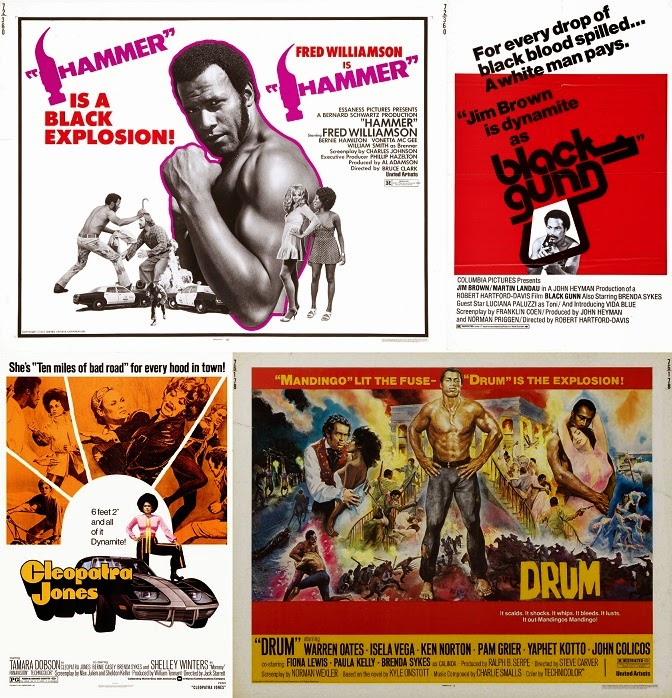
 Three big guns of black action got together for the first time to take on Jay Robinson and his Hitlerian plan of global black genocide. It's Jim Brown, Fred Williamson, and Jim Kelly to the rescue in Gordon Parks, Jr's comic book action favorite that consistently delivers the goods and then some. An essential title for Brown, Hammer, and Kelly fans, and action movie lovers in general. A genre heavyweight, THREE THE HARD WAY should have been a franchise. This team of heroes got together again in the lively western TAKE A HARD RIDE (1974) and the pedestrian ONE DOWN, TWO TO GO (1982).
Isaac
Hayes is Truck... Mack Truck Turner. When you meet him, you'll never
forget him. Double T is a skip tracer who incurs the wrath of Dorinda, a
fiery, foul-mouth pimpstress (Nichelle Nichols) after gunning down
vicious drug lord Gator in a stakeout. Dorinda then hires out a clutch
of kingpins, one of which is the sadistic "insurance salesman" Harvard
Blue (Yaphet Kotto), to flatten Truck, and anybody close to him. Any
negative connotations attached to the black action genre is glorified
every couple of minutes in Jonathan Kaplan's TRUCK TURNER. If ever there
was one movie that signifies the heart and soul of what blaxploitation
was, it's this movie. The majestically uncouth TRUCK TURNER is arguably
the best escapist action film of its kind. At least 20 reasons why TT is
the greatest could be easily jotted down. Isaac Hayes repeated his SHAFT music composition duties, only the TURNER score didn't have repeat success in sales.
Rockne Tarkington is Samson, the flamboyant, yet passive strip club owner with a pet lion as his bouncer. Samson stands up to the black and white criminal element, wanting his neighborhood safe and free of crime. Psychotic gangster Johnny Nappa (William Smith) has other ideas, and plots to retire Samson... permanently. Thoroughly underrated, BLACK SAMSON's strength lies mostly in the hands of Smith's unpredictably sadistic villain. A familiar face to the Drive-in crowd, Carol Speed (THE BIG BIRD CAGE, ABBY) is Leslie, Samson's Delilah. Her exaggerated line readings and facial expressions are a distraction, but in a good way. Chuck Bail's debut was followed up with...
17. CLEOPATRA JONES AND THE CASINO OF GOLD 1975
Tamara Dobson returns in this even bigger, blatantly Bond-styled sequel that takes her to Hong Kong to rescue her two agent friends from Bianca Javan (Stella Stevens), the formidable lesbian leader of a powerful HK based drug empire. Co-produced by the Warner and Shaw Brothers, CLEOPATRA JONES & THE CASINO OF GOLD is a lavish adventure chock full of familiar faces to kung fu fanatics. This glossy, high-dollar bet lost out at the box office, but has since become worth its weight in gold over the years. Surpassing the first movie in action and excitement, Cleo retired, unfortunately, after two films.
18. DOLEMITE 1975
 One
of the crowning achievements of black action is DOLEMITE. Breathin' down yo' neck with every bit the $90,000 spent on it, the application of 'best' in relation to this list is in accordance with just how good at being a bad movie DOLEMITE truly is. Its
star, Rudy Ray Moore (literally playing himself), makes a memorable
leading man in spite of flagrant production inadequacies. Dolemite (Rudy pronounces it Dole-A-Mite) is a pimp framed
by both rival crook and club owner Willie Green (played by director D'Urville Martin) and corrupt cops. Once he's out of the slammer, Dolemite lays down the hammer, pickin' off slick Willie's goons with a fist and kick typhoon, unleashin' a thrilla' with his all girl army of kung fu killas'. A terrible
movie, but terribly fun at the same time. The martial arts choreo is
blisteringly bad, but enacted with an undeniable energy that other exploitation movies cannot match. If you want to see something that captures a similar vibe check out the awful FORCE FOUR (1974) or DARKTOWN STRUTTERS (1975).
One
of the crowning achievements of black action is DOLEMITE. Breathin' down yo' neck with every bit the $90,000 spent on it, the application of 'best' in relation to this list is in accordance with just how good at being a bad movie DOLEMITE truly is. Its
star, Rudy Ray Moore (literally playing himself), makes a memorable
leading man in spite of flagrant production inadequacies. Dolemite (Rudy pronounces it Dole-A-Mite) is a pimp framed
by both rival crook and club owner Willie Green (played by director D'Urville Martin) and corrupt cops. Once he's out of the slammer, Dolemite lays down the hammer, pickin' off slick Willie's goons with a fist and kick typhoon, unleashin' a thrilla' with his all girl army of kung fu killas'. A terrible
movie, but terribly fun at the same time. The martial arts choreo is
blisteringly bad, but enacted with an undeniable energy that other exploitation movies cannot match. If you want to see something that captures a similar vibe check out the awful FORCE FOUR (1974) or DARKTOWN STRUTTERS (1975).
Ken
Norton was all the rage after defeating Muhammad Ali March 31st, 1973
via split decision, breaking the jaw of 'The Greatest' in round two. The two
heavyweights fought again in September of that year, and for the third
and final time in 1976. In between Norton's boxing run, he made two
movies, MANDINGO and DRUM. The former caused quite an uproar during its
original theatrical run for its offensive imagery and language. Based on
Kyle Onstott's novel of the same name, Norton is the title buck bought by James Mason. Lots of interracial sex and violence ensues. Over the years the film has garnered more respect as a serious piece of cinema as opposed to the crass exploitation assigned to it; a label that fits the gloriously outrageous sequel like a glove.
20. J.D.s REVENGE 1976
 J.D.'s REVENGE is probably the only psychological horror film in the black themed canon. Straddling the line between typical blaxploitation tropes and a serious quasi-horror picture, it tells the tale of Ike Hendricks being possessed by the spirit of infamous gangster J.D. Walker; using him to exact revenge on those who murdered him and his sister. Glynn Turman is fabulously over the top in what amounts to a dual role--one as the level-headed romantic Ike and the other as the dementedly predatory J.D. Walker. If you like standard horror fare like SUGAR HILL and ABBY (both 1974), give this underrated gem a shot. An incredibly gifted actor, an early black themed movie featuring Turman is CARTER'S ARMY (1970), aka BLACK BRIGADE a Made For TV movie featuring the likes of Robert Hooks, Rosey Grier, Moses Gunn, Richard Pryor, and Billy Dee Williams.
copyright 2013. All text is the property of coolasscinema.com and should not be reproduced in whole, or in part, without permission from the author. All images, unless otherwise noted, are the property of their respective copyright owners.


 Made in the middle of his European western tenure, Lee Van Cleef is all American beef in BARQUERO (1970). Confident, brutish, and often smoking a pipe, Lee's sweat glands get a major workout as Travis, the burly barquero (Spanish for ferryman), and potential front cover of Macho Monthly. Short-changed in the characterization department, Van Cleef gets more mileage out of his brawny disposition in this movie whose major selling point is LVC versus Warren Oates.
 Douglas starts things off in a similarly paced style to Peckinpah's THE WILD BUNCH (1969) just prior to all hell breaking loose. We first meet the nastiest of villains, Remy, in bed with this Mexican woman who asks far too many questions--none of which will do anything for her life expectancy. Once the time is right, Remy's gang of bandits ride in and proceed to massacre anything that moves, male or female. This rambunctious shootout tries, and largely succeeds in matching the BUNCH on the violence meter, only without the numerous shades of red splattering the screen.
 As for the movie itself, BARQUERO never outguns the Peckinpah classic (released a year earlier), yet the tight editing, particularly of this opening action sequence, packs a lot of firepower. Moreover, it goes a long way in visualizing the sort of cold-blooded bastard Remy (Oates) is without the use of much dialog. As buildings blow up, bullets and bodies fly all over the place, Remy has his morning coffee; this is interspersed with his shooting whoever crosses his path--his own men slacking off on the job, and the occasional woman who just happens to be in the wrong place at the wrong time. The film probably should have been titled 'Remy' since Oates's pot-smoking psychopath gets the bulk of the screen time while the Barquero spends more time toking on his pipe.
 Speaking of which, on the other side of the river is Travis (Van Cleef), the rugged boatman whom we learn little about since the script is more interested in teasing details than giving them. What we do know is Van Cleef loves his barge, loves it more than anything. He cares less about the citizenry of the town he has saved, and more with the fact that Remy intends to burn his boat--killing him, and everyone else should he get hold of it. He cares for Anna (Hartley), too, but only so far as getting her out of her clothes. When he does, he doesn't proceed like he's realizing an ambition, he treats it as a conquest. Travis apparently likes it rough. Van Cleef's charisma carries his character where the exposition tries and fails. His expression seldom changes, and he's always one step ahead of Remy--which drives Remy even more insane than he already is.
 Forrest Tucker nearly robs both men of their macho bravado as Mountain Phil, this half-crazed cowboy who is constantly in a cheerful mood whether he's killing bandits with his knife, or eating a handful of ants. He gets all of the funny scenes and the movie would be a lot less enjoyable without him. A month earlier Tucker played Lawrence Murphy, the main heavy who brawls with The Duke in the classic, CHISUM (1970).

 The lengthy stretch in the middle is where BARQUERO is dead in the water. There's some great moments spread out as Remy attempts to barter with Travis, but it's when the plot tries to expand on the supplementary cast members that it loses momentum. Mariette Hartley is among these casualties. She's beautiful to look at, but has very little of a role to chew on. Marie Gomez as Nola, on the other hand, is even less fleshed out (despite possessing ample flesh) as Travis's fiery, rifle-toting lover, but we get a better feel for her Hispanic Annie Oakley character via her mannerisms. There's a hint of a possible cat fight brewing between the two ladies (Anna refers to Nola as half a man!), but this never surfaces.
 Aside from its explosive beginning and middling middle, BARQUERO closes things out on a less bombastic, but no less enthralling finish. Probably the only western to feature a gunfight on a body of water, Remy finally builds his own makeshift boats in a last ditch attempt to procure the barge he's obsessed over for the better of 90 minutes. It's frustrating to see these guys surrounded by so much wood and rope and nobody ever comes up with the idea to build a raft till the very end. With most all the supporting cast with holes in them, things are wrapped up with a gun duel between our not-so-hero and villain.


 It doesn't ride with the best westerns, but it's not for a lack of trying. BARQUERO stands out for the grimacing, macho posturing of Lee Van Cleef and Warren Oates; and for its watery setting and dynamite opening and closing sequences. Oozing with machismo and drenched in sweat, fans of Van Cleef's Italian six-shooter cinema should see him in one of his few Stateside western lead roles.